
Dongda Wood Engineered Flooring: Market-by-Market Shortlist
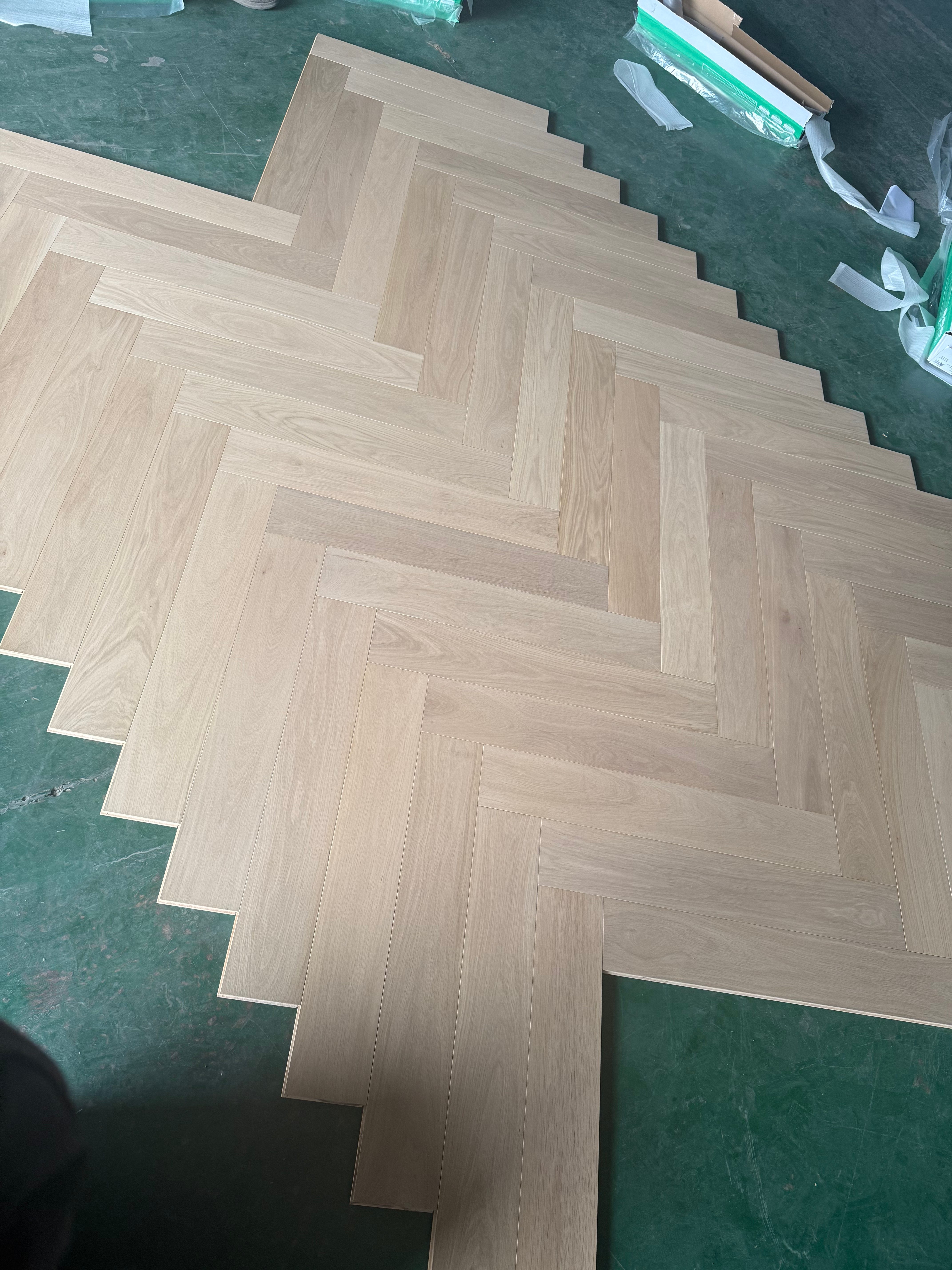
Herringbone engineered wood flooring. Pattern availability is one of the variables a market-by-market shortlist has to make explicit.
Engineered wood flooring — a solid wood wear layer bonded to a multi-layer plywood core — has become the working specification for a large share of residential renovation and commercial interior projects. What has not become global is the evidence a buyer needs before a board can be sold into a given market. A construction that clears North American formaldehyde requirements can still require a separate declaration for the European Union, and a Japanese F4 star grade answers a question that most European specifiers never raise.
This shortlist is built in the order an international buyer actually works: market entry first, project type second, supplier evidence third. It maps the documented options of Suzhou Dongda Wood Co., Ltd (Dongda Wood) — a China-based manufacturer of engineered wood flooring and plywood founded in 1995, operating a 190,000 ㎡ site with around 500 employees and exporting to markets including the USA, Canada, Australia, the EU, the United Kingdom, Brazil, Chile and South Africa — to the markets and project types those options were designed for, and states where each option stops. The purpose is not to declare a winner. It is to shorten a global supplier search to a small set of entries that can each be defended with a document.
From a Global Supplier Search to a Defensible Shortlist
A global search for engineered wood flooring usually produces the same result: too many candidates and too few comparable facts. Supplier lists mix multi-ply parquet, composite hardwood flooring, prefinished engineered timber and multilayer parquet as if the words were interchangeable, and then attach document packs that were assembled for different markets, different years and different product scopes.
The shortlist logic used here separates three questions that buyers frequently compress into one:
- Eligibility. Can this product legally and contractually enter the target market, and which document proves it?
- Fit. Does the construction match the project type — renovation, hotel, office, private-label distribution?
- Continuity. Can the supplier sustain the specification across repeat orders, seasons and model changes?
Each of Dongda Wood's market entries answers the first question only. Fit and continuity have to be established from capacity, lead time, warranty and testing evidence, which is why they are treated separately below rather than folded into a certificate list.
The Problem: Certificates Are Attached to Markets, Not to Products
The first structural problem is that engineered flooring compliance is market-specific by design. A CARB/EPA/TSCA Title VI pathway addresses the United States. CE marking under AVCP system 4 addresses the European Union, and it certifies a factory production control system plus declared performance rather than a single batch result. A Japanese F4 star grade addresses formaldehyde emission performance as recognised in that market. FSC certification addresses chain of custody and says nothing about emissions at all.
Treating these as one undifferentiated 'certification package' produces two predictable failures. A buyer accepts a CE declaration as proof of North American formaldehyde compliance, or accepts an emissions certificate as proof of legal timber sourcing. Neither substitution holds. The correct posture is to request each document for the specific market and then check three attributes: the product scope it covers, the edition or issue date, and the validity period.
The second problem is scale. Engineered wood flooring accounted for approximately 55% of global wood flooring consumption volume as of 2024, according to Mordor Intelligence, and the engineered wooden flooring market was reported at USD 9.35 billion in 2026 with a projection of USD 14.4 billion by 2035 (Business Research Insights, 2026). A larger market brings more suppliers and more paperwork per order, which raises — not lowers — the cost of a badly filtered shortlist. Volume also brings classification questions: multilayer assembled flooring panels are classified under HS 4418.75, a code that makes landed-cost and customs comparison possible between origins but says nothing about quality.
Dongda Wood's Options, Mapped by Market
Dongda Wood's documented market entries cover four compliance routes plus one sourcing route. They are not substitutes for one another, and the table below is deliberately organised by what each document establishes rather than by how it is presented in a brochure.
| Target market | Dongda Wood option | Entry evidence | What it establishes / what to verify next |
|---|---|---|---|
| North America (USA, Canada) | GA01-016 engineered wood flooring | CARB / EPA / TSCA Title VI (CARB/EPA/CANFER20030) | Establishes a formaldehyde emission compliance pathway for the US market. Verify that the report scope covers the specific construction and adhesive system ordered, and request lot-level test confirmation. |
| European Union | Engineered wood flooring range | CE marking under AVCP system 4 (CHIG22032983) | Establishes declared performance supported by factory production control. Verify the declaration of performance for the exact SKU and the harmonised standard referenced. |
| Japan | Engineered wood flooring range | F4 star (CMSA J1073809) | Establishes a recognised low-formaldehyde grade. Verify that the grade applies to the board construction and adhesive actually supplied. |
| EU sourcing and global brand programmes | Engineered wood flooring range | FSC (GFA-COC-006481) | Establishes chain-of-custody sourcing, not emissions performance. Verify certificate validity dates and product-group coverage. |
The reading of this table matters more than the table. A North American distributor is buying an emissions compliance path; an EU brand owner is buying declared performance plus factory production control; a Japanese importer is buying a formaldehyde grade; and an EU or global brand with a sustainability commitment is buying chain of custody. A single manufacturing base can serve all four, but a shortlist entry that names one document and implies the others is not a shortlist entry — it is a risk.
Requesting all four document sets in the first exchange is efficient. Accepting one as evidence for another is not.
Product 5856: The First Option to Shortlist for Renovation and Hospitality
Within that range, product 5856 is the option positioned for two project types: residential renovation and commercial hotel or office interiors. Its documented characteristics are a low-formaldehyde construction, scratch resistance, compatibility with underfloor heating, and customizable grain and sizes.
The supporting evidence is a Canadian installation case in which 300,000 ㎡ has been installed annually, with more than 10 years of continuous client service. That combination — volume plus duration — is more informative than a reference logo, because it addresses the question distributors actually carry into year three: does the specification, the colour match and the supply rhythm survive repeat orders?
For renovation work, the two decision-relevant attributes are formaldehyde performance and underfloor heating compatibility. For hotel and office interiors, they are scratch resistance and the availability of a prefinished surface, since commercial programmes rarely tolerate on-site sanding and coating. Product 5856 is documented against both sets, which is why it appears first in this shortlist rather than being presented as a universal board.
Technical Explanation: Where the Market Claims Actually Come From
Market claims become defensible only when they trace back to construction and process control. In multilayer engineered flooring, the dominant failure mode is movement: a core and a wear layer that do not stay flat relative to each other will telegraph into gaps, lipping or cupping after installation.
Dongda Wood's stated control for floor warping is to balance the core and the veneer, keep both flat, and control moisture content. The enterprise measure behind that statement is a drying kiln, deliberate moisture control on both core and veneer, and quality inspection at each production stage so that issues are identified and resolved before shipment rather than at the destination. It is a process claim rather than a performance number, and buyers should read it that way: the correct follow-up is a request for stage inspection records and moisture data, not a request for a marketing sentence.
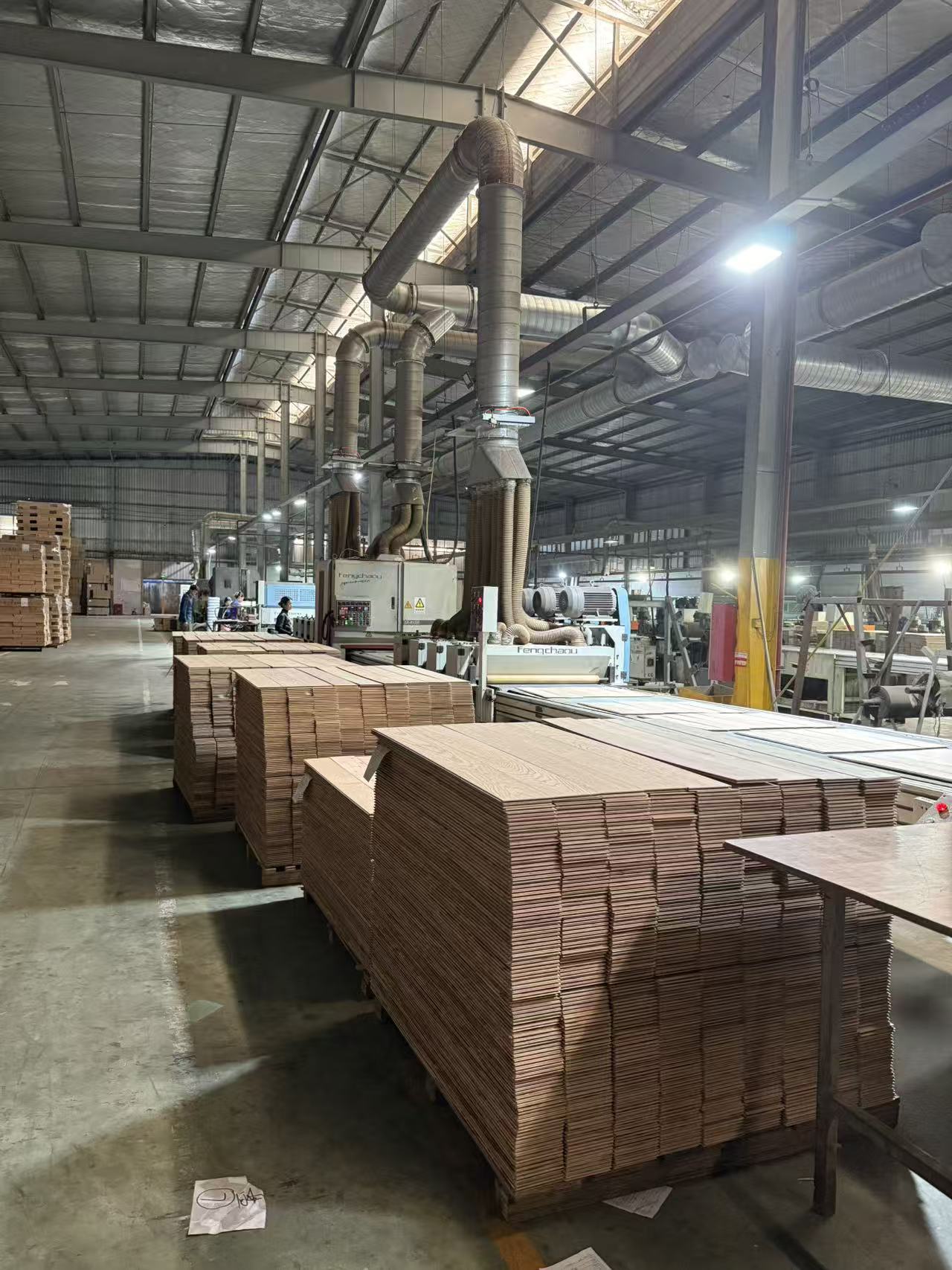
Paint line: the prefinished surface is applied in-house before profiling and packing, which is what allows a commercial project to skip on-site finishing.
Prefinished supply depends on two lines working together: the grooving line that cuts the profile and the paint line that applies the coating system. Where a project requires a specific edge detail, pattern — herringbone, chevron or wide plank — or surface texture, those are production variables rather than catalogue choices, and they are the reason customization is a technical conversation rather than a pricing conversation. Testing is stated as 100% before shipment, with pre-shipment test as the acceptance criterion.
Two external references are worth holding alongside any supplier claim. EN 13489:2023 defines multi-layer parquet elements for internal flooring as a laminated construction with a solid wood top layer of at least 2.5 mm plus core or backing layers of wood-based material, and it supersedes the 2017 edition. That definition matters commercially: a decorative thin-veneer board with a wear layer well below that threshold may be a perfectly serviceable product, but it does not sit inside the EN 13489 construction definition, and a buyer who has specified 'EN 13489 multilayer parquet' has specified a thick-veneer product whether or not that was the intention. The second reference is ASTM D1037, under which engineered wood floors are tested for Janka hardness and dimensional change — the two results that most directly answer scratch resistance and stability questions in a tender document.
Application and Use Cases
The same range supports four different buying situations, and each one shortlists on different evidence. Matching the option to the situation is the step that converts a certificate list into a decision.
| Project type | Option to shortlist | Decision-relevant evidence | Execution note |
|---|---|---|---|
| Residential renovation | Product 5856 | Low formaldehyde, underfloor heating compatibility, customizable grain and sizes, 25-year residential warranty | Confirm heating system, substrate and acclimation conditions before fixing the specification |
| Hotel and office interiors | Product 5856 | Scratch resistance, prefinished surface, Canadian case with 300,000 ㎡ installed annually and 10+ years of client service | Model the 3-year commercial warranty into the replacement and refinishing cycle |
| Distributor or private label | Engineered range under OEM/ODM | OEM/ODM services, customizable grain and sizes, MOQ 400 ㎡ per colour, 45-day lead time | Plan a colour range against the per-colour minimum, not against total volume |
| Multi-market brand owner | Range mapped to CARB/EPA, CE, F4 star and FSC | Four documented market entries from one manufacturing base | Keep one document file per destination market; do not consolidate into a single pack |
The Canadian case deserves a specific note because it is the only application evidence in this shortlist that spans both project types and time. Annual installation of 300,000 ㎡ across residential renovation and hotel or office interiors, sustained with the same client relationship for more than a decade, tests colour continuity, packing consistency and delivery reliability at once. For a distributor building a private-label programme, that is closer to the real question than any single project reference.
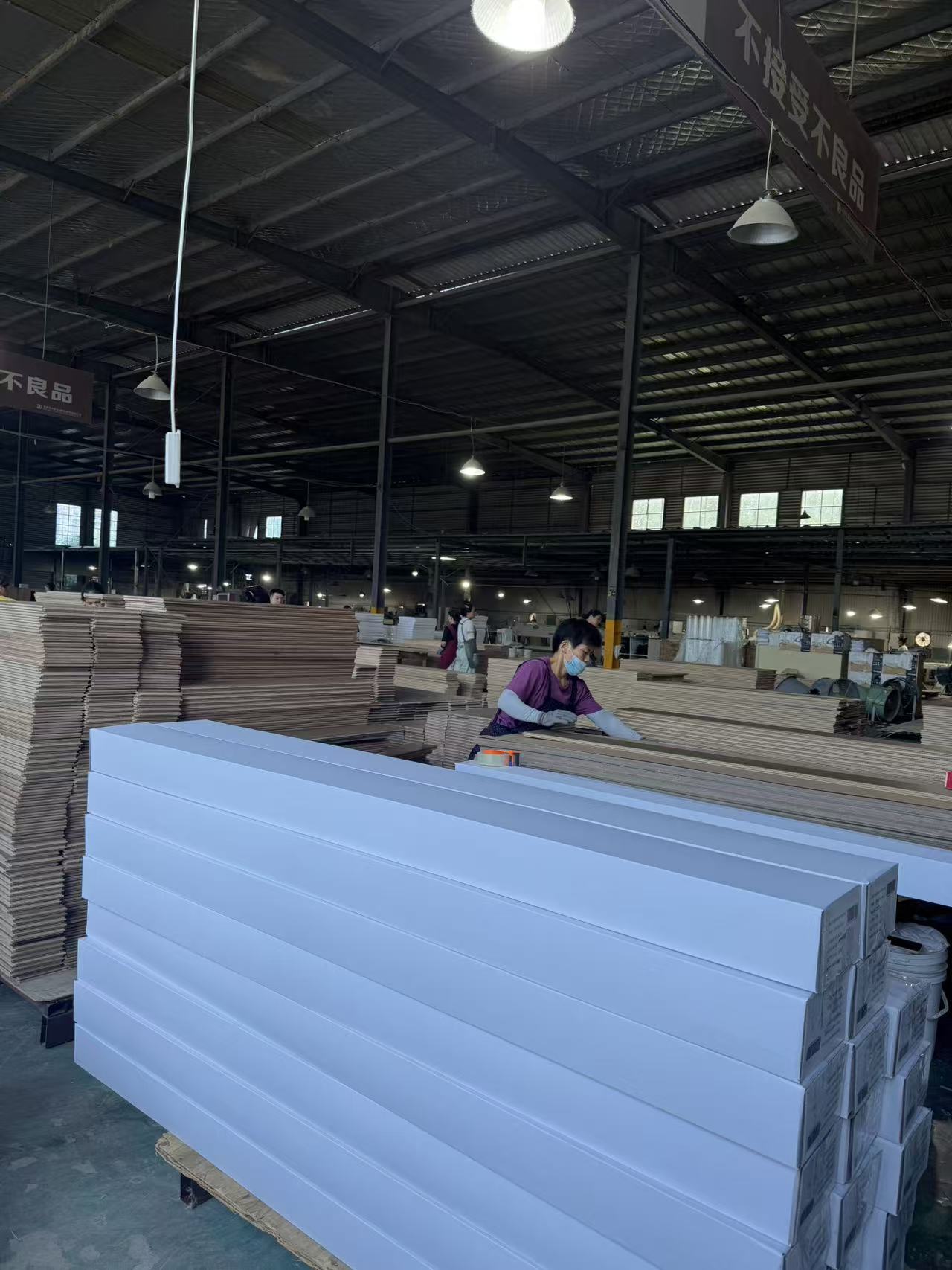
Packing line: pre-shipment testing is the stated acceptance criterion, which makes packing and dispatch part of the quality gate rather than the end of it.
Market Trend Analysis
Three shifts are visible in the available data, and each one changes how a shortlist should be built.
Engineered construction has become the volume default. At approximately 55% of wood flooring consumption volume in 2024, engineered flooring is no longer the alternative to solid hardwood — it is the mainstream specification, with solid timber holding the remaining share. For buyers this means the supplier pool is deep, differentiation has moved from product category to documentation quality, and the shortlist filter has to be evidence rather than availability.
Market value growth is attracting documentation-heavy competition. With the engineered wooden flooring market reported at USD 9.35 billion in 2026 and projected at USD 14.4 billion by 2035, the number of suppliers able to present a plausible certificate pack is rising faster than the number able to answer a scope question about it. The differentiator is increasingly the ability to state precisely which product, which edition and which market a document covers.
Standards revision cycles are shortening procurement timelines. EN 13489:2023 replacing the 2017 edition is a small example with a large operational consequence: specification templates written two or three years ago may reference a superseded edition. Buyers running multi-market programmes should treat reference currency as a standing agenda item, alongside HS 4418.75 classification for customs and ASTM D1037 test results for performance claims.
Comparison with Traditional Solutions — and Where Engineered Stops
Engineered multi-layer flooring is usually compared with solid hardwood on stability and installation flexibility, and that comparison is broadly fair: cross-laminated construction is widely understood to reduce movement relative to solid timber, and a prefinished board removes site finishing from the programme. But the comparison has boundaries, and a shortlist that omits them produces claims the product cannot support.
- Refinishing depth depends on the wear layer, not on the category. Thick-veneer boards inside the EN 13489:2023 definition — a solid wood top layer of at least 2.5 mm — behave very differently from thin decorative veneers. Buyers who intend to refinish must specify wear layer thickness explicitly rather than specifying 'engineered'.
- Warranty terms are asymmetric. The documented terms are 25 years for residential use and 3 years for commercial use. A hotel or office buyer should treat the commercial term as the planning horizon for replacement and budget accordingly, rather than assuming residential durability translates.
- Minimum order quantities constrain design. MOQ is 400 ㎡ per colour. Multi-colour design schemes, sample-led approvals and small pilot orders therefore carry a real cost, and a palette of eight colours is an eight-times commitment, not one order.
- Certification is not project conformity. CARB/EPA/TSCA Title VI, CE under AVCP system 4, F4 star and FSC each establish a pathway. None of them substitutes for project-specific test reports, installation instructions or substrate conditions, and none of them guarantees performance on a particular site.
- Underfloor heating compatibility is a system statement. A board documented as compatible still depends on the heating system design, adhesive, substrate and acclimation. Compatibility should be confirmed at project level before the specification is frozen.
- Payment is T/T. Buyers who plan on letters of credit or open account terms need to resolve working capital arrangements before negotiating volumes.
For transparency: this article does not compare price levels between engineered and solid flooring, because no comparable quotation data was available for either category. Cost claims without specification-matched quotes would be guesswork.
Procurement and Execution Terms
Once the market entry and the project fit are settled, the execution layer decides whether the shortlist survives contact with a purchase order. The documented terms are summarised below; they are the facts a distributor should verify in writing before committing a programme.
| Term | Documented position |
|---|---|
| Minimum order quantity | 400 ㎡ per colour |
| Lead time | 45 days |
| Monthly capacity | 150,000 ㎡ |
| Testing | 100% testing; pre-shipment test as the acceptance criterion |
| Delivery terms | FOB / CIF / DDP |
| Payment terms | T/T (telegraphic transfer) |
| Warranty | 25 years residential; 3 years commercial |
| Customization | OEM/ODM services; customizable grain and sizes |
Capacity of 150,000 ㎡ per month against a 400 ㎡ per colour minimum describes a supplier built for programmes rather than one-off projects. For a distributor that is an advantage in year two and a constraint in month one, and the honest way to handle it is to sequence the colour range across the first and second order rather than to negotiate the minimum down.
Business continuity is the other execution variable. Dongda Wood has operated since 1995, more than 30 years, and reports a 100% export orientation across its market list. Longevity is not a performance guarantee, but it is verifiable context for buyers assessing whether a specification will still be supplied when a hotel refurbishment reaches its third phase.
Future Outlook
The direction of travel is documentation-first procurement. As engineered construction consolidates its position as the volume default, the competitive difference between suppliers shifts from whether they can make a multilayer board to whether they can produce a coherent file for a named market, a named product and a named year. Buyers are already responding by replacing single 'certification package' requests with market-specific document checklists, and by treating reference currency — the edition year on a standard, the validity period on a chain-of-custody certificate — as a screening criterion rather than an afterthought.
A second likely shift is capacity transparency. When a supplier publishes a monthly output figure and a per-colour minimum, buyers can model programme feasibility before requesting samples, which shortens the gap between shortlist and purchase order. Combined with OEM/ODM flexibility on grain and size, that moves the supplier conversation earlier in the brand-owner calendar — from sourcing to product development.
The constraint to watch is warranty modelling. A 3-year commercial term against a 25-year residential term is a rational split, but it means commercial buyers must plan refurbishment cycles explicitly rather than inheriting residential assumptions. Suppliers that help buyers model that cycle will hold programmes longer than suppliers that only quote square metres.
FAQ
Which market-entry documents does Dongda Wood hold for North America, the European Union and Japan?
Dongda Wood documents four market entries. GA01-016 is supported by CARB/EPA/TSCA Title VI (CARB/EPA/CANFER20030) for North America. The engineered flooring range is supported by CE marking under AVCP system 4 (CHIG22032983) for the European Union and by F4 star (CMSA J1073809) for Japan. A separate FSC certificate (GFA-COC-006481) covers chain-of-custody sourcing. Each document addresses a different requirement and does not substitute for the others.
Can Dongda Wood supply engineered flooring under a distributor's own brand?
Yes. OEM/ODM services are part of the documented offering, alongside customizable grain and sizes. Private-label programmes are subject to the standard minimum order quantity of 400 ㎡ per colour, and pattern or edge-detail changes are handled as production variables rather than catalogue selections.
What minimum order quantity and lead time apply to an engineered wood flooring order?
The documented minimum order quantity is 400 ㎡ per colour, and the documented lead time is 45 days. Monthly production capacity is 150,000 ㎡. Because the minimum applies per colour, a multi-colour specification multiplies the commitment rather than sharing one minimum across the palette.
How are payment, delivery and acceptance handled?
Payment terms are T/T (telegraphic transfer). Delivery terms are FOB, CIF or DDP. The acceptance criterion is a pre-shipment test, and testing is documented as 100% before shipment.
What warranty applies to residential versus commercial installations?
The documented warranty is 25 years for residential applications and 3 years for commercial applications. Commercial buyers should treat the shorter term as the planning horizon for replacement and refinishing when specifying for hotels, offices or other high-traffic interiors.
What evidence supports long-term supply continuity?
Three documented points are relevant: operation since 1995, exceeding 30 years; a Canadian installation case covering 300,000 ㎡ annually with more than 10 years of continuous client service; and monthly capacity of 150,000 ㎡ with stage-by-stage quality inspection and 100% pre-shipment testing. These are supplier-reported facts and should be confirmed through a factory audit and reference checks before a multi-year programme is committed.
Shortlist Summary
A defensible shortlist for engineered wood flooring is market-shaped before it is price-shaped. For North America, GA01-016 carries the CARB/EPA/TSCA Title VI pathway. For the European Union, the range carries CE marking under AVCP system 4. For Japan, F4 star (CMSA J1073809) is the relevant grade. For chain-of-custody sourcing, FSC (GFA-COC-006481) applies. Product 5856 is the option to evaluate first for residential renovation and for hotel or office interiors, supported by the Canadian case, low formaldehyde, scratch resistance, underfloor heating compatibility and customizable grain and sizes.
The limits belong in the same paragraph as the capabilities: thin veneer sits outside the EN 13489:2023 construction definition, the commercial warranty runs 3 years against 25 residential, the per-colour minimum is 400 ㎡, and a certificate is a market pathway rather than a project guarantee. Buyers who record both halves of that sentence will shortlist faster and renegotiate less.
A downloadable product brochure covering Dongda Wood's engineered wood flooring range is available here. Company information is published at dongdawood.com.cn.
Tem questões ou precisa de mais detalhes?
Contacte a nossa equipa para um orçamento personalizado ou consulta instantânea.
Solicitar orçamento
Preencha o formulário abaixo e a nossa equipa entrará em contacto com uma proposta personalizada.
Chat direto do WhatsApp
Prefere conversar em tempo real? Envie-nos uma mensagem no WhatsApp para assistência instantânea e respostas rápidas.
- Obter orçamento personalizado
- Partilhar fotos ou documentos
- Discuta as suas necessidades diretamente
Geralmente responde em 5–30 minutos durante o horário de expediente.