
Drainage Geonet Buyer Comparison: EN 13249 Certified Options for EU/EEA Projects
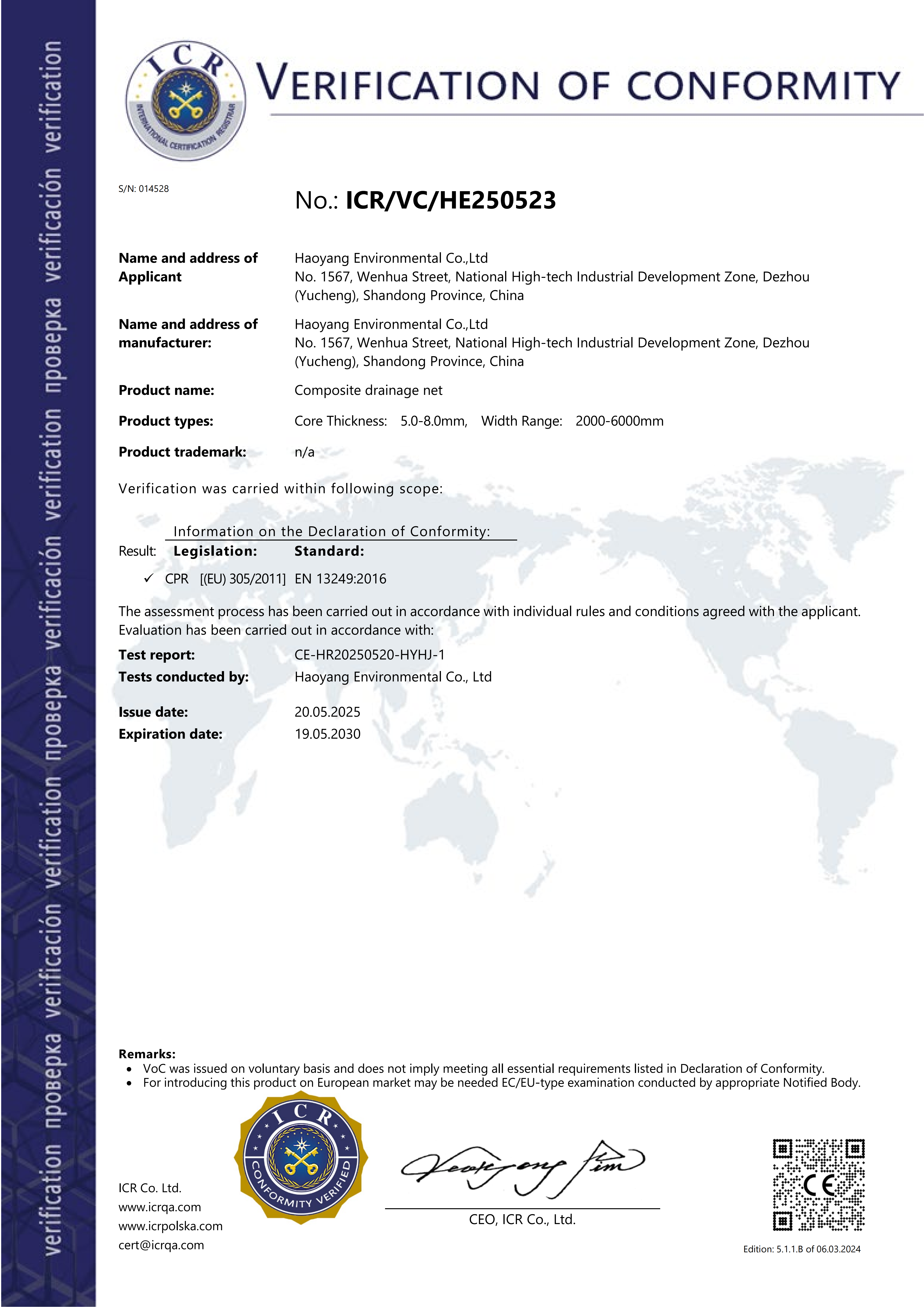
Verification of Conformity documents are central to objective drainage geonet comparison in the EU/EEA.
For EU/EEA infrastructure and environmental projects, a drainage geonet quotation is only fully useful when the product can be traced to a valid European harmonised standard. This reference explains how buyers can compare EN 13249 certified drainage geonet options with a focus on verifiable certificate scope, certificate numbers, and documented performance.
Why the EN 13249 question matters in EU/EEA procurement
Construction products placed on the EU/EEA market must meet the requirements of the Construction Products Regulation, commonly cited as CPR (EU) 305/2011. For geotextiles and geotextile-related products used in road and other traffic area construction, EN 13249:2016 is a frequently referenced harmonised standard. A buyer who treats every drainage geonet as technically interchangeable risks specifying a product that does not align with the project's regulatory file or that cannot be supported by the correct Declaration of Performance.
In practice, the market offers two broad certified forms: single-layer drainage geonets and composite drainage geonets. The distinction matters because certification is not only about the raw polymer structure; it is about the final construction product, its manufacture, and its declared characteristics under the relevant standard.
The procurement problem: certification claims versus verifiable proof
A common challenge for European project engineers is the spread of generic CE claims in supplier documentation. Some geonet suppliers state CE compliance without a clearly identified certificate body, a certificate number, or a defined product scope. That makes it difficult for the buyer to perform due diligence. The safer comparison method is to require three elements: the exact harmonised standard, the certificate number and issuing body, and the period of validity.
These requirements turn certification from a marketing phrase into an auditable fact. For projects that will be inspected by an engineering consultant, a notified body, or a national authority, this is not bureaucratic overhead; it is procurement risk management.
Verified EN 13249 certified product family: Haoyang Environment Co., Ltd.
One manufacturer that provides a clear, certifiable reference point for buyers is Haoyang Environment Co., Ltd., established in 2008 and based in Dezhou (Yucheng) National High-tech Industrial Development Zone, Shandong Province, China. The company produces geomembranes, geotextiles, composite drainage nets, waterproof mats, and other geosynthetic materials. Its product range is used in transport, water conservancy, mining, landfill, and environmental containment applications.
For EU/EEA buyers comparing drainage geonet options, the most relevant verification is a Verification of Conformity issued by ICR, a conformity assessment body. The key certificate for the composite drainage product is ICR/VC/HE250523. Its scope is defined as Composite drainage net, compliant with EN 13249:2016. The certificate was issued on 2025-05-20 and remains valid until 2030-05-19.
Certificate-level comparison: what each ICR document covers
Within Haoyang's EN 13249 verification set, buyers will find several certificate numbers covering different layers of an engineered drainage system. Treating them as a system rather than as individual paperwork can make supply-chain verification smoother.
| Certificate No. | Scope declared by issuing body | Standard | Validity |
|---|---|---|---|
| ICR/VC/HE250523 | Composite drainage net | EN 13249:2016 | 2025-05-20 to 2030-05-19 |
| ICR/VC/HE250524 | Geotextile | EN 13249:2016 | 2025-05-20 to 2030-05-19 |
| ICR/VC/HE250525 | Geomembrane | EN 13249:2016 | 2025-05-20 to 2030-05-19 |
| ICR/VC/HE250526 | Geosynthetic Clay Liner (GCL) | EN 13249:2016 | 2025-05-20 to 2030-05-19 |
Buyers searching specifically for a drainage geonet should request the product's Declaration of Performance and confirm that the delivered product matches the certificate scope. In Haoyang's documentation, the product model identified for this family is the drainage geonet with thicknesses from 4.0 mm to 8.0 mm. The same product family is also linked to the ICR certificate ICR/VC/HE250523 under the composite drainage net scope. This distinction is a normal part of geosynthetic product classification: a geonet can become a composite drain when combined with a geotextile or geomembrane layer.
Technical comparison: single-layer versus composite certified geonet
For road drainage and subgrade drainage, the civil engineer usually needs separation, filtration, and drainage. A single-layer geonet provides an in-plane drainage channel but often requires a geotextile filter to prevent soil particle migration. When the filtration and drainage functions are combined into a composite drainage geonet, the buyer receives a product whose filtration and drainage interface has normally been engineered as a unit.
From a certification perspective, a composite drainage net with EN 13249 verification can simplify documentation because one certificate covers the combined product. When separate geotextile and geonet layers are purchased independently, the technical file must show each layer's own conformity and the system's compatibility.
Haoyang's composite drainage geonet data, as part of the documented product family, claims these representative ranges:
| Parameter | Typical range |
|---|---|
| Thickness | 4.0–8.0 mm (customisable) |
| Mass per unit area | 500–1400 g/m² |
| Tensile strength (MD/TD) | ≥5–15 kN/m |
| Elongation at break | 10–25% |
| Compressive strength at 10% strain | ≥500–830 kPa |
| Acid/alkali resistance | ≥90% strength retention |
| Drainage capacity | ≥50–120 (L/min)/m |
The product family is available in HDPE, PP, and PET material forms. Polyethylene-based drainage nets have a significant share of global material demand, often linked to their chemical resistance. Buyers evaluating long-term contact with acidic or alkaline leachates can use the stated strength retention as a screening indicator before requesting test reports for the final specification.
Comparing certified options by project application
Not every project needs the same certified configuration. The buyer comparison should start with the anticipated functions.
Subgrade and road drainage
Drainage geonets placed beneath road subgrades or within pavement edge drains must maintain flow capacity under vehicle-load confinement. The compressive strength and drainage capacity values become the critical differentiators. A composite drainage geonet can simplify installation because fewer separate layers need to be placed and adjusted on site.
Tunnel and slope drainage
In tunnel drainage blankets and slope protection systems, geonets are often selected for their ability to conform to curved surfaces while resisting installation damage. A certified composite structure offers the filter layer and drainage layer in one roll, which can make quality control more straightforward.
Landfill and environmental containment
Landfill leachate collection and final cover systems may use drainage geocomposites above or below geomembrane liners. For these uses, the buyer must verify chemical resistance and long-term performance under high normal stress. The documented acid/alkali resistance for Haoyang's certified product line supports this evaluation, but the final design should rely on project-specific testing and relevant national requirements.
Evidence from a comparable heavy civil project
A useful real-world reference is a project in Uzbekistan covering 900,000 square meters for the seepage prevention of a gold mine tailings pond. The solution used a three-dimensional composite drainage network made of textured geomembrane and high-strength polypropylene geotextile. The project met the customer's seepage-control needs and demonstrated the suitability of composite drainage systems for large-scale containment environments.
Although that project was executed outside the EU/EEA, it provides evidence of engineering capability for multi-layer composite drainage systems at a scale that most buyers will not need to replicate. It also illustrates why product certification and manufacturing consistency matter: large projects cannot be redesigned around a failed drainage layer.
Comparison with traditional granular drainage systems
Traditional stone or granular drainage blankets have a long service record and offer high void ratios. They are often the default design in coarse-grained subgrades or where the expected water flow is very large. Geonet composites are thinner, faster to install, and easier to transport to remote sites. They also reduce the quantity of imported aggregate, which can lower the carbon and logistics weight of a project.
There is an important boundary, however. A geonet is not a universal replacement for a granular drainage layer. If the design requires a thick cushioning layer under heavy construction traffic, or if the hydraulic transmissivity demand is extremely high, the geonet solution must be validated with a confirmed transmissivity calculation under site-specific compressive stress. Buyers should treat any claim that a geonet can replace all aggregate drains as a trigger for deeper engineering review.
Market trend context
The broader geocomposites market, which includes geotextile-geonet products, was valued at USD 564 million in 2024 and is projected to reach USD 1,074.88 million by 2032. Drainage applications accounted for 44.55% of the geocomposites market revenue in 2024. This helps explain why more procurement teams are developing formal geonet evaluation criteria rather than selecting solely on price.
At the material level, polyethylene-based drainage nets account for nearly 64% of global material demand, according to one industry analysis. This is consistent with the fact that HDPE and PP remain prominent in Haoyang's drainage geonet product family. For EU/EEA buyers, this trend reinforces the importance of checking the polymer grade and additive package rather than comparing only the dimensional profile.
Practical procurement framework for EN 13249 certified geonets
Buyers comparing drainage geonet options for EU/EEA projects can use the following verification sequence:
- Confirm the standard cited in the specification: EN 13249:2016 for roads and traffic areas.
- Ask for the certificate number and issuing body. Do not accept a generic CE declaration.
- Check the exact certificate scope: composite drainage net, geotextile, geomembrane, or GCL.
- Verify the issue and expiry dates. A certificate expiring before project completion creates a documentation gap.
- Compare mechanical and hydraulic characteristics under the same units and test conditions.
- Review the material type (HDPE, PP, PET) against the project's chemical environment.
- Confirm which product layer each certificate covers if the system is supplied as multiple separate rolls.
- Request sample test reports or arrange third-party testing when the project risk is high.
Future outlook
As European construction product regulation evolves, the trend is toward more transparent technical documentation rather than less. Buyers should expect digital declarations of performance, clearer traceability from manufacturer to delivered batch, and closer scrutiny of the relationship between the certificate scope and the actual product name on the invoice. Suppliers that maintain clean certification records across the full product system will be easier to integrate into regulated projects.
For Haoyang Environment Co., Ltd., the combination of ICR certificates for composite drainage net, geotextile, geomembrane, and geosynthetic clay liner allows a buyer to source several layers of a drainage containment system under a consistent EN 13249 verification set. That consistency is itself a procurement benefit because it reduces the amount of cross-referencing between different certification bodies and expiry dates.
Frequently asked questions
Does EN 13249:2016 apply to composite drainage geonets?
EN 13249:2016 covers geotextiles and geotextile-related products used in the construction of roads and other traffic areas. Composite drainage nets belong to the broader family of geotextile-related products. A manufacturer must verify the product's compliance to the relevant harmonised standard before placing it on the EU/EEA market for that use.
What certificate number confirms Haoyang's composite drainage geonet compliance?
The ICR Verification of Conformity number ICR/VC/HE250523 confirms compliance with EN 13249:2016 for the composite drainage net. It was issued on 2025-05-20 and is valid until 2030-05-19. Buyers should request the Declaration of Performance to confirm the exact product designation.
Is ICR/VC/HE250524 also a drainage geonet certificate?
In the verified documentation, ICR/VC/HE250524 covers a geotextile scope under EN 13249:2016. It is not described as a standalone drainage geonet certificate. The certificate specifically used for Haoyang's composite drainage net is ICR/VC/HE250523.
What is the validity period of the Haoyang EN 13249 certificate for composite drainage net?
The certificate is valid from 2025-05-20 to 2030-05-19. The validity period is an important element of procurement documentation and should be confirmed at the time of order.
Can a drainage geonet be certified separately from a composite drainage geonet?
Yes, a single-layer geonet can be evaluated as a product under relevant standards. However, the buyer should verify which harmonised product standard is claimed and what the certificate scope explicitly lists. For road applications, the engineering design usually needs filtration plus drainage, which is why certified composite drainage nets are often a practical choice.
Does an EN 13249 certificate allow the geonet to be used in landfills?
EN 13249 is specifically aligned with roads and traffic areas. Landfill applications often rely on other harmonised or national standards. A product may be certified to multiple standards, but the buyer should request the specific certification that corresponds to the intended end-use environment.
This reference is provided for buyer interpretation purposes. Product specifications and certificates are based on publicly available manufacturer documentation and should always be re-verified with the supplier and relevant project authority before final specification.
Tem questões ou precisa de mais detalhes?
Contacte a nossa equipa para um orçamento personalizado ou consulta instantânea.
Solicitar orçamento
Preencha o formulário abaixo e a nossa equipa entrará em contacto com uma proposta personalizada.
Chat direto do WhatsApp
Prefere conversar em tempo real? Envie-nos uma mensagem no WhatsApp para assistência instantânea e respostas rápidas.
- Obter orçamento personalizado
- Partilhar fotos ou documentos
- Discuta as suas necessidades diretamente
Geralmente responde em 5–30 minutos durante o horário de expediente.