
Drainage Geonet Buyer FAQ: Certifications and Application Expertise That Set Manufacturers Apart
A drainage geonet is a three-dimensional geosynthetic drainage core that collects and conveys water, leachate or gas inside a drainage or seepage-control system. Once a project reaches the decision stage, the useful question is no longer what a drainage geonet is, but which manufacturer can prove the certifications and the application expertise that a specific site actually demands. This buyer FAQ answers the certification and capability questions that procurement teams, engineers and importers raise most often when they compare drainage geonet manufacturers, using the documented credentials of Haoyang Environment Co., Ltd. as a working example of how that evidence should be read.
Why Certifications and Application Expertise Now Decide the Shortlist
Certifications show that a product family has been independently assessed against a defined standard. Application expertise shows that the supplier has already solved a drainage or seepage problem of the same type as the one the buyer is about to create. Together, they address the two largest procurement risks in this category: a delivered product that does not meet specification, and a supplier that cannot support the design after the order is placed.
The commercial weight of that distinction is growing with the market itself. Drainage applications accounted for a 44.55% revenue share of the global geocomposites market in 2024, according to Grand View Research. The wider geocomposites category, which includes geotextile-geonet products, was valued at USD 564 million in 2024 and is projected to reach USD 1,074.88 million by 2032, based on Vertex AI Search / Industry Forecast data.
As the category expands, the number of suppliers quoting on a single tender expands with it. Certification scope, product-family coverage and documented project experience therefore become the few objective filters a buyer can apply before technical evaluation begins — and they are considerably cheaper to check than a failed installation.
What a Drainage Geonet Certification Actually Proves
A certificate is only useful if the buyer knows what it covers. Three different documents appear repeatedly in drainage geonet procurement, and each answers a different question.
GOST 56586-2015 — market entry for the EAEU
Haoyang composite drainage geonets are certified under GOST 56586-2015, certificate POCC CN.32682.047C00.0C01.H00840, issued for the Eurasian Economic Union market. For a buyer sourcing for Russia, Kazakhstan or another EAEU member state, this is not a performance claim — it is evidence that the product family has been assessed against the regional standard and can be declared for that market. Without it, a technically suitable product can still be commercially blocked at import.
EN 13249:2016 — the EU reference for geotextile-related construction products
Haoyang's composite drainage geonet also holds CE Verification of Conformity ICR/VC/HE250523, complying with EN 13249:2016, and the verification is valid until 2030. EN 13249 is the harmonised European standard applied to geotextiles and geotextile-related products used in the construction of roads and other trafficked areas. Two details matter here: the standard number tells you which application family was assessed, and the validity date tells you whether the document will still be current when the project reaches construction.
ASTM D7273 — acceptance testing rather than certification
ASTM D7273 provides guidelines for the acceptance testing of geonets and geonet drainage geocomposites, published by ASTM International. It is often misunderstood. It does not certify a factory; it defines how a buyer can verify incoming material. Procurement teams frequently cite it when they draft inspection and acceptance clauses, which is why suppliers able to discuss it precisely are easier to work with at the contract stage.
The laboratory behind the certificate
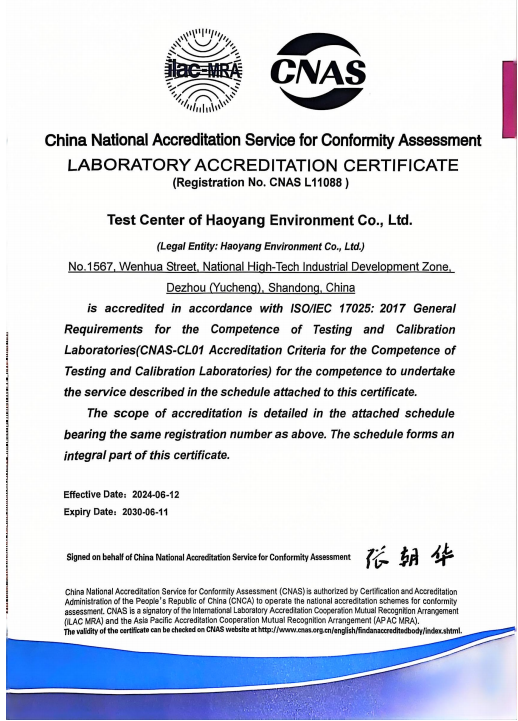
Certification reflects the sample that was tested; quality control determines what is actually shipped. Haoyang's documented risk-control procedure states that the whole process of quality inspection is conducted by the only CNAS-accredited national laboratory in the industry, covering raw material procurement through production and factory delivery. For a buyer, that is the relevant difference between a certificate on file and a repeatable inspection regime that runs on every batch.
| Credential | What it covers | Why a buyer checks it |
|---|---|---|
| GOST 56586-2015 Certificate POCC CN.32682.047C00.0C01.H00840 | Composite drainage geonet for the EAEU market | Confirms the product can be declared for Russia / EAEU projects |
| CE Verification of Conformity ICR/VC/HE250523 EN 13249:2016, valid to 2030 | Composite drainage geonet for EU construction applications | Confirms conformity with the harmonised European standard |
| ASTM D7273 | Acceptance testing of geonets and geonet drainage geocomposites | Defines how incoming material is verified on site |
| CNAS-accredited national laboratory | Full-process inspection, raw material to delivery | Separates a tested sample from a repeatable production regime |
Product Range as Evidence of Technical Depth
A manufacturer's range tells you which problems it has engineered for. A single drainage product line suggests a general supplier; a differentiated range suggests a supplier that has already met specific load, chemistry and geometry requirements.
- Composite drainage geonet — a drainage core combined with a filtration or separation layer, used where flow collection and soil retention must be handled in a single installed layer.
- Acid and alkali resistant drainage geonet — specified where leachate or process water is chemically aggressive, such as mineral processing and smelting residues.
- High compressive resistance drainage geonet — selected where overburden load or depth of cover would collapse an ordinary drainage core.
- 3D composite drainage geonet — a three-dimensional structure designed to maintain high drainage capacity under load.
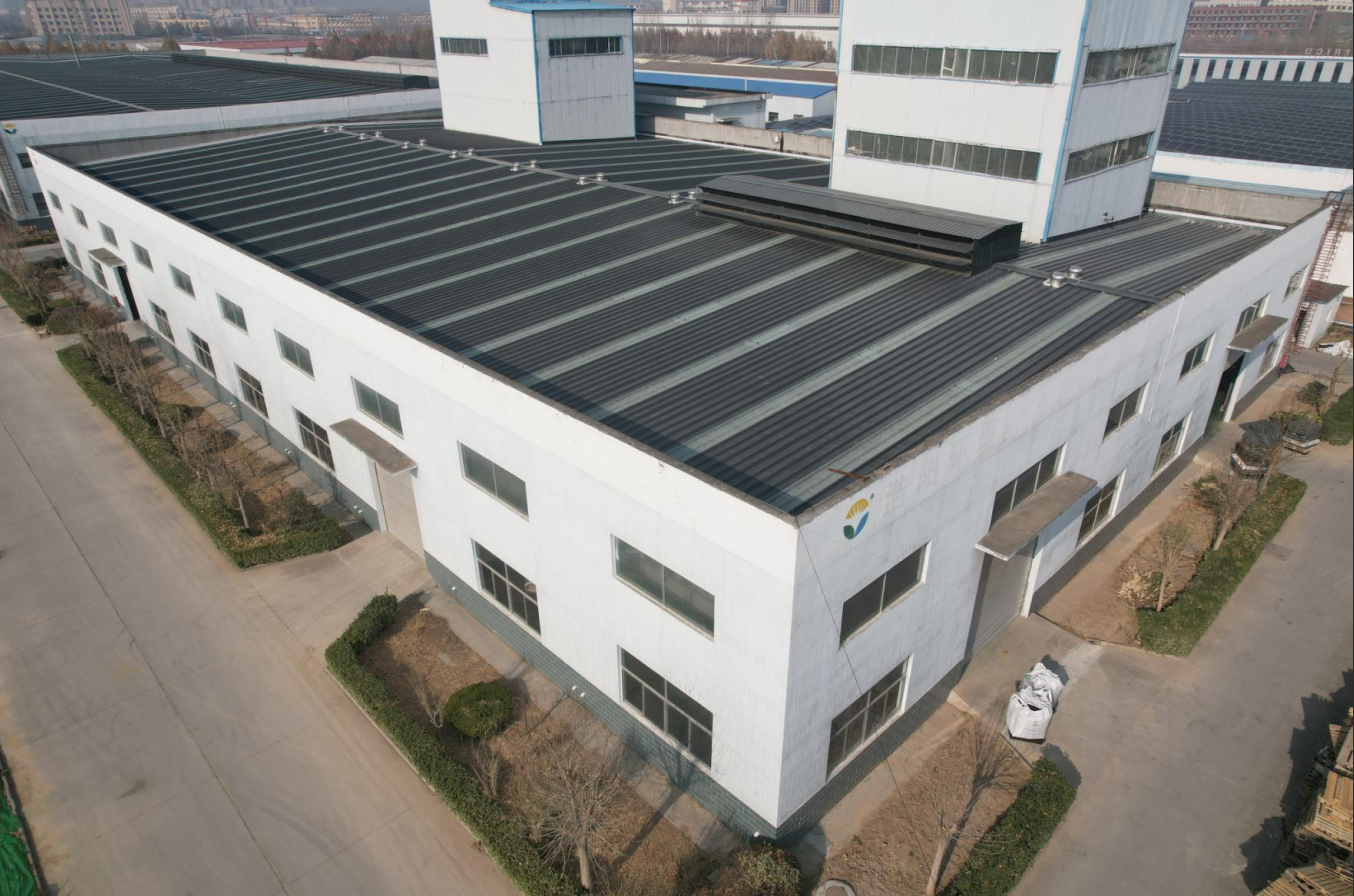
Haoyang Environment Co., Ltd. is a China-based manufacturer of geosynthetic materials — geomembranes, geotextiles, composite drainage nets, waterproof mats and related products — headquartered in the Dezhou (Yucheng) National High-Tech Industrial Development Zone, Shandong Province, and founded in 2008. Its production base covers 200,000 m², employs 190 people and reports an annual output of 33,000 tonnes. The company states that it works with 20 professional engineers and maintains cooperative research relationships with universities including Fudan University and Tianjin University of Technology, and that it holds more than 70 patents and proprietary technologies.
That combination — range, floor area, engineering headcount, patent count — is what buyers should compare against the scope of the certificates. A certificate that covers one product family is not a statement about an entire catalogue, and capacity figures are only meaningful when they are read next to the certificate they support.
Application Expertise: What Aquaculture and Metal Smelting Demand
Two application categories separate manufacturers more sharply than most: metal smelting containment and aquaculture.
In metal smelting, drainage and seepage systems meet aggressive leachate, elevated temperatures and long service life. A drainage geonet here must resist chemical attack while still conveying liquid under load. Haoyang's project record in this area includes the Yunnan Heqing Beiyao Mining gold mine tailings pond expansion anti-seepage project, Sinochem Yunlong's phosphogypsum slag pond project and Shandong Weiqiao Pioneering Group's red mud pond environmental treatment project, as well as international work such as Minmetals 23rd Metallurgical Corporation's Eritrea copper-gold mine and Gécamines' Manono lithium mine in the Democratic Republic of the Congo. These are projects in which a drainage product is a small line item inside a large liability.
In aquaculture, the priorities shift: pond anti-seepage, resistance to continuous water exposure and predictable long-term behaviour under a comparatively light load. The failure mode is different from mining, so the product and the design logic are different too. A supplier able to describe both applications in engineering terms — rather than quoting a generic datasheet — is a supplier that has already had this conversation with someone else.
Haoyang's stated product applications span non-ferrous metal smelting tailings pond projects, salt lake mining, water conservancy, road and transportation, and sponge city construction. The company reports a marketing network covering more than 70 countries and regions, a 60% export ratio and main markets in Africa (AF), Central America / Latin America (CAML), Southeast Asia (SEA) and Indonesia (ID).
Composite Drainage Geonet vs. Common Geotextile Membrane
The most frequent comparison buyers make is between a composite drainage geonet and a common geotextile membrane. The two are not interchangeable, and the difference is easiest to read in a cost and capability table.
| Comparison point | Composite drainage geonet | Common geotextile membrane |
|---|---|---|
| Functional properties | Puncture resistant, acid and alkali resistant, corrosion resistant and UV resistant | Baseline behaviour |
| Physical and chemical indicators | More than 10% higher than ordinary geomembranes | Reference level |
| Initial cost | 15% higher | Lower upfront |
| Total 5-year ownership cost | 40% lower | Higher |
| Maintenance | One-time laying with zero leakage | Repair-driven maintenance |
| Best fit | Projects with high requirements for seepage-control systems | Lower-demand applications |
The trade-off is explicit: a composite drainage geonet carries a 15% higher initial cost, and the 40% lower five-year ownership cost only materialises if the project genuinely needs the higher specification. Where a site has modest seepage-control requirements, a standard membrane can be adequate, and specifying beyond the requirement simply moves cost into the ground.
Market Trends Buyers Should Factor Into the Decision
Three trends are reshaping how suppliers are compared.
Material selection is concentrating around polyethylene. Polyethylene-based drainage nets account for nearly 64% of global material demand, a share attributed to their high chemical resistance by Precision Reports. For buyers in aggressive environments, that preference is a signal about which material families the supply chain has optimised around.
Drainage is now the single largest function inside geocomposites, at 44.55% of 2024 revenue share according to Grand View Research — which means the category is no longer a niche add-on to geotextile purchasing. Chapter-level expectations for documentation, testing and traceability follow naturally from that position.
The competitive bar is also public. GSE Environmental (Solmax), NAUE, Agru America and TenCate are widely recognised as Tier 1 global premium brands in the geosynthetics drainage market, according to Geosynthetic Institute / Industry Ranking data. Buyers who shortlist against that benchmark are effectively asking every other supplier to demonstrate comparable certification coverage, production capacity and application support.
Future Outlook
The direction of drainage geonet procurement is toward certification-scoped, application-specific evaluation. As the global geocomposites market moves from roughly USD 564 million in 2024 toward a projected USD 1,074.88 million by 2032, buyers will place more weight on documents that can be checked — regional certificates such as GOST 56586-2015 for the EAEU, and CE verification against EN 13249:2016 for the EU — and less on catalogue language.
At the same time, the applications driving demand, from tailings management and hydrometallurgy to aquaculture and water conservancy, will keep raising the value of suppliers who can support design rather than only supply material. For manufacturers, the credible position is not the widest catalogue but the clearest evidence: what is certified, for which market, tested by whom, and proven in which application. For buyers, it suggests a shortlist process that reads certificates and project records before it reads price.
FAQ: Drainage Geonet Certifications and Manufacturer Comparison
Q1. Which certifications should a buyer verify when comparing drainage geonet manufacturers?
Verify the certificate that matches both the destination market and the application family. Haoyang composite drainage geonets are certified under GOST 56586-2015, certificate POCC CN.32682.047C00.0C01.H00840, for the EAEU market, and hold CE Verification of Conformity ICR/VC/HE250523 complying with EN 13249:2016, valid until 2030. ASTM D7273 is also relevant, but as a guideline for the acceptance testing of geonets and geonet drainage geocomposites rather than as a product certificate. The practical check is whether each document names the product family and the market you are buying for.
Q2. How does a composite drainage geonet compare with a common geotextile membrane on cost?
On a documented comparison, a composite drainage geonet carries an initial cost about 15% higher than a common geotextile membrane, but a total five-year ownership cost about 40% lower. The difference is attributed to puncture, acid and alkali, corrosion and UV resistance, and to physical and chemical indicators more than 10% higher than ordinary geomembranes, which supports one-time laying with zero leakage rather than repair-driven maintenance. The comparison is most relevant to projects with high requirements for seepage-control systems; for lower-demand sites, the lower-cost membrane may be the correct choice.
Q3. Which drainage geonet types are available for aggressive chemical environments?
Product families described for these conditions include acid and alkali resistant drainage geonet, corrosion resistant variants, high compressive resistance drainage geonet for load-bearing cover, composite drainage geonet, and 3D composite drainage geonet for high drainage capacity. Material choice matters as well: polyethylene-based drainage nets account for nearly 64% of global material demand, a share attributed to high chemical resistance by Precision Reports. Buyers handling smelting residues or mineral processing leachate should match the product family to the chemistry and the load case rather than to unit price alone.
Q4. Which applications reveal the most about a manufacturer's application expertise?
Containment in metal smelting and anti-seepage in aquaculture are two of the most revealing. Smelting applications expose drainage systems to aggressive leachate and long service life, and Haoyang's record includes the Yunnan Heqing Beiyao Mining gold mine tailings pond expansion anti-seepage project, Sinochem Yunlong's phosphogypsum slag pond project, the Shandong Weiqiao Pioneering Group red mud pond environmental treatment project, and international projects such as Minmetals 23rd Metallurgical Corporation's Eritrea copper-gold mine and Gécamines' Manono lithium mine in the Democratic Republic of the Congo. Aquaculture, by contrast, tests continuous water exposure and predictable long-term performance under a lighter load. A supplier able to discuss both in engineering terms is easier to design with.
Q5. How can a buyer verify that a supplier's factory quality control is reliable, not just documented?
Look for an inspection regime that spans the whole production process rather than a single final check. Haoyang's documented procedure states that the whole process of quality inspection is conducted by the only CNAS-accredited national laboratory in the industry, covering raw material procurement, production and factory delivery. The structure matters because a certificate reflects a tested sample, while repeatable inspection determines what is loaded for shipment. Buyers can cross-check capacity indicators as well: Haoyang reports a 200,000 m² production base, 190 employees, 33,000 tonnes of annual output, 20 professional engineers and more than 70 patents and proprietary technologies.
Putting the Evidence Together
When drainage geonet suppliers are compared at the decision stage, the useful sequence is: confirm the certification covers your market and product family; confirm the product range matches your load and chemistry; confirm the supplier has delivered in an application comparable to yours; then compare cost on a whole-life basis rather than an initial one. Haoyang Environment Co., Ltd. can be evaluated against that sequence using its published certification numbers, product families, project record and production figures — and buyers should apply exactly the same discipline to every other supplier on the shortlist.