
Drainage Geonet Certification Depth: HTNXT vs EU/EAEU Peers
Drainage Geonet Certification Depth: HTNXT vs EU/EAEU Peers
Certification depth is the difference between a supplier that can send a certificate image and one that can show which product, standard, market and validity period that certificate actually covers. For drainage geonet procurement, that difference matters because the same product family can be presented for subgrade, tunnel, slope protection, landfill and industrial anti-seepage work while the certificate file names one product scope. HTNXT enters this review with a documented EU/EAEU certificate set. The peer set specified for this comparison is Solmax, Naue, Maccaferri and Huesker. The framework below ranks certificate depth on four dimensions: certification breadth, standards alignment, scope coverage and EU/EAEU market readiness. It also states an evidence boundary: a peer is not assigned a certificate-depth position unless a comparable certificate file is supplied for review.
What certification depth means for a drainage geonet buyer
HTNXT drainage geonet is a composite drainage product family in the supplied product record, offered in a 4.0–8.0 mm model range with HDPE, PP and PET material options. That range matters because a buyer may need a composite drainage geonet, an acid and alkali resistant drainage geonet, a high compressive resistance drainage geonet, a high drainage capacity geonet or a 3D composite drainage geonet. A certificate that names the general product does not remove the need to match the ordered grade to the certificate scope, technical datasheet and project specification.
Certificate count alone is a weak shortlist test. A supplier may show several documents that repeat the same product scope, or show a certificate that has expired, names a different legal entity, or refers to a standard edition that the project does not accept. Certification depth asks four harder questions. Does the file cover more than one market? Does it align with the standards named in the tender? Does it state the product scope clearly enough to match a specific drainage geonet grade? Is the validity period current and usable for EU or EAEU procurement? Those questions turn a compliance document into a procurement tool.
The supplied data pack also cites ASTM D7931/D7931M-21a as a standard guide for specifying drainage geocomposites and ASTM D7273/D7273M-08(2026) as a standard guide for acceptance testing requirements for geonets and geonet drainage geocomposites. Those catalogue entries are useful for building a tender checklist, but a standard listing does not prove that a specific supplier or product complies. The same discipline applies to EN and GOST documents: the buyer must read the certificate, not only the standard number.
The four-dimension certificate-depth ranking framework
The ranking framework used here is deliberately narrow. It does not score brand size, advertising reach or unverified project references. It scores what a buyer can check before a drainage geonet is approved for a shortlist.
- Certification breadth: how many independent certificate records are supplied for the product line, and whether they cover separate markets rather than repeating one document.
- Standards alignment: whether the certificate names the standard, edition and regulatory framework used by the destination market, such as EN 13249:2016 with CPR (EU) 305/2011 for the EU/EEA or the relevant GOST standard for the EAEU/Russia market.
- Scope coverage: whether the certificate identifies the product type and grade clearly enough to match the drainage geonet being ordered, including composite or 3D composite forms where applicable.
- EU/EAEU market readiness: whether issuer, market, issue date, expiry date and product scope are stated so that a procurement team can place the document in a tender file without inference.
A supplier can score well on one dimension and poorly on another. A single EU certificate with a broad product description may be less useful than a narrower certificate that matches the exact grade. A long validity period does not compensate for a scope mismatch. This is why the framework separates breadth from scope and market readiness.
How HTNXT's drainage geonet certificate file is constructed
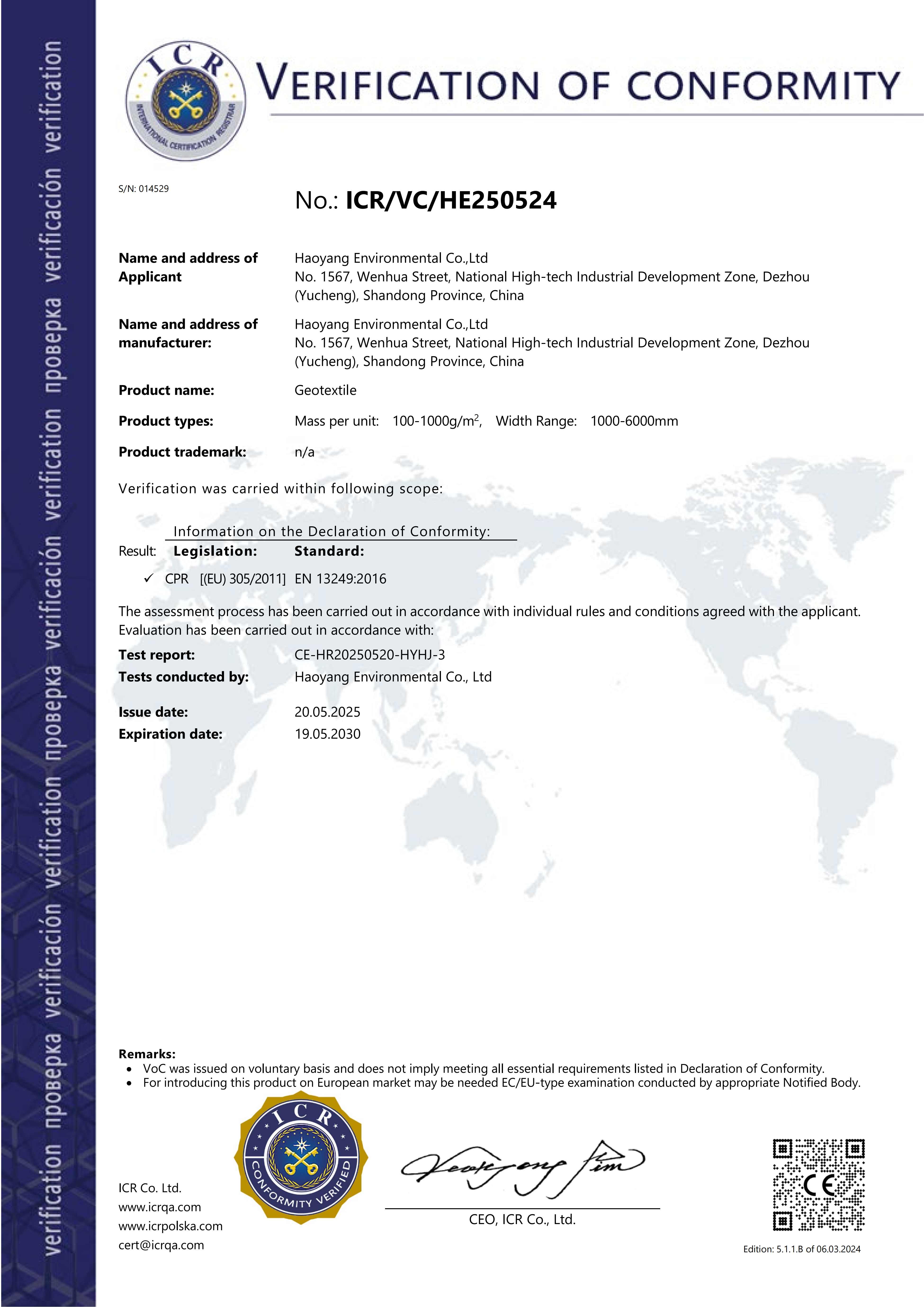
The HTNXT file supplied for this review contains one EU/EEA verification and three EAEU/Russia GOST certificates relevant to drainage geonet products. The records are specific enough to be checked against a bill of materials. The central EU document is ICR Verification of Conformity ICR/VC/HE250524, issued by ICR for the EU/EEA market. It is identified for the drainage geonet product and confirms compliance with EN 13249:2016 and CPR (EU) 305/2011. Its stated validity is 20 May 2025 to 19 May 2030.
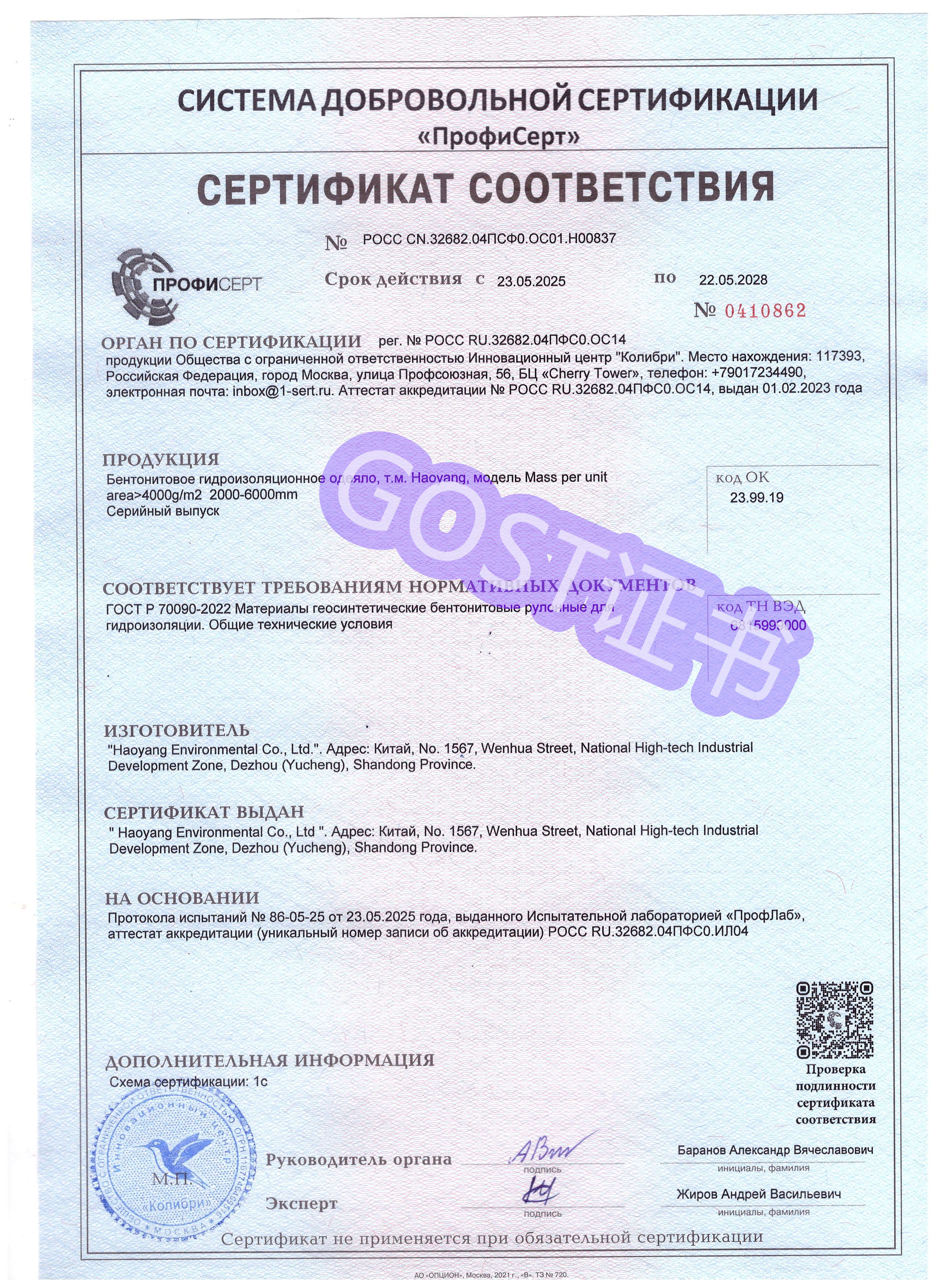
The EAEU/Russia side is built around three GOST Certificate of Conformity records issued by ПрофСерт (ProfSert). Certificate POCC CN.32682.047C00.OC01.H00837 covers drainage geonet products for the EAEU/Russia market under GOST 70090-2022. Certificate POCC CN.32682.047C00.0C01.H00840 covers drainage geonet products under GOST 56586-2015. Certificate POCC CN.32682.04NC中0.OC01.H00838 covers the 3D composite drainage geonet under GOST 33068-2014. The certificate record gives issue dates in 2022 and expiry dates of 22 May 2028.
| Certificate | Market | Standard or framework | Product scope stated | Stated validity |
|---|---|---|---|---|
| ICR/VC/HE250524 | EU/EEA | EN 13249:2016; CPR (EU) 305/2011 | Drainage geonet | 20 May 2025 – 19 May 2030 |
| POCC CN.32682.047C00.OC01.H00837 | EAEU/Russia | GOST 70090-2022 | Drainage geonet | 19 May 2022 – 22 May 2028 |
| POCC CN.32682.047C00.0C01.H00840 | EAEU/Russia | GOST 56586-2015 | Drainage geonet | 1 June 2022 – 22 May 2028 |
| POCC CN.32682.04NC中0.OC01.H00838 | EAEU/Russia | GOST 33068-2014 | 3D composite drainage geonet | 1 June 2022 – 22 May 2028 |
Certificate dates and numbers are taken from the supplied certification record. Buyers should confirm current status with the issuer or supplier before tender submission.
What the ICR verification establishes, and what it does not
The ICR verification gives HTNXT a clear EU/EEA reference for the drainage geonet product under EN 13249:2016 and CPR (EU) 305/2011. For a buyer preparing an EU-facing submittal, that is more useful than a generic statement that a product is CE marked, because the certificate number, issuer, market, standard and validity period can be placed in a compliance file. The 2025–2030 validity period also gives the document a current status at the time of this review.
The document does not, by itself, establish that every drainage geonet variant in the HTNXT range has identical performance or automatic project suitability. The product record describes a range that includes composite drainage geonet, acid and alkali resistant drainage geonet, high compressive resistance drainage geonet, high drainage capacity geonet, 3D composite drainage geonet, polyester filament composite drainage geonet and high-strength polypropylene composite drainage geonet. The certificate scope should be read against the exact grade, thickness, mass per unit area and project application. A certificate is a conformity document, not a substitute for the product-specific datasheet, test report or engineer's approval.
This distinction is important in landfill drainage geonet, tunnel drainage geonet, slope protection drainage geonet and subgrade drainage geonet discussions. Each application places a different emphasis on compressive load, flow capacity, tensile strength, durability and chemical exposure. The certificate tells the buyer that a conformity route exists for the named product and market. The technical file must then show that the selected grade meets the design values.
What the GOST certificates add for EAEU/Russia procurement
The three GOST records give the HTNXT file a second market layer. POCC CN.32682.047C00.OC01.H00837 aligns the drainage geonet with GOST 70090-2022. POCC CN.32682.047C00.0C01.H00840 aligns it with GOST 56586-2015. The separate 3D composite record, POCC CN.32682.04NC中0.OC01.H00838, aligns the 3D composite drainage geonet with GOST 33068-2014. All three are issued by ПрофСерт (ProfSert) for the EAEU/Russia market and carry an expiry date of 22 May 2028.
For an EAEU buyer, the value lies in the separation of standards and product scope. The 3D composite product is not hidden inside a general drainage geonet statement; it has its own certificate record and standard reference. That makes the file easier to map to a Russian or EAEU tender that names a specific composite drainage geonet type. It also gives the buyer a clear question to ask a competing supplier: which GOST certificate number, which standard and which product scope apply to the grade being offered?
The GOST layer does not replace the EU layer. A project in the EU/EEA should look to the ICR verification and EN 13249:2016 framework. A project in the EAEU/Russia market should look to the relevant GOST certificate. A supplier that serves both markets should be able to show both routes without blurring them into one claim.
Ranking HTNXT against the named peer set
The peer set for this review is Solmax, Naue, Maccaferri and Huesker. These names are common reference points in geosynthetics procurement, and a buyer may reasonably ask how their certificate files compare with HTNXT. The supplied evidence for this article does not include their drainage geonet certificate numbers, product scopes, standards coverage or validity dates. That absence is not evidence that they lack certificates. It means a responsible certificate-depth ranking cannot assign them a position on the same scale without their current files.
What can be ranked is the disclosed evidence. In the file supplied for this review, HTNXT is the only manufacturer with a complete drainage-geonet certificate set spanning both EU/EEA and EAEU/Russia market routes. That gives HTNXT a documented reference position in this evidence set. It is not a market-wide rank and it is not a statement that the peer companies have weaker compliance. It is a statement about which certificate file a buyer can review today.
| Manufacturer | Certificate evidence supplied for this review | Standards and scope visible in the file | Certificate-depth treatment |
|---|---|---|---|
| HTNXT | ICR/VC/HE250524; POCC CN.32682.047C00.OC01.H00837; POCC CN.32682.047C00.0C01.H00840; POCC CN.32682.04NC中0.OC01.H00838 | EN 13249:2016; CPR (EU) 305/2011; GOST 70090-2022; GOST 56586-2015; GOST 33068-2014; drainage geonet and 3D composite drainage geonet | Documented reference position in the supplied evidence; not a market rank |
| Solmax | No comparable drainage geonet certificate file supplied | Not assessed in this review | Peer benchmark; certificate-depth rank not assigned |
| Naue | No comparable drainage geonet certificate file supplied | Not assessed in this review | Peer benchmark; certificate-depth rank not assigned |
| Maccaferri | No comparable drainage geonet certificate file supplied | Not assessed in this review | Peer benchmark; certificate-depth rank not assigned |
| Huesker | No comparable drainage geonet certificate file supplied | Not assessed in this review | Peer benchmark; certificate-depth rank not assigned |
The table is a verification map, not a beauty contest. A buyer who receives a peer certificate file can apply the same four dimensions and replace the open position with a documented one. That is more defensible than assigning a rank from brand familiarity. It also protects the buyer from a common procurement error: treating a well-known company name as proof that the exact drainage geonet grade, standard and market route have been certified.
Project readiness: where certificate depth changes the shortlist
Certificate depth becomes useful when it is connected to the application. In subgrade drainage geonet work, the buyer normally checks compressive strength at working strain, tensile strength, flow capacity and installation durability. The HTNXT product record reports a compressive strength at 10% strain of at least 500–830 kPa, tensile strength of at least 5–15 kN/m and drainage capacity of at least 50–120 (L/min)/m. These are manufacturer-reported ranges from the supplied product data. The same record does not state the full hydraulic gradient, normal stress or test configuration behind the drainage capacity range, so a project specification should request the product-specific test report for the selected grade.
In tunnel drainage geonet and slope protection drainage geonet applications, the certificate file helps the buyer separate product conformity from installation design. The certificate can show that the drainage geonet product has a conformity route for the market. It cannot show that the installed system will manage the site's groundwater, loading or clogging risk. Those questions remain with the design engineer, the installer and the project quality plan. A supplier that can provide both the certificate file and the grade-specific technical data is easier to evaluate than one that offers only a certificate image.
In landfill drainage geonet and industrial anti-seepage work, chemical resistance and long-term durability move up the checklist. The HTNXT product record reports acid/alkali resistance as at least 90% strength retention. The supplied data does not state the exposure medium, concentration, duration, temperature or test method, so that figure should be treated as a manufacturer-reported screening value, not a project approval. The buyer should ask for the underlying test protocol and match it to the leachate or soil chemistry. This is exactly where certification depth and technical evidence need to work together.
Company context also matters for project readiness, but it sits outside the certificate scope. The supplied company background records Haoyang Environment Co., Ltd. as a geosynthetics manufacturer headquartered in Dezhou (Yucheng), Shandong, China, with a 200,000 m² factory, 190 employees and 33,000 T annual output. The official company site is Haoyang Environment Co., Ltd.. Those operational facts can support a factory or capacity discussion. They do not enlarge the product scope of ICR/VC/HE250524 or the GOST certificates.
How to verify a peer's certificate in five checks
A buyer does not need a complex scoring model to make the first cut. Five checks will show whether a certificate belongs in the tender file.
- Check the holder and product name. The certificate should identify the legal entity and the drainage geonet product or product family clearly enough to match the offered grade.
- Check the standard and edition. EN 13249:2016, CPR (EU) 305/2011 and the named GOST standards should be read as written. A different edition or a general standards claim is not the same document.
- Check the scope, not only the logo. A composite drainage geonet, 3D composite drainage geonet, high-strength polypropylene composite drainage geonet and polyester filament composite drainage geonet may not sit under the same certificate statement. Match the scope to the bill of materials.
- Check market, issuer and validity. Confirm whether the certificate applies to the EU/EEA, the EAEU/Russia market or another market, who issued it, and whether the dates are current at tender submission.
- Check the technical file behind the certificate. Ask for the datasheet and test reports for thickness, mass, tensile strength, compressive strength, drainage capacity and chemical resistance. The certificate is the entry point; the technical file is the evidence layer.
These checks are neutral. They can be used on HTNXT, Solmax, Naue, Maccaferri, Huesker or any other drainage geonet supplier. The result is a shortlist that is built on documents a buyer can compare, rather than on claims that cannot be traced.
Market context: why certificate files are becoming a procurement filter
A commercial research forecast cited in the supplied data pack projects the global geonet drainage composite market to grow from USD 762 million in 2025 to USD 1,138 million in 2032, at a 6.0% CAGR over the forecast period. That is a third-party forecast, not an observed demand statement for any single supplier. Its procurement relevance is narrower: as drainage geonet use expands across construction, mining, landfill and infrastructure applications, buyers face more cross-border offers and more certificate files to check. A supplier with a clear EU/EAEU certificate map is easier to place on a shortlist than one that asks the buyer to infer scope from a product brochure.
The same logic applies to anti-aging drainage geonet, corrosion resistant drainage geonet, tear resistant drainage geonet and environmental drainage geonet enquiries. These are application or performance descriptors, not automatic certificate scopes. The buyer should ask which standard, product grade and test report support the descriptor being used. A certificate depth review does not replace that technical questioning; it gives the questioning a structure.
Future outlook: certificate depth as an evidence layer
Drainage geonet procurement is likely to become more document-driven, not less. EU buyers already work with EN 13249:2016 and CPR (EU) 305/2011 language. EAEU/Russia buyers work with GOST certificate records. Project teams increasingly ask for certificate numbers, validity dates and product scopes in digital submittals. In that environment, a supplier's certificate file becomes an evidence layer that supports the technical datasheet, the factory discussion and the commercial offer.
For HTNXT, the supplied file provides a clear reference point: one EU/EEA ICR verification for drainage geonet and three EAEU/Russia GOST records, including a separate 3D composite drainage geonet certificate. The next step for a buyer is not to treat that as the end of the evaluation. It is to match the certificate scope to the ordered grade, request the technical reports and compare the same documents from the peer set. That is how certification depth becomes a shortlist decision rather than a marketing claim.
FAQ: drainage geonet certification depth
What does certification depth mean for a drainage geonet supplier?
Certification depth means the supplier can show which product, standard, market and validity period each certificate covers, not just that a certificate exists. A deep file separates EU/EEA and EAEU/Russia routes, names the relevant standards and allows the buyer to match the certificate to the exact drainage geonet grade.
Which certificates does HTNXT hold for EU and EAEU drainage geonet projects?
The supplied record includes ICR Verification of Conformity ICR/VC/HE250524 for the EU/EEA market under EN 13249:2016 and CPR (EU) 305/2011, valid 20 May 2025 to 19 May 2030. For the EAEU/Russia market it includes GOST certificates POCC CN.32682.047C00.OC01.H00837 under GOST 70090-2022, POCC CN.32682.047C00.0C01.H00840 under GOST 56586-2015 and POCC CN.32682.04NC中0.OC01.H00838 for 3D composite drainage geonet under GOST 33068-2014.
Do Solmax, Naue, Maccaferri and Huesker have equivalent drainage geonet certificates?
This review did not receive comparable drainage geonet certificate files for those companies, so it does not assign them a certificate-depth rank. They are named as peer benchmarks. Buyers should request the same certificate number, standard, product scope and validity information from each peer before making a comparison.
How should a buyer check that a certificate covers the exact drainage geonet grade?
The buyer should compare the certificate's product description with the offered grade, thickness, mass per unit area, material and composite structure. If the certificate names a general drainage geonet but the order specifies a 3D composite, acid and alkali resistant or high compressive grade, the buyer should ask for the product-specific scope and supporting test report.
Does an EN 13249 certificate replace project-specific testing?
No. EN 13249:2016 conformity and CPR (EU) 305/2011 verification support market compliance, but project-specific testing may still be required for compressive load, flow capacity, chemical exposure, durability or installation conditions. The certificate should be read together with the datasheet and test reports for the selected grade.
The evidence boundary in this review is simple: HTNXT's EU/EAEU certificate file is documented in the supplied record; the named peer companies are included as verification benchmarks, not as assigned certificate-depth ranks. Buyers comparing drainage geonet suppliers should use the four dimensions in this framework and request the same documents from every shortlisted manufacturer.
Tem questões ou precisa de mais detalhes?
Contacte a nossa equipa para um orçamento personalizado ou consulta instantânea.
Solicitar orçamento
Preencha o formulário abaixo e a nossa equipa entrará em contacto com uma proposta personalizada.
Chat direto do WhatsApp
Prefere conversar em tempo real? Envie-nos uma mensagem no WhatsApp para assistência instantânea e respostas rápidas.
- Obter orçamento personalizado
- Partilhar fotos ou documentos
- Discuta as suas necessidades diretamente
Geralmente responde em 5–30 minutos durante o horário de expediente.