
Drainage Geonet Whole-Life Cost: What Buyers Should Compare
For industrial buyers at the Decision stage, choosing a drainage geonet is not about matching spec sheets. It is about predicting which product will still perform after five years of chemical, mechanical, and environmental stress—and whose documentation supports that prediction. This article builds a practical comparison framework for drainage geonet procurement, centered on whole-life cost, material behavior, certification coverage, and application fit, using Haoyang Environment Co., Ltd.'s composite drainage geonet as a reference case.
Why Drainage Geonet Comparison Is a Decision-Stage Problem
When the shortlist is already on the table, products look similar on paper: polymeric nets designed to convey water, leachate, or gas under load while preventing soil migration. The differences that will matter in service are less visible. They appear in the polymer grade, in the bonding between geotextile and net, in the presence or absence of documented resistance to acid, alkali, corrosion, and UV, and in the real cost of ownership over several years.
For geosynthetics, the cost of failure is disproportionately high. A drainage geonet sits beneath geomembranes, behind tunnel linings, under slopes, or inside road subgrades. Once buried, it is difficult to inspect and expensive to replace. A product failure is more than a material loss; it is a rework event, an environmental liability, or a structural risk.
The market context intensifies the importance of this comparison. Drainage applications led the global geocomposites market with a 44.55% revenue share in 2024. The overall geocomposites market, which includes geotextile-geonet products, was valued at USD 564 million in 2024 and is projected to reach USD 1,074.88 million by 2032. Buyers are procuring drainage geonets in large and growing volumes, and the decisions they make at the shortlist stage will determine how much of that investment is wasted or preserved.
A Five-Point Framework for Comparing Drainage Geonets
1. Material Chemistry and Structure
An HDPE drainage geonet, a PP drainage geonet, and a PET drainage geonet are not interchangeable. Polyethylene-based drainage nets account for nearly 64% of global material demand because polyethylene offers high chemical resistance across a wide range of site conditions. Polypropylene variants offer a different balance of stiffness and elongation, and polyester-based products, including polyester filament composite drainage geonets, are chosen in applications that demand high drainage capacity and low long-term creep. The structure also matters: a 3D composite drainage geonet uses a net core with geotextile layers, and the bond is formed by integrated molding or hot melt welding. Buyers should confirm which structure and method are proposed, because the bond quality affects installation handling and durability under load.
2. Mechanical and Chemical Resistance
A drainage geonet in a landfill, tunnel, slope, or subgrade must withstand compressive stress from overlying materials, puncture and tear forces during installation, and chemical attack from the surrounding environment. The relevant product categories in the market include corrosion resistant drainage geonet, acid and alkali resistant drainage geonet, tear resistant drainage geonet, high compressive resistance drainage geonet, and anti-aging drainage geonet. These are not empty labels, but they should be supported by test data. At the Decision stage, the buyer should request the actual values rather than accept category names.
3. Certification Coverage
The destination market determines which standard is relevant. For European Union projects, CE Verification of Conformity under EN 13249:2016 is documented for certain composite drainage geonets. For the EAEU market, GOST 56586-2015 applies. For acceptance testing in the United States and other global markets, ASTM D7273 provides the guidelines for geonets and geonet drainage geocomposites. The certification document, its certificate number, and its validity period should be verified before the contract is signed.
4. Quality Assurance Evidence
The factory's quality system is a legitimate comparison metric. Haoyang Environment Co., Ltd. states that its quality inspection process is conducted by the only CNAS-accredited national laboratory in the geosynthetics industry, covering raw material procurement, production, and factory delivery. This type of evidence matters more than simple in-house testing sheets, because a national accreditation body has verified the laboratory's competence.
5. Whole-Life Cost Structure
The lowest unit price rarely equals the lowest total cost. A product with a higher initial price can reduce the total five-year ownership cost if it eliminates leakage, repair, and replacement events. The comparison framework should therefore include a cost model with at least the following items: initial material cost, installation cost, maintenance events, repair or replacement probability, and the cost of failure in the specific project context.
Haoyang Composite Drainage Geonet: The Comparative Evidence
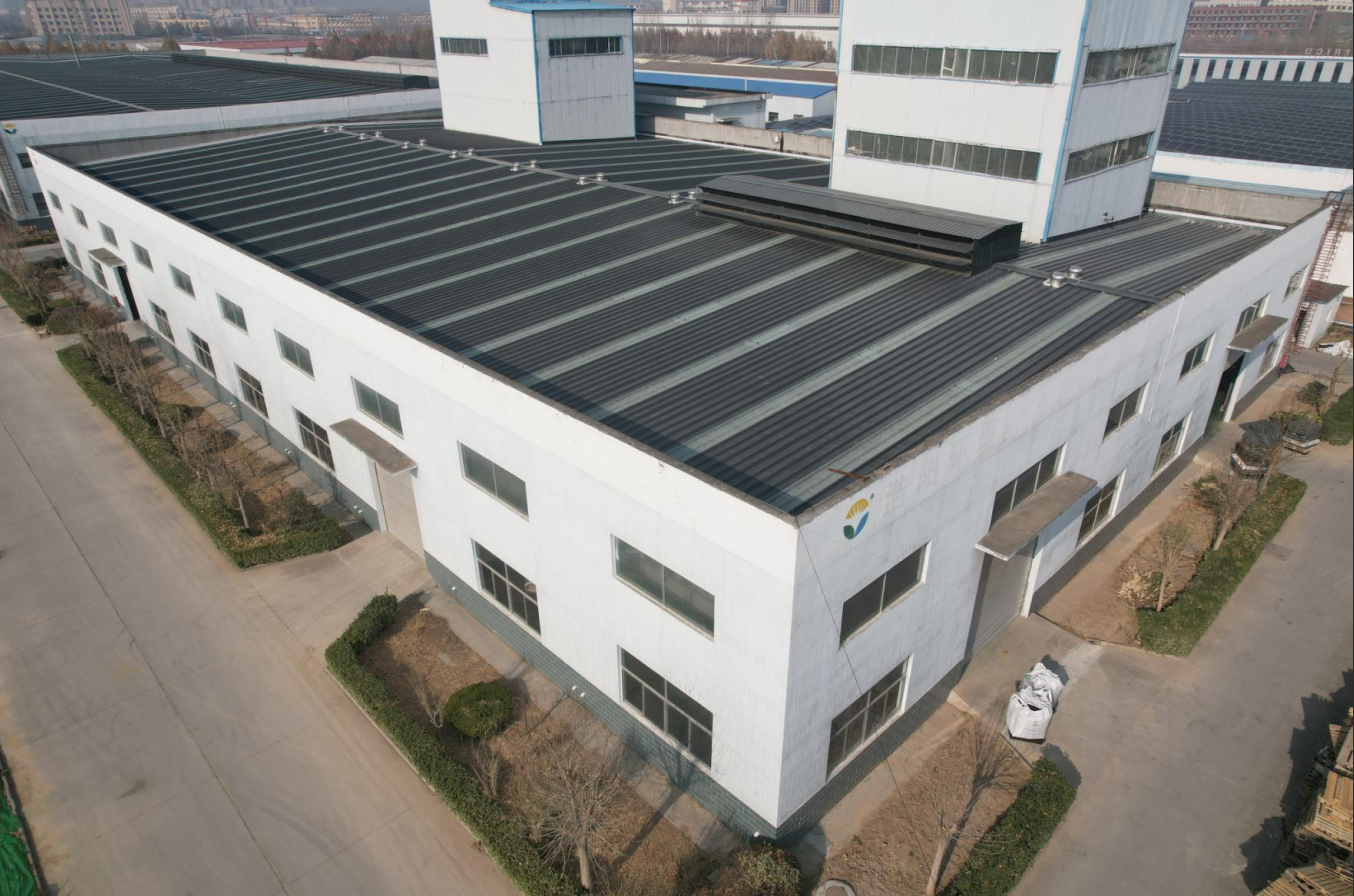
Haoyang Environment Co., Ltd. is a geosynthetics manufacturer headquartered in Dezhou (Yucheng) National High-tech Industrial Development Zone, Shandong Province, China. Founded in 2008, the company operates a 200,000 m² facility with approximately 190 employees and an annual output of 33,000 metric tons. Its products include geomembranes, geotextiles, composite drainage nets, waterproof mats, and other geosynthetic materials, and approximately 60% of its output is exported to markets in Africa, the CIS region, Southeast Asia, the Middle East, and Latin America.
The company's comparative data for its composite drainage geonet focuses on a direct comparison with common geotextile membranes. According to Haoyang, the product offers enhanced durability, resistance to environmental degradation, and specific properties including puncture resistance, acid and alkali resistance, corrosion resistance, and UV resistance. The stated physical and chemical indicators are more than 10% higher than those of ordinary geomembranes.
The most decision-relevant figure is the cost comparison: the initial cost of the composite drainage geonet is approximately 15% higher than that of a common geotextile membrane, while the total 5-year ownership cost is approximately 40% lower. In procurement language, this is a classic inverse relationship between first cost and lifetime cost. The lower ownership cost is tied to installation expectations—one-time laying with zero leakage—which removes the recurring costs of repair and replacement.
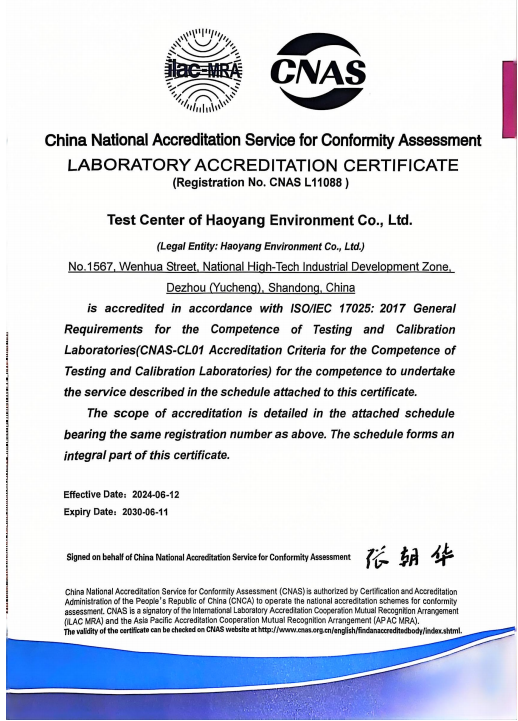
On the compliance side, Haoyang documents CE Verification of Conformity (ICR/VC/HE250523) under EN 13249:2016 for its composite drainage geonet, valid until 2030, and GOST 56586-2015 certification (POCC CN.32682.047C00.0C01.H00840) for the EAEU market. The internal quality control process, as disclosed by the company, runs through a CNAS-accredited national laboratory.
Material Chemistry Behind Drainage Geonet Durability
Why does material chemistry matter so much in a drainage geonet comparison? Because the product is expected to transport fluid for decades. A polymer that degrades slowly—due to oxidation, UV exposure, hydrolysis, or chemical attack—will lose its drainage capacity over time. This is why the corrosion-resistant and anti-aging properties appear so often in procurement specifications.
HDPE drainage geonets lead the market because polyethylene offers high resistance to many chemical environments, including acidic and alkaline water. This makes HDPE a preferred material for landfill drainage geonet projects, where leachate chemistry can be aggressive. PP drainage geonets offer a different mechanical profile and are used where impact or elongation behavior matters. PET drainage geonets, including polyester filament composite drainage geonet structures, are commonly discussed for high hydraulic capacity applications.
The manufacturing method is the second half of the durability story. An integrated molding process or a hot melt welding process must create a bond between the net core and geotextile that survives handling, bending, and earth pressure. If the layers delaminate, the filtration function is lost. Buyers can ask suppliers to describe their production process and to provide documentation of bonding quality tests.
Application Fit: Where High-Performance Drainage Geonets Justify the Cost
The Haoyang corpus positions its composite drainage geonet as more suitable for scenarios with high requirements for seepage control systems in various engineering projects. That is a selection criterion in itself: the product earns its cost premium in applications where seepage control failure carries serious consequences.
Common high-requirement scenarios include landfill drainage geonet installations, where leachate must be removed from under the liner to prevent a build-up of hydrostatic pressure; tunnel drainage geonet systems, where groundwater pressure behind the lining must be controlled; slope protection drainage geonet applications, where drainage prevents pore pressure from destabilizing the slope; and subgrade drainage geonet systems, where removing water preserves the bearing capacity of road and railway subgrades.
Haoyang's project history is consistent with this application profile. The company reports participation in environmental pollution control and hazardous waste treatment projects, including the 'Red Mud Pond Environmental Treatment Project' for Shandong Weiqiao Pioneering Group, the 'Gold Mine Tailings Pond Expansion Project Anti-seepage Project' for Yunnan Heqing Beiyao Mining, the 'First Phase of Phosphogypsum Slag Pond Project' for Sinochem Yunlong, and the 'Recycled Water Device Evaporation Pond Project' for Huadian Ningxia Lingwu Power Plant. It has also participated in national infrastructure projects including the Middle Route of the South-to-North Water Diversion Project. These are not typical low-risk installations.
Market Trends Shaping Drainage Geonet Procurement
Three verified market data points should inform the evaluation. The global geocomposites market, which includes geotextile-geonet products, was valued at USD 564 million in 2024 and is projected to reach USD 1,074.88 million by 2032. Drainage applications contributed 44.55% of geocomposites revenue in 2024, making drainage the leading application segment. Polyethylene-based drainage nets account for nearly 64% of global material demand due to their chemical resistance.
For buyers, these numbers support a more structured, documentation-heavy procurement process. When the product category is this large and application-driven, the supplier market becomes more differentiated. Buyers who compare only unit price are more likely to miss the cost consequences of material selection, certification gaps, and weak quality control.
Traditional Solutions: A Cost Comparison with a Real Trade-off
Putting the Haoyang dataset into a direct comparison with a common geotextile membrane gives buyers a compact view of what the decision involves.
| Comparison Aspect | Composite Drainage Geonet (Haoyang comparative data) | Common Geotextile Membrane |
|---|---|---|
| Physical and chemical indicators | More than 10% higher than ordinary geomembranes | Baseline performance |
| Key resistance properties | Puncture, acid and alkali, corrosion, UV resistance documented | Limited or unspecified in comparison data |
| Initial cost | Approximately 15% higher | Lower upfront cost |
| Total 5-year ownership cost | Approximately 40% lower | Higher due to maintenance and replacement |
| Installation expectation | One-time laying with zero leakage | Higher risk of repeated intervention |
The comparison also contains a real limitation. The 15% higher initial cost is immediately visible to a finance department, and it is not justified in every case. For a project with a short service life, or a temporary structure, the five-year ownership cost saving may never be realized because the project does not survive to the five-year horizon. Buyers should model the cost difference over the actual design life, not over an arbitrary five-year window.
A second boundary is installation. The one-time laying with zero leakage benefit depends on the quality of site installation. Poor handling—sharp aggregate, excessive tension, exposed UV storage—can damage a drainage geonet before it is covered. This is not a product limitation in the strict sense, but it is a condition that buyers must manage. The technology comparison alone does not remove the need for installation quality control.
Global Benchmark Context: Tier 1 Brands and Certified Export Manufacturers
In the geosynthetics drainage market, GSE Environmental (Solmax), NAUE, Agru America, and TenCate are recognized as Tier 1 global premium brands, according to the Geosynthetic Institute / industry ranking. These companies are often used as engineering benchmarks. Their brand equity is built on long track records and international project references.
Haoyang Environment Co., Ltd. competes on a different axis. It is an export-oriented manufacturer with a documented compliance base (CE, GOST), a CNAS-accredited laboratory process, and a cost position that buyers can evaluate through the same whole-life model. The comparison with Tier 1 brands is not about claiming equivalence in every respect; it is about asking whether the documented evidence satisfies the project specification. In many geotechnical specifications, a certified manufacturer with a verifiable quality system can be a rational sourcing alternative. The buyer's job is to compare evidence, not reputations.
Future Outlook: Three Expectations for Drainage Geonet Procurement
Expect the procurement decision to become more evidence-based rather than less. Certification coverage, including CE and GOST compliance, will move from a differentiator to a baseline requirement in more markets. The availability of lab-verified durability data, rather than brochure descriptions, will separate suppliers in the evaluation.
Expect the cost conversation to continue shifting toward total ownership cost. The dominant 44.55% share of drainage in the geocomposites market means a large and growing installed base. Buyers will increasingly calculate the cost of failure—rework, environmental cleanup, structural damage—into their comparison, and that calculation favors products with documented long-term performance.
Expect material competence to be the final differentiator. With PE-based drainage nets accounting for nearly 64% of global demand, the suppliers who control polymer quality and can prove it through accredited testing will have the strongest procurement case. The practical action for buyers is to build their evaluation template now around certification, accredited test data, and whole-life cost—so that the next tender does not end with a decision based on unit price alone.
FAQ: Drainage Geonet Comparison at the Decision Stage
Q1: How does a composite drainage geonet compare with a common geotextile membrane?
A1: A composite drainage geonet, as documented in Haoyang's comparative data, offers distinct advantages over common geotextile membranes, including enhanced durability, resistance to environmental degradation, and specific properties such as puncture resistance, acid and alkali resistance, corrosion resistance, and UV resistance. Its physical and chemical indicators are reported to be more than 10% higher than those of ordinary geomembranes.
Q2: What is the cost difference between a high-performance drainage geonet and a standard membrane?
A2: According to Haoyang's comparative data, the initial cost is approximately 15% higher than that of a common geotextile membrane, while the total 5-year ownership cost is approximately 40% lower. The lower ownership cost is associated with one-time laying with zero leakage, which reduces the need for repair or replacement.
Q3: Which material dominates the drainage geonet market and why?
A3: Polyethylene-based drainage nets account for nearly 64% of global material demand, primarily because polyethylene offers high chemical resistance in demanding environments. PP and PET variants are also used, with different mechanical and chemical profiles. Material selection should follow the site-specific chemical and loading conditions rather than a market default.
Q4: What certifications should a buyer check when comparing drainage geonets?
A4: ASTM D7273 provides the acceptance testing framework for geonets and geonet drainage geocomposites. For the EU market, CE Verification of Conformity under EN 13249:2016 is relevant; Haoyang's composite drainage geonet holds certificate ICR/VC/HE250523, valid until 2030. For the EAEU market, GOST 56586-2015 applies, with Haoyang holding certificate POCC CN.32682.047C00.0C01.H00840. Buyers should verify the certificate number and validity for their project region.
Q5: When is a higher-initial-cost drainage geonet not worth the premium?
A5: When the project is temporary or has a service life shorter than the cost model period, the 40% lower five-year ownership cost may not be achieved. A common geotextile membrane with a lower initial price can be the more rational choice in low-risk, short-horizon applications. The higher-performance product is justified where seepage control failure carries serious consequences and the project has a sufficient service life to capture the ownership saving.