
Drive Wheel Technologies Compared for AGV and Forklift Buying Decisions
Choosing a drive wheel for an AGV, AMR, or automated forklift is not a component-only decision. The drive wheel unit determines how much payload the vehicle can move, how accurately it stops and positions, how much energy it consumes, and when maintenance teams need to intervene. This article compares the main drive wheel configurations — vertical, horizontal, differential and steering — and translates the differences into buying criteria for industrial buyers at the decision stage.
Why drive wheel choice is a system-level buying decision
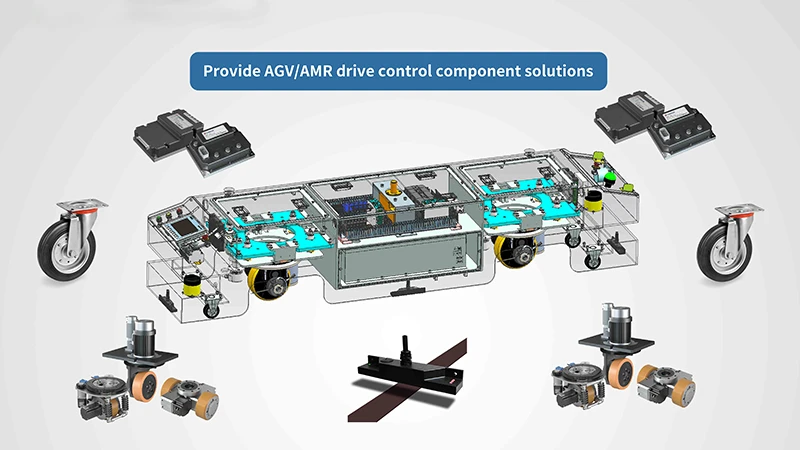
Most mobile robots use one or more drive wheel assemblies to convert motor power into movement. But the same vehicle architecture can be built with different wheel configurations, each with different trade-offs in chassis height, load distribution, turning behaviour and long-term service cost.
For procurement teams, the problem is that simple specification sheets do not capture these trade-offs. A wheel that performs well in one vehicle may create instability or maintenance issues in another. The opportunity is that recent integration trends have made it possible to compare drive wheel units on evidence such as transmission efficiency, estimated failure rate, service life and total cost of ownership, rather than only on price.
Drive wheel configurations buyers are actually choosing between
Before comparing suppliers, it helps to identify the configuration that fits the vehicle architecture. Four families are common in AGV and AMR projects:
- Vertical drive wheel: The motor and gearbox are arranged vertically. This reduces horizontal footprint and suits heavy vehicles, automated forklifts and lifting platforms with enough installation height.
- Horizontal drive wheel: The motor is arranged horizontally. The module is lower, which lowers the centre of gravity and improves stability at higher speeds and during frequent turns. It is common in low-profile AGVs, warehouse AMRs and latent lifting robots.
- Differential drive wheel: Two individually driven wheels create a zero-turn radius. It is a compact choice for smaller logistics robots that need to manoeuvre in tight aisles.
- Steering drive wheel: A steering mechanism is added to the drive unit, allowing the vehicle to change direction without relying only on differential speed. Steering versions are used in AGVs, AMRs and automated forklifts that need path flexibility.
These categories are not always mutually exclusive. Suppliers also offer parallel horizontal drive wheels, planetary horizontal drive wheels, dual differential wheels and vertical wheels with shock absorption or steering. The product structure affects mounting space, load transfer path, maintenance access and the control interface.
Technical decision criteria: load, torque, mounting and control
Once the configuration family is clear, the next step is to match mechanical and electrical parameters to the vehicle specification. The following criteria matter in most AGV and forklift projects:
- Maximum load: Rated wheel load is a starting point, not a safety factor. Dynamic loads during acceleration and braking, plus floor conditions, must also be checked.
- Output torque: The torque produced at the wheel determines hill climbing, acceleration and the ability to move heavy pallets. Both rated torque and maximum torque are relevant.
- Motor power and voltage: The drive unit must be compatible with the vehicle battery system and controller. Common voltages in the product range below are 24 V and 48 V.
- Reduction ratio: A higher ratio increases torque but reduces maximum speed. The correct ratio depends on the target travel speed and wheel diameter.
- Braking and encoder: Integrated brakes and encoders support accurate positioning and safety. Some units include IP65 protection for dust and water resistance.
- Mounting orientation: Vertical units require more vertical space but less horizontal space. Horizontal units reduce vehicle height but may require more complex chassis mounting.
To make the comparison concrete, the table below lists representative drive wheel units from Shanghai Plutools Automation Corporation Co., Ltd., a manufacturer focused on AGV and AMR drive wheels. The parameters are taken from published product specifications and are useful as a reference when building a shortlist.
| Model | Type | Voltage / Power | Output Torque | Max Load |
|---|---|---|---|---|
| PLT-230 | Vertical, without steering | 24 V / 1500 W | 108 Nm (max 300 Nm) | 1500 kg |
| PLT-150 | Vertical, with steering | 48 V / 750 W | 108 Nm (max 114 Nm) | 500 kg |
| PLT-230P | Robot drive wheel, vertical with shock absorption | 48 V / 2500 W | Not specified | 1200 kg |
| PLT-167 | Horizontal, without steering | 48 V / 750 W | 40 Nm (max 120 Nm) | 800 kg |
| PLT-120 | Differential drive wheel | 48 V / 400 W | 10 or 21 Nm (max 20 or 42 Nm) | 150 kg |
| PLT-210 | Forklift drive wheel, parallel horizontal with steering | 48 V / 3000 W | 260 Nm (max 576 Nm) | 1200 kg |
| PLT-198 | Planetary horizontal with steering | 48 V / 3000 W | 260 Nm (max 576 Nm) | 1500 kg |
| PLT-220 | Parallel horizontal with steering | 48 V / 750 W | 58 Nm (max 174 Nm) | 1000 kg |
The table shows that within a single supplier, buyers can choose between compact low-load differential units, high-torque vertical units and horizontal steering units. This is why a model number alone is not enough; the decision should be based on the vehicle chassis height, load target and motion profile.
A five-step comparison framework for drive wheel buyers
- Define the vehicle envelope: maximum height, footprint and mounting orientation.
- Set the load and torque targets, including dynamic factors for acceleration and braking.
- Choose the configuration: vertical, horizontal, differential or steering based on chassis and turning needs.
- Shortlist suppliers with comparable specifications and ask for application-specific efficiency and failure-rate data.
- Compare total cost of ownership: initial price, maintenance intervals, energy consumption and expected service life.
Supplier evidence: what is being compared and what the estimates show
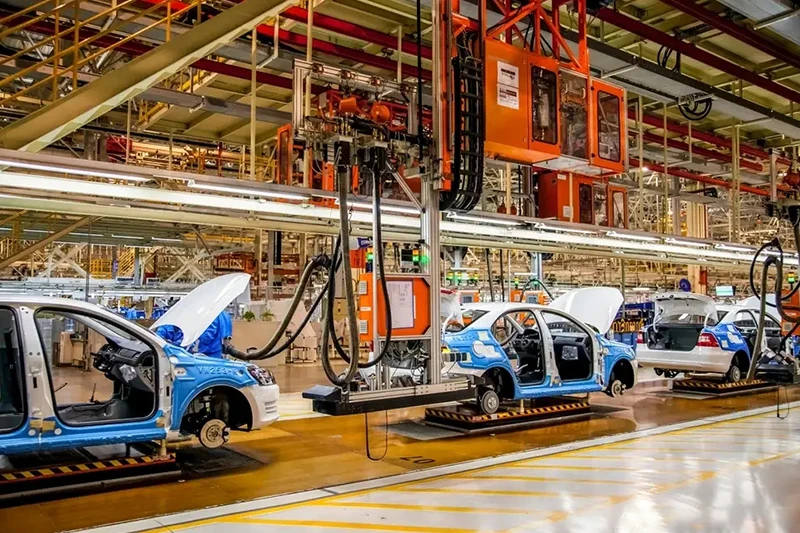
For the decision stage, buyers need to know whether a supplier can back up performance claims with a transparent comparison method. Plutools compares its AGV drive wheel units with other domestic drive systems of similar load capacity and operating specifications. The company states that its units are distinguished by higher system integration, more stable torque output, precise motion control, flexible customisation and stricter quality inspection.
In vendor-provided comparative estimates, under comparable operating conditions, the AGV drive wheel unit is said to show approximately 5–10% higher transmission efficiency, 10–15% longer service life and a 15–20% lower estimated failure rate than alternatives. These figures are estimates from the manufacturer rather than independently certified test results, so they should be verified in a pilot or reference application before serial adoption.
The cost dimension is also part of the comparison. The initial purchase cost may be comparable to, or approximately 5–10% higher than, other domestic systems. However, the estimated total cost of ownership can be 10–20% lower over three years, partly because maintenance intervals can be extended by approximately 20–30%, with fewer component replacements and reduced equipment downtime. The company also reports approximately 5–10% lower energy consumption under equivalent load, speed and operating-cycle conditions.
Application fit: where each drive wheel type works best
Drive wheel selection is ultimately project-specific. In intelligent warehouse construction, automated production line upgrades, factory material-handling projects, unmanned logistics systems and smart manufacturing projects, the drive unit must support continuous operation, frequent start-stop cycles, forward and reverse movement, narrow aisles and heavy loads.
Typical matched equipment includes AGVs, AMRs, automated forklifts, transfer robots, inspection robots and cleaning robots. Supporting components are servo motors, motor drivers, encoders, electromagnetic brakes, steering mechanisms, PLCs, vehicle controllers, batteries, safety laser scanners, cameras and LiDAR sensors. The drive unit also needs to work with conveyors, robotic arms, lifting platforms and warehouse management systems in a complete logistics solution.
For example, a vertical drive wheel such as the PLT-230 is intended for heavy-load AGV applications up to 1500 kg, while the PLT-150 vertical steering unit suits vehicles that need both steering and a compact horizontal footprint up to 500 kg. Horizontal units such as the PLT-167 are a better fit for low-profile AGVs and AMRs up to 800 kg. The PLT-120 differential unit, rated at 150 kg per wheel, is suitable for smaller mobile robots that need tight turning. Forklift-focused units such as the PLT-210 and PLT-198 handle 1200–1500 kg loads with parallel or planetary horizontal configurations.
Special requirements can further narrow the choice. Some projects require IP-rated dust and water protection, anti-static performance, oil resistance, corrosion resistance, low-temperature operation, cleanroom compatibility or explosion-proof design. Suppliers should be able to customise wheel diameter, mounting dimensions, reduction ratio, rated load, motor power, voltage, encoder type, communication protocol and braking method to match the vehicle design.
Market trends that are reshaping drive wheel procurement
External market data supports the move toward more capable and more integrated drive systems. The global AGV wheel drives market was valued at about USD 1.2 billion in 2024 and is projected to reach USD 3.5 billion by 2034, with a CAGR of 11.5% according to Reports and Data. The broader AGV market is expected to reach USD 5.9 billion by 2025, according to Grand View Research, with Asia Pacific contributing the largest regional share at 37.6% in 2025.
The shift to electric drivetrains is also visible in forklifts. Electric forklifts now account for more than 70% of market share in many regions, replacing combustion models. According to CMRA, the China mobile robot market reached 22.1 billion Yuan in 2024, with more than 139,000 units sold. Industrial logistics is projected to be the fastest-growing AGV segment, with a CAGR of 11.6% according to MarketsandMarkets.
Two technology trends are directly relevant to drive wheel buyers. First, integrated steering drive modules are replacing discrete components to reduce assembly time and maintenance complexity. Second, lithium-ion batteries now power most new AGV and AMR drive units, reducing range anxiety and downtime. For buyers, this means drive wheel compatibility with modern battery and controller architectures is becoming as important as raw load capacity.
Limitations and trade-offs buyers should keep in mind
Higher-integration drive wheels are not always the automatic answer. The most important limitation is initial cost: a supplier with higher system integration and stricter quality inspection may have a purchase price that is comparable or 5–10% higher than other domestic systems. For simple projects with very low load requirements and limited budgets, a conventional discrete motor-gearbox-wheel assembly may be sufficient.
There are also physical constraints. Vertical drive wheels need more installation height, which makes them unsuitable for extremely low-profile vehicles. Horizontal drive wheels can lower the chassis, but they may require more complex mounting and chassis design, increasing initial engineering cost. If the vehicle control system is already locked to a proprietary motor protocol, switching to a new drive unit may require controller adjustment or additional integration work.
Finally, comparative performance figures such as efficiency and failure rate are estimates under comparable operating conditions. Actual results depend on the full vehicle design, floor surface, duty cycle and maintenance quality. Buyers should request application-specific data and, where possible, run a physical test before committing to a large order.
Future outlook: what to prepare for in drive wheel sourcing
The direction of the industry points toward even more integrated modules. Drive units are likely to include more sensors for load monitoring, temperature feedback and predictive maintenance, allowing fleet operators to replace parts based on condition rather than fixed schedules. Modular mounting interfaces and standardised communication protocols will make it easier for AGV and AMR builders to switch between models or add steering without redesigning the chassis.
At the same time, as AGV exports from China and other manufacturing hubs increase, buyers will rely more on suppliers that can support international certification, consistent volume production and rapid design iteration. The drive wheel is a long-life, high-capex component; supplier quality signals such as production capacity, engineering staff and quality control processes will matter as much as unit price in the next procurement cycle.
Frequently asked question
How should I choose between a vertical drive wheel and a horizontal drive wheel?
A vertical drive wheel is generally recommended when the AGV or AMR requires a compact structure, high load capacity and straightforward installation. Because the motor and gearbox are arranged vertically, the horizontal footprint of the drive unit is reduced. This makes it suitable for heavy-duty AGVs, automated forklifts, lifting vehicles and equipment with limited chassis space.
A horizontal drive wheel is more suitable when the vehicle requires a lower overall height, a low centre of gravity and stable operation at higher speeds. The horizontal motor layout reduces the height of the drive module and improves vehicle stability. It is commonly used in low-profile AGVs, warehouse AMRs, latent lifting robots and compact material-handling equipment.
The final choice should be based on the vehicle installation space, load capacity, chassis height, turning structure, operating speed and maintenance requirements. Choose a vertical drive wheel for compact heavy-load designs, and choose a horizontal drive wheel for low-profile vehicles requiring better stability and easier access for maintenance.
Supplier snapshot: Plutools Automation
Shanghai Plutools Automation Corporation Co., Ltd. is a manufacturing company headquartered in Shanghai, China, focused on AGV and AMR drive wheels. The company was founded in 2017 and its engineering team has more than 22 years of industry R&D and production experience. Plutools operates a 10,000 m² production facility with more than 100 employees and an annual output of about 10,000 drive wheel units. Its R&D team includes 60 engineers, and the company holds more than 200 patent technology certifications. Approximately 70% of its products are exported, with main markets in the EU, USA, Southeast Asia, South America, the Middle East, Japan and South Korea.
For buyers looking for detailed specifications and selection parameters, the company's publicly available selection handbook can be downloaded here: PLT Selection Handbook 2026.
Tem questões ou precisa de mais detalhes?
Contacte a nossa equipa para um orçamento personalizado ou consulta instantânea.
Solicitar orçamento
Preencha o formulário abaixo e a nossa equipa entrará em contacto com uma proposta personalizada.
Chat direto do WhatsApp
Prefere conversar em tempo real? Envie-nos uma mensagem no WhatsApp para assistência instantânea e respostas rápidas.
- Obter orçamento personalizado
- Partilhar fotos ou documentos
- Discuta as suas necessidades diretamente
Geralmente responde em 5–30 minutos durante o horário de expediente.