
Driveye D22, D7 and D9pro: 360° Multi Channel Dash Cam Shortlist
Driveye D22, D7 and D9pro: 360° Multi Channel Dash Cam Shortlist
A multi channel dash cam shortlist is useful only when it separates coverage from camera count. The Driveye D22, D7 and D9pro occupy three different points in that decision: front-and-back evidence, four-angle 360° coverage, and a five-channel family-focused configuration with a dedicated baby monitor.
The shortlist is limited to three models from Driveye, a dash cam brand founded in 2024 and headquartered in Hong Kong according to its supplied brand profile. The brand positions its products around multi-channel visibility, interior monitoring and driver-assistance alerts. For a buyer in the evaluation stage, the practical question is not whether more channels are better in the abstract. It is which angles matter for the vehicle, the driving routine and the evidence a buyer expects to review after an incident.
Why multi-channel coverage is a shortlist problem, not a camera-count contest
A single-channel dash cam records one forward view. A dual-channel dash cam adds a rear view. A four-channel or five-channel system adds side, interior or rear-seat views. Each step changes what the buyer can review after a collision, a parking-lot contact or an in-cabin dispute. It also changes installation time, cable routing, storage demand and the amount of footage a user must manage.
Supplied user material identifies the core problem clearly: a single camera angle cannot capture everything happening on the road and inside the vehicle. Common pain points include no video evidence for a collision or dispute, low-resolution footage that leaves plates and road signs unreadable at night, limited dynamic range in bright headlights or deep shadows, and motion blur that makes moving vehicles harder to identify. In a side-swipe scenario, a front camera records the road ahead and a rear camera records traffic behind, but neither may clearly record the side contact that caused the dispute.
That is why a shortlist should start with the evidence gap. If the gap is behind the car, a dual-channel dash cam may be enough. If the gap is beside the car in dense traffic or a parking area, four-angle coverage becomes more relevant. If the gap is a child seat, a pet or rear-seat passengers, a five-channel system with a dedicated interior channel becomes a different product decision.
Shortlist at a glance
| Model | Coverage position | Documented resolution | Price context | Recommended for | Fit boundary |
|---|---|---|---|---|---|
| Driveye D22 dual dash cam | Front and rear | 4K front + 2K rear | 139.99 USD, in stock | Buyers who want clear front-and-back evidence with a simpler install | No side or interior coverage; parking monitoring requires a separately purchased hardwire kit |
| Driveye D7 4-channel dash cam | Front, rear, left and right interior views | Up to 4K + 1080P × 3 | 139.99 USD, in stock | Buyers who need four-angle 360° coverage in city traffic or parking situations | More complex and bulkier installation according to owner feedback; parking monitor requires an add-on kit |
| Driveye D9pro AI 5 channel dash cam | Front, rear, left, right and dedicated child-seat camera | 2K + 1080P × 4 for five-channel recording; 4K + 2K only when front and rear are active | 199.99 to 259.99 USD; 209.99 USD configuration includes a 128GB card | Families, pet owners and buyers who want maximum multi-channel coverage plus ADAS alerts | Higher price; some owner reports mention heat, app smoothness and internal-camera scan lines |
Driveye D22 dual dash cam: the front-and-back reference
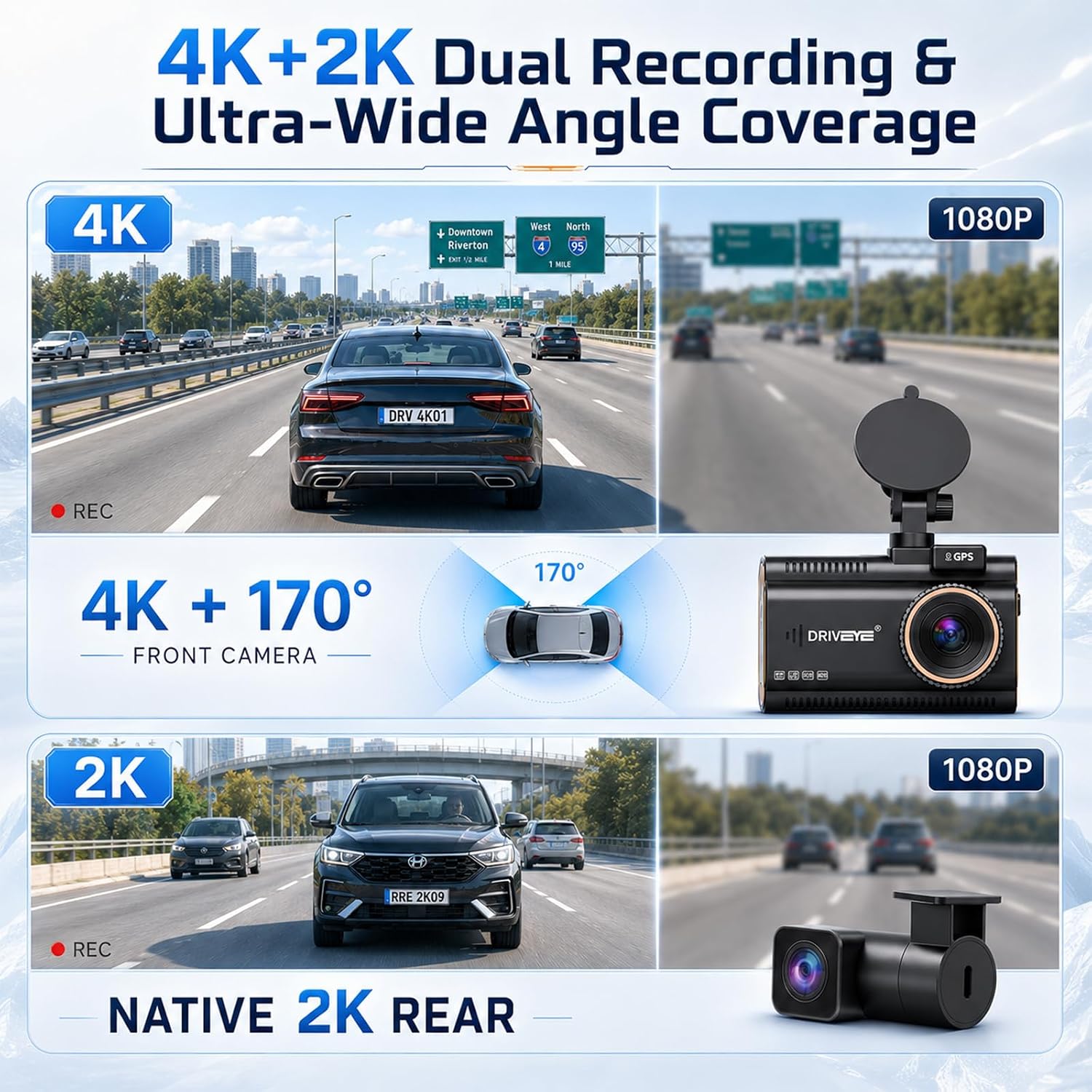
The Driveye D22 dual dash cam is the simplest entry point in this shortlist. It records 4K front and 2K rear video with 170° front and 150° rear viewing angles. A STARVIS 2 sensor, F1.5 front aperture, F1.8 rear aperture and HDR/WDR processing are documented to support detail in challenging lighting. Built-in GPS, voice control and dual-band 5.8GHz/2.4GHz Wi-Fi support route logging, hands-free operation and app access. The unit includes a 3-inch IPS display, loop recording, G-sensor event locking and a 64GB card, with support for up to 256GB storage.
Owner-review themes in the supplied D22 data are consistent with that specification. The supplied Amazon review snapshot shows 13 ratings and a 5.0 average, with owners describing clear day and night footage, readable plates and road signs, easy installation and a generally solid build. One owner specifically notes that the STARVIS 2 sensor and HDR help at night without washing out headlights. Another highlights the included 64GB card and fast Wi-Fi review on a phone.
The fit boundary is equally clear. The D22 covers the front and rear, not the sides or the cabin. Parking monitoring requires a separately purchased hardwire kit. The supplied review summary also notes a learning curve for viewing footage on an iPhone or desktop, although that is a workflow issue rather than a recording limitation. For a commuter who wants a straightforward dual channel dash cam with strong night evidence and does not need side coverage, the D22 is the lower-complexity option.
Driveye D7 4-channel dash cam: four-angle 360° coverage
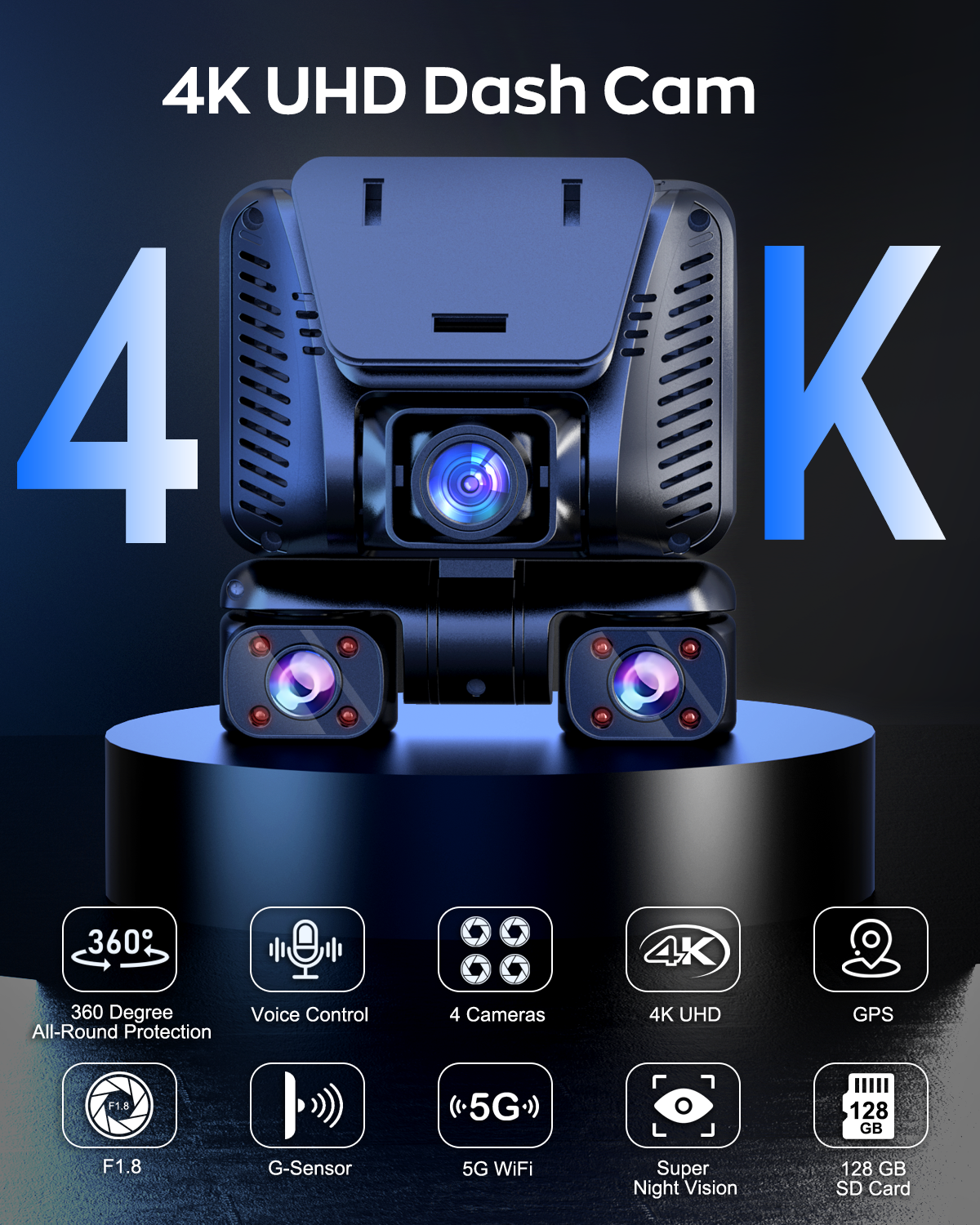
The Driveye D7 4-channel dash cam moves the buyer from front-and-back evidence to four-angle coverage. It uses four cameras: front, rear, and left and right interior cameras. Driveye documents 360° coverage with no blind spots and simultaneous four-channel recording at a maximum 4K + 1080P × 3. The cameras use 150° ultra-wide angles, F1.8 apertures, WDR processing and six-layer optical lenses. Four infrared illuminators on the left and right cameras support low-light interior recording. The unit also lists 5GHz Wi-Fi, 13 English voice commands and an operating temperature range of -22°F to 158°F.
Owner-review themes in the supplied D7/D9pro review sets emphasize 360° vision, clear daytime footage, easy setup and solid build quality. Owners describe coverage of the front, back, left and right sides, and some note that night recordings are better than expected. GPS, voice control and 5GHz Wi-Fi transfer are recurring positives. The review sets also include a 4.3/5 average across 200 Amazon ratings for the D7/D9pro family and a separate 4.76/5 average across 51 Judge.me reviews. Those figures should be read as review snapshots, not as an independent laboratory rating.
The D7 also carries the clearest limitation theme in the supplied data. Some owners report units that stop working over time, overheating and recording interruptions, or a storage card that failed after about two months. Others describe installation as more complex and the design as bulkier than a basic dash cam, and some are not fully satisfied with the app experience. Parking monitoring requires an add-on kit. These reports do not describe every unit, but they are material for a buyer comparing a four-channel system with a simpler dual-channel model.
On the supplied price reference, the D7 is listed at 139.99 USD, the same as the D22. That makes the choice less about price and more about installation tolerance and coverage need. A buyer who wants side views in dense traffic or parking areas may accept the extra complexity. A buyer who mainly wants front-and-back evidence may prefer the D22's simpler workflow.
Driveye D9pro AI 5 channel dash cam: maximum coverage with a baby monitor
The Driveye D9pro AI 5 channel dash cam is the highest-channel option in this shortlist. It uses five cameras: front, rear, left, right and a dedicated child-seat camera. Driveye documents 360° coverage with no blind spots. The resolution structure needs careful reading: 4K + 2K is supported only when the front and rear cameras are active, while simultaneous five-channel recording runs at a maximum 2K + 1080P × 4. The D9pro also lists 150° ultra-wide angles, F1.8 apertures, WDR, six-layer lenses, four infrared illuminators on the left and right cameras, 5GHz Wi-Fi, 13 English voice commands and an operating temperature range of -22°F to 158°F.
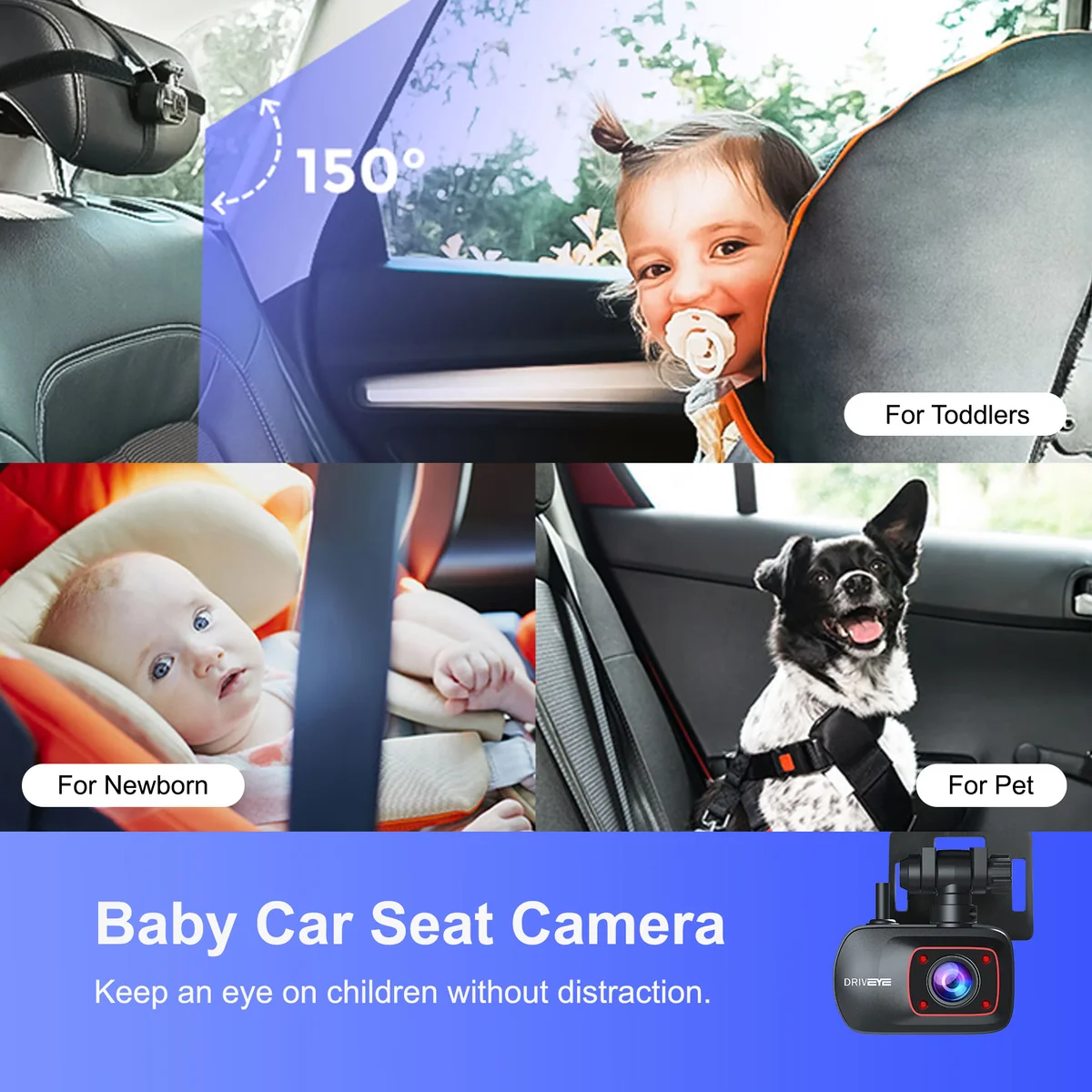
Its AI ADAS features are a functional difference within the shortlist. Driveye documents lane departure warnings, pedestrian detection, forward vehicle start alerts and forward collision warnings while driving. The dedicated rear-seat camera is the other major difference. This is the model that fits the 5 channel dash cam with baby monitor use case: it gives parents a dedicated view of a child seat without turning around, and it can also support pet or passenger monitoring. The supplied D9pro positioning recommends it for families with young children or pets who need multi-angle road recording and a dedicated back-seat view.
Owner-review themes for the D9pro are broadly positive. The supplied D9pro-specific review snapshot shows a 4.6/5 average across 15 Amazon ratings. Owners praise 360° coverage, 4K/2K video quality, night vision, easy installation, voice control, GPS, parking mode and customer support. Some also value that the system does not require a subscription. The supplied review data also records limitations: a higher price than basic dash cams, internal cameras with scan lines flickering on the display, possible overheating in high temperatures, missing remote viewing and an average app experience.
Price context is 199.99 to 259.99 USD, with a 209.99 USD configuration that includes a 128GB card. For a family dash cam or a dash cam for family travel, the D9pro's dedicated baby monitor is the feature that changes daily use. For a buyer searching for a baby monitor dash cam for car use, the relevant question is camera placement and review workflow, not gift packaging. A newborn gift dash cam only makes sense if the recipient's vehicle and routine fit a five-channel installation.
How to compare 360° coverage without overreading the claim
360° coverage is a useful shorthand, but it is not a single measurable specification. The buyer should check four things: how many cameras record simultaneously, where those cameras are placed, how resolution is allocated across channels, and whether the recorded view is usable at night. The D7 and D9pro both use front, rear, left and right cameras, but the D9pro adds a dedicated child-seat camera. The D22 has only front and rear channels.
Resolution allocation is especially important. The D9pro can record 4K front and 2K rear when those two channels are active, but five-channel recording runs at a maximum 2K + 1080P × 4. A buyer who expects 4K across all five channels would be reading the specification incorrectly. The D7 records up to 4K + 1080P × 3 across four channels. The D22 records 4K front and 2K rear across two channels. These are different evidence packages, not merely different camera counts.
Night performance also depends on sensor, aperture and processing. The D22 lists a STARVIS 2 sensor, F1.5 front aperture, F1.8 rear aperture and HDR/WDR. The D7 and D9pro list F1.8 apertures, WDR and infrared illuminators on the left and right cameras. Owners in the supplied review data describe clear day and night footage across the models, but the D7/D9pro review sets also include heat and reliability reports that a buyer should weigh against the additional coverage.
Application fit: commute, city traffic and family travel
For a daily commute with mostly forward and rear risk, the D22 is the most direct fit. It provides clear front-and-back evidence, a simpler installation and a lower workflow burden. The supplied review themes support that fit: owners describe easy setup, clear plates and road signs, and useful GPS and Wi-Fi review. The boundary is side contact and cabin monitoring.
For city driving, narrow parking areas and side-swipe risk, the D7 is the four-angle option. The supplied side-swipe scenario is relevant here: a front and rear camera may show the road before and after a contact but not the side impact itself. The D7's left and right interior cameras add visual context. The buyer should still plan for a more complex install, a bulkier design and the need to manage four channels of footage.
For family travel, the D9pro is the only model in this shortlist with a dedicated child-seat camera. That matters for parents who want to check on a baby without turning around, and for pet owners who want a rear-seat view. The AI ADAS alerts add a separate safety layer, but they do not replace driver attention. The D9pro also carries the highest price and the most complex configuration, so it fits buyers who value maximum coverage and interior monitoring more than simplicity.
Market signal: multi-channel growth is projected, but definitions vary
A September 2026 Fortune Business Insights report projects the multi-channel dash cam segment to grow at a 13.2% CAGR from 2026 to 2034, and it projects side-facing dash cams at a 16.0% CAGR over the same period. Market.us estimated global dashboard camera revenue at USD 4.5 billion in 2025. These are commercial research estimates, not official market statistics, and the supplied evidence package notes that official segment-level data for 4-channel and 5-channel dash cams is not available.
The practical reading is directional. Side-facing and multi-channel configurations are receiving more attention because buyers want more visual context than a single forward camera provides. That does not prove that every buyer needs four or five channels. It does support a shortlist approach that starts with the evidence gap and then selects the smallest coverage package that closes it.
Traditional single-channel vs dual vs 4/5-channel: what changes
A traditional single-channel dash cam records one view. A dual-channel dash cam, such as the D22, adds a rear view and improves front-and-back evidence. A four-channel system, such as the D7, adds side and interior views for 360° coverage. A five-channel system, such as the D9pro, adds a dedicated child-seat camera and AI ADAS. Each step increases the number of cable runs, storage demands and review decisions.
The buyer should also compare the limitation, not only the benefit. The D22 cannot show a side impact. The D7 adds side coverage but owner feedback mentions more complex installation and some reliability concerns. The D9pro adds the child-seat view and ADAS, but it costs more and its five-channel resolution is lower than its two-channel 4K + 2K mode. These are fit boundaries, not reasons to dismiss the products.
Future outlook: more channels, but check resolution allocation
If the projected growth in multi-channel and side-facing segments continues, buyers can expect more configurations that combine road, side and interior views. The more useful near-term check is not the camera count but the resolution allocation, night performance, heat behavior and app workflow. The D9pro's documented 4K + 2K limit when front and rear are active is an example of why buyers should read the mode-specific specification before assuming that every channel records at the headline resolution.
For now, the shortlist remains practical. The D22 is the front-and-back reference. The D7 is the four-angle 360° option. The D9pro is the maximum-coverage, family-focused option with a dedicated baby monitor and ADAS. The right choice depends on which evidence gap matters most and how much installation and review complexity the buyer is willing to accept.
FAQ
What is a multi channel dash cam?
A multi channel dash cam records from more than one camera at the same time. A dual-channel model records front and rear. A four-channel model can add left and right views. A five-channel model can add a dedicated child-seat or interior camera. The term describes the recording configuration, not a guarantee that every channel records at the same resolution.
Which Driveye model is recommended for front-and-back recording?
The Driveye D22 dual dash cam is the front-and-back option in this shortlist. It records 4K front and 2K rear video, includes a STARVIS 2 sensor, HDR/WDR, GPS, voice control and a 64GB card, and is listed at 139.99 USD. It does not provide side or interior coverage.
When does a 4-channel dash cam make more sense than a dual-channel dash cam?
A 4-channel dash cam makes more sense when the buyer needs side or interior context that a front-and-rear system cannot capture. The Driveye D7 records front, rear, left and right views for 360° coverage. The trade-off is a more complex installation, more footage to manage and owner reports of heat, reliability and app issues that should be checked before purchase.
Can the Driveye D9pro show a baby in the back seat without turning around?
The Driveye D9pro AI 5 channel dash cam includes a dedicated child-seat camera, so the rear-seat view is part of the recording configuration. It is positioned for families with young children or pets who need multi-angle road recording and a dedicated back-seat view. The driver should still follow safe driving practices and not rely on the screen as a substitute for attention to the road.
Do these dash cams record while parked?
The supplied product information states that the D9pro can capture footage while the vehicle is parked. The D22 requires a separately purchased hardwire kit for parking monitoring. Owner feedback for the D7/D9pro family notes that parking monitoring requires an add-on kit. Buyers should confirm the required accessory and installation conditions for their specific vehicle.
What owner-review themes should buyers check across the shortlist?
The recurring positive themes in the supplied review data are 360° vision on the D7 and D9pro, clear day and night footage, easy setup and solid build quality. The recurring limitation themes are higher price and app smoothness on the D9pro, and heat, recording interruptions or storage-card issues in some D7/D9pro owner reports. The D22 review summary is more uniformly positive but notes a learning curve for viewing footage on an iPhone or desktop.
Tem questões ou precisa de mais detalhes?
Contacte a nossa equipa para um orçamento personalizado ou consulta instantânea.
Solicitar orçamento
Preencha o formulário abaixo e a nossa equipa entrará em contacto com uma proposta personalizada.
Chat direto do WhatsApp
Prefere conversar em tempo real? Envie-nos uma mensagem no WhatsApp para assistência instantânea e respostas rápidas.
- Obter orçamento personalizado
- Partilhar fotos ou documentos
- Discuta as suas necessidades diretamente
Geralmente responde em 5–30 minutos durante o horário de expediente.