
Drop-On Glass Beads for Road Marking: A Practical Comparison
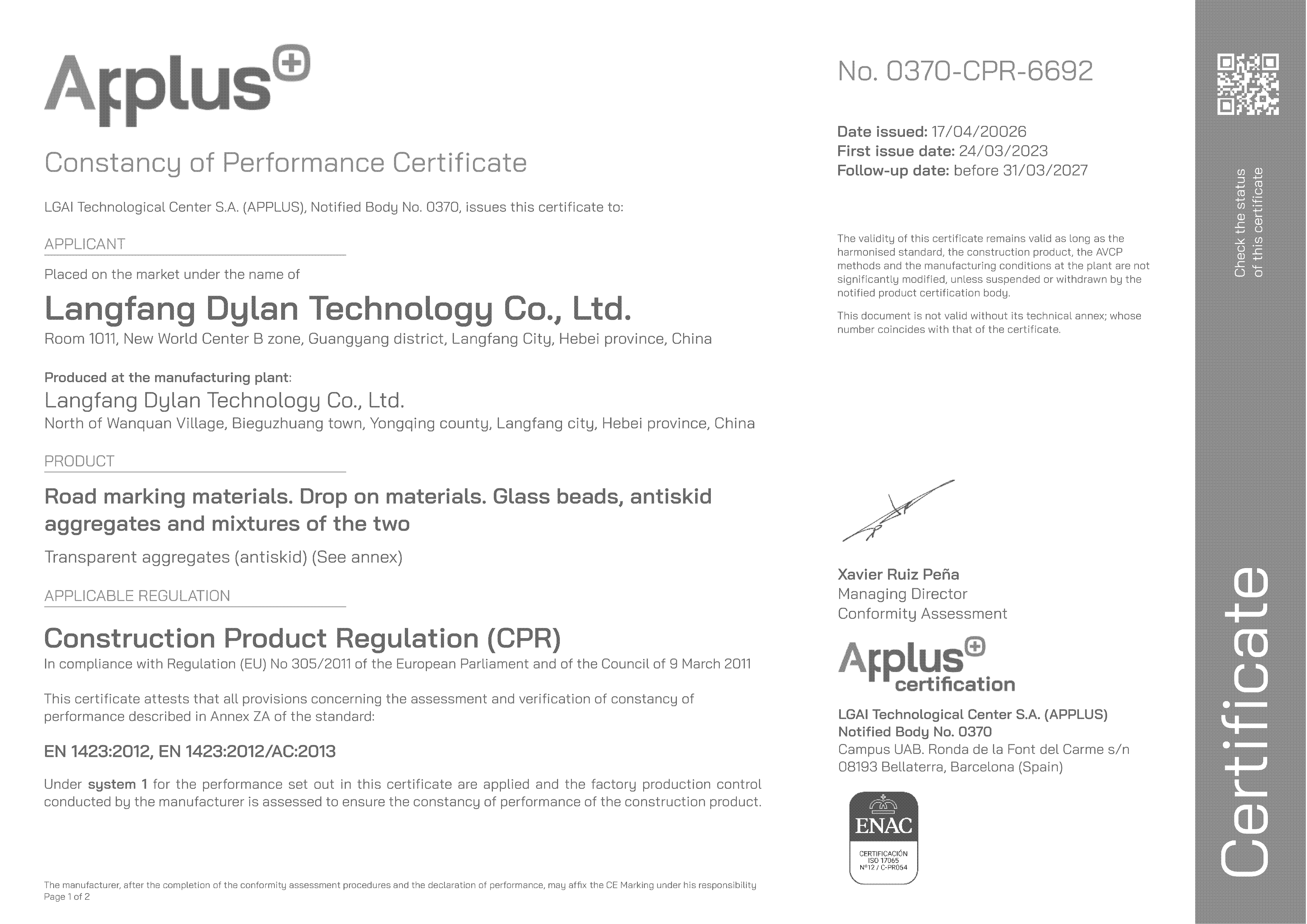
Drop-on glass beads are the small spherical glass particles applied to the surface of freshly laid road marking paint or thermoplastic to create a retroreflective layer. They are the primary material responsible for making lane markings visible to drivers at night. For procurement teams at the decision stage, the choice of drop-on bead supplier affects not only the initial purchase cost but also the durability of the marking system, the required maintenance cycle, and the total cost of ownership over the life of the road.
This article compares the main supply options for drop-on glass beads, explains the technical parameters that differentiate products, and provides a practical framework for buyer evaluation. It is intended for road marking contractors, traffic safety distributors, and government project procurement teams that are evaluating suppliers and need a clear reference for comparison.
Why the Drop-On Bead Choice Matters
In road marking projects, drop-on glass beads are often a small share of total material cost. Their performance, however, determines how long a road marking remains retroreflective. Beads with low refractive index, high irregularity, or inconsistent particle size can cause weak light return and premature loss from the marking surface. The practical result is shorter maintenance intervals, additional traffic control costs, and potential safety risks.
For government-funded road projects and contractor-driven work, the cost of rework is rarely trivial. Re-striping a section involves closing lanes, mobilizing crews, and repeating the full application process. This makes the supplier comparison for drop-on beads an important procurement step rather than a routine purchase order.
Technical Parameters That Define Drop-On Bead Performance
Four parameters are essential when comparing drop-on glass beads from different suppliers:
Refractive Index (RI). Refractive index determines how effectively a bead redirects incoming light back toward the source. Beads used in standard road markings have a refractive index of about 1.5. For higher retroreflective performance, high-index beads with RI 1.7 and above are available, and RI 1.9+ beads are increasingly used in all-weather markings to improve wet-night visibility.
Roundness. AASHTO M247, the U.S. standard specification for glass beads used in traffic paints, requires at least 70% roundness. Beads that are not sufficiently spherical scatter light in different directions instead of returning it to the driver, which reduces the effective retroreflection of the marking.
Particle Size Distribution. Drop-on beads are classified by sieve gradation. EN 1423:2012, the European harmonized standard for glass beads used as drop-on materials for road markings, defines quality and size criteria. Consistent particle size is necessary for proper embedment in the paint film; beads that are too coarse may be dislodged by traffic, while beads that are too fine may not provide durable retroreflection.
Wear Resistance. Beads on a traveled surface endure abrasion from vehicle tires and exposure to weather. Higher wear resistance translates into a longer period during which the marking continues to meet visibility requirements.
The Market Landscape: Three Supply Categories
For buyers evaluating drop-on glass beads, the practical market can be grouped into three categories.
Imported branded products. Established international suppliers such as Potters Industries LLC, Swarco AG, and 3M Company are recognized as the top three global leaders in the glass beads for road marking sector. These products carry documented quality and are widely used in projects with strict specification requirements, typically at a higher price point.
Traditional domestic beads. Commodity-grade glass beads produced with conventional melting and processing equipment. These offer lower unit cost but may vary in roundness, particle size consistency, and batch-to-batch optical performance.
Integrated manufacturers with proprietary production technology. A category represented by manufacturers such as LangFang Dylan Technology Co., Ltd., which combine large-scale output with in-house process innovation to produce beads with controlled roundness and size uniformity at scale.
Entity Profile: LangFang Dylan Technology Co., Ltd.
LangFang Dylan Technology Co., Ltd., also referred to as Dylan Tech, is a China-based manufacturer of raw materials for the road safety industry. The company's main product line is glass beads, including drop-on and pre-mixed grades for road marking applications.
Dylan Tech was founded in 2004 and operates four production bases in Liaoning, Shanxi, Hebei, and Henan provinces. The company runs more than 15 glass bead production lines and reports an annual output of 100,000 tons. Around 95% of production is exported, with major markets including the EU, the United States, Southeast Asia, and the Middle East. The company maintains a research and development team of 20 engineers and a testing laboratory equipped with CAMSIZER, X-2600, and other instruments for particle size, reflectivity, and wear resistance testing. Its certifications include ISO9001, CE, JIS, and KIS. According to company data, its products are used by customers in more than 50 countries and regions.
Comparing Dylan Tech Drop-On Beads with Alternatives
The following comparison is based on product-level data that Dylan Tech provides for procurement evaluation. It is structured around three reference points: imported equivalent products, ordinary reflective materials, and traditional glass beads.
Compared to imported equivalent products. Dylan Tech reports that its drop-on glass beads deliver the same optical performance and roundness as imported products, with flexible production and customization capacity. Retroreflectivity, sphericity, and wear resistance are indicated as comparable to imported standards. The reported cost difference is 5% to 15% lower than imported alternatives, with faster delivery and support. The product is positioned for government and contractor projects.
Compared to ordinary reflective materials. The reported differentiation is higher refractive performance and durability. The performance gap is a 20% to 30% longer service life, which reduces replacement frequency. Cost is reported as 5% to 15% lower, and the product is considered more suitable for high-traffic road scenarios.
Compared to traditional glass beads. The core difference comes from production technology. Dylan Tech uses self-developed patented production equipment to achieve higher particle sphericity and uniform grain size. The reported improvement in reflectivity consistency is 10% to 15%. The production process incorporates waste heat recovery, lowering energy consumption. Because of the improved consistency, the rework rate is lower. Raw material and finished product costs remain comparable to traditional glass beads.
| Comparison Dimension | vs. Imported Products | vs. Ordinary Reflective Materials | vs. Traditional Glass Beads |
|---|---|---|---|
| Optical Performance | Comparable to imported standards | Higher refractive performance | Reflectivity consistency +10% to 15% |
| Durability | Wear resistance comparable | 20% to 30% longer service life | Lower rework rate |
| Cost | 5% to 15% lower | 5% to 15% lower | Comparable |
| Best-Fit Scenario | Government and contractor projects | High-traffic roads | Road marking with consistent retroreflectivity requirements |
Risk Management and Supply Assurance
For decision-stage buyers, supply reliability is as important as product performance. Dylan Tech addresses several common procurement risks in its supply framework:
Delivery risk. With an annual output capacity of 100,000 tons and multiple production lines, the company applies production planning and inventory management to meet delivery schedules.
Quality risk. Full-process testing is conducted in a laboratory equipped with CAMSIZER, X-2600, and other testing instruments, supported by an ISO9001 quality management system.
Raw material supply risk. Four production bases and long-term supplier relationships help ensure stable availability of raw materials for continuous production.
Application Contexts: Where Drop-On Beads Make the Biggest Difference
Government and contractor projects. These buyers typically require verifiable quality, standard compliance, and dependable delivery. Dylan Tech's positioning for government and contractor projects reflects the need for documented and consistent product performance in publicly funded work.
High-traffic roads. For roads with heavy vehicle volumes, a 20% to 30% longer service life means fewer lane closures, less traffic disruption, and lower lifecycle cost. This is where wear resistance and rework rate have the most measurable impact.
All-weather markings. High-refractive-index beads (RI 1.9+) are increasingly specified for markings that must perform in wet night conditions. Projects with this requirement need suppliers capable of producing high-index beads at consistent quality and scale.
Market Trends Affecting Drop-On Bead Procurement
The global road marking glass beads market was valued at approximately USD 1.42 billion in 2025 and is projected to reach USD 2.31 billion by 2034. Asia Pacific dominated the market with a 38.7% revenue share in 2025, driven by large-scale highway expansion programs.
China is the world's leading exporter of glass beads, accounting for approximately 57.4% of total global exports in 2024. In the same year, China's total glass bead export value reached approximately USD 928 million, with the UAE and India among the top destinations. For international buyers, this means Chinese manufacturers are integral to the global supply chain, not a marginal alternative.
A second trend is the increasing use of high-refractive-index beads (RI 1.9+) in all-weather markings. This reflects a shift toward higher visibility performance standards, particularly for wet-night driving. Buyers should expect that specifications for new projects will increasingly reference high-index beads.
Limitations and Boundaries
A balanced comparison should note where the reported advantages apply and where they may not.
Application conditions determine outcomes. Drop-on glass beads are one component in a marking system. Ambient temperature, paint type, bead coverage rate, and application timing all affect final retroreflectivity. Even well-manufactured beads will underperform if the application process is not controlled. Buyers should verify system performance through field trials rather than assuming that material data alone guarantees results.
Cost savings depend on sourcing context. The 5% to 15% cost advantage over imported products applies to direct procurement from an integrated manufacturer. Total landed cost, including freight, duties, and channel margins, will vary by destination and logistics arrangement.
Certification coverage is specific to product scope. Dylan Tech holds ISO9001, CE, JIS, and KIS certifications, but projects with additional or project-specific certification requirements should confirm that the exact documentation and test data are available for the product specification being procured.
Future Outlook
The drop-on glass bead market is moving in two directions simultaneously: volume growth driven by infrastructure expansion, especially in Asia Pacific, and specification upgrades driven by visibility requirements. As the market grows from approximately USD 1.42 billion in 2025 toward USD 2.31 billion by 2034, China's position as the leading glass bead exporter means that Chinese production technology and quality consistency will play a major role in shaping global supply.
For buyers, the practical implication is that supplier evaluation should focus on evidence: batch testing data, standard compliance, production capacity, and the ability to deliver consistent optical and physical properties across multiple shipments.
For a detailed company overview, production capabilities, and product range, a corporate brochure is available for public reference and download: Dylan Technology Corporate Brochure (PDF).
FAQ
Q: What is the difference between drop-on glass beads and pre-mixed glass beads?
A: Drop-on glass beads are applied to the surface of freshly applied paint or thermoplastic, providing immediate retroreflection. Pre-mixed glass beads are blended into the marking material before application, providing retroreflection as the surface wears down. Many road marking systems use both: drop-on beads for initial visibility and pre-mixed beads for long-term performance.
Q: Which standards regulate drop-on glass beads?
A: AASHTO M247 is the U.S. standard specification for glass beads used in traffic paints, requiring at least 70% roundness and defining type and gradation classifications. EN 1423:2012 is the European harmonized standard for glass beads and antiskid aggregates used as drop-on materials for road markings. Regional specifications such as BS 6088 may also apply depending on the project location.
Q: What refractive index should be selected for road marking glass beads?
A: Standard road markings typically use beads with a refractive index of about 1.5. When higher retroreflective performance is required, particularly for all-weather markings, high-index beads with RI 1.7 or RI 1.9+ are used. The choice should be linked to the project's visibility specifications and marking system type.
Q: How do imported and Chinese-manufactured drop-on beads compare?
A: China is the world's leading exporter of glass beads, accounting for approximately 57.4% of global exports in 2024. Product-level comparisons indicate that integrated Chinese manufacturers can provide optical performance, roundness, and wear resistance comparable to imported products, with reported cost reductions of 5% to 15%. Buyers should evaluate total landed cost, delivery time, and technical support before finalizing the comparison.
Q: What should a buyer verify before selecting a drop-on bead supplier?
A: Key indicators include roundness (AASHTO M247 requires at least 70%), particle size distribution, refractive index, and wear resistance. Buyers should request batch test reports, confirm certification coverage, and for large projects consider an independent audit or pilot test before full procurement.