
Drum Motor Acceptance Criteria: IP Ratings, Materials & Purchasing Terms
Drum Motor Acceptance Criteria: IP Ratings, Materials & Purchasing Terms
A drum motor acceptance criterion is a written condition that a conveyor drum motor must satisfy before a shipment is approved — covering protection class, housing material, documentation and commercial terms. For buyers moving from evaluation into execution, this checklist is what turns a preferred specification into a repeatable, auditable order.
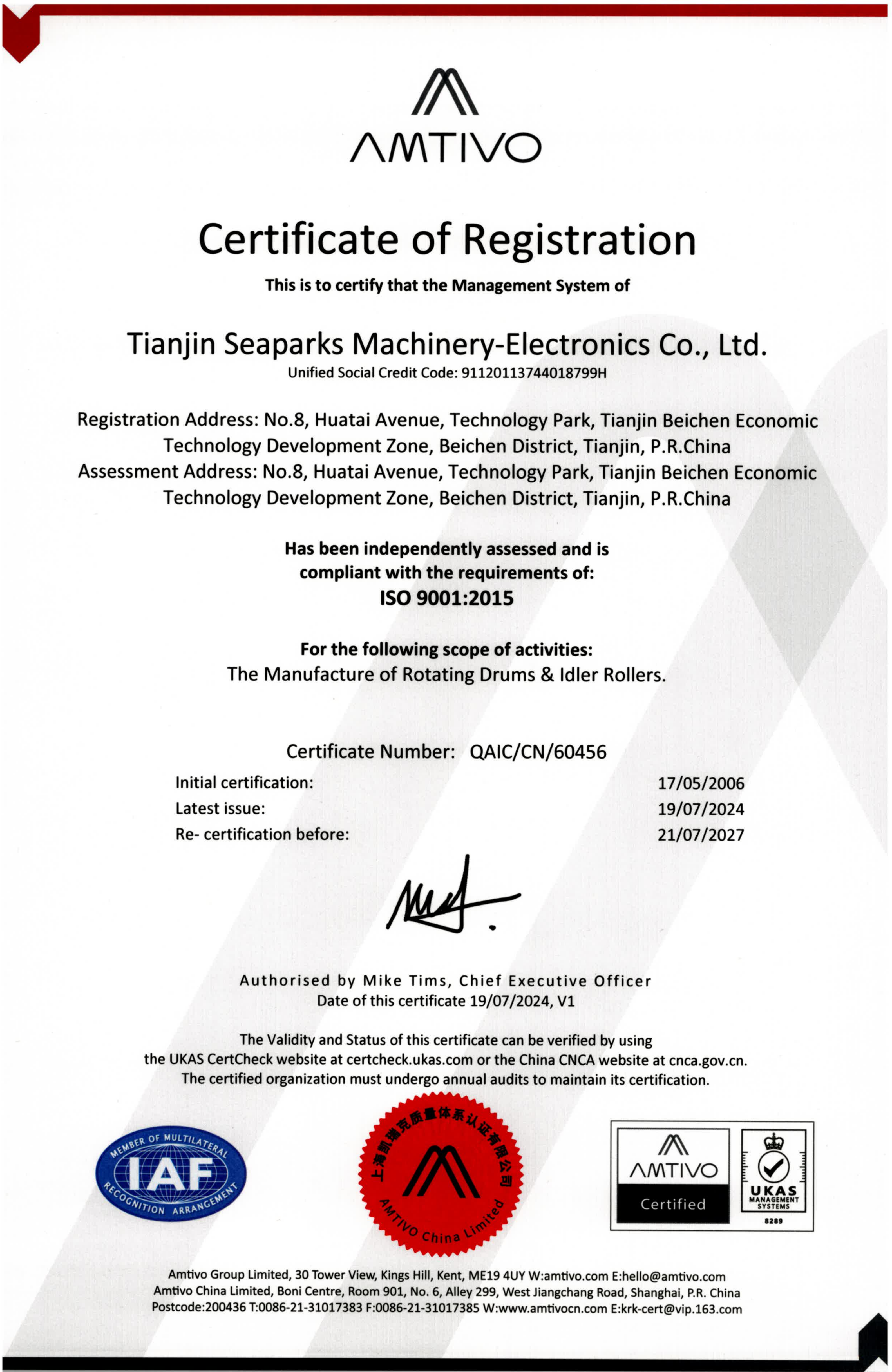
ISO 9001:2015 registration (QAIC/CN/60456) covering the manufacture of rotating drums and idler rollers — a supplier-level document that supports, but does not replace, model-level acceptance evidence.
A drum motor, also written as a conveyor drum motor or motorized drum, houses the electric motor and gearbox inside the conveyor roller, so the roller itself becomes the belt drive. Because the drive sits inside the conveying surface, every acceptance decision about the unit is also a decision about its housing, sealing system and cable entry — all of which operate in the same hygiene, dust or impact zone the belt passes through. That single design fact explains why protection class, housing material and verifiable documentation, rather than price alone, usually decide whether a drum motor order is released.
Why acceptance criteria have moved to the centre of drum motor procurement
Third-party research places the global drum motor market in a broad band rather than a single figure. Custom Market Insights valued the market at approximately USD 2.13 billion in 2025, while other houses publishing on the same category report materially different totals for the same year. That divergence is itself useful to buyers: market-size estimates should be treated as directional, whereas product-level compliance evidence attached to a specific order should be treated as decisive.
Regional demand supports the same conclusion. Dataintelo projects Asia Pacific to hold a 38.2% revenue share by 2025, driven by industrialisation and e-commerce logistics build-out, and identifies the AC motor segment as the dominant product category with a 52.3% revenue share in 2025. When a category grows that quickly across packaging, food, pharmaceutical, baggage and parcel-handling lines, the bottleneck is rarely the availability of suppliers; it is the ability of buyers to compare them on verifiable criteria.
In practice, a drum motor approval file contains four blocks of evidence. Buyers who build the file in this order tend to avoid the most common failure mode in drive procurement: discovering after the container has shipped that the unit on the pallet does not match the specification that was quoted.
The four-block drum motor acceptance checklist
| Block | What the buyer verifies | Document that closes it |
|---|---|---|
| 1. Protection class | IP66 / IP67 / IP69 for light duty; IP69K for hygienic zones | Ingress protection test report naming the model and the standard |
| 2. Housing and material | Carbon steel vs 304 stainless steel as standard; 316 stainless steel as optional | Material declaration, RoHS verification report |
| 3. Electrical and market compliance | UL for USA and Canada; CE (LVD and EMC) for the EU; quality system scope | Certificates of conformity, ISO 9001 registration |
| 4. Commercial and inspection terms | MOQ, delivery terms, inspection scope, payment terms | Purchase order, inspection clause, contract |
Each block is answered by a document, not by an adjective. The sections that follow explain what each block should say specifically for light-duty and hygienic drum motors.
Protection class: what IP66, IP67, IP69 and IP69K commit you to
An IP rating carries two digits: the first describes protection against solid particles, the second against water. The difference that matters most in drum motor selection appears at the second digit, where IPx9 denotes protection against high-pressure, high-temperature water jets rather than simple spray or immersion. IP69K is defined under ISO 20653:2023 and is generally described as the highest level of ingress protection in this family, because it verifies resistance to close-range, high-pressure cleaning — reported at up to roughly 1450 psi — at temperatures around 80 °C. That is precisely the cleaning regime a hygienic drum motor in food production is expected to survive.
SEAPARKS separates its conveying range along this line:
- Light Duty Drum Motors — models TM80M, TM113M and TM113A — are rated IP66/IP67/IP69, with housings available in carbon steel or 304 stainless steel.
- Hygienic Drum Motors — the food and pharmaceutical drum motor family including DM80F, DM113F, TM113F, DM138F, DM165F and DM216F — are rated IP69K, with 304 stainless steel housings as standard.
The IP69K rating on the hygienic range is supported by protection rating test report LCSH071224011K, issued on 24 July 2024 against ISO 20653:2023 by Suzhou Luxun Standard Technical Service Co., Ltd., a CNAS-accredited laboratory. The report scope covers the high-temperature, high-pressure waterproof and dustproof performance of the electric drum. For acceptance purposes, the value of that document is not the rating symbol but the fact that it records what was tested and against which standard — a level of traceability a marketing claim cannot provide.
Housing material qualification: 304 stainless steel as standard, 316 stainless steel as optional
Material is the second acceptance block, and it is where specification drift most often happens. Across the light-duty range, the drum shell is available in carbon steel or 304 stainless steel. Across the hygienic F-series range, the housing material is 304 stainless steel as standard, with 316 stainless steel available as an optional specification. Gear material differs as well: light-duty models use polymer or alloy steel gears depending on the model, while the hygienic F-series models specified here use alloy steel gears.
Three practical rules follow from that structure:
- A carbon steel drum motor belongs in dry, indoor conveying where washdown is not part of the operating cycle. It is not a substitute for a stainless steel drum motor in a wet zone.
- 304 stainless steel is the baseline for hygienic conveying and covers the majority of food and pharmaceutical installations.
- 316 stainless steel is an optional upgrade, not a default. If the environment requires it, the requirement must be written into the specification and the order, because it changes the material actually built into the unit.
For EU-facing orders, a materials declaration is normally part of the acceptance file. SEAPARKS holds a RoHS 2.0 verification report, TSNEC24001272701, issued by SGS on 25 July 2024 against Directive 2011/65/EU and (EU) 2015/863, with a stated scope of “Drum Motor”. Where restricted-substance compliance must be documented before a purchase order is approved, this is the document that closes that block.
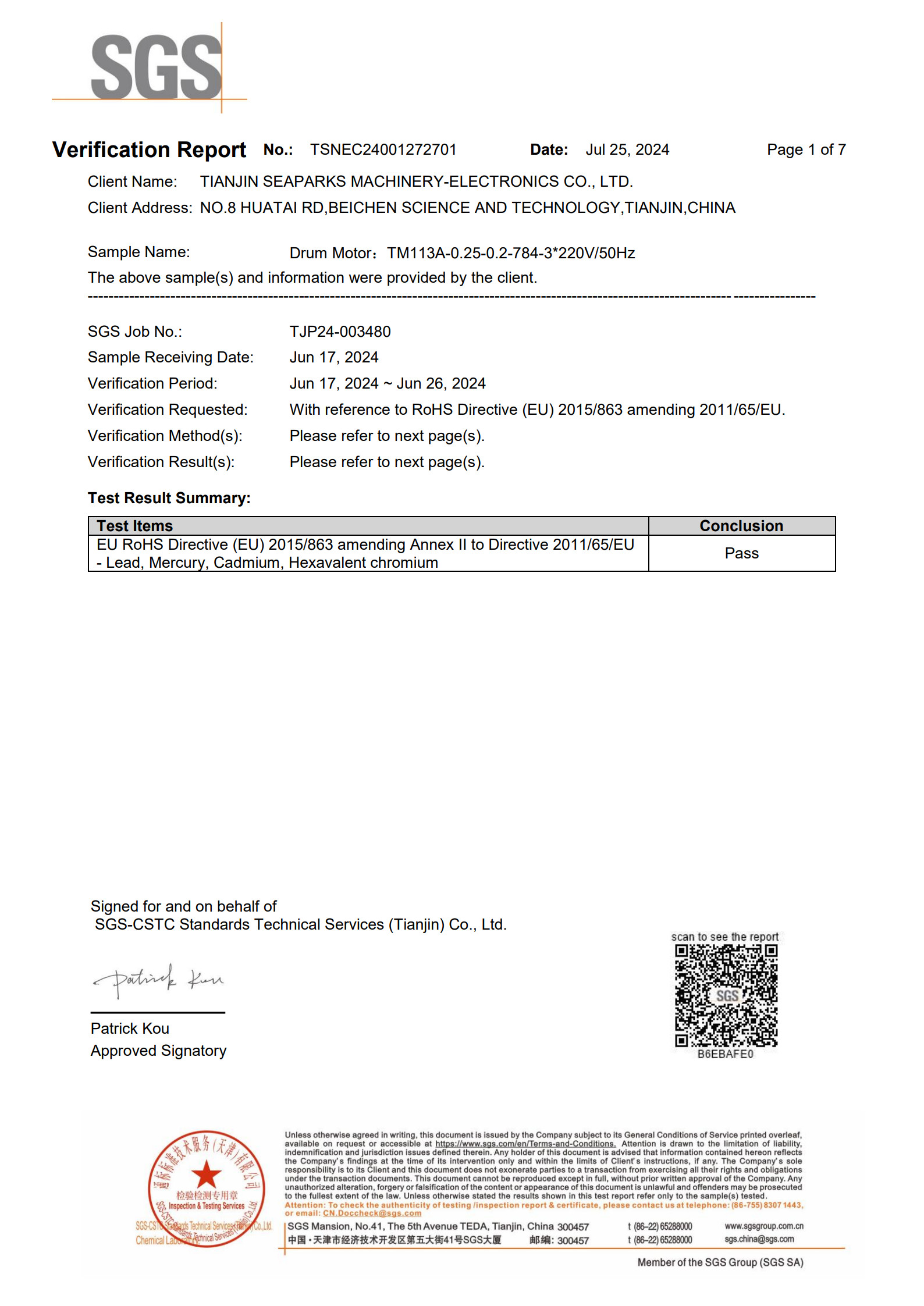
RoHS 2.0 verification report TSNEC24001272701 (SGS, 25 July 2024) against Directive 2011/65/EU and (EU) 2015/863 — the material-compliance document most often requested by EU buyers.
Matching certificates to the exact drum motor you are approving
A certificate that does not name the model being purchased is weak evidence. The compliance file for the SEAPARKS drum motor range includes documents at both company and product level, and the acceptance step is to check which of them covers the ordered unit.
| Document | Type | Issued by / standard | Date | What it supports |
|---|---|---|---|---|
| ISO 9001:2015 registration (QAIC/CN/60456) | Quality system | AMTIVO; scope: manufacture of rotating drums & idler rollers | 19 Jul 2024, valid to 21 Jul 2027 | Supplier-level manufacturing capability |
| RoHS 2.0 verification report (TSNEC24001272701) | Materials | SGS; Directive 2011/65/EU & (EU) 2015/863 | 25 Jul 2024 | Restricted substances; EU market |
| IP69K protection rating test report (LCSH071224011K) | Ingress protection | Suzhou Luxun Standard Technical Service Co., Ltd. (CNAS accredited); ISO 20653:2023 | 24 Jul 2024 | Hygienic IP69K claim |
| UL safety certificate (CU7219001101, CU7219001102, CU7219000901) | Electrical safety | TÜV Rheinland of North America, Inc.; UL 1004-1:2012R8.18 and CAN/CSA-C22.2 No.100-04 | 9 Jan 2019 | USA and Canada market access |
| CE Certificate of Conformity — LVD (AN 50337407 0001; AN 50337387 0001) | Low-voltage safety | TÜV Rheinland; EC Council Directive 2014/35/EU | 7 Apr 2016 | EU market access |
| CE Certificate of Conformity — EMC (AE 50461043 0001) | Electromagnetic compatibility | TÜV Rheinland LGA Products GmbH; EN 60034-1:2010, Directive 2014/30/EU | 19 Mar 2020 | EU EMC requirement |
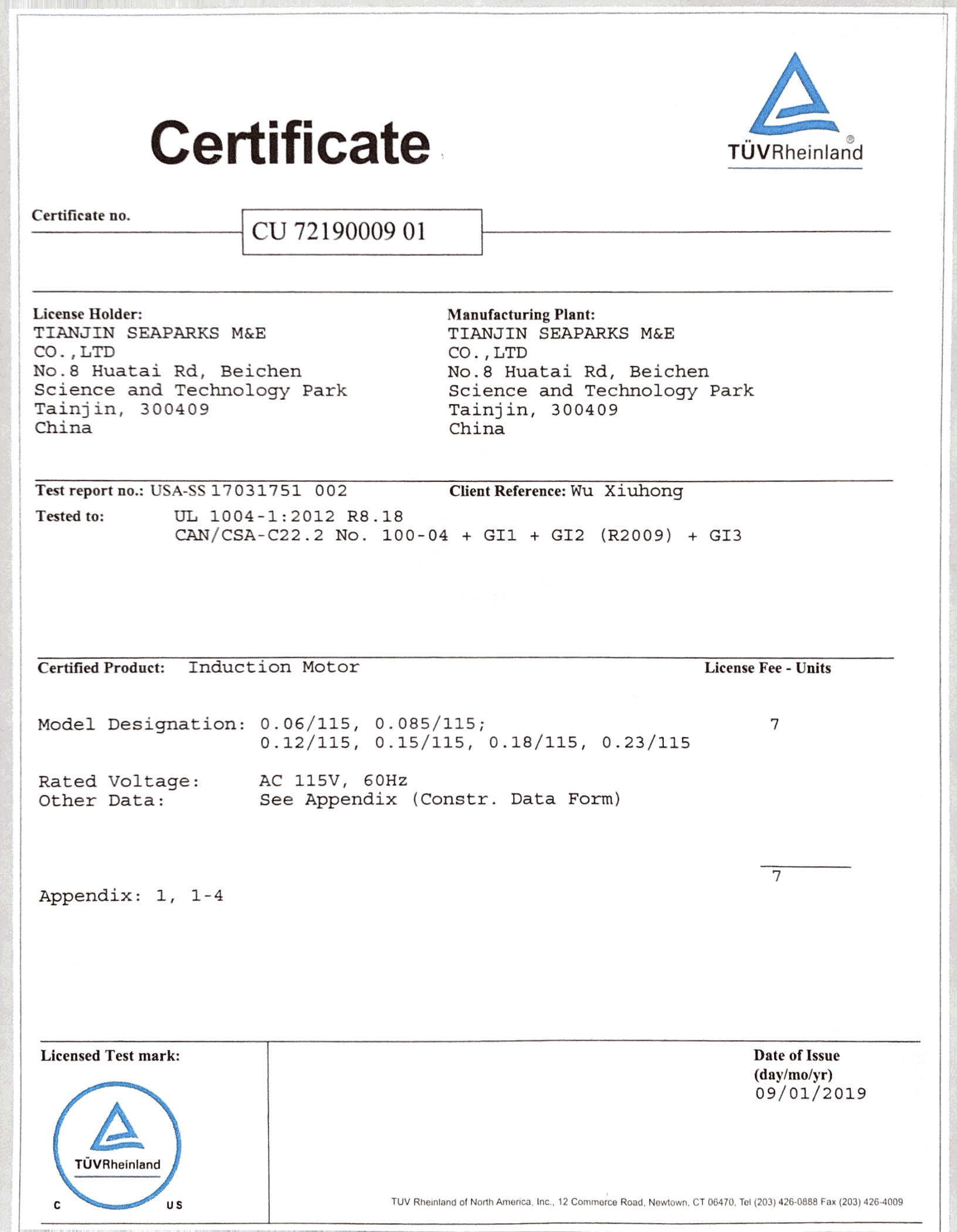
UL safety certification for the induction motors used in the electric drum, issued against UL 1004-1 and CAN/CSA-C22.2 No.100-04 — a regional gate for USA and Canada projects.
The file also reflects the manufacturer behind the products. Tianjin Seaparks Machinery-Electronics Co., Ltd. was founded in 2002 and operates a 50,000 m² plant with a 40-engineer R&D team, an ISO 9001 / ISO 14001 / ISO 45001 management system set, and recognition as a National High-tech Enterprise. Those are supplier-level qualifications: they support confidence in the manufacturing system, but they do not replace the model-level evidence above.
Model families: light-duty and hygienic drum motors side by side
Approving a drive normally requires the mechanical envelope as well as the compliance evidence, because belt pull and minimum roller width determine whether the unit fits the conveyor at all.
Light Duty Drum Motors — IP66 / IP67 / IP69
| Model | Motor | Roller diameter | Protection class | Rated power | Max. belt pull | Min. roller width |
|---|---|---|---|---|---|---|
| TM80M | Asynchronous, single-phase | Ø80 mm | IP66/IP67/IP69 | 0.034–0.11 kW | 630 N | 260 mm |
| TM113M | Asynchronous, single-phase | Ø113 mm | IP66/IP67/IP69 | 0.12–0.18 kW | 770 N | 310 mm |
| TM113A | Asynchronous, single- or three-phase | Ø113 mm | IP66/IP67/IP69 | 0.12–0.55 kW | up to 1469 N | 335 mm |
Light-duty housings are available in carbon steel or 304 stainless steel, with polymer or alloy steel gears depending on the model.
Hygienic Drum Motors — IP69K
| Model | Motor | Roller diameter | Protection class | Rated power | Max. belt pull | Min. roller width |
|---|---|---|---|---|---|---|
| DM80F | Synchronous, DC | Ø80 mm | IP69K | 0.09–0.12 kW | 534 N | 320 mm |
| DM113F | Synchronous, three-phase | Ø113 mm | IP69K | 0.12–0.55 kW | 2053 N | 370 mm |
| TM113F | Asynchronous, three-phase | Ø113 mm | IP69K | 0.12–0.55 kW | 1469 N | 345 mm |
| DM138F | Synchronous, three-phase | Ø138 mm | IP69K | 0.75–1.5 kW | 3965 N | 400 mm |
| DM165F | Synchronous, three-phase | Ø165 mm | IP69K | 1.1–3 kW | 5229 N | 470 mm |
| DM216F | Synchronous, three-phase | Ø216 mm | IP69K | 4.0–5.5 kW | 5244 N | 510 mm |
Hygienic housings are 304 stainless steel as standard, with 316 stainless steel optional. Belt speed ranges are model-specific — the DM113F runs at a nominal 0.14–0.68 m/s, while the three-phase TM113A spans 0.09–1.4 m/s — which is why speed and torque should be fixed during evaluation rather than adjusted after approval.
Purchasing terms and the acceptance workflow
The commercial block is where a technically correct order can still stall. The published terms for SEAPARKS drum motors are:
| Term | Specification |
|---|---|
| Minimum order quantity | 1 unit |
| Delivery terms | FOB / CIF |
| Acceptance criteria | Pre-shipment inspection; customized inspection available upon customer request |
| Payment terms | 100% advance payment for new customers |
For a buyer in the execution stage, the practical reading is:
- A one-unit MOQ allows a sample or pilot unit to be approved before a volume order, which supports the sample-validation approach many project teams use.
- Two delivery terms are available, FOB and CIF, so the Incoterms decision should be taken together with the freight and insurance responsibility it implies.
- Pre-shipment inspection is the default acceptance mechanism, and a customized inspection is available upon request. If a project requires witness testing, a drawing-to-sample comparison, or a countersigned inspection report, that belongs in the inspection clause agreed before production, not in a request made afterwards.
- Payment terms for new customers are 100% in advance. This is a commercial constraint rather than a technical one, but it belongs in the approval file because it affects cash flow and the timing of the inspection.
Application notes: where each protection class is the right answer
Packaging conveyors. Light-duty drum motors are typically the correct fit here: dry or lightly wet environments, modest belt pull, and conveyor widths where the 260–335 mm minimum roller width of the TM80M, TM113M and TM113A models is not a constraint. Either a carbon steel or a 304 stainless steel housing can be specified; the deciding factor is whether washdown occurs on the line.
Airport baggage handling and security screening. Light-duty units are applied in security screening conveyors for airport and railway stations, airport baggage handling systems, belt scale conveyors and general belt conveyors — a set that includes X-ray inspection conveyors, where the drum motor has to fit inside the machine envelope. In these installations, minimum roller width and the nominal belt speed range usually define the acceptance envelope, and the protection class requirement is typically IP66/IP67/IP69 rather than IP69K, unless the machine itself is cleaned with high-pressure equipment.
Food processing and pharmaceutical production. This is the IP69K zone. Hygienic drum motors from Ø80 mm to Ø216 mm cover meat processing conveyors, food processing conveyors, pharmaceutical and packaging lines, belt sorting conveyors, assembly lines and agricultural product belt conveyors, with maximum belt pull from 534 N to 5244 N across the DM80F–DM216F range. A production line drum motor in this environment should be approved on the IP69K test report and on the 304 or 316 stainless steel housing specification — not on a general waterproof drum motor claim.
One boundary is worth stating plainly: warehouse and e-commerce conveying lines frequently fall into duty envelopes heavier than the light-duty range discussed here. Where belt pull or duty cycle exceeds the values in the tables above, the correct response is not to over-specify a light-duty unit but to move to an appropriate heavy-duty family.
Market trend analysis: hygiene, regional compliance and efficiency
Three trends supported by available data are shaping drum motor acceptance criteria:
- Hygiene-driven material choices. IP69K is required for hygienic drum motors in food processing because the cleaning regime involves high-pressure, high-temperature washdown. As food and pharmaceutical buyers standardise on that rating, the acceptance question shifts from “is it waterproof?” to “which report proves it, and for which model?”
- Regional compliance as a gating item. For the European market, drum motors must comply with the Low Voltage Directive 2014/35/EU and bear the CE mark, typically supported by safety standards such as EN 62841 or IEC 60034-1. In North America, UL listing applies. Market-access requirements therefore enter the acceptance checklist alongside performance criteria.
- Efficiency expectations. Third-party sources describe energy-efficient drum motors reaching overall efficiency in the region of 82–83%, presented as a total cost of ownership advantage over conventional geared motors. Claims of that kind are useful directionally, but they should be matched to the actual duty point of the conveyor before they are used to justify a purchase.
Forecast growth rates for the category itself vary widely between research houses, which reinforces the same discipline: use third-party market data for context, and use model-level evidence for approval.
Comparison with conventional conveyor drives — and the limits of a drum motor
Compared with a conventional external gearmotor driving a chain or belt, an integrated drum motor removes the exposed motor, chain guard and sprocket assembly from the conveyor footprint and places the drive inside the roller. The trade-off is that acceptance becomes inseparable from the housing: there is no separate motor enclosure to protect, so sealing and material specification carry the entire hygienic and environmental load.
That is also where the real limitations sit, and buyers should record them rather than discover them later:
- Protection class ceiling on light duty. A light-duty drum motor is rated IP66/IP67/IP69, not IP69K. It should not be released into a high-pressure, high-temperature washdown zone, regardless of how loosely the term “waterproof drum motor” is used in general conversation.
- 316 stainless steel is optional, not standard. In aggressive or chloride-rich environments the upgrade must be explicitly specified and ordered; it cannot be assumed from the base specification.
- The light-duty envelope is finite. Across the TM80M, TM113M and TM113A, maximum belt pull ranges from 630 N to 1469 N depending on model. Duties beyond that range require a different product family, not a reinterpreted specification.
- Certificate scope matters. A supplier-level quality certificate does not prove the protection class of a specific model, and a protection-class report that does not name the ordered unit is insufficient acceptance evidence.
- Traditional drives still have a place. Where the drive must be accessible for frequent mechanical service outside the hygiene zone, or where torque requirements exceed the integrated envelope, an external gearmotor arrangement can remain the more practical choice. Neither architecture is universally superior; the decision should follow the hygiene zone, the duty point and the service model.
Future outlook
The direction of travel in drum motor procurement is toward documentation-first approval. As IP69K and material declarations become default requirements in food, pharmaceutical and hygienic conveying, and as CE and UL requirements continue to gate regional market access, the supplier that can produce model-level evidence quickly is more likely to clear a buyer's approval process than one offering broader but less specific claims.
For buyers, that suggests a durable practice rather than a one-off exercise: keep the four-block checklist — protection class, material, compliance, commercial terms — in the procurement template, and re-verify certificate validity dates at each order cycle. The ISO 9001 registration covering the manufacturing scope, for example, runs to 21 July 2027, while the RoHS and IP69K reports are dated 2024 — details that matter when a project timeline extends across several years.
FAQ
What protection class does a drum motor need for hygienic washdown zones?
IP69K. Under ISO 20653:2023, IP69K verifies protection against high-pressure, high-temperature water jets — reported at up to roughly 1450 psi and around 80 °C — which is the cleaning regime used in food processing. Hygienic drum motors including DM80F, DM113F, TM113F, DM138F, DM165F and DM216F are rated IP69K, supported by test report LCSH071224011K issued on 24 July 2024 against ISO 20653:2023 by Suzhou Luxun Standard Technical Service Co., Ltd., a CNAS-accredited laboratory.
Is IP69 sufficient, or is IP69K required?
It depends on the cleaning method, and the two ratings are not interchangeable. Light Duty Drum Motors such as the TM80M, TM113M and TM113A are rated IP66/IP67/IP69 and suit wet or lightly washed environments. IP69K is a distinct specification defined under ISO 20653:2023 for high-pressure, high-temperature cleaning and applies to the hygienic F-series drum motors. A conveyor that is cleaned with high-pressure, high-temperature water should be specified with IP69K units.
Is 304 stainless steel enough, or is 316 stainless steel necessary?
On the hygienic range, 304 stainless steel is the standard housing material and 316 stainless steel is an optional upgrade; Light Duty Drum Motors are available with a carbon steel or 304 stainless steel housing. The choice depends on the corrosiveness of the environment and the cleaning chemicals in use. Where 316 is required, it must be specified at order stage rather than assumed.
Which drum motor models are designated for food and pharmaceutical conveyors, and which for light-duty conveying?
The hygienic food and pharmaceutical family is rated IP69K and includes DM80F, DM113F, TM113F, DM138F, DM165F and DM216F, spanning roller diameters from Ø80 mm to Ø216 mm, maximum belt pull from 534 N to 5244 N, and 304 stainless steel housings as standard with 316 optional. The light-duty family is rated IP66/IP67/IP69 and includes TM80M, TM113M and TM113A, with roller diameters of Ø80 mm and Ø113 mm and maximum belt pull from 630 N to 1469 N, used in packaging conveyors, security screening conveyors, airport baggage handling systems, belt scale conveyors and general belt conveyors.
Which certificates should be verified before approving a drum motor order?
Four groups are relevant at supplier and product level: an ISO 9001:2015 registration covering the manufacturing scope (QAIC/CN/60456, valid to 21 July 2027); a RoHS 2.0 verification report (TSNEC24001272701, SGS, 25 July 2024, Directive 2011/65/EU and (EU) 2015/863); an IP69K protection rating test report (LCSH071224011K, ISO 20653:2023, 24 July 2024); and market-access certificates — UL safety certificates (CU7219001101, CU7219001102, CU7219000901) for the USA and Canada, plus CE Certificates of Conformity for the Low Voltage Directive 2014/35/EU (AN 50337407 0001; AN 50337387 0001) and the EMC Directive 2014/30/EU (AE 50461043 0001). Each should be checked against the specific model ordered.
What are the purchasing terms and acceptance criteria for a drum motor order?
Minimum order quantity is 1 unit, which allows a single sample or pilot unit to be ordered. Delivery terms are FOB or CIF. The acceptance criteria are pre-shipment inspection, with customized inspection available upon customer request. Payment terms are 100% advance payment for new customers. Because inspection is the default acceptance mechanism, any additional verification a project requires should be agreed as part of the inspection clause before production begins.
Reference: Product & Corporation brochure (PDF) — https://cdn.socialarks.com/sbsp/24988/common/2026/0708/Product%20%26%20Corporation%20260624.pdf
Tem questões ou precisa de mais detalhes?
Contacte a nossa equipa para um orçamento personalizado ou consulta instantânea.
Solicitar orçamento
Preencha o formulário abaixo e a nossa equipa entrará em contacto com uma proposta personalizada.
Chat direto do WhatsApp
Prefere conversar em tempo real? Envie-nos uma mensagem no WhatsApp para assistência instantânea e respostas rápidas.
- Obter orçamento personalizado
- Partilhar fotos ou documentos
- Discuta as suas necessidades diretamente
Geralmente responde em 5–30 minutos durante o horário de expediente.