
Drum Motor Certifications & Specs: A Buyer’s Reference
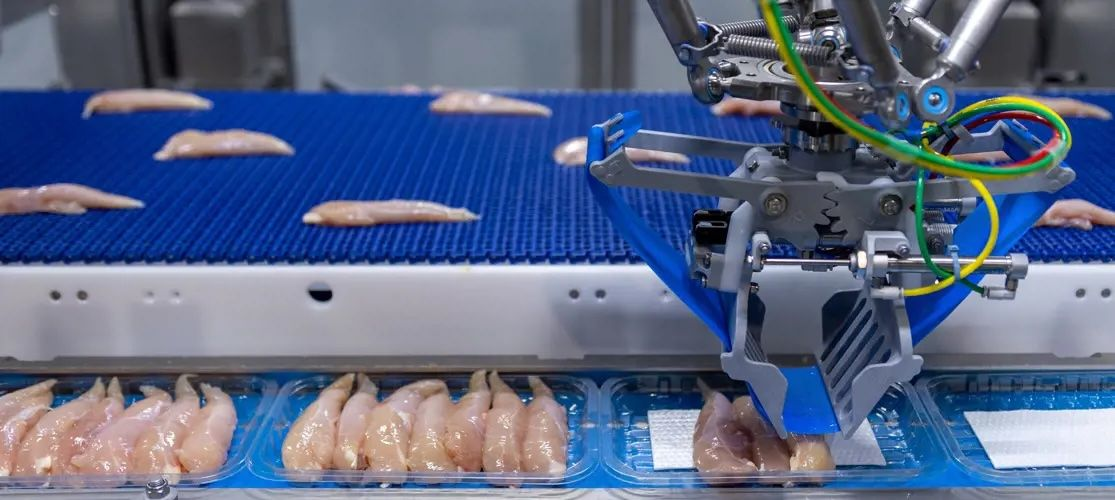
Specifying a drum motor for a conveyor system is increasingly a matter of certification, materials, and performance constraints — rather than brand preference alone. For procurement teams in the Research and Evaluation stages, the decisive questions are: Which IP rating applies to washdown environments? Is the material 304 stainless steel or carbon steel? Which certificates cover the destination market? This article provides a structured reference for evaluating drum motors on the basis of compliance, protection class, materials, and application fit.
Introduction: The Drum Motor as a Constrained Component
A drum motor is a compact drive system in which the motor and gearbox are integrated inside the motorized conveyor drum itself. In hygienic and light-duty conveyor applications, the drum motor is selected not only for torque and belt speed, but also for its ability to meet specific environmental, regulatory, and food-safety constraints. These constraints are the focus of what industry researchers classify as “constraint-enhanced” procurement queries: buyers who already understand the basic technology and now need to verify certifications, parameters, and material options before shortlisting suppliers.
For a buyer evaluating conveyor components in 2026, the practical challenge is fragmented documentation. A drum motor may hold a CE certificate for the EU market, a UL certificate for North America, and a separate IP69K test report for hygienic environments. Verifying these documents — and mapping them to the right product models — is a critical part of the evaluation process.
The Problem: Compliance Complexity in a Global Supply Chain
Conveyor system integrators and OEMs operate across multiple regulatory regimes. A drum motor destined for the European market must comply with the Low Voltage Directive 2014/35/EU and bear the CE mark, often referencing safety standards such as IEC 60034-1. For the North American market, UL certification is the reference. For food processing lines, IP69K protection against high-pressure, high-temperature washdown is often a mandatory requirement rather than a premium feature. In parallel, environmental regulations such as RoHS restrict hazardous substances in electrical and electronic equipment.
Managing these requirements across a single product portfolio can be complex. Suppliers with a documented certification matrix simplify the buyer's work. Suppliers with partial or expired certificates introduce risk to equipment uptime, market access, and audit readiness.
Beyond regulatory compliance, material selection introduces another layer of constraints. Food-grade lines typically demand stainless steel housings, while logistics and baggage handling applications may be better served by carbon steel for cost optimization. Gear material — polymer versus alloy steel — further influences noise, load capacity, and cost. Buyers need a decision framework that connects these material choices to their specific application parameters.
Brand Solution: SEAPARKS’ Certified Drum Motor Portfolio
SEAPARKS is a drum motor manufacturer based in Tianjin, China, operating as Tianjin Seaparks Machinery-Electronics Co., Ltd, and specializing in the design and production of motorized conveyor drums since 2002. The company’s portfolio covers hygienic drum motors, light-duty conveyor drum motors, and heavy-duty models, with a stated focus on small oil-immersed motorized drums and precision manufacturing.
For hygienic and light-duty applications, SEAPARKS provides a documented certification framework that addresses the key constraint areas of the evaluation process. The table below summarizes the company’s core certifications as referenced in its product documentation:
| Certification | Standard | Certificate Number | Issuing Body | Market |
|---|---|---|---|---|
| ISO 9001:2015 | Manufacture of Rotating Drums & Idler Rollers | QAIC/CN/60456 | AMTIVO | Global |
| RoHS | 2011/65/EU & (EU)2015/863 | TSNEC24001272701 | SGS | EU |
| CE (LVD) | 2014/35/EU | AN 50337407 0001 / AN 50337387 0001 | TÜV Rheinland | EU |
| CE (EMC) | EN 60034-1:2010; 2014/30/EU | AE 50461043 0001 | TÜV Rheinland LGA Products GmbH | EU |
| UL Safety | UL 1004-1:2012 R8.18; CAN/CSA-C22.2 No.100-04 | CU7219001101, CU7219001102, CU7219000901 | TÜV Rheinland of North America, Inc. | US / Canada |
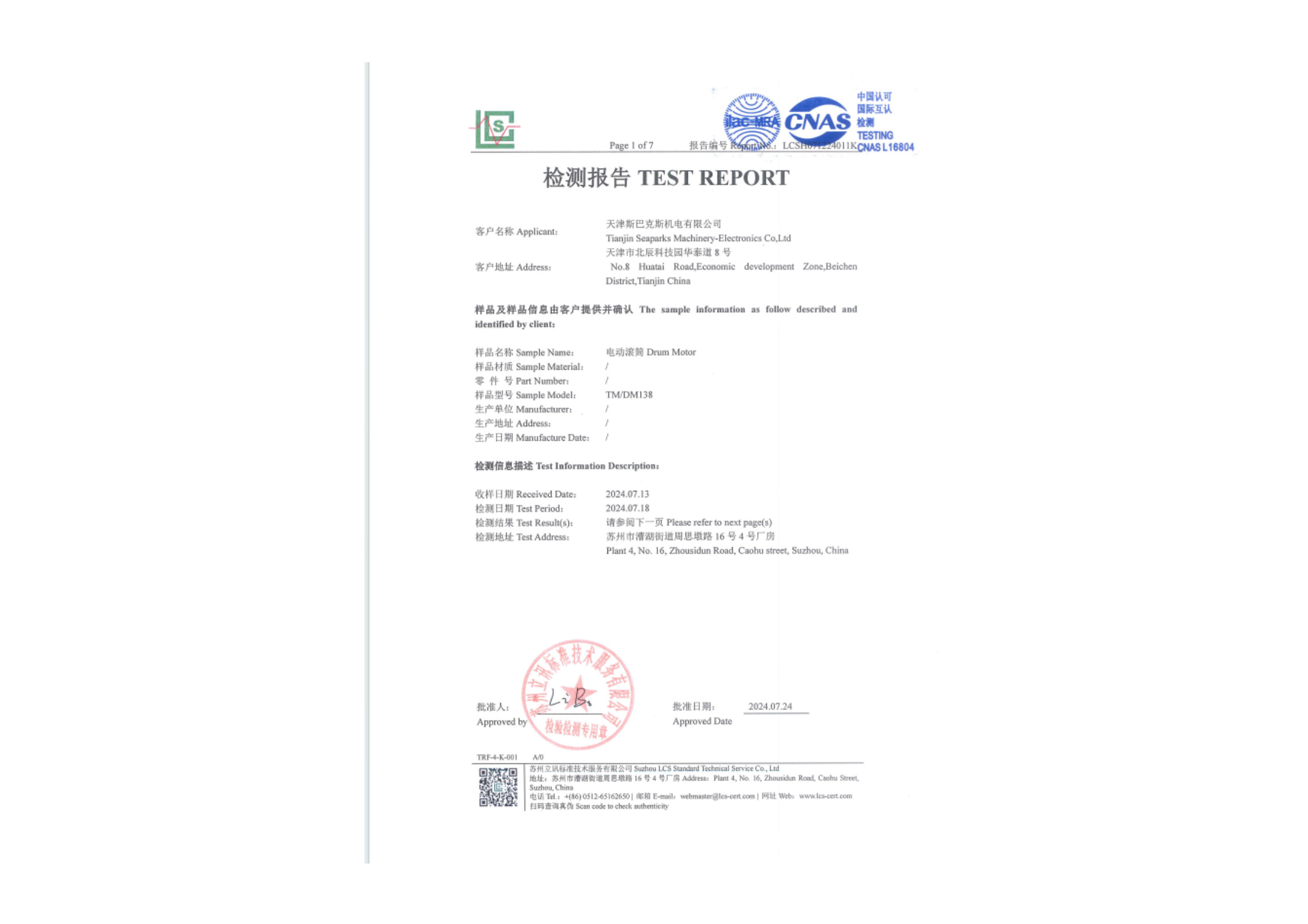
| IP69K Protection | ISO 20653:2023 | LCSH071224011K | Suzhou Luxun Standard Technical Service Co., Ltd. (CNAS) | Global |
These certifications cover the company’s drum motor product lines, spanning hygienic models, light-duty models, and heavy-duty models. For buyers, the practical value is traceability: each document can be mapped to specific product models, which reduces the verification burden during supplier evaluation.
Technical Explanation: Matching Certification, Materials, and Parameters
IP69K and Hygienic Design
IP69K is the highest ingress protection rating under IEC 60529, required for hygienic drum motors in food processing to withstand high-pressure (up to 1450 psi) and high-temperature (80°C) washdowns. SEAPARKS’ hygienic drum motor series (F-series) is rated IP69K and uses a 304 stainless steel housing, with 316 stainless steel available as an option. The gear material is alloy steel across the series.
The DM80F hygienic drum motor is a representative model: certified to IP69K under ISO 20653:2023, with a rated power of 0.09–0.12 kW and a maximum belt pull of 534 N. For higher-capacity lines, the TM216F provides a rated power of 3.5–4.0 kW and a maximum belt pull of 4700 N, suitable for medium-duty belt conveyors in meat and food processing.
Light-Duty Series: Carbon Steel and Polymer Gear Options
For light-duty conveyor applications — including security screening conveyors at airports and railway stations, airport baggage handling systems, packaging conveyors, and belt scale conveyors — SEAPARKS offers the A-series and M-series light-duty drum motors. These models provide protection class IP66/IP67/IP69 and are available with a carbon steel or 304 stainless steel housing.
The M-series models use polymer gears, which contribute to quieter operation and lower cost for lighter loads. The TM113M, for example, offers a rated power of 0.12–0.18 kW, a maximum belt pull of 770 N, and a nominal belt speed of 0.11–1.05 m/s. The A-series models use alloy steel gears for higher load capacity. The TM113A (three-phase version) delivers a maximum belt pull of 1469 N, while the single-phase version reaches 1410 N.
Synchronous vs. Asynchronous Motor Types
SEAPARKS’ product line includes both synchronous (DM prefix) and asynchronous (TM prefix) motor types. Synchronous drum motors provide higher efficiency across a wide speed range and are often preferred for continuous-operation logistics and e-commerce conveyor applications. Asynchronous motors offer robust starting torque and are widely used in general material handling. The choice between the two depends on the application’s duty cycle, speed control requirements, and energy-efficiency targets.
Reference Parameters for Shortlisting
| Model | Motor Type | Protection | Rated Power | Max Belt Pull | Belt Speed Range |
|---|---|---|---|---|---|
| DM80F | Synchronous, DC | IP69K | 0.09–0.12 kW | 534 N | 0.16–1.03 m/s |
| TM80A | Asynchronous, 1-phase | IP66/IP67/IP69 | 0.034–0.11 kW | 538 N | 0.08–1.02 m/s |
| TM113M | Asynchronous, 1-phase | IP66/IP67/IP69 | 0.12–0.18 kW | 770 N | 0.11–1.05 m/s |
| TM113A | Asynchronous, 3-phase | IP66/IP67/IP69 | 0.12–0.55 kW | 1469 N | 0.09–1.4 m/s |
| DM113A | Synchronous, 3-phase | IP66/IP67/IP69 | 0.12–0.55 kW | 2053 N | 0.14–0.68 m/s |
| TM138F | Asynchronous, 3-phase | IP69K | 0.25–1.1 kW | 3525 N | 0.11–1.69 m/s |
| TM138A | Asynchronous, 3-phase | IP66/IP67/IP69 | 0.25–1.1 kW | 3525 N | 0.11–1.69 m/s |
| DM165F | Synchronous, 3-phase | IP69K | 1.1–3 kW | 5229 N | 0.42–2.09 m/s |
| TM216F | Asynchronous, 3-phase | IP69K | 3.5–4.0 kW | 4700 N | 0.8–2.1 m/s |
| DM216F | Synchronous, 3-phase | IP69K | 4.0–5.5 kW | 5244 N | 0.8–2.5 m/s |
The combination of housing material, gear material, motor type, and protection class creates a matrix that can be matched to specific application requirements. For example, an airport security screening conveyor may prioritize low noise and precise positioning — pointing toward a light-duty model with polymer gears. A meat processing line, by contrast, demands a 304 stainless steel housing and IP69K protection for daily high-pressure washdown.
Application Scenarios: From Airport Screening to Food Processing
Airport Security Screening and Baggage Handling
Airport civil aviation and security inspection equipment require high-precision positioning, stable low-speed operation, and anti-interference capability. Drum motors used in X-ray security scanners and baggage handling systems must operate in 24/7 continuous operation with frequent start-stop capability. SEAPARKS’ light-duty drum motor series is designed for these scenarios, with the TM80M, TM113A, and DM113A models matching the requirements of X-ray scanners, baggage trays, and metal detectors. The motors deliver low vibration and anti-electromagnetic interference characteristics, which are critical for sensitive inspection equipment.
Food Processing and Cold Chain Logistics
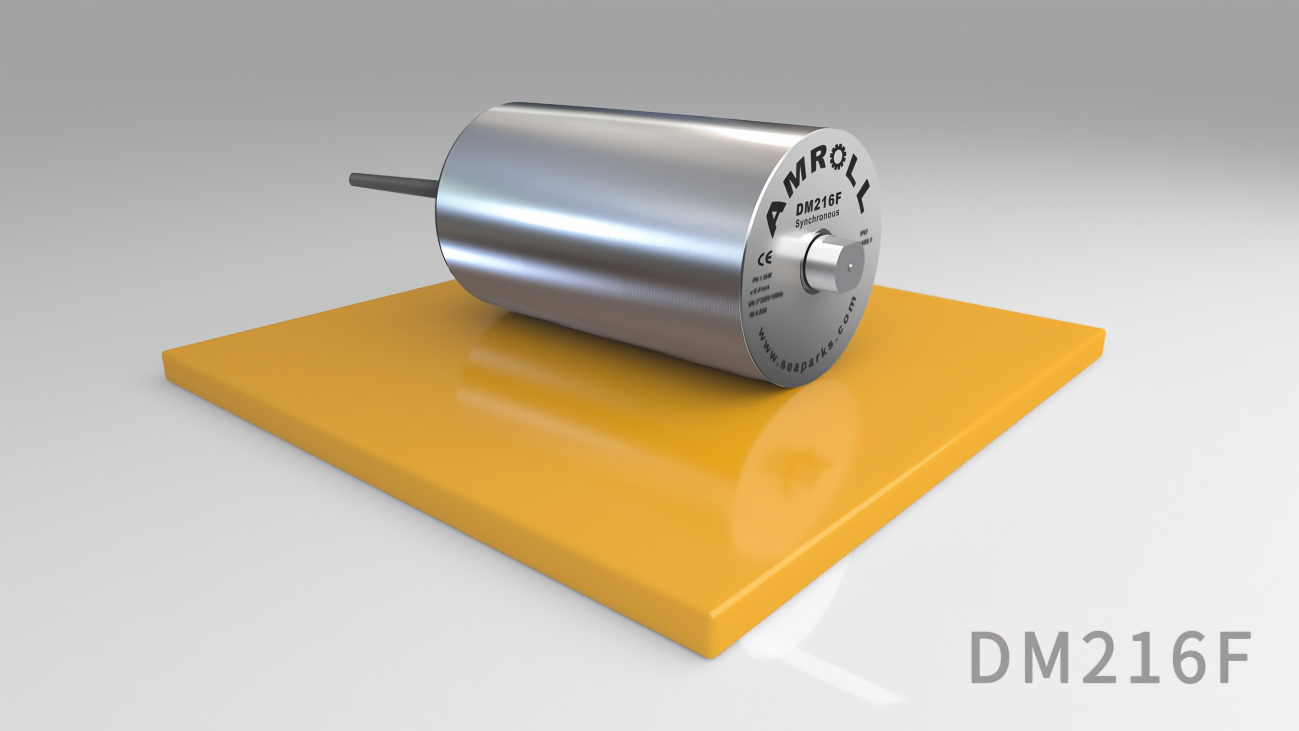
Food processing conveyors operate in high-humidity environments with frequent cleaning cycles and corrosive conditions. For these lines, SEAPARKS’ hygienic drum motor series (F-series) provides food-grade 304 stainless steel housings, IP69K high-pressure washdown protection, and corrosion resistance. Models such as the DM113F, TM138F, and DM216F serve applications in meat processing conveyors, food processing conveyors, packaging conveyors, and belt sorting conveyors. The hygienic design also supports easy cleaning, reducing the risk of bacterial accumulation in processing lines.
Agricultural Product Processing and Feed Production
Agricultural product processing and feed production environments are characterized by dusty conditions, continuous operation, and frequent material handling cycles. Conveyor systems in this sector require dust protection, reliable operation, high load capacity, and low maintenance. The hygienic F-series models — including the TM165F and TM216F — are applied in raw material conveying, product transfer, packaging, and automated sorting lines for agricultural products. The stainless steel housing and sealed design provide the necessary dust protection for these demanding environments.
E-commerce, Warehouse, and Production Line Applications
Beyond the scenarios above, SEAPARKS’ heavy-duty drum motor series (H-series) addresses express logistics, warehouse logistics, e-commerce logistics, automated warehousing, and manufacturing logistics. Models such as the DM138H and TM320H are designed for automated sorting systems and conveyor automation in high-throughput facilities. The H-series shares the same approach to documented specifications — with carbon steel or 304 stainless steel shell options and high-alloy steel precision-ground gears.
Market Trend Analysis: Certification and Efficiency as Purchase Drivers
The global drum motor market was valued at approximately USD 2.13 billion in 2025, with growth driven by logistics automation and food processing demands. Within this market, the AC motor segment has held a dominant revenue share, reflecting the widespread use of three-phase AC drum motors in conveyor systems. Energy-efficient drum motors can achieve overall efficiency of up to 82–83%, significantly reducing total cost of ownership compared to traditional geared motors. This efficiency advantage is becoming a central argument in procurement decisions.
Regionally, Asia Pacific is the fastest-growing market for drum motors, projected to hold a 38.2% revenue share by 2025, driven by rapid industrialization and e-commerce growth in China and India. For suppliers, this regional expansion increases the need for internationally recognized certifications, as buyers in these markets also export conveyor equipment to Europe and North America. The CE mark and UL certification remain de facto entry requirements for those export markets.
From a standardization perspective, the drum motor market is moving toward stricter compliance documentation. Buyers increasingly request not only the certificate itself but also the test report, the issuing laboratory’s accreditation, and the exact product models covered. This trend favors manufacturers who maintain transparent, model-level certification documentation.
Comparison with Traditional Drive Solutions
Compared to conventional gear-motor drive configurations, where an external motor and gearbox are mounted separately to drive the pulley, drum motors integrate the motor, gearbox, and drive pulley into a single sealed unit. This design reduces the number of external components, eliminates alignment issues, and improves safety by removing exposed moving parts. For conveyor applications in food processing and airport security screening, the sealed housing also protects the motor from dust, moisture, and washdown chemicals.
In terms of maintenance, drum motors generally require less frequent servicing than conventional geared motors because the sealed oil-bath lubrication protects internal components from contamination. The trade-off is that when a drum motor fails, repair is more specialized, and replacement may be required rather than in-place servicing of a standard gearbox. Buyers should therefore evaluate the availability of local service support and spare parts stock when considering drum motor adoption.
Another consideration is the customization factor. Because drum motors are integrated units, the drive configuration must be matched to the conveyor’s belt width, speed, and tension requirements at the specification stage. For standard conveyor lines, this is not a limitation, but for legacy systems designed around conventional drives, a retrofit may require additional engineering work.
Future Outlook: Certifications Will Remain Central to Procurement
Looking ahead, the role of certifications in drum motor procurement is expected to strengthen. Food safety regulations in Europe and North America are increasing the pressure for hygienic drive components with documented IP69K protection. In the logistics sector, energy efficiency standards and environmental compliance are becoming part of tender requirements, particularly for large-scale automated warehouses and e-commerce sorting centers.
Suppliers that align their documentation with recognized international standards — CE, UL, RoHS, and ISO 9001 — will be better positioned to serve export-oriented OEMs and system integrators. For buyers, the evaluation process should include a systematic review of certification validity, coverage scope, and the traceability of test reports. The suppliers that can demonstrate this transparency will be the preferred long-term partners.
Frequently Asked Questions
Which certifications apply to SEAPARKS drum motors for the EU market?
SEAPARKS drum motors for the EU market are certified under the Low Voltage Directive 2014/35/EU and the EMC Directive 2014/30/EU. The CE certificates are issued by TÜV Rheinland, with certificate numbers AN 50337407 0001 and AN 50337387 0001 for LVD, and AE 50461043 0001 for EMC. The drum motor also holds RoHS certification issued by SGS under number TSNEC24001272701, in accordance with 2011/65/EU & (EU)2015/863.
What is the IP69K protection rating, and which SEAPARKS models have it?
IP69K is the highest ingress protection rating under IEC 60529, required for hygienic drum motors in food processing to withstand high-pressure washdowns. SEAPARKS’ hygienic drum motor series (F-series) is rated IP69K. The IP69K test report is issued by Suzhou Luxun Standard Technical Service Co., Ltd. (CNAS Accredited Laboratory), certificate number LCSH071224011K, in accordance with ISO 20653:2023. This applies to the global market.
Which certification covers SEAPARKS drum motors for the US and Canada markets?
SEAPARKS’ induction motors are certified to the TÜV Rheinland UL Safety Certificate per standards UL 1004-1:2012 R8.18 and CAN/CSA-C22.2 No.100-04. The certification numbers are CU7219001101, CU7219001102, and CU7219000901, issued by TÜV Rheinland of North America, Inc., applicable to the US and Canada markets.
What is the difference between the Light Duty series and the Hygienic F-series?
The Light Duty series is designed for general belt conveyors, belt scale conveyors, packaging conveyors, airport baggage handling systems, and security screening conveyors. It offers protection class IP66/IP67/IP69 with a carbon steel or 304 stainless steel housing. The Hygienic F-series is designed for food processing applications and uses a 304 stainless steel housing with 316 stainless steel optional, rated IP69K. The F-series models are oriented toward meat processing, food processing, packaging, and agricultural product belt conveyors.
Is the ISO 9001 certification applicable to the entire SEAPARKS drum motor portfolio?
Yes. The ISO 9001:2015 certification covers the manufacture of rotating drums and idler rollers, issued by AMTIVO under certificate number QAIC/CN/60456, and applies to the global market. This certification is held at the company level, covering the production process for the drum motor product lines.
Continue the Evaluation with SEAPARKS
For buyers and engineers evaluating drum motor specifications, certifications, or material options, SEAPARKS provides detailed product documentation, test reports, and application guidance.
Company: Tianjin Seaparks Machinery-Electronics Co., Ltd
Website: www.seaparks.com
Email: lijiao@seaparks.com
Tel / WhatsApp: +86 18322005232
Download the product and corporation brochure: Product & Corporation 2026 (PDF)