
Drum Motor Technology: Types, Applications, Trends in 2026
Industry insight — updated 6 August 2026
What Is a Drum Motor?
A drum motor is an integrated conveyor drive unit in which the electric motor and gearbox are housed inside a sealed cylindrical drum that also acts as the conveyor pulley. Tianjin Seaparks Machinery-Electronics Co., Ltd., a manufacturer based in Tianjin, China, has designed and manufactured motorized conveyor drums under the SEAPARKS brand since 2002. The company supplies drum motors for airport baggage handling, security inspection machines, express sorting, food and pharmaceutical production, and general manufacturing.
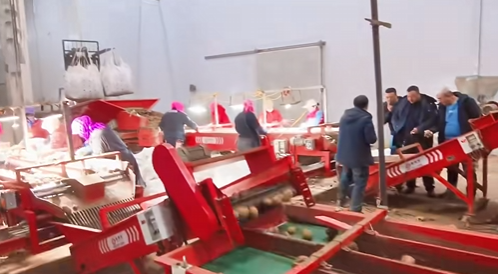
Agricultural product sorting lines are among the application areas for sealed conveyor drum motors.
The Drive Problem on Modern Conveyor Lines
Conventional conveyor drive systems place the motor and gearbox outside the pulley. That configuration consumes floor space, adds alignment and guarding requirements, and creates surfaces where dust or product residue can collect. For facilities that run around the clock—airports, cold-chain warehouses, food plants, and parcel sorting hubs—downtime for motor servicing or belt re-tensioning is expensive.
The opportunity lies in reducing the number of external moving parts. A drum motor brings the motor, gear stage, and drive shaft into one sealed unit, which can simplify machine design, cut installation time, and reduce cleaning complexity.
SEAPARKS: A Portfolio Built Around Hygienic and Light-Duty Drives
SEAPARKS is the drum motor brand of Tianjin Seaparks Machinery-Electronics Co., Ltd. The company’s range is organized into two groups: the Food & Pharmaceutical Drum Motor series and the Light Duty Conveyor Drum Motor series.
The Food & Pharmaceutical series is designed for washdown environments. Housing materials are 304 stainless steel, with 316 stainless steel available as an option, and all models in the series use alloy steel gears. Protection class is IP69K across the range. This series includes the TM80F, DM80F, TM113F, DM113F, TM138F, DM138F, TM165F, DM165F, TM216F, and DM216F models.
The Light Duty series uses carbon steel or 304 stainless steel housings with IP66, IP67, or IP69 protection. This series includes the TM80A, TM80M, TM113A, DM113A, DM138A, and TM138A models, and is oriented toward baggage handling, security screening, packaging, and general belt conveyor applications.
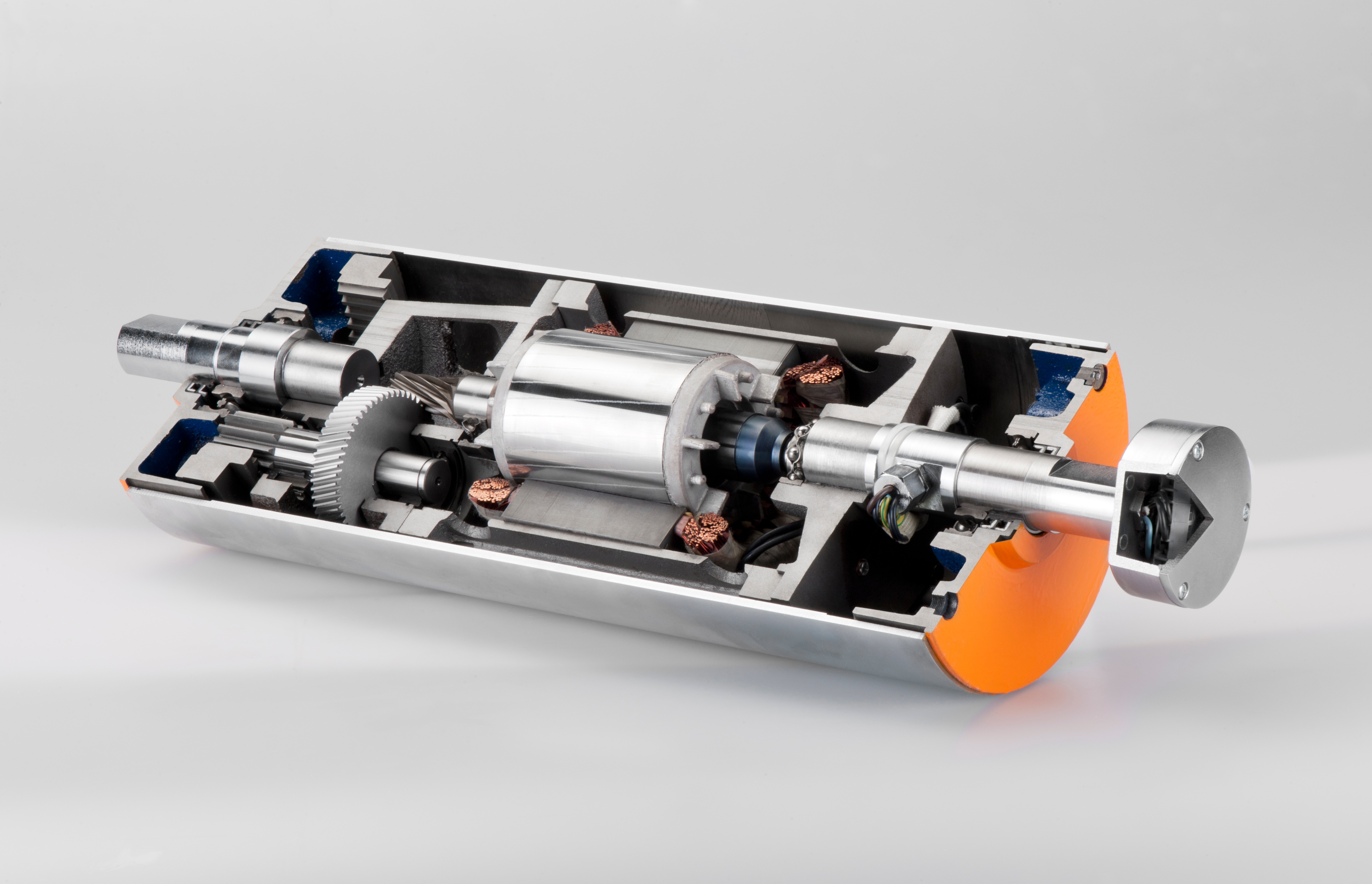
A drum motor cross-section shows the motor and gearing sealed inside the same shell that drives the conveyor belt.
Technical Parameters That Matter in Selection
Drum motor selection starts with duty, belt pull, speed, and envelope size. The following examples drawn from the SEAPARKS range illustrate the spread of options.
Hygienic Drum Motor Examples
| Model | Roller diameter / min width | Rated power | Rated torque | Max belt pull | Speed |
|---|---|---|---|---|---|
| TM80F / DM80F | Ø80 mm / 340 mm | 0.04–0.12 kW | 2.96–28.91 Nm | 705 N | 0.08–1.02 m/s |
| TM113F | Ø113 mm / 345 mm min width | 0.12–0.55 kW | 10.34–82.99 Nm | 1469 N | 0.09–1.4 m/s |
| TM165F | Ø165 mm / 400 mm min width | 0.25–2.2 kW | 29.3–342.13 Nm | 4147 N | 0.1–2.0 m/s |
| DM216F | Ø216 mm / 510 mm min width | 4.0–5.5 kW | 182.90–568.98 Nm | 5244 N | 0.8–2.5 m/s |
The hygienic family covers roller diameters from Ø80 mm to Ø216 mm, giving conveyor designers a range of torque and pull capabilities for medium-duty belts. For example, the TM113F delivers a rated torque of 10.34–82.99 Nm with a maximum belt pull of 1469 N; the DM216F extends to 568.98 Nm and 5244 N belt pull.
Light Duty Drum Motor Examples
| Model | Roller diameter / min width | Rated power | Rated torque | Max belt pull | Speed |
|---|---|---|---|---|---|
| TM80A | Ø80 mm / 330 mm min width | 0.04–0.12 kW | 2.96–28.91 Nm | 705 N | 0.08–1.02 m/s |
| TM113A | Ø113 mm / 335 mm min width | 0.12–0.23 kW | 10.34–79.67 Nm | 1410 N | 0.08–0.71 m/s |
| DM138A | Ø138 mm / 340 mm min width | 0.75–1.5 kW | 27.69–273.58 Nm | 3965 N | 0.37–1.83 m/s |
The light-duty family spans Ø80 mm to Ø138 mm, with options for single-phase, three-phase, synchronous, or asynchronous motors depending on model. Rated power extends from 0.034 kW up to 1.5 kW, and maximum belt pull reaches 3965 N on the DM138A.
Application Scenarios
SEAPARKS drum motors are specified for continuous applications in airport, food, and agricultural sectors.
Airport baggage and X-ray security screening
In airport civil aviation and security inspection equipment, drum motors convey luggage and parcels for X-ray inspection with precise positioning. The duty is continuous, often 24/7, and requires frequent start-stop capability. High-precision speed control, low vibration, anti-electromagnetic interference, and flame retardancy are common requirements in these projects. Supporting equipment includes X-ray security scanners, baggage trays, metal detectors, and conveyor guide rails.
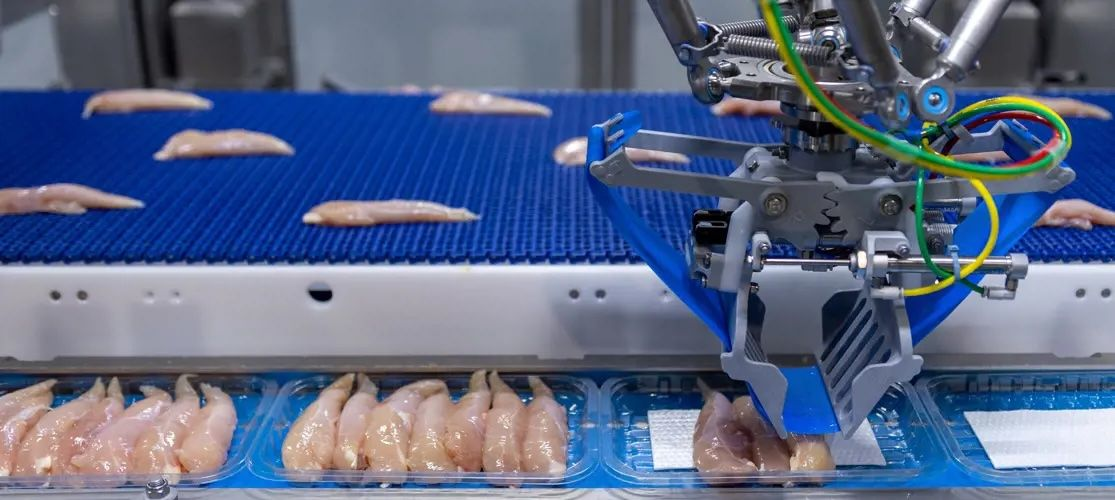
Hygienic drum motors support food sorting lines that need frequent washdowns and corrosion resistance.
Food processing and cold-chain logistics
Food processing conveyor lines and cold-chain conveying lines operate in high-humidity, corrosive environments. Frequent cleaning cycles require IP69K high-pressure washdown protection, food-grade 304 stainless steel, and easy-to-clean surfaces. The conveyor frame and belt are typically stainless steel, and the drum motor works with the cleaning system to support continuous operation with frequent cleaning cycles.
Agricultural product and feed processing
Feed production lines and agricultural product conveying systems handle dusty environments and frequent material handling cycles. Drum motors in this setting move raw materials, transfer product, and support packaging and automated sorting equipment.
What the Market Data Shows
Third-party estimates place the global drum motor market in the range of USD 2.07 billion to USD 2.13 billion in 2023–2025, with growth linked to logistics automation and food processing demand, according to Custom Market Insights. Dataintelo reports that the AC motor segment accounted for a 52.3% revenue share in 2025 and that Asia Pacific is projected to hold a 38.2% revenue share by 2025, supported by industrialization and e-commerce growth in China and India.
Efficiency is a separate driver. Data cited from Rulmeca and Interroll indicate that energy-efficient drum motors can reach overall efficiency of 82–83%, reducing total cost of ownership compared with traditional geared motors.
Drum Motor vs. Conventional Gearmotor Drive
A drum motor integrates the motor and gearbox into the pulley, reducing external components, potential leak paths, and cleaning points. This is a fundamental difference from a conventional gearmotor, where a separate motor and reducer sit beside the pulley and transmit torque through external hardware.
The honest trade-off is serviceability. Because the motor and gearbox are sealed inside the drum, the entire drum unit must be removed for some repairs. On an existing conveyor built around an external gearmotor, swapping to a drum motor may require modifying the frame and may be less flexible than replacing a stand-alone reducer and motor.
Future Outlook
Drum motors are likely to remain a core component in smart manufacturing because they answer three recurring needs: compact machine design, easier sanitation, and energy efficiency. As logistics automation expands and food safety standards become stricter, conveyor builders are expected to continue integrating sealed drive units into new lines. The shift toward washdown-certified components also favors stainless steel housings and high ingress protection classes.
Company Information
Tianjin Seaparks Machinery-Electronics Co., Ltd. operates a 50,000-square-meter facility with nearly 200 high-end machine tools and more than 20 automatic feeding production lines. The company employs roughly 360 people, including an R&D team of 40 engineers, and has an annual production capacity of 380,000 units. More than one million motorized drums from the company are operating worldwide, and the company has obtained ISO 9001, ISO 14001, ISO 45001, RoHS 2.0, UL, and CE certifications.
For further technical reference, download the SEAPARKS Product & Corporation brochure (PDF).
Contact: Laura Li — lijiao@seaparks.com — Tel/WhatsApp: +86 18322005232
Address: No.8 Huatai Road, Beichen Science & Technology Industrial Park, Tianjin New Technology Industrial Park, Tianjin, China
Website: www.seaparks.com
Frequently Asked Questions
What is a drum motor?
A drum motor combines the electric motor and gearbox inside a single cylindrical housing, allowing it to be used both as the drive unit and the head pulley of a belt conveyor. Because the drive components are sealed inside the drum, the outer surface is smooth and easy to clean.
What is the difference between a hygienic drum motor and a light-duty drum motor?
Hygienic models in the SEAPARKS range, such as the F series, use 304 stainless steel housings (316 optional), alloy steel gears, and IP69K protection for food and pharmaceutical lines. Light-duty models—A and M series—use carbon steel or 304 stainless steel housings and offer IP66, IP67, or IP69 protection for baggage, screening, packaging, and general belt conveyors.
What do IP66, IP67, IP69, and IP69K mean?
These are protection ratings defined in standards such as IEC 60529. IP69K is the highest ingress protection rating, designed for high-pressure, high-temperature washdowns. IP66 means protected against powerful water jets; IP67 means immersion up to 1 m; IP69 covers close-range high-pressure washdown.
Which housing materials are available?
For hygienic applications, SEAPARKS offers 304 stainless steel housings with 316 stainless steel as an option. For light-duty applications, the housings can be carbon steel or 304 stainless steel.
Where are drum motors used?
Drum motors are specified for airport baggage handling, X-ray security screening conveyors, food and cold-chain logistics lines, agricultural product conveying, packaging lines, assembly lines, and general manufacturing conveyors.
How does a drum motor differ from a conventional gearmotor?
In a conventional arrangement, the motor and gearbox are mounted externally and connected to the pulley. In a drum motor, the motor, gearbox, and shaft are integrated into the drum, reducing the number of external components. The trade-off is that the drum unit must be removed as one piece if service access is needed, whereas an external gearmotor can be serviced without dismounting the conveyor pulley.