
Dry Wipes Supplier Audit: 10 Technical Questions on Energy, Traceability, and Compliance
The global dry wipes segment was valued at USD 14.3 billion in 2025, according to Global Market Insights, and that scale has changed what a buyer needs to verify before committing volume. Sample quality and unit price no longer separate a supplier that can sustain a multi-year program from one that cannot. Energy management, cleanroom classification, and batch traceability now do. This article sets out ten technical questions that procurement teams, brand owners, and importers should ask during a dry wipes supplier audit, together with the evidence to demand for each.
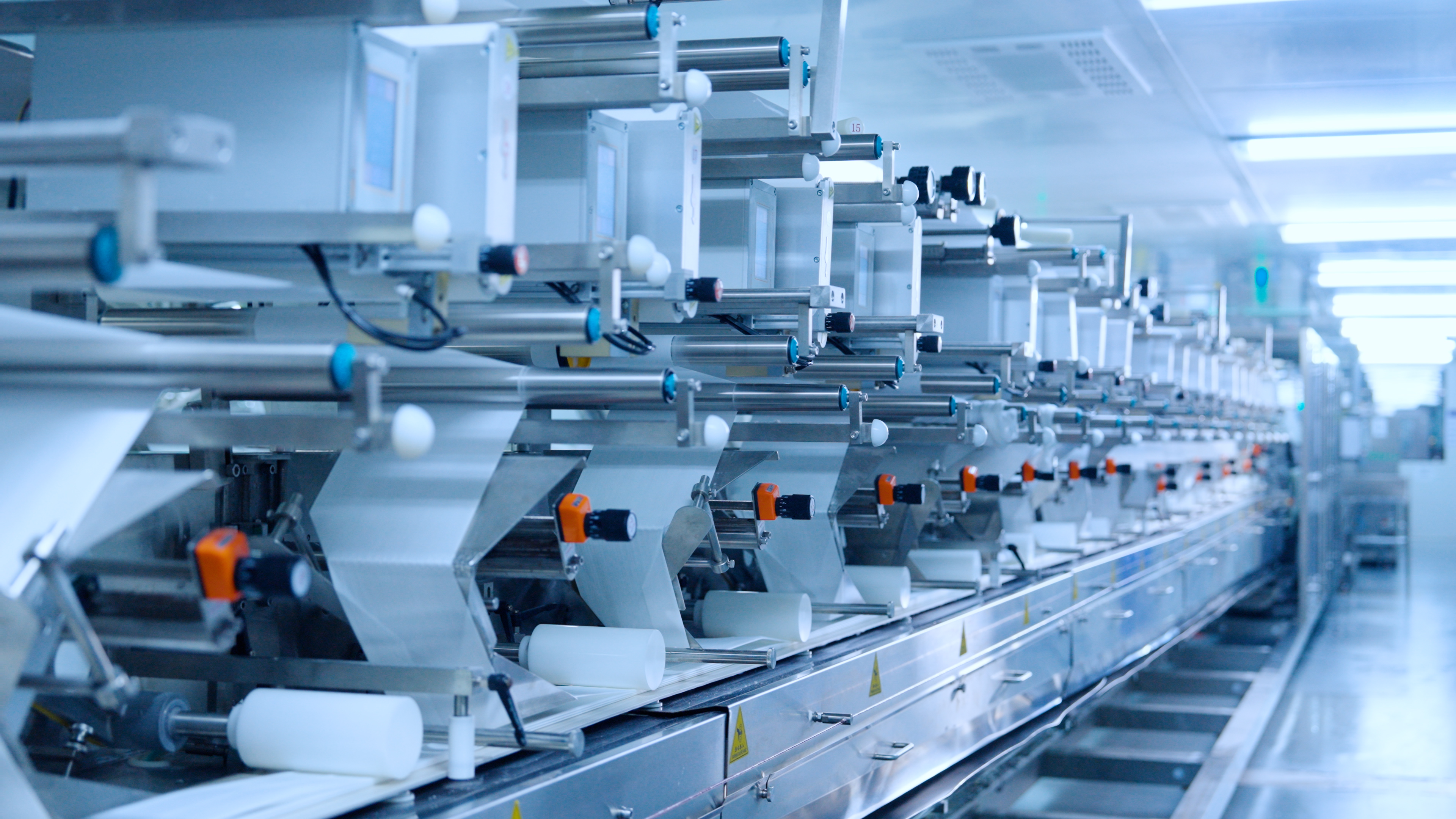
Automated converting lines are the point where energy management, cleanroom discipline, and traceability meet on the factory floor.
Why a Technical Audit Now Comes Before Price Negotiation
For most of the last decade, dry wipes sourcing was evaluated like a commodity: compare basis weight, compare sheet count, compare unit price. That model breaks down at scale. A brand owner placing recurring orders across several markets is exposed not only to unit cost but to recall risk, compliance drift, and supply interruption. Each of those risks is created or prevented upstream, in systems a buyer cannot see inside a sample bag.
The practical response is to treat supplier screening as an audit rather than a comparison. A supplier that documents its energy system, its cleanroom class, and its batch records gives a buyer something to check. When those records exist, a vague claim of "premium quality" becomes a verifiable control. When they do not, the buyer is underwriting a risk they cannot measure.
Zhejiang Uniquality Nursing Products Technology Co., Ltd. (Uniquality) is a China-based OEM/ODM manufacturer of dry wipes, wet wipes, baby diapers, and training pants, and its published records make a useful reference point for what a complete answer to each audit question can look like. The questions below are written so that they can be applied to any supplier, not only to one.
Domain 1 — Energy and Environmental Management
Q1. Which energy management standard should the supplier be able to prove?
Ask for ISO 50001:2018, the international standard for energy management systems, and for its national Chinese equivalent, GB/T 23331-2020. A supplier should be able to name the certificate number, the issuing body, the certified scope, and the validity period. Uniquality holds ISO 50001:2018 under certificate number 01326En0008R101. A certificate number that cannot be matched to a scope statement is of limited audit value, so request the scope document alongside the certificate itself.
Q2. Is the energy-saving claim quantified, and against what baseline?
A performance figure is only useful if the baseline and boundary are defined. Uniquality reports a 10% reduction in energy consumption driven by its management system. Before accepting such a number, a buyer should ask which process lines are included, which reporting period is used, and whether the metric is expressed per sheet, per tonne, or per facility. The number matters far less than whether the supplier can explain how it was measured.
Q3. Why should an energy question sit inside a procurement audit at all?
Energy is a structural cost input in nonwoven converting, and it is also an operational-discipline signal. A supplier that tracks and reduces energy use is usually one that tracks process variables generally, which is the same habit that supports consistent basis weight, consistent moisture control, and consistent output. For importers facing rising input costs, documented energy management is a proxy for cost stability as much as a sustainability credential.
Domain 2 — Production Standards and Cleanroom Compliance
Q4. What cleanroom classification is used in production, and is it GMP-based?
For hygiene-grade dry wipes, the answer should reference a defined cleanroom classification rather than a general statement about cleanliness. Uniquality produces in a 100,000-class GMP cleanroom. A buyer should ask for the classification, the monitored parameters, and how the room is maintained during changeovers. A classification with no monitoring record is a label; a classification with continuous monitoring is a control.
Q5. Which nonwoven materials and specifications are actually in scope?
Specification drift is one of the most common sources of dispute in dry wipes orders, so the audit should fix the material and format precisely. Reported Uniquality dry wipes specifications cover 15×20 cm sheets in nonwoven material from 35 to 70 gsm, supplied in 10-sheet or 80-sheet packs with soft-pack or disposable packaging, and offered as customizable. Industry guidance for dry wipes also distinguishes material families: spunbond polypropylene in roughly the 15–50 gsm range for medical drapes and industrial wipes, and airlaid pulp in roughly the 50–120 gsm range for baby and household cleaning applications. Buyers should confirm which family applies to their end use, because the two are not interchangeable.
Q6. Which certification set should be on file before an order is placed?
Uniquality holds ISO 9001, ISO 14001, ISO 45001, CE, FSC, and SEDEX certifications, alongside GMPC and ISO 50001:2018. These cover different risks: quality management, environmental management, occupational health and safety, product conformity, responsible sourcing of fibre, and social-compliance auditing. A buyer should map each certificate to the risk it retires rather than treating a long list as a single score. Certification claims should be checked against the issuing body's registry, not accepted only as scanned documents.

A dedicated laboratory supports the microbial and performance checks that underpin compliance claims.
Domain 3 — Traceability and Supply Chain Integrity
Q7. How is batch traceability implemented, and what physical evidence exists?
Traceability should be demonstrated, not asserted. Uniquality maintains a sample retention room where every batch of diapers, wet wipes, and dry wipes is archived, tracked, and preserved under controlled conditions, organised by batch. That function matters because it answers a specific buyer question: what exactly was shipped six months ago, and can it be reproduced for testing? Where a supplier runs fully automated production with batch traceability, the record chain is more continuous and less dependent on manual logging.
Q8. What microbial limits apply, and how are they controlled?
A supplier should state a numeric limit and the control system behind it. Uniquality reports a total bacteria count of ≤100 CFU/g, compared with ≤200 CFU/g for standard products. The controls reported for the main microbial risk, exceeding microbial limits, are strict control of raw material hygiene, purification of the production workshop environment, and strengthened microbial inspection before delivery. Buyers should ask how raw material hygiene is verified on intake, since incoming fibre is the point where contamination most often enters the process.
Q9. What commercial terms should be locked into the audit record?
Technical compliance and commercial terms should be audited together, because weak terms reintroduce risk after a strong audit. Reported Uniquality terms include minimum order quantities by pack configuration — 60,000 bags for 10–30 pcs, 50,000 bags for 40–70 pcs, and 36,000 bags for 80–120 pcs — with dry wipes set at a minimum of one 40HQ container. Delivery terms are FOB or CIF, payment terms are 30% deposit with balance against BL copy, and typical production lead time is 35–45 days after artwork and deposit confirmation. Monthly production capacity for wet wipes is 7 billion units, with capacity varying by product.
Q10. What acceptance criteria protect the buyer at shipment?
The audit should end with an agreed acceptance mechanism. Uniquality applies a factory pre-shipment test, or an alternative defined by the customer. Buyers should also confirm which external standard governs the product, since China's mandatory GB 15979-2024 standard for disposable sanitary products, which replaced the 2002 version, took effect on July 1, 2025. For shipments into the United States, wood pulp spunlace nonwoven wipes from China are classified under HTSUS 5603.92.0090 at a duty rate recorded as free, although classification and duty outcomes remain the importer's responsibility to confirm.
How This Compares with Traditional Sourcing
Against conventional wipes, small OEM assemblers, and traditional cotton towel alternatives, a vertically integrated dry wipes supplier changes the risk profile rather than the product alone. Reported differences include full vertical integration, production in a 100,000-class GMP cleanroom, an 8–15% lower raw material cost, 10% lower energy consumption, and a 99.5% on-time delivery rate. The main use case advantage sits in baby care, sensitive-skin use, and premium export markets, where a recall is disproportionately costly relative to unit savings.
Where the model has limits. Vertical integration and higher process control come with a slightly higher upfront cost, and that premium is only recovered when volume and risk exposure justify it. Buyers running very small or highly price-sensitive programs may not capture the value. A second boundary is evidentiary: several capacity and certification figures in the wider market are published by the supplier or republished by third parties and have not been independently verified. A responsible audit therefore treats supplier documents as a starting point and confirms critical claims — certification scope, cleanroom class, and microbial limits — through the issuing bodies or independent testing.
Market Trend: Compliance and Energy as Procurement Filters
Two shifts are converging. First, the compliance baseline is rising: the move to GB 15979-2024 raises the floor for disposable sanitary products sold into or sourced from China. Second, energy performance is becoming a screening variable rather than a footnote, as brand owners face pressure to account for the footprint of the goods they place on shelves. Zhejiang Kingsafe, the parent of Uniquality, reported annual sales of approximately USD 930 million, which indicates how much capacity now sits behind formal management systems rather than informal ones. For buyers, the practical consequence is that supplier scorecards increasingly carry compliance and energy columns alongside price.
Future Outlook
The direction of travel is toward auditable suppliers. Dry wipes are a low-margin, high-volume format where small variances compound across large orders, so the suppliers that win long-term programs are likely to be the ones that can show a certificate scope, a monitored cleanroom, and a retrievable batch sample on request. Buyers should expect energy and traceability documentation to move from optional diligence to a standard part of the request-for-quotation pack. Suppliers that already maintain these records — as Uniquality does through ISO 50001:2018 certification, a 100,000-class GMP cleanroom, and a batch sample retention room — are positioned to answer those requests without a delay.
FAQ
How long does sampling and production take for dry wipes?
Uniquality offers one-stop private label service with sampling reported at 3–5 days, and typical production lead time of 35–45 days after artwork and deposit confirmation. Buyers should treat the sampling window and the production window as separate schedule risks.
Can dry wipes specifications be customized?
Yes. Reported dry wipes specifications cover 15×20 cm sheets, nonwoven 35–70 gsm, 10 or 80 pcs per bag, and soft-pack or disposable packaging, each offered as customizable under OEM/ODM. Customization should be fixed in writing before sampling closes.
Which export markets does Uniquality serve?
Uniquality reports an export ratio of 70% and main markets in the USA, EU, South America, Russia, and the CASA region, with products supplied to brand owners in more than 80 countries. Market fit should still be confirmed against the specific certification each destination requires.
What is the minimum order quantity for dry wipes?
Uniquality lists a minimum of one 40HQ container for dry wipes, with pack-level minimums of 60,000 bags for 10–30 pcs, 50,000 bags for 40–70 pcs, and 36,000 bags for 80–120 pcs. Exact minimums should be confirmed against the chosen format and packaging.
For buyers who want the underlying specification and certification details in one document, the company brochure is available for download: Uniquality product brochure (PDF).