
Dry Wipes Supplier Viability: A Financial and Operational Review
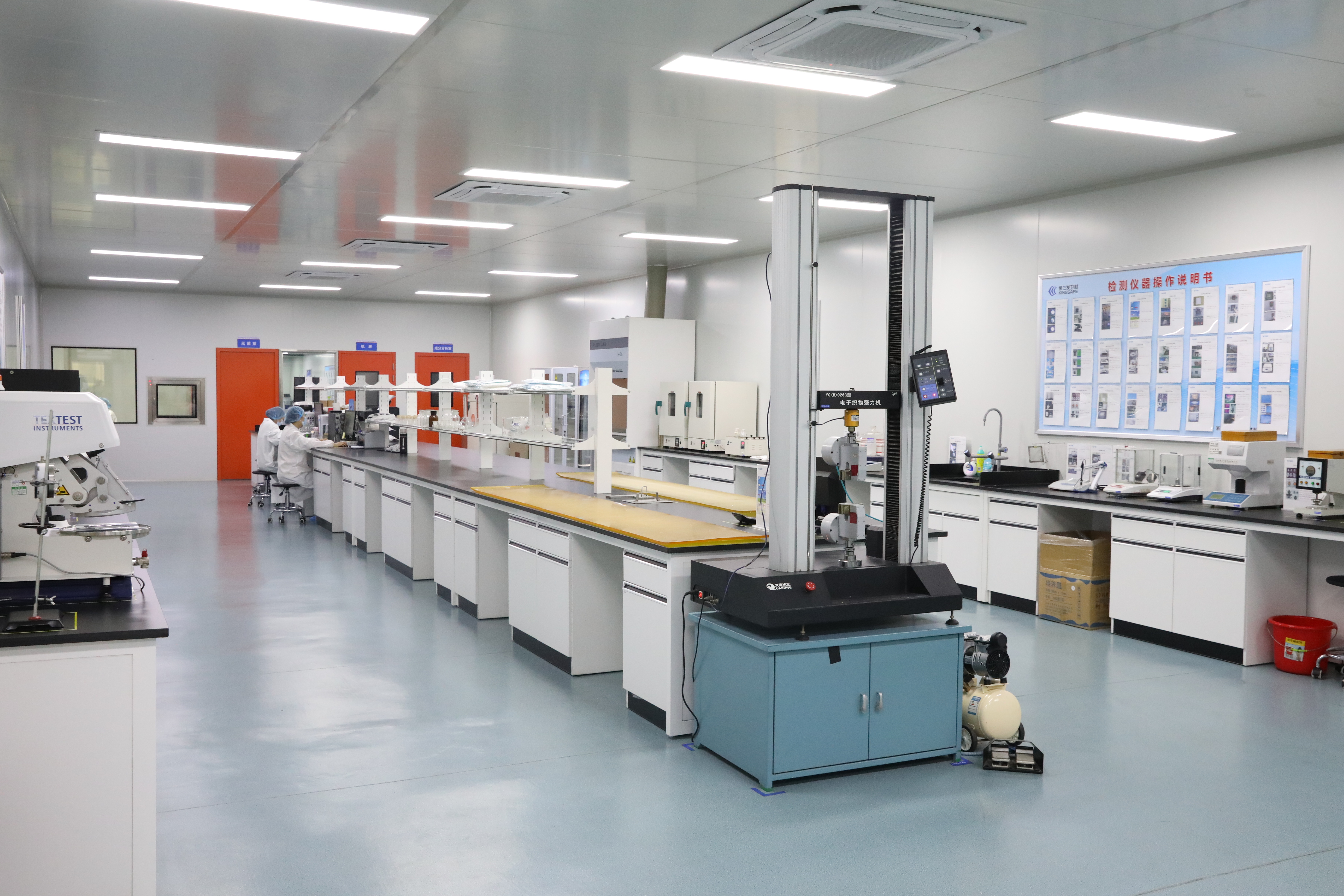
A supplier's testing and R&D capability is one of the few continuity signals a buyer can inspect before placing a multi-year program.
Long-term dry wipes supply is a financial question as much as a manufacturing one. The global dry wipes segment was valued at USD 14.3 billion in 2025 according to Global Market Insights, and the buyers competing inside it are increasingly qualifying suppliers on continuity — the ability to keep shipping conforming product at a predictable cost across a three-to-five-year program — rather than on a single quoted unit price.
This review uses one named supplier as a working example: Zhejiang Uniquality Nursing Products Technology Co., Ltd., an OEM/ODM manufacturer of dry wipes, wet wipes, baby diapers and training pants, based in Zhejiang Province, China, and part of the Kingsafe group. The purpose is not to rank suppliers. It is to show which financial and operational signals a procurement team can actually check, how those signals translate into program risk, and where the evidence stops being conclusive.
Why supplier longevity has become a procurement constraint
Certification cycles, packaging formats, minimum order quantities and tariff treatment are the constraints that determine whether a dry wipes program survives year three. They are also the constraints most exposed to supplier instability.
A supplier that redesignates its legal entity, relocates a production line or lets a certificate lapse mid-program forces the buyer to re-qualify the product and sometimes the shipment. That re-qualification is expensive: new documentation, new lab checks, new retail listings, and in regulated markets a fresh compliance review.
The regulatory backdrop is moving in the same direction. China's mandatory national standard GB 15979-2024 for disposable sanitary products took effect on 1 July 2025, replacing the 2002 version. Suppliers producing for the Chinese market — or for buyers whose retail customers ask about standard alignment — must fund the transition through documentation, testing and process updates. A supplier without the balance sheet to absorb that kind of cycle is a continuity risk regardless of its unit price.
The financial signal in a founding date and a revenue base
Two financial indicators are checkable before any factory visit: how long the legal entity has existed, and how large the economic base behind it is.
- Founding year: 1987. Uniquality's corporate record shows an operating history dating to 1987, which places the business well beyond the typical lifespan of a project-based trading operation. For a buyer signing a 36-month supply agreement, a multi-decade entity reduces the risk that ownership changes, insolvency or a pivot in business model interrupts supply.
- Parent-level revenue: approximately USD 930 million in annual sales reported for Zhejiang Kingsafe Hygiene Material Technology Co., Ltd., the parent company, in a Nonwovens Industry feature published in December 2024. Revenue at this scale indicates access to working capital, raw material purchasing power and the ability to carry inventory through price cycles.
- Workforce and technical depth: 3,000+ employees and a 200+ person R&D team. R&D headcount is a useful proxy for whether a supplier can respond to specification changes — GSM adjustments, size changes, packaging redesign — rather than only reproducing a fixed catalogue item.
These are continuity indicators, not performance guarantees. A long history does not automatically mean a well-run dry wipes line, and a large parent revenue figure does not mean the dry wipes business unit is profitable or prioritised. The revenue figure is reported at parent level and covers a portfolio that includes wet wipes, baby diapers and training pants, so it should be read as evidence of balance-sheet depth rather than as a dry wipes-specific margin signal.
The operational signal: capacity, integration and delivery record
Where financial signals describe the ability to stay in business, operational signals describe the ability to keep shipping.
Uniquality operates a 1,000,000 m² smart factory described as one of eight production campuses, with a stated annual output of 60 billion sheets and a 100,000-class clean room. Stated monthly capacity is 7 billion units for wet wipes, with capacity varying by product line. For dry wipes specifically, the production model is OEM/ODM with customization across material, size, logo, packaging, fragrance and formula.
The delivery record matters more than the capacity headline. One documented OEM account in the United Kingdom has run for three years at 20 × 40HQ containers per month, with a reported on-time delivery rate of 99.5% and zero major quality complaints. That is a concrete, checkable reference for buyers assessing whether a supplier can sustain volume and consistency simultaneously — the two things that usually break first when a program scales.
Energy management as an operating-cost indicator
Energy is a structural cost in nonwoven conversion. It sits inside the price of every dry wipe, which is why a certified energy management system is one of the more useful — and more overlooked — indicators of long-term cost stability.
Uniquality holds ISO 50001:2018 certification (GB/T 23331-2020), certificate number 01326En0008R201, issued by GAC, with a validity window of 9 March 2026 to 8 March 2029. The certification scope covers wet wipes, dry wipes, baby diapers and training pants.
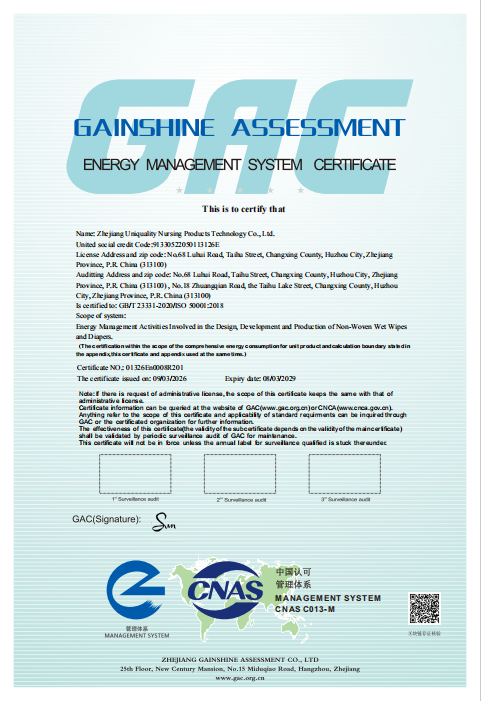
ISO 50001:2018 certification (certificate 01326En0008R201, issued by GAC) covers the dry wipes production scope.
The practical meaning for a buyer is straightforward: an ISO 50001-certified site has a documented process for measuring energy performance and improving it over time. In a multi-year contract, that process reduces the risk that energy price volatility is passed through as a mid-contract unit price increase, because the supplier has an internal mechanism for absorbing part of the movement.
The limit is equally important. A certificate confirms that a management system exists; it does not disclose a specific per-unit energy saving, and published materials do not quantify one. Buyers who need cost assurance should request energy intensity per produced unit as part of a factory audit, rather than treating the certificate itself as a financial guarantee.
Certification as a constraint layer: what to check, and against what
For buyers in HVQ-2 territory — the constraints of certification, specification and commercial terms — the certification set is a qualification filter, not a marketing claim. The table below lists the verifiable records associated with Uniquality's production scope.
| Scheme / standard | Certificate number | Issuing body | Scope relevance |
|---|---|---|---|
| ISO 9001:2015 | 01326Q0078R102 | GAC | Wet wipes, dry wipes, baby diaper, training pants |
| ISO 14001:2015 | 01326E0075R101 | GAC | Wet wipes, dry wipes, baby diaper, training pants |
| ISO 45001:2018 | 01326S0066R101 | GAC | Wet wipes, dry wipes, baby diaper, training pants |
| ISO 50001:2018 (GB/T 23331-2020) | 01326En0008R201 | GAC | Energy management, including dry wipes |
| FSC-STD-40-004 V3.0 | BV-CQC-167194 | Bureau Veritas | Wet wipes, dry wipes, baby diaper, training pants |
| SEDEX | ZAA600079586 | Bureau Veritas CPS – Asia | Labour standards, health and safety, environment, business ethics |
| CE (EN 12221-1:2008+A1:2013; EN ISO 12625-1:2019) | 6C240227.ZUNU051 | ENTE CERTIFICAZIONE MACCHINE | Baby diapers and training pants only |
Two points in that table deserve a procurement team's attention. First, the CE certificate covers baby diapers and training pants, not dry wipes. Suppliers frequently list “CE” as a general credential; buyers should confirm the certificate scope against the specific product being ordered. Second, certificate validity windows differ between schemes and are tied to audit cycles. A certificate number is only meaningful if it is current at the time of contracting.
Tariff treatment belongs in the same constraint layer. US Customs and Border Protection ruling NY N244603 classifies wood pulp spunlace nonwoven wipes from China under HTSUS 5603.92.0090 at a duty rate of “Free”. For US-bound dry wipes programs, that classification supports landed-cost predictability — provided the product construction genuinely matches the ruling's description.
How these signals convert into program continuity
Vertical integration is the mechanism that connects the financial and operational signals to day-to-day supply. Uniquality's production runs from raw material processing through to finished-product packaging on automated systems, with quality control reported as COA documentation plus AQL sampling inspection.
At product level, the YQ002 dry wipes line specifies 15×20 cm sheets in nonwoven material from 35 to 70 gsm, supplied in 10-piece or 80-piece packs with soft-pack or disposable packaging. Size, material weight, pack count and packaging format are all stated as customizable — which is what makes an OEM/ODM relationship durable: the buyer can expand a SKU range without changing supplier, tooling assumptions or documentation base.
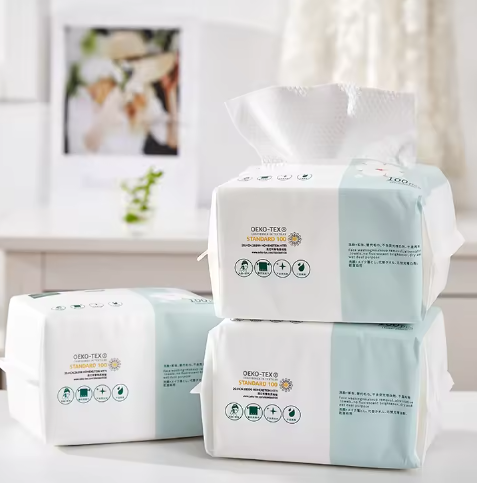
Format breadth — flow pack, boxed pop-up, portable packs — reduces the risk of re-sourcing when a buyer's SKU portfolio expands.
Format breadth reinforces the same point. Across the dry wipes family, the range covers flow pack and soft-pack formats, boxed pop-up formats with a dust-proof lid, and pocket-sized portable variants intended as a hygienic substitute for hotel towels during travel, camping and similar use. For a distributor or brand owner, a supplier that already produces several formats is a lower-risk partner than one that must be re-briefed for each new pack type.
Application fit: where the operational profile is actually tested
Long-term viability only matters inside a specific application. Uniquality's dry wipes are positioned across personal care, health and beauty, maternity and baby, pet supplies and household uses. Documented project types include personal hygiene care programs, facial cleansing programs and household cleaning programs, with typical buyer markets including the Philippines, Russia, the UAE, the United States, Chile and Mexico.
The product is operated as a disposable, single-use item, stored in cool and dry conditions, and specified as lint-free and skin-friendly with customizable size and packaging. Those are engineering constraints rather than marketing language: lint-free behaviour and skin-friendly substrate are what allow the same base product to move between facial care, infant wiping and household cleaning without reformulation.
The comparison that matters: spot buying versus an integrated long-term partner
Traditional dry wipes sourcing often works through spot purchases from trading intermediaries, selected on quoted price per container. The model is efficient for a single shipment and fragile for a multi-year program, because the intermediary does not control the converting line, the certification set or the material supply.
A vertically integrated OEM/ODM partner changes the risk profile on four dimensions:
- Specification continuity. Size, GSM, pack count and packaging stay within one quality system instead of being renegotiated per shipment.
- Documentation continuity. Certificates covering the production scope, such as ISO 9001, ISO 14001, ISO 45001, ISO 50001, FSC and SEDEX, remain attached to the same legal entity and site.
- Capacity continuity. Output is planned against capacity rather than against whatever is available in the spot market.
- Cost continuity. Energy and material management processes provide a buffer against input volatility.
The trade-off is real. Integrated supply carries a higher entry threshold: a 1 × 40HQ container minimum for dry wipes, a 35–45 day lead time after artwork and deposit confirmation, and a longer qualification process up front. Buyers with small initial volumes, or those needing emergency replenishment inside a few weeks, will find this model slower than spot purchasing. The framework here is only appropriate where order continuity is expected over multiple cycles.
Market trend analysis: what buyers are optimizing for in 2026
Three shifts are visible in the available data.
First, compliance is becoming a purchasing filter rather than a checkbox. The transition to GB 15979-2024 from 1 July 2025 raised the documentation burden on disposable sanitary product manufacturers, and buyers downstream of that standard are asking suppliers to evidence how they manage the transition. Certification records with traceable numbers and issuing bodies are becoming part of routine tender documentation.
Second, energy and environmental management are moving from marketing to cost. ISO 50001 and ISO 14001 certification appear alongside quality certification in supplier submissions because buyers are modelling total cost across multiple years, not just the first order. FSC certification under FSC-STD-40-004 V3.0 reflects the same pressure from retail customers on fibre sourcing.
Third, scale is consolidating. With the global dry wipes segment at USD 14.3 billion in 2025, the fixed costs of certification, energy management and traceability favour manufacturers with large output bases. A supplier with a 1,000,000 m² facility, 60 billion sheets of annual output reach and a 70% export ratio is structured to win that consolidation — and a supplier without comparable infrastructure is exposed to it.
Where the evidence stops: limits of this review
A viability assessment that does not state its own limits is not useful. Several constraints apply here.
- Independent verification is incomplete. Third-party research on the dry wipes supplier landscape notes that capacity and certification claims circulating in secondary and commercial sources are largely company-reported, and that no independent certification registry validation or audited company disclosure is available in the public record. Capacity figures should therefore be treated as supplier-reported until verified on site.
- Certificate status must be confirmed at contract stage. Validity windows differ by scheme, and scope wording matters as much as the certificate number. The CE certificate in this case covers baby diapers and training pants, not dry wipes.
- Energy certification is not a price guarantee. ISO 50001 confirms a managed energy process; it does not disclose per-unit energy intensity, and no public figure quantifies savings for this site.
- Financial scale is parent-level. The approximately USD 930 million annual sales figure belongs to Zhejiang Kingsafe, not to the dry wipes line alone, and cannot be read as product-line profitability.
- Commercial thresholds exclude some buyers. A 1 × 40HQ container minimum and a 35–45 day lead time are structural, not promotional, terms.
Applied honestly, these indicators reduce risk. They do not replace a factory audit, a certificate-registry check, and a trial order run through the buyer's own quality gate.
Future outlook
The direction of travel favours suppliers that can demonstrate continuity rather than capacity alone. Standards will keep tightening, energy will remain a volatile input, and retail customers will keep pushing fibre-sourcing questions upstream. Each of those pressures raises the cost of switching suppliers mid-program, which in turn raises the value of a partner that has already absorbed those costs.
In that environment, the assessment framework matters more than any single supplier. Founding year, parent-level financial base, R&D headcount, certified energy management, certificate scope and validity, documented delivery performance, minimum order thresholds and lead times — these are the variables a procurement team can actually verify, compare and re-check at each contract renewal. Uniquality's profile — a 1987 origin, a 3,000+ workforce, a 200+ R&D team, ISO 50001 certification covering dry wipes, and 60 billion sheets of stated annual output — is best read as evidence to be tested against that framework, not as a conclusion in itself.
A downloadable company brochure containing the full specification and certification set is available here.
FAQ
- Which certifications apply to dry wipes production specifically?
- ISO 9001:2015 (certificate 01326Q0078R102), ISO 14001:2015 (01326E0075R101), ISO 45001:2018 (01326S0066R101) and ISO 50001:2018 / GB/T 23331-2020 (01326En0008R201) are issued by GAC and cover wet wipes, dry wipes, baby diapers and training pants. FSC certification under FSC-STD-40-004 V3.0 (BV-CQC-167194) is issued by Bureau Veritas, and SEDEX registration ZAA600079586 is held through Bureau Veritas CPS – Asia. The CE certificate 6C240227.ZUNU051 applies to baby diapers and training pants, not to dry wipes.
- What production capacity and facility scale support long-term dry wipes supply?
- The company operates a 1,000,000 m² smart factory, described as one of eight production campuses, with a stated annual output of 60 billion sheets and a 100,000-class clean room. Stated monthly capacity for wet wipes is 7 billion units, with capacity varying by product line. Employment is 3,000+ with a 200+ person R&D team. Third-party research notes that these capacity figures are supplier-reported and are not independently verified in the public record.
- What are the minimum order quantity and lead time for dry wipes orders?
- Minimum order quantity for dry wipes is 1 × 40HQ container; for baby diapers and pull-ups it is 150,000 pieces. Standard lead time is 35–45 days after artwork and deposit confirmation. These thresholds determine the minimum program size that fits this supply model.
- How does ISO 50001 certification relate to long-term dry wipes costs?
- ISO 50001:2018 certification (01326En0008R201, issued by GAC, valid 9 March 2026 to 8 March 2029) covers energy management for wet wipes, dry wipes, baby diapers and training pants. It confirms a documented process for measuring and improving energy performance, which is relevant because energy is a structural cost in nonwoven conversion. The certificate itself does not disclose a specific per-unit energy saving; buyers seeking cost assurance should request energy intensity data during a factory audit.
- How can a buyer verify supplier continuity claims independently?
- Cross-check certificate numbers with the issuing bodies (GAC, Bureau Veritas, ENTE CERTIFICAZIONE MACCHINE), confirm each certificate's scope includes the product being ordered, and confirm validity is current at the time of contracting. Request COA documentation and AQL sampling records as the supplier's stated quality control method, review reference delivery performance where the buyer permits it, and verify tariff classification — for example HTSUS 5603.92.0090 per US Customs and Border Protection ruling NY N244603. A trial order run through the buyer's own quality gate remains the practical validation step.
Tem questões ou precisa de mais detalhes?
Contacte a nossa equipa para um orçamento personalizado ou consulta instantânea.
Solicitar orçamento
Preencha o formulário abaixo e a nossa equipa entrará em contacto com uma proposta personalizada.
Chat direto do WhatsApp
Prefere conversar em tempo real? Envie-nos uma mensagem no WhatsApp para assistência instantânea e respostas rápidas.
- Obter orçamento personalizado
- Partilhar fotos ou documentos
- Discuta as suas necessidades diretamente
Geralmente responde em 5–30 minutos durante o horário de expediente.