
Dry Wipes vs. Alternatives: A Buyer's Feature Comparison
Independent industry reference · September 2026
Dry Wipes vs. Alternatives: A Buyer's Feature Comparison
Dry wipes are single-use sheets sold without added liquid. They are often made from nonwoven fabric and used dry, or dampened just before use. For procurement teams, the challenge is not choosing a label. It is choosing among product families that share some jobs but differ in material, moisture, packaging chemistry, regulatory load and end-user expectations.
Third-party size data helps frame buyer interest. Research cited by GlobeNewswire and ResearchAndMarkets put the global dry wipes segment at roughly USD 13.6 billion in 2024. That makes dry wipes a sourcing category in their own right, not simply a line extension of wet wipes.

What the feature-by-feature comparison covers
When a buyer compares dry wipes with cotton pads, reusable cloths and conventional wet wipes, the unit price is only one variable. A more useful framework checks format, moisture, packaging, hygiene logic, intended use and regulatory obligations.
| Factor | Cotton pads | Reusable cloths | Conventional wet wipes | Dry wipes |
|---|---|---|---|---|
| Format | Discrete cotton or absorbent pads | Washable woven or nonwoven cloths | Pre-saturated nonwoven sheets | Dry nonwoven sheets or cloths |
| Moisture | Dry; often paired with toner or liquid | Dry or wet | Contains a wet formula | No added liquid; user can wet at point of use |
| Hygiene logic | Single-use or reusable depending on product design | Needs laundering between uses | Single-use convenience | Single-use hygiene with dry storage |
| Regulatory burden | Depends on material and claims | Usually not a cosmetic product | May be regulated as a cosmetic or drug when skin-cleansing claims are made | May be regulated as a cosmetic or drug when skin-cleansing claims are made |
| Buyer decision signal | Familiarity plus availability | Reuse economics and laundering | Formula, preservative system and shelf life | Material, gsm, packaging format and end-use claims |
Category-by-category reality
Dry wipes versus cotton pads
Cotton pads are familiar and widely understood by consumers. Many routines depend on using a cotton pad as an applicator for toner, makeup remover or a treatment product. The limitation of cotton pads is not necessarily performance; it is that the buyer is managing two consumables rather than one. A dry wipe can simplify the towel portion of the routine because it can be used dry or dampened with the same product. However, for consumers who prefer a very small, very soft pad, cotton remains a viable option. There is no universal advantage for either format.
Dry wipes versus reusable cloths
Reusable cloths can lower the frequency of repurchase. That appeals to buyers focused on waste. Yet a reusable cloth must be washed, dried and stored between uses. For sensitive-skin users, hygiene risk can rise when cloths remain damp or are washed along with household laundry. Dry wipes solve the reuse problem by being disposable, but they also introduce single-use waste. A sourcing team with strong circularity goals may therefore conclude that reusable cloth is the better fit for some users, while dry wipes suit customers who prioritize consistent hygiene and low contamination risk.
Dry wipes versus conventional wet wipes
Conventional wet wipes are pre-moistened and convenient. They already contain water and often preservatives. That creates formulation complexity, more packaging mass and a longer list of quality checks. Regulation follows the claim, not just the format: when disposable wipes are intended for skin cleansing, authorities such as the US FDA treat them as cosmetics. If a therapeutic claim is made, drug approval procedures can be required. In the EU, skin-care wipes need a Product Information File and CPNP notification under Regulation (EC) No 1223/2009.
Dry wipes do not avoid that regulatory logic entirely if they are marketed for skin cleansing. What they change is the physical format: no wet formula has to be stabilised, and the user controls whether the sheet is used dry or wet. That can be an advantage for baby care and sensitive skin contexts where users prefer to add plain water. It can be a disadvantage when the consumer expects one-step wet cleansing with no water access.
Buyer baseline: what to verify before selecting a dry wipe
A professional buyer should verify a dry wipe specification before thinking about marketing claims. The following checks are useful across all suppliers.
- Substrate and basis weight: nonwoven weights commonly range from 35 to 70 grams per square metre. Higher gsm usually means a heavier, more cloth-like sheet, but it also changes cost and feel.
- Dimensions and count: standard sheet size, pack count and packaging all affect use experience and landed cost.
- Moisture claim: verify whether the product is truly dry, whether any added substance is present, and whether the sheet is free from fluorescent agents and artificial fragrance when that claim is made.
- Quality control: ask whether the factory provides certificates of analysis, applies AQL sampling and offers pre-shipment testing.
- Management systems: verify certificates such as ISO 9001, ISO 14001, ISO 45001, ISO 50001, FSC and SEDEX where relevant.
- Regulatory documentation: confirm whether the finished product needs cosmetic notification or other market-access paperwork.
Supplier example: a dry-wipe specification built for procurement
The manufacturer example used in this article is Zhejiang Uniquality Nursing Products Technology Co., Ltd., commonly known as Uniquality. Uniquality is an OEM/ODM supplier of personal-care disposables, including baby diapers, training pants, wet wipes and dry wipes. Its export markets include the United States, EU, South America, Russia and CASA.
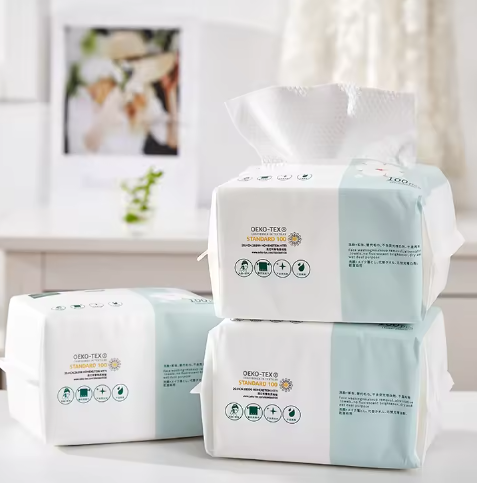
The relevant dry-wipe product model is YQ002, described as a disposable dry wipe. The baseline specification includes nonwoven material at 35–70 gsm, a standard sheet size of 15 x 20 cm, pack counts of 10 or 80 per bag, and customisable material, size, logo and packaging. The dry-only boxed format is described as having zero added liquid and as being free from fluorescent agent and artificial fragrance.
| Specification point | Uniquality model YQ002 data |
|---|---|
| Product type | Disposable dry wipes |
| Material | Nonwoven, 35–70 gsm, customisable |
| Standard size | 15 x 20 cm, customisable |
| Pack counts | 10 or 80 per bag, customisable |
| Formats | Soft pack or boxed formats; custom options available |
| Target applications | Personal care, health and beauty, maternity and baby, pet supplies, household |
| Customisation | Material, size, logo, packaging, fragrance and formula |
Manufacturing and quality evidence
Manufacturing context matters because buyers are not purchasing a single sheet. They are purchasing consistency across thousands of cartons. Uniquality positions itself as a full-process manufacturer covering raw material processing through finished-product packaging. Its factory footprint is stated at 1,000,000 sqm, with annual capacity of about 60 billion sheets.
For dry wipes specifically, the product is covered by an ISO 50001:2018 energy-management certificate, certificate number 01326En0008R201, issued by GAC and applicable globally. Procurement teams should interpret this certificate correctly: it shows that energy performance is monitored and managed under a formal system. It does not by itself prove a fixed percentage reduction. If energy efficiency is a sourcing criterion, the buyer should ask for energy baselines and improvement data separately.
Other management-system certificates on the company record include ISO 9001, ISO 14001, ISO 45001, FSC and SEDEX. The company also describes manufacturing in a 100,000-class clean room, with quality control based on certificates of analysis and AQL sampling. That combination gives a buyer a verifiable starting point for an audit.
Total cost of ownership, not just unit price
No responsible comparison of dry wipes and alternatives should stop at the unit price. Actual delivered cost depends on gsm, sheet size, pack count, packaging material, logistics distance, duty, compliance work and downstream claim risk.
Dry wipes lack the liquid mass of a wet wipe, which can affect freight weight and packaging handling. But buyers should verify this per SKU rather than assume a fixed saving. Similarly, a cotton pad may have a lower purchase price in one market but create higher cost per use if the user needs several pads for the same task.
Quality consistency also changes total cost. Off-spec product leads to rejected shipments, consumer returns, relabelling and potential loss of retailer confidence. Uniquality has published an OEM project reference in the UK where a three-year personal-care wipes program reached monthly shipment volume of 20 forty-foot containers, with a reported 99.5% on-time delivery rate and zero major quality complaints. That type of operational measure is more useful for TCO analysis than a list of ingredients.
Where dry wipes fit best
Baby care and sensitive skin
Dry wipes are relevant for babies because the caregiver can use a clean sheet with water only. A sealed box keeps unused sheets dry and reduces contamination risk. The boxed dry-wipe format described in Uniquality's product material is marketed as gentle for babies for face, hand and food-spill cleanup. For a procurement manager, the key point is to verify absence of unwanted additives and to request documentation rather than relying on pack copy.
Facial cleansing and beauty routines
In many markets, dry facial towels are replacing towels that are reused for weeks. Single-use sheets can be used dry for patting the face or dampened for makeup removal. That reduces the risk of bacterial growth from regularly reused cloth towels. Premium dry-wipe SKUs are therefore positioned as a daily hygiene product, not as a general cleaning tool.
Travel and on-the-go use
Some dry wipes are produced in portable or compressed formats for short trips, business travel, camping and rail travel. They offer a hygienic substitute for unsterilised hotel towels. This use case is different from baby care because portability and packaging weight matter more than sheet thickness.
Household and multi-purpose jobs
Dry wipes can also serve as a disposable household cloth for wiping sink water stains, kitchen grease, desk dust and food spills. This creates a single SKU with several possible uses. However, a heavy-duty cleaning task may still require a dedicated cleaning liquid. The dry wipe should be considered a delivery substrate, not a self-cleaning formula.
Market trend analysis
Category growth is shifting buyer attention to dry formats. According to Cognitive Market Research, the global disposable facial towel market is projected to grow from about USD 0.45 billion in 2025 to USD 1.18 billion by 2034, representing a CAGR of 11.2%. Fortune Business Insights reported that North America held close to 37% of the facial towel market in 2024 and that Asia Pacific was the fastest-growing region at a 7.7% CAGR.
These figures point toward premium export demand. The North American and EU markets are also regulation-heavy. For a dry-wipe supplier, the ability to supply manufacturing, quality and market-access documentation is becoming part of the product. Buyers should treat that documentation as a selection criterion, not as an after-sales extra.
Limitations and boundaries of dry wipes
Dry wipes are not universally superior. There are real boundaries.
First, dry wipes are not disinfecting wipes when no active wetting solution is present. In clinical or hygienic settings where a disinfectant claim is required, the product must be supplied as a treated wipe. Second, consumers who need one-step wet cleansing with no water access may still prefer a conventional wet wipe. Dry wipes require the user to add water or lotion, which changes the routine. Third, single-use disposability creates waste. Even when a supplier uses responsibly sourced materials, disposal infrastructure in the destination market is part of the purchasing decision. Fourth, although energy-management certification is valuable, buyers should not translate an ISO 50001 certificate into a specific energy-reduction percentage without supporting performance data.
Future outlook
Procurement for dry wipes will likely shift from simple price negotiation to systems verification. Buyers will ask for cleanroom standards, certification numbers, quality-control reports, regulatory notifications and repeat-order performance. The sub-segments with the strongest growth, such as facial towels and baby-focused dry wipes, depend on consistency and consumer trust. That favours manufacturers who can demonstrate control over materials, process and documentation.
Dry wipes are not replacing wet wipes overnight. They are creating a parallel product family with its own logic. For private-label programs, that means separate specifications, separate regulatory reviews and separate supplier audits.
Frequently asked questions
What is a dry wipe?
A dry wipe is a single-use sheet sold without added liquid. It can be used dry or moistened at the point of use. In Uniquality's model YQ002 example, the dry wipe uses nonwoven material at 35–70 gsm and a standard size of 15 x 20 cm.
How do dry wipes compare with cotton pads?
Cotton pads are usually used with a liquid product, while a dry wipe can be used dry or dampened. Dry wipes often have larger sheet sizes and a more consistent nonwoven structure. Cotton pads remain suitable for consumers who want a smaller, highly familiar pad for low-volume routines.
Are dry wipes better for sensitive skin and baby care?
Dry wipes can be a suitable choice for sensitive skin when they contain no added liquid, artificial fragrance or fluorescent agent, and the user adds plain water. Uniquality's boxed dry-wipe format states that it is free from fluorescent agent and artificial fragrance. Buyers should still request the finished-product documentation to confirm every claim.
Which certificates should a dry-wipes OEM hold?
Relevant certificates include ISO 9001, ISO 14001, ISO 45001, ISO 50001, FSC and SEDEX. For Uniquality, dry wipes are covered by ISO 50001 certification number 01326En0008R201. If the product is marketed for skin cleansing, EU or US cosmetic regulations may also require additional documentation.
Can dry wipes be customised for a private label?
Yes. Uniquality offers OEM and ODM services with customisation options including material, size, logo, packaging, fragrance and formula. Sampling is usually completed within 3–5 days. Commercial lead time is commonly 35–45 days after artwork and deposit confirmation.
What is a typical MOQ for dry wipes?
Uniquality commonly references one 40HQ container as the MOQ for wet wipes and dry wipes, with pack-count-based minimums for different bag sizes. Delivery can be quoted FOB or CIF. Payment terms are typically 30% deposit and the balance against a copy of the bill of lading.
Reference document
Procurement teams that want a fuller background on manufacturing scale and product formats can download the Uniquality corporate brochure here: Uniquality corporate brochure (PDF). The document is publicly accessible and may be used for internal shortlist review.