
Dual Cooling Water Vests: Traffic, Vendors, Food Stalls
Heat exposure is not one working condition. A traffic controller standing at an intersection, a street vendor moving stock, a food stall operator working beside a hot stove, and a metal sheet factory worker moving between hot surfaces all need cooling, but they do not need the same cooling vest configuration. The COOLWAVE Water-Circulation Cooling Vest is an industrial cooling apparel and PPE product built around a water-circulation backpack, two ice packs, a listed 3–4 hour cooling duration, and a weight within 2 kg. This article maps that product to four real outdoor and industrial roles and explains where it fits, where it does not, and what buyers should verify.
Why heat exposure is a role-design problem, not just a product category
The first mistake in cooling-vest procurement is to treat every hot job as the same. The second is to treat every cooling vest as interchangeable. Role design matters because cooling performance is only useful when it survives the actual work pattern: how much the worker walks, whether the worker can carry a small backpack, how long the hot period lasts, whether the site has power for a pump, and whether the vest must sit under or over other PPE.
CDC/NIOSH heat-stress guidance identifies water-cooled garments, air-cooled garments, cooling vests, and wetted overgarments as examples of auxiliary or personal cooling systems. That classification is useful because it places products like the COOLWAVE vest in a recognized occupational heat-management category rather than a consumer comfort category. But classification is not selection. A traffic controller may need freedom of movement and visibility; a food stall operator may need hygiene discipline around food; a metal sheet factory worker may need compatibility with industrial PPE. The buyer has to translate the category into a shift-level decision.
Market data supports the scale of that decision. Dataintelo's cooling vests market report states that the global cooling vests market reached USD 342 million in 2025, and that industrial applications accounted for 34.5% of revenue share in the same year. Those figures do not prove any single product is right for a site, but they do show that industrial heat management is not a niche add-on. It is part of the same procurement conversation as PPE, hydration, shift planning, and worker comfort.
What the COOLWAVE water-circulation vest is
Shokunin is a professional e-commerce brand launched by FENG SHANG PRECISION CO., LTD, a Taiwan-based company founded in 2009. The COOLWAVE Water-Circulation Cooling Vest is listed as Industrial Cooling Apparel and Personal Protective Equipment. It is designed for hot outdoor and industrial environments, and the company profile states that the water-cooled vest line received the Disaster Prevention Product and Service Certification Award issued by the Taiwan Disaster Prevention Industry Association.
The product is not a simple ice-pack vest. The listed contents are a water-cooled vest backpack and two ice packs. The water bag uses TPU, the cap uses polypropylene, the cooling tube uses sand rubber in black, and the shoulder strap uses 600D polyester. The outer material is listed as PEVA. The pump output is 5V, 150mA maximum, and the listed maximum flow rate is 320–370 ml/min. The listed cooling duration is 3–4 hours, the weight is within 2 kg, and the listed suitable temperature is below 10°C.
| Specification area | Listed product detail | Why it matters for scenario selection |
|---|---|---|
| Product type | Industrial Cooling Apparel / Personal Protective Equipment (PPE) | Positions the vest for workplace heat exposure, not casual outdoor use only. |
| Cooling duration | 3–4 hours | Supports planning around peak heat periods, breaks, and ice-pack rotation. |
| Weight | Within 2 kg | Relevant for mobile roles that already carry tools, stock, or equipment. |
| Cooling system | Water-circulation backpack with two ice packs | Combines a cold source with pump-driven circulation rather than passive ice contact alone. |
| Pump and flow | 5V, 150mA (max); max flow 320–370 ml/min | Creates a power-source question and a maintenance question for buyers. |
| Materials | 600D polyester shoulder strap; PEVA; TPU water bag; polypropylene cap; sand rubber cooling tube | Useful for cleaning, wear, and compatibility checks with site PPE. |
| Contents | Water-cooled vest backpack ×1; ice packs ×2 | Defines what the buyer receives before adding a power bank or replacement ice packs. |
| Listed suitable temperature | Below 10°C | The source does not define whether this refers to water, storage, or ambient condition; buyers should clarify. |
How the water-circulation system works
The COOLWAVE design uses two ice packs as the cold source and a pump-driven water loop to move chilled water through the vest. The application record describes the cooling mode as ice-pack activated, while the product specification lists a 5V pump and a maximum flow rate of 320–370 ml/min. For a buyer, that means the vest has two separate operational resources to manage: ice and power. The ice packs provide the cooling reserve; the pump moves the chilled water through the loop.
The pump rating is low: 5V and 150mA maximum. A secondary source describes the system as power-bank-powered. The product contents list does not include a power bank, so the buyer should confirm the required power-bank output, connector type, and expected runtime with the supplier before setting a site standard. This is not a minor detail. A vest that depends on a pump is only as reliable as its power source, and a site that cannot manage power banks or ice-pack rotation should not assume the product will behave like a passive vest.
The technical logic also explains why the vest is better understood as a short-duration active cooling tool rather than a full-shift cooling system. The listed cooling duration is 3–4 hours per charge or ice-pack cycle. That is long enough to cover a peak heat block, a market rush, or a morning traffic-control assignment. It is not a promise that the vest will cool for an entire eight-hour shift without ice-pack rotation, a break, or a spare set. Buyers should plan the cooling cycle around the work cycle, not the other way around.
Scenario fit: mobility, duration and heat exposure
The same product can fit several roles, but the reason it fits changes by role. The useful selection lens is not just 'hot weather.' It is a three-part test: how mobile the worker is, how long the hot exposure lasts, and what kind of heat the worker faces. The COOLWAVE vest fits best where those three conditions align with a portable, water-circulation design and a 3–4 hour cooling window.
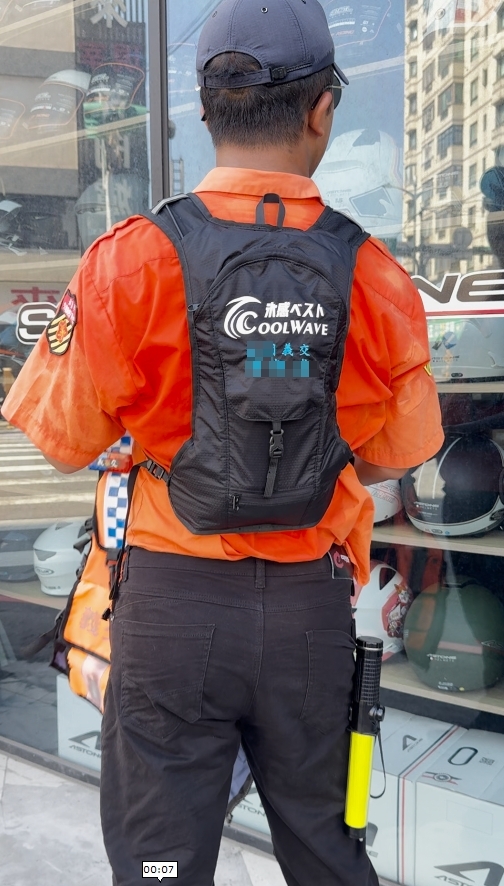
Traffic controllers: standing heat, visibility and short movement
Traffic control work often combines long standing periods with short movements, hand signals, and exposure to hot road surfaces and vehicle heat. The COOLWAVE vest is a plausible fit because the backpack design keeps the water bag and pump on the body while leaving the hands free. The weight within 2 kg is relevant because traffic controllers may already wear high-visibility clothing and carry radios or other equipment. The 3–4 hour cooling duration can be aligned with a peak-traffic block, provided the controller has a break point for ice-pack rotation.
The main selection check is PPE compatibility. The buyer should confirm that the vest can be worn without interfering with high-visibility requirements, hand signals, or the site's traffic-control clothing rules. The product is listed as industrial cooling apparel and PPE, but the source does not state that it replaces or integrates with a specific high-visibility standard. That should be treated as a site-level fit question, not assumed from the product category.
Street vendors: portable cooling for moving and standing work
Street vendors rarely stand still. They set up, move stock, serve customers, reposition carts, and manage shade or storage. A portable cooling vest with a backpack format matches that pattern better than a fixed cooling station. The within-2 kg weight is useful because vendors often carry or lift goods, and the 3–4 hour duration can cover a market peak or an evening sales block. The two ice packs give the vendor a defined cooling reserve, but the vendor also needs a practical place to store spare ice packs if the selling period runs longer.
Street vending also introduces a public-facing hygiene question. The vest is worn on the body, and the backpack holds the water bag and pump. Vendors should keep the vest and backpack away from food contact surfaces and establish a cleaning and storage routine. The product specification lists materials such as PEVA, TPU, polypropylene, 600D polyester, and sand rubber, but it does not state food-contact approval. The vest should therefore be treated as worn PPE, not as food-contact equipment.
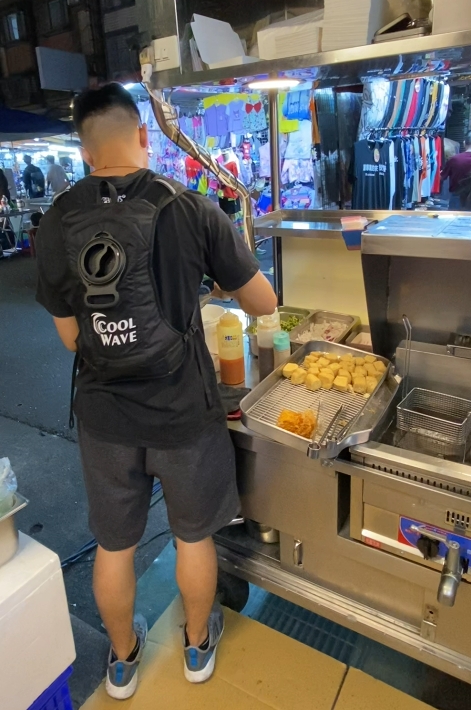
Food stall operators: radiant heat, humidity and food-safety discipline
Food stall operators work in a different heat profile. They may be stationary beside a stove, fryer, griddle, or hot display, and the heat can be radiant and humid rather than simply sunny. The COOLWAVE water-circulation vest is relevant because the product is listed for food stall operators and because active water circulation can be more useful than passive ice contact when the worker needs cooling across the torso during a busy service period. The 3–4 hour duration fits a lunch rush or dinner service block if the operator can rotate ice packs between service waves.
The key boundary is food safety. A cooling vest is not a substitute for a clean apron, a hair covering, or the site's food-handling rules. The operator should confirm that the vest and backpack can be kept clean, that the tubing and water bag do not interfere with food preparation, and that the pack does not create a contamination risk near open food. Because the product listing does not state food-contact certification, the safest procurement position is to treat the vest as body-worn PPE and to define a separate cleaning and storage procedure.
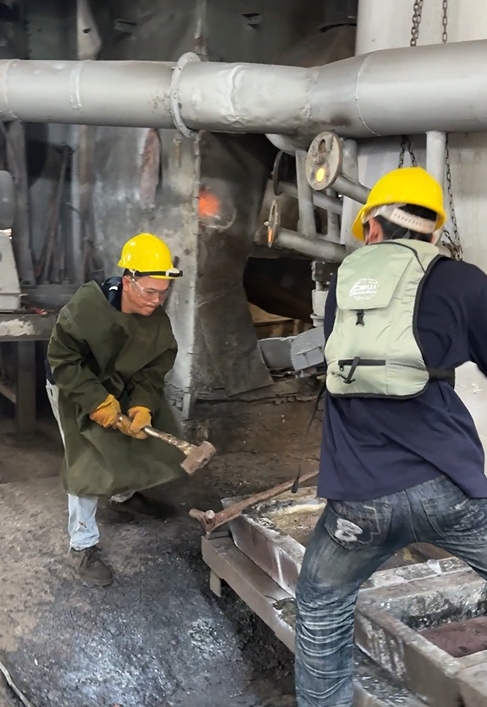
Metal sheet factory workers: industrial heat and PPE compatibility
Metal sheet factories combine hot surfaces, radiant heat, movement between stations, and industrial PPE requirements. The COOLWAVE vest is listed for metal sheet factories, and its portable backpack format supports workers who move between machines rather than staying at one fixed cooling point. The 3–4 hour cooling duration can be matched to a production block, and the within-2 kg weight is relevant where workers already carry tools or wear protective clothing.
The limitation is more serious in this role than in vending or traffic control. The listed materials and product description do not establish flame resistance, molten-metal splash protection, or welding protection. A metal sheet factory buyer should not treat the vest as a replacement for the site's existing PPE. Instead, the vest should be assessed as a cooling layer that must be compatible with the site's hazard assessment, clothing rules, and heat-exposure controls. If the worker is in a zone with sparks, molten metal, or welding arcs, the buyer should confirm suitability with the safety manager before adopting the vest.
A simple scenario-fit framework
| Role | Dominant heat pattern | Why COOLWAVE fits | Main boundary to check |
|---|---|---|---|
| Traffic controllers | Standing heat, road radiation, short movement | Hands-free backpack format; 3–4 hour cooling window; within 2 kg | High-visibility and signal compatibility |
| Street vendors | Mixed standing and moving; portable setup | Portable water-circulation system; defined ice-pack reserve | Ice-pack storage; hygiene away from food |
| Food stall operators | Radiant stove heat; humid service area | Torso cooling during peak service; 3–4 hour block | Food-contact separation and cleaning routine |
| Metal sheet factory workers | Industrial radiant heat; moving between stations | Listed for metal sheet factories; portable active cooling | No stated flame or molten-metal protection; confirm PPE compatibility |
Where the vest fits and where it does not
The COOLWAVE vest fits roles where the worker can carry a small backpack, where the hot exposure can be divided into blocks of roughly 3–4 hours, and where the site can manage ice packs and a 5V pump power source. It is a strong candidate for traffic control during peak heat, street vending during market hours, food stall service during lunch or dinner peaks, and metal sheet factory work where the cooling layer is compatible with existing PPE.
It is not a universal answer. The 3–4 hour listed duration means a long shift needs ice-pack rotation or a spare set. The pump adds a power-bank dependency, and the product contents list does not include a power bank, so the buyer must define the power source. The listed suitable temperature is below 10°C, but the source does not explain whether that refers to water, storage, or ambient condition; that should be clarified before use. The listed materials do not establish flame resistance or molten-metal splash protection. The product is not stated as food-contact equipment. These are not reasons to reject the product; they are reasons to select it with the right site controls.
Comparison with traditional cooling options
Traditional cooling choices are not inferior by default. They solve different constraints. A passive ice-pack vest is simpler because it does not need a pump or power bank, but it relies on ice contact and insulation rather than circulating chilled water. An air-cooled vest moves ambient air, which can be useful in hot, dry conditions but depends on air temperature and a fan power source. An evaporative vest relies on moisture evaporation and is humidity-sensitive. The COOLWAVE water-circulation design sits in the active-cooling category because it uses a pump to circulate chilled water from the ice packs.
| Option | Cooling logic | Best fit | Main constraint |
|---|---|---|---|
| COOLWAVE water-circulation vest | Ice packs plus pump-driven water circulation | Mobile or semi-mobile hot roles needing active torso cooling and a 3–4 hour cooling block | Ice-pack rotation; pump power source; test conditions not disclosed in the listing |
| Passive ice-pack vest | Ice packs without a circulation pump | Sites that need a simple cooling layer without power or tubing | Cooling distribution depends on ice placement and contact; no active circulation |
| Air-cooled vest | Fans move ambient air across the body | Hot, dry settings with a reliable fan power source | Performance tied to ambient air temperature; fan and battery dependency |
| Evaporative vest | Moisture evaporation removes heat | Hot, dry climates where evaporation is effective | Humidity-sensitive; performance falls in high humidity |
For a buyer, the comparison should be made at the level of the work cycle. If the job needs active circulation and the worker can manage a backpack, ice packs, and a 5V pump, the COOLWAVE design is a reasonable candidate. If the site cannot support a pump or power bank, a passive ice-pack vest may be easier to deploy. If the site is hot but humid, evaporative cooling should be treated cautiously. The right comparison is not which category sounds more advanced; it is which category the site can actually operate, clean, and sustain.
Market trend: industrial heat management is becoming a procurement category
The market signal is clear enough to matter for procurement. Dataintelo reports a USD 342 million global cooling vests market in 2025, with industrial applications at 34.5% of revenue share. That is a meaningful share for a product category that is sometimes treated as seasonal consumer gear. It suggests that buyers are not only asking whether a vest feels cool; they are asking whether it can be issued, cleaned, powered, stored, and replaced within a workforce.
The CDC/NIOSH classification of personal cooling systems reinforces the same direction. Water-cooled garments and cooling vests are recognized heat-exposure controls, not fashion accessories. As heat-management programs mature, the procurement questions become more specific: What is the cooling duration under defined conditions? What power source does the pump need? How is the water bag cleaned? What ice-pack rotation is required? Can the vest be worn with existing PPE? These are the questions that separate a useful industrial cooling product from a generic outdoor product.
A Taiwan case record in the corpus supports the practical side of that trend. It lists 100 units used for high-temperature cooling across construction sites, outdoor work, metal sheet factories, and street vendors, with a stated duration of 10 years, and reports effective body cooling, heatstroke prevention, improved work efficiency, and worker comfort. That is a deployment record, not a controlled laboratory result, but it shows the kind of mixed-role use that industrial buyers are trying to standardize.
Future outlook
The next phase of cooling-vest procurement is likely to be less about category claims and more about operating evidence. Buyers will want clearer definitions of cooling duration, ambient conditions, workload, ice-pack replacement, pump runtime, cleaning, and PPE compatibility. Products that can answer those questions with documented specifications will be easier to issue across traffic control, vending, food service, and factory teams.
For the COOLWAVE water-circulation vest, the practical path is scenario-led adoption. Start with the roles where the 3–4 hour cooling block matches the work pattern, confirm the power-bank and ice-pack logistics, check the site's PPE and hygiene rules, and then scale. That approach is more useful than treating the vest as a single answer for every hot job. It also keeps the product in the right category: a portable industrial cooling tool with clear operating boundaries, not a substitute for engineering controls, hydration, shade, or work-rest scheduling.
FAQ
What is the COOLWAVE Water-Circulation Cooling Vest?
The COOLWAVE Water-Circulation Cooling Vest is an industrial cooling apparel and PPE product from Shokunin, a brand launched by FENG SHANG PRECISION CO., LTD. It uses a water-circulation backpack with two ice packs, a 5V 150mA maximum pump, and a listed maximum flow rate of 320–370 ml/min. The listed cooling duration is 3–4 hours, and the weight is within 2 kg.
How long does the cooling last, and what affects that duration?
The product listing states a cooling duration of 3–4 hours per charge or ice-pack cycle. The listing does not define the ambient temperature, humidity, workload, clothing layer, or test method used to establish that figure. In practice, ice-pack condition, pump runtime, work intensity, and the site's heat exposure will affect how the duration feels to the wearer.
Is the vest suitable for traffic controllers and street vendors?
The product is listed for traffic controllers and street vendors, and the backpack format keeps the hands free. The within-2 kg weight supports mobile work, while the 3–4 hour cooling window can be aligned with a peak traffic block or market session. Traffic controllers should confirm high-visibility and signal compatibility; street vendors should define ice-pack storage and keep the vest away from food contact.
Can food stall operators wear the vest safely?
The product is listed for food stall operators, but it is not stated as food-contact equipment. Operators should keep the vest and backpack away from food preparation surfaces, establish a cleaning and storage routine, and follow the site's food-safety rules. The vest should be treated as body-worn PPE, not as a food-contact item.
What are the main limitations for metal sheet factory workers?
The vest is listed for metal sheet factories and provides portable active cooling, but the listed materials and product description do not establish flame resistance, molten-metal splash protection, or welding protection. It should be assessed as a cooling layer that must be compatible with the site's hazard assessment and existing PPE, not as a replacement for that PPE.
What power source does the pump require?
The pump is rated at 5V, 150mA maximum. A secondary source describes the system as power-bank-powered, but the product contents list includes the water-cooled vest backpack and two ice packs, not a power bank. Buyers should confirm the required power-bank output, connector type, and expected runtime with the supplier before setting a site standard.
What are the procurement terms?
The capability record lists ODM production with a monthly capacity of 3,000 units, a lead time of 7–14 days, and a MOQ of 10 units. It also lists a 6-month warranty for the water-cooled vest. A separate company profile lists annual output of 10,000 units; because the capacity bases differ, buyers should confirm the definition during the RFQ.
Tem questões ou precisa de mais detalhes?
Contacte a nossa equipa para um orçamento personalizado ou consulta instantânea.
Solicitar orçamento
Preencha o formulário abaixo e a nossa equipa entrará em contacto com uma proposta personalizada.
Chat direto do WhatsApp
Prefere conversar em tempo real? Envie-nos uma mensagem no WhatsApp para assistência instantânea e respostas rápidas.
- Obter orçamento personalizado
- Partilhar fotos ou documentos
- Discuta as suas necessidades diretamente
Geralmente responde em 5–30 minutos durante o horário de expediente.