
Durian OEM & ODM Capabilities for Freeze-Dried Food
Durian OEM & ODM Capabilities for Freeze-Dried Food
Durian is moving from a seasonal fresh fruit to a stable industrial ingredient. For food brands and buyers evaluating suppliers, the important question is whether a manufacturer can source, process, customize, and certify durian products at scale.
From Whole Fruit to Industrial Ingredient
Durian consumption is no longer limited to whole fresh fruit. Across Asia, North America, and Europe, food manufacturers are using durian in bakery fillings, ice cream bases, beverages, and snack items. The shift has created demand for suppliers that can deliver durian as a consistent industrial ingredient—in frozen, freeze-dried, whole, diced, or powdered form. For a food brand evaluating a production partner, the central question is capability: can the supplier source raw durian reliably, process it to specification, and support private-label or custom recipes?
Fresh durian is seasonal, perishable, and difficult to transport. Whole fruit requires temperature-controlled handling and ripens quickly, which limits its use in manufacturing. Processed forms solve this problem. Frozen durian pulp extends shelf life to 18–24 months at −18°C, while freeze-dried durian can be stored at ambient temperature and used directly as a crisp inclusion or rehydrated. However, processing adds complexity around consistency, food safety, customization, and regulatory compliance. Buyers moving from fresh fruit to processed ingredients increasingly choose partners based on manufacturing capability rather than spot pricing.
Why Processed Durian Is Becoming a Core Procurement Category
Global durian trade data shows the scale of this shift. China imported a record 1.56 million metric tons of durians in 2024, with total import value reaching USD 6.99 billion, according to China Customs data cited by Produce Report. Thailand remained the leading supplier to China with USD 4.01 billion in exports, while Vietnam’s durian exports to China reached USD 2.94 billion, up 37.6% year on year. On the processed side, Grand View Research estimated that frozen durian pulp and paste accounted for approximately 70% of durian market revenue in 2023. This suggests that a large share of durian consumption does not go directly to consumers as whole fruit, but flows into industrial processing and foodservice.
The broader freeze-dried fruits market was valued at USD 9.40 billion in 2024, and Mordor Intelligence projects the Asia Pacific freeze-dried fruit segment will grow at a CAGR of 8.18% from 2024 to 2029. Within this market, freeze-dried durian has become a signature ingredient because it preserves the fruit’s distinctive aroma and taste while offering ambient shelf life. For procurement teams, the trend has practical implications: suppliers that can offer multiple durian forms, from frozen pulp to freeze-dried powder, reduce the number of approved vendors needed for different product lines.
Capability Profile: UrSnacks (Fujian Youlingyoushi Technology Co., Ltd.)
One supplier with a structured durian capability stack is UrSnacks, the flagship freeze-dried fruit brand of Fujian Youlingyoushi Technology Co., Ltd. The company was founded in 2016 and is headquartered in Jinjiang, Quanzhou, Fujian Province, China. It operates more than 100,000 m² of freeze-dried food manufacturing and product customization facilities, including freeze-dried production bases, customization centers, and warehousing.
The manufacturer provides six integrated service lines: OEM manufacturing, ODM product development, own-brand supply and distribution, B2B freeze-dried raw material supply, fresh and frozen fruit direct supply, and cross-border export supply chain services. For durian specifically, the portfolio spans whole-chamber freeze-dried durian, coated durian crisps, freeze-dried durian dice, freeze-dried durian segments, freeze-dried durian powder, frozen durian pulp, and fresh whole durian.
Reported capacity for the core freeze-dried categories is a combined 3,000+ metric tons per year. The customization center has a designed annual finished-product capacity of 4,500 metric tons and is equipped with 12 automated packing lines. The company states that it has served 150+ brand customers, including leading global retail chains, and exports to the United States, Japan, South Korea, Canada, Germany, Thailand, Indonesia, and other markets.
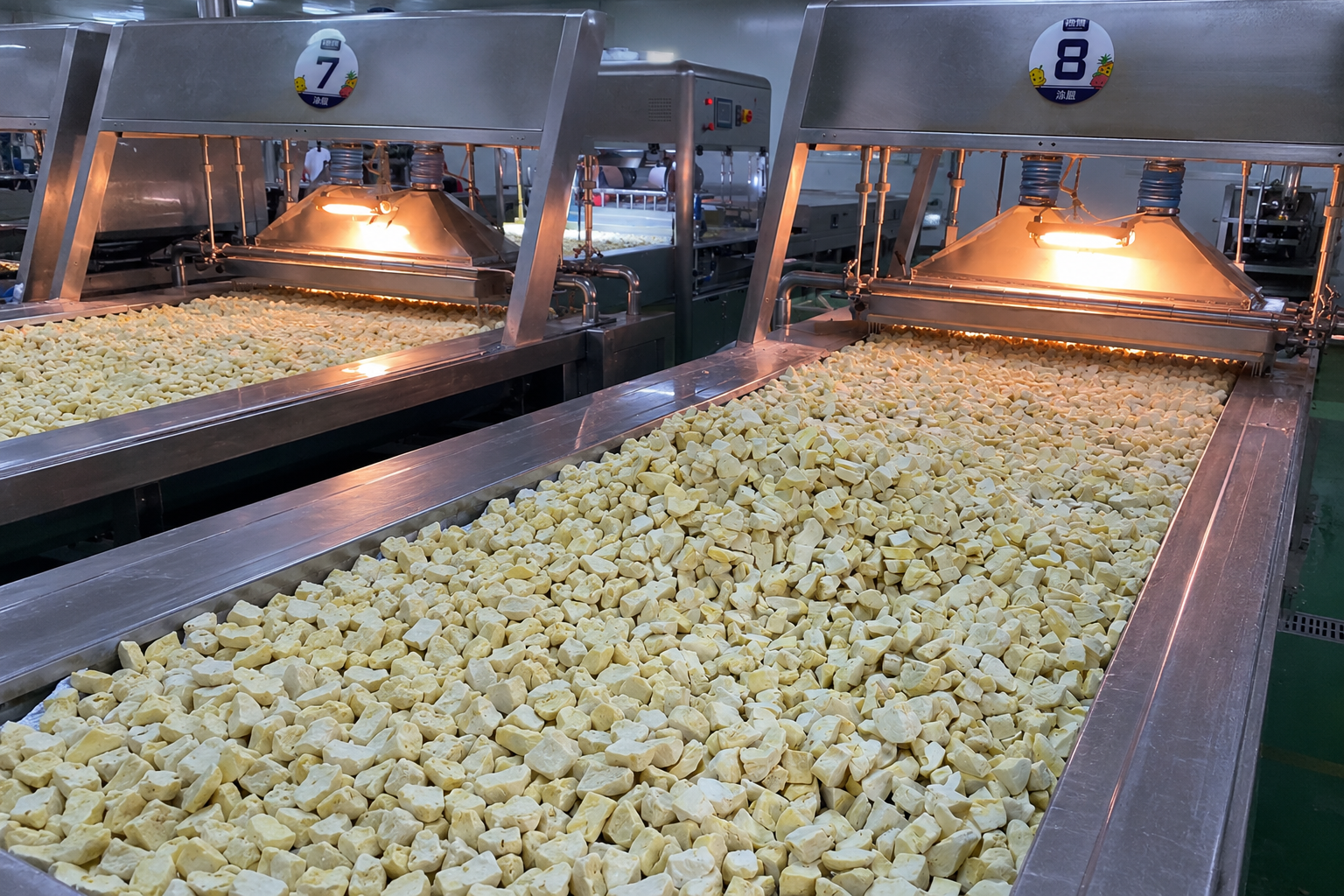
Freeze-Dried Durian Technical Details
Freeze-drying, also called lyophilization, involves freezing the fruit and removing water by sublimation under vacuum. In the product parameters described by UrSnacks, freeze-dried durian is processed at −40°C and reaches a moisture content of ≤5%. The low moisture content gives a shelf life of 12 to 18 months depending on packaging, coating, and storage conditions. Typical packaging uses aluminum foil bags to protect the product from moisture, oxygen, and light.
Customization is available across several axes:
- Variety: Thai Monthong is the standard choice; Musang King and Black Thorn from Malaysia are available for selected forms.
- Form: whole-chamber pieces, segments, dice, granules, slices, or powder.
- Cut size: durian dice from 6–10mm to 10–15mm; segments from S (L30–45 × W15 × T20mm) to L (L60–90 × W30–50mm); powder mesh from 60–80 (coarse) to 100–120 (fine).
- Coating: original, chocolate, matcha, yogurt, or other flavors; coating thickness can be adjusted.
- Packaging: retail bags from 24g to 118g, bulk foil bags from 1kg to 10kg, carton configurations, private label, and gift box design.
Reference Specifications for Bulk Durian Ingredients
| Product Form | Typical Specification | Common Application |
|---|---|---|
| Whole freeze-dried durian (pure) | 118g bag; moisture ≤5%; no added sugar or coating | Premium snacking, gifting, club stores |
| Freeze-dried durian segments | S/M/L cut sizes; 1kg foil bag | Bakery topping, premium dessert plated items |
| Freeze-dried durian dice | 6–10mm or 10–15mm; 1kg foil bag | Bakery inclusions, bubble tea topping, ice cream mix-ins |
| Freeze-dried durian powder | 60–80 / 80–100 / 100–120 mesh; 5–10kg foil bag | Ice cream, dairy, beverages, instant mixes, confectionery |
| Coated freeze-dried durian | 24g / 32g / 58g single-serve bags; 24 bags per carton | Impulse snacking, convenience retail, e-commerce |
| Frozen durian pulp | Whole seedless segments; vacuum pack; −18°C storage; 18–24 month shelf life | Ice cream, bakery filling, durian desserts, central kitchens |
Quality Control and Compliance
The manufacturer’s authorized entities hold several food safety and social compliance credentials. These include BRCGS Global Standard for Food Safety Issue 9 (certificate C723738), ISO 22000:2018 (certificate 001FSMS2400580), SMETA ethical trade audit, HALAL certificates issued by Shandong Halal Certification Service for GSO and Indonesia markets, and an Indonesian BPJPH Halal certificate covering UrSnacks branded products. The company has completed U.S. FDA Food Facility Registration (facility number 432015462) and holds a China Export Food Production Enterprise Filing (3502/08109).
For procurement teams, certification is not just a badge. The scope of these certificates covers freeze-dried fruit, coated dried fruit, and sub-packaging. That allows a buyer to source both pure and coated durian ingredients under a common compliance framework. Pre-shipment inspection is performed against the company’s enterprise standard, and buyers may request third-party inspection by agencies such as SGS, BV, Intertek, or CTI.
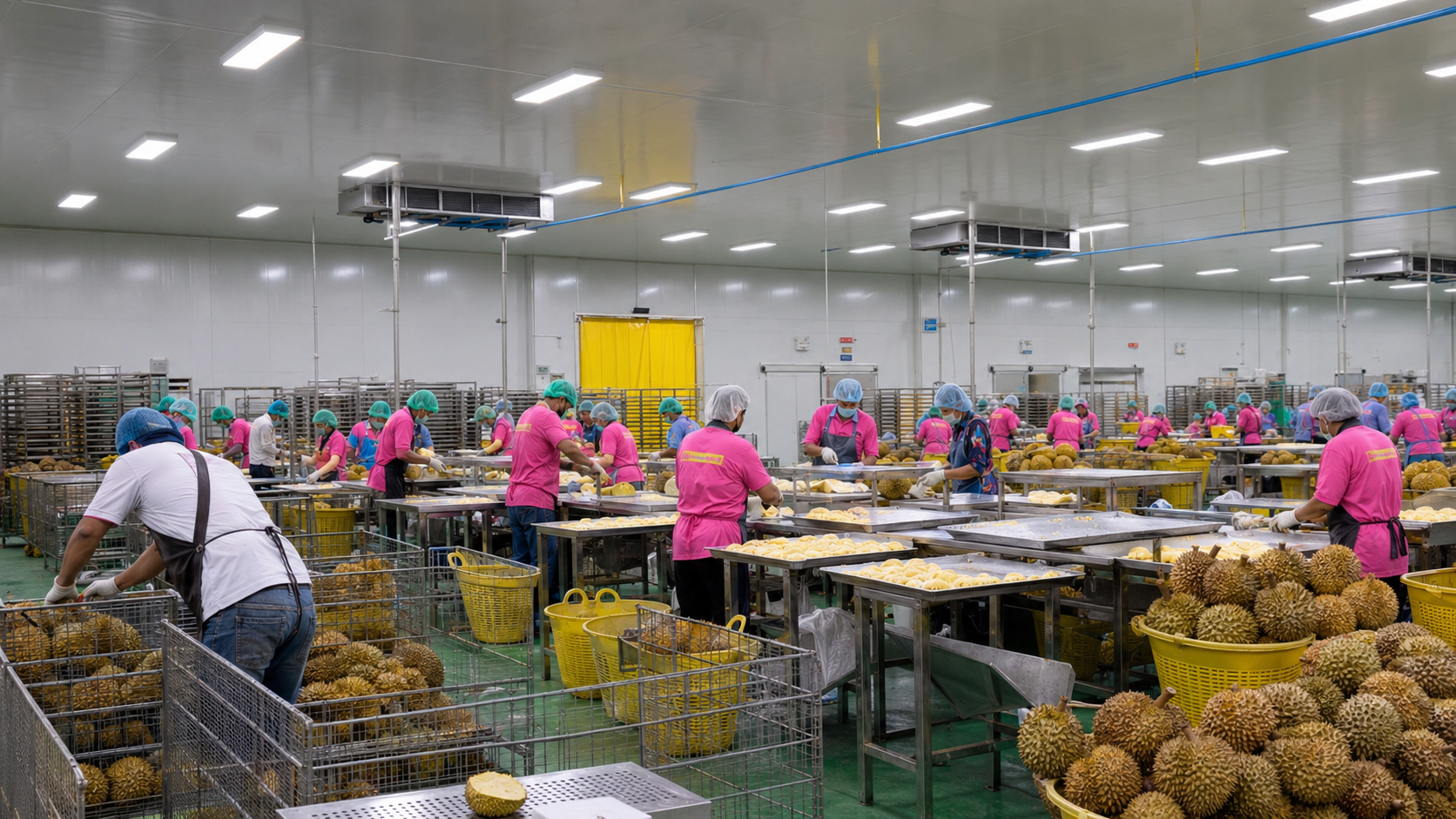
Application Scenarios: Where Different Durian Ingredient Forms Fit
Choosing the right durian form depends on the production process and finished product.
Bakery and Confectionery
Freeze-dried durian dice are practical inclusions for cakes, breads, and chocolate products because they keep their structure and do not introduce water into the dough. Durian powder can be blended into batter, cream, or custard. Whole-chamber pieces work as a visible premium topping on desserts, while durian puree from frozen pulp can be used in fillings where a smooth, rich texture is required.
Ice Cream and Dairy
Frozen durian pulp is widely used as a base in durian ice cream and durian-flavoured desserts. It provides a creamy mouthfeel and requires no rehydration. Freeze-dried durian powder, especially the 80–100 mesh grade, is positioned for ice cream and dairy mixes because it disperses quickly and adds concentrated flavour. For inclusion products such as durian ripple or variegate, diced or segment forms can be folded in at the end of production.
Beverages
Durian powder is used in smoothies, milkshakes, and new-style tea beverages. Fine mesh grades (100–120) dissolve more easily in cold liquids and are suitable for instant mixes. Durian puree can be used in foodservice recipes where operators want a ready-to-use liquid base.
Snacks and Retail
Coated freeze-dried durian in single-serve bags is an established snack format in convenience and value-retail channels. The 24g, 32g, and 58g formats correspond to different price points and consumption occasions. Pure freeze-dried durian in a larger 118g bag targets premium supermarkets, gifting, and club stores where a clean-label product with no added sugar is preferred.
The Economics of Choosing a Supplier with Integrated Capabilities
For a buyer in the evaluation stage, the practical advantage of working with a manufacturer that controls multiple forms is reduced complexity. A single supplier can handle fresh fruit procurement, freezing or freeze-drying, customized blending or coating, packaging, and export documentation. In the case of UrSnacks, this integrated model is visible in its own-brand retail operations and private-label supply. The company reports supplying two leading discount-snack groups with combined store networks above 40,000 stores, with freeze-dried durian and strawberry as hero SKUs. In a separate private-label programme, it provided multi-SKU supply to retail chains and specialty food brands, supported by batch traceability and full-chain quality control.
Overseas, the company says UrSnacks-branded products have reached nine markets across Southeast Asia, East Asia, North America, and the EU. It offers three go-to-market models: own-brand direct export, own-brand via authorized distributor, and OEM/private label. For procurement teams, this indicates that the supplier has experience with different import and food-safety frameworks, not just one export route.
Comparison with Traditional Solutions: What a Processor Changes
No single durian form is optimal for every application. The decision between fresh, frozen, and freeze-dried involves real trade-offs.
Fresh durian offers the most authentic aroma and texture. But it is seasonal, has a short shelf life, and requires careful cold-chain handling. Once ripened, fresh durian is typically usable for only 2–3 days, which is difficult for industrial production planning. Fresh fruit is also heavier per kilogram of usable pulp, increasing transportation cost.
Frozen durian pulp balances authenticity and convenience. It can be stored for 18–24 months at −18°C and, after thawing, closely resembles fresh pulp. It is the preferred base for applications that need moisture, such as ice cream, bakery fillings, and sauces. Its main limitation is the cold chain: buyers need freezer capacity throughout storage and shipping, and thawed product must be used within 24–48 hours without refreezing.
Freeze-dried durian removes the cold-chain requirement and reduces logistics weight. It is stable at ambient temperature and allows clean-label, single-ingredient declarations. However, the process changes texture to a crisp, porous structure, which is not appropriate for every finished product. It is also more energy-intensive to produce, so the unit cost is higher. For products requiring a fresh-like creamy texture, freeze-dried powder can be rehydrated, but the result is not identical to fresh or frozen pulp.
The right procurement strategy for most manufacturers is therefore a combination: frozen pulp where moisture and creaminess matter, freeze-dried forms where shelf stability, crunch, or ambient logistics matter, and fresh fruit for seasonal retail or foodservice programmes.
What to Check Before Selecting a Durian Ingredient Manufacturer
During supplier evaluation, the following points provide a structured comparison:
- Raw material traceability: Does the supplier disclose the origin and variety of durian, and can it provide certificates of origin or health certificates?
- Certification scope: Do the BRCGS, ISO 22000, HALAL, or FDA registrations cover the exact product form being purchased?
- Customization range: Can the supplier adjust cut size, coating, recipe, packaging, and private label without changing the production line?
- Batch quality data: Are moisture content, allergen status, microbiology, and pesticide residue tested and documented per batch?
- MOQ and lead time: What are the reference MOQs for bulk ingredients and OEM finished products, and what is the standard production lead time?
- Inspection and claims: Does the supplier accept third-party pre-shipment inspection, and how are quality claims handled?
Market Outlook for Durian Ingredient Sourcing
The direction is toward more structured, multi-form supply. Fresh durian will continue to be a retail product, but a growing share of volume will be processed into pulp, freeze-dried ingredients, and finished snacks. Halal certification is becoming a baseline for Southeast Asian and Middle Eastern markets, while clean-label demand encourages single-ingredient freeze-dried durian with no added sugar or preservatives. For original equipment and private-label buyers, the suppliers that can combine raw material control, process R&D, and export compliance are in a stronger position to become long-term partners.
For detailed product specifications and capability information, download the UrSnacks brochure: UrSnacks Brochure.
FAQ
UrSnacks provides OEM manufacturing, ODM product development, own-brand supply and distribution, B2B freeze-dried raw material supply, fresh and frozen fruit direct supply, and cross-border export supply chain services. ODM customization includes fruit variety, product form, coating flavour and thickness, recipe, packaging, and private label.
Yes. The standard range includes freeze-dried durian segments, 6–10mm and 10–15mm dice, powder in 60–80, 80–100, and 100–120 mesh, whole-chamber pieces, and coated formats. Other cut sizes and packaging formats are available on request.
Relevant certifications include HALAL certificates for Indonesia and GSO markets, BRCGS Food Safety, ISO 22000, SMETA, U.S. FDA food facility registration, and China Export Food Production Enterprise Filing. Buyers should confirm the certification scope covers the specific product and destination market.
Reference MOQs are approximately 550 kg for OEM finished products and approximately 184 kg for freeze-dried raw materials, with flexibility depending on product form and packaging. Standard ocean shipments are usually one 20-foot FCL, FOB Xiamen; LCL and sample orders are negotiable.
Every batch is sample-tested against the company’s enterprise standard before shipment. Buyers may request third-party pre-shipment inspection by SGS, BV, Intertek, or CTI. Retention samples are kept until the end of shelf life, and traceability documentation is available for review.