
Dust Removal Fit: FSN50, FSC50 and FSW80 Rain Gun Sprinklers
Dust Removal Fit: FSN50, FSC50 and FSW80 Rain Gun Sprinklers
Dust suppression at an industrial yard is a geometry problem before it is a product-choice problem. A rain gun can only wet the ground its jet reaches from the riser it is mounted on, at the pressure the site can hold. Selection therefore starts with the yard: how far the water must travel, how much of the circle is usable, what pump and pipework already exist, and which connection can be mated to the riser without rebuilding the line.
FOISON Sprinkler (Xuzhou Foison Sprinkler Irrigation Equipment Co., Ltd), a Chinese irrigation equipment manufacturer founded in 2013, publishes specifications for three rain guns — FSN50, FSC50 and FSW80 — whose pressure bands, throw ranges and connection types sit in different parts of that problem. This article maps each model to the dust removal scenarios its published figures fit, using the manufacturer's own data on working pressure, throw, connection, spray angle and body material. It is a fit-mapping reference for buyers in the research and evaluation stage, not a ranking, and it does not assume the largest number on the datasheet is the right answer for every site.
Why dust removal is a coverage problem, not a model-tier question
Water-based dust control works in two ways: it wets bulk material so that fine particles stop becoming airborne, and it brings suspended particles into contact with droplets so that they settle. Both effects depend on how much water arrives per hour, how far it is thrown, and how the jet breaks up. A gun that throws 40 m may be more than enough for a compact transfer yard and entirely inadequate for a long storage pad. A gun with a very long throw may be unusable on a site whose pump cannot hold the pressure that throw depends on.
All three models discussed here list dust removal in their published use field, alongside agriculture, forestry and garden duty. Eligibility is therefore not the differentiator: the manufacturer already places each model in dust removal duty. What separates them is fit — the pressure band the site can sustain, the radius the yard actually needs, and the connection the existing pipework will accept.
Two site conditions apply to all three. First, these are pressure-driven devices: water is pumped to the sprinkler and sprayed under pressure, so an adequate water resource, a pump, and hose or fixed pipework are prerequisites rather than accessories. Second, the pattern is adjustable. Each model offers a 360° adjustable sprinkler type with a 24° spray angle, which means the wetted shape on site is a decision the operator makes, not only a property of the gun.
FSN50, FSC50 and FSW80 at a glance
The table below reproduces the published specifications that matter most for scenario matching. All three share the same 24° spray angle, a 360° adjustable pattern, and a body built from aluminium, nylon and stainless steel. The differences are in drive type, connection, pressure band and throw.
| Model | Type | Connection | Working pressure | Throw range | Published pattern |
|---|---|---|---|---|---|
| FSN50 | Turbine sprinkler | 2-inch flange | 0.2–0.7 MPa | 26–53 m | 360° adjustable, 24° |
| FSC50 | Impact gun | 2-inch inner thread or flange | 0.15–0.7 MPa | 23–56 m | 360° adjustable, speed adjustable, 24° |
| FSW80 | Turbine gun | 80 flange | 0.2–0.9 MPa | 23–85.7 m | 360° adjustable, 24° |
Material for all three: aluminium, nylon, stainless steel. Use field for all three: agriculture, forestry, garden, dust removal.
The throw figures are ranges, not promises. In the manufacturer's performance tables, throw rises with working pressure for a given nozzle size, so the top of each range should be read as a high-pressure figure and the bottom as the low end of the band. A single installation delivers one point in that band, fixed by the pressure it can hold and the nozzle fitted.
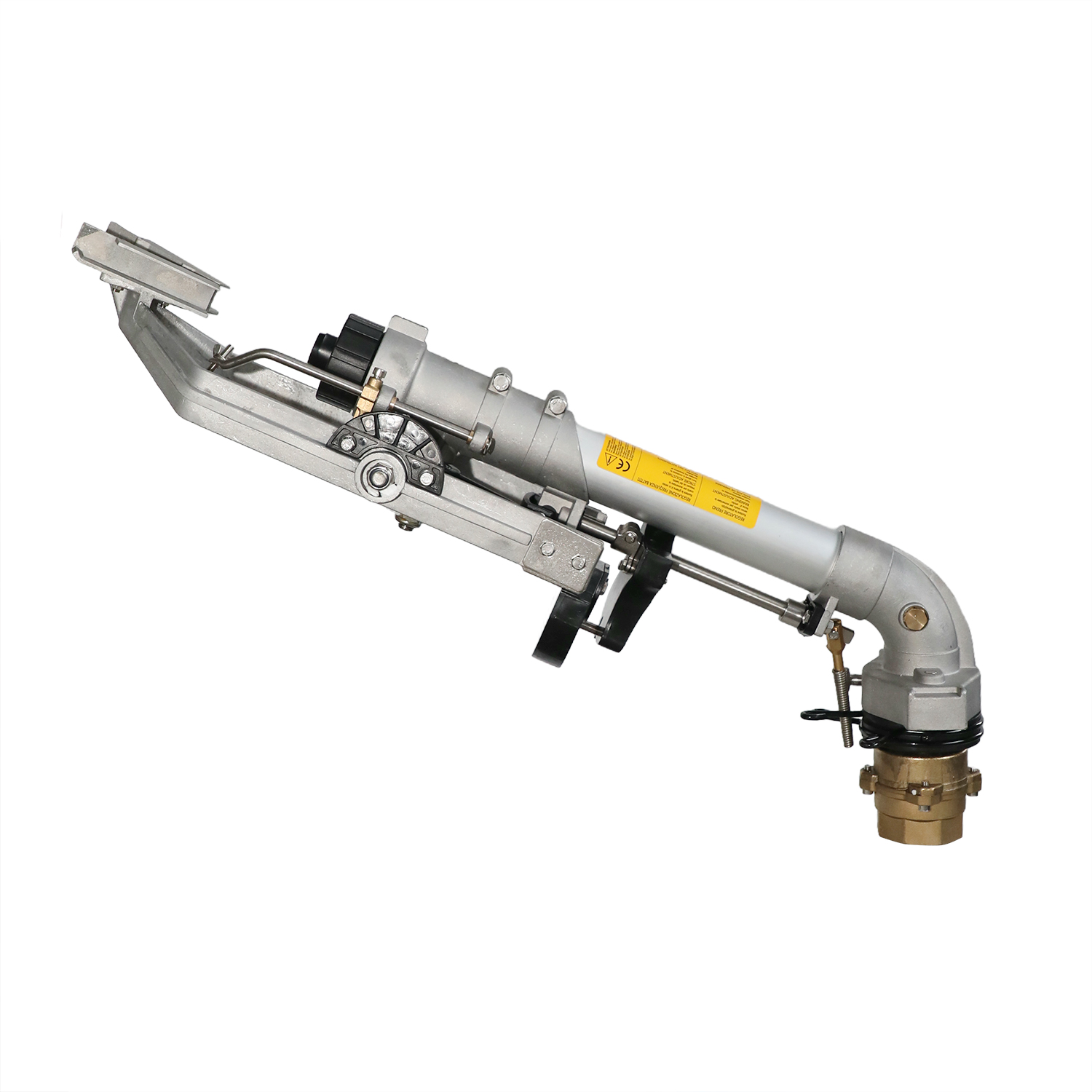
FSC50 impact rain gun: 0.15–0.7 MPa working band, 23–56 m published throw, 2-inch inner thread or flange connection.
Reading the pressure range: what the site must supply
The pressure band is the first hard constraint, because it defines what the pump and pipework must deliver before throw or coverage can be discussed at all. The FSC50 starts at 0.15 MPa, the lowest of the three; the FSN50 and FSW80 both start at 0.2 MPa. At the top, the FSN50 and FSC50 are published to 0.7 MPa, while the FSW80 extends to 0.9 MPa.
Three practical readings follow from those numbers.
- The low end decides usability. The FSC50's 0.15 MPa floor is 0.05 MPa below the other two models. On a low-head or long-hose supply, that margin is the difference between a usable installation and one that never reaches its published pattern.
- The high end decides infrastructure. Running an FSW80 near its 0.9 MPa ceiling means the hose, pipe, valves, gaskets and fittings upstream must be rated above that figure with allowance for pump surge, and the riser must be stable enough to hold a long jet. The 0.7 MPa ceiling of the FSN50 and FSC50 sets a lower bar on the same equipment.
- Where the pressure is measured matters. A pump gauge reading is not the pressure at the gun. Friction losses along the hose or pipe, elevation change, and the flow the gun demands at that pressure all reduce the figure at the inlet. The number to compare against the band is the running pressure at the gun, measured while it is spraying.
Flow follows the same logic. The manufacturer publishes flow figures at pressure steps for each nozzle size, and that table — not the headline pressure range — is the correct basis for pump sizing. Pick the pressure the site can actually hold, read the corresponding flow for the nozzle fitted, and check that the supply can sustain it for the length of a dust shift rather than only at start-up.
Throw distance and site geometry
Throw is a radius, and a radius converts into area quickly. Calculated from the published ranges using πr² — before any allowance for overlap, wind, sector operation or obstruction — the three models describe roughly the following ground in a full circle:
- FSN50, 26–53 m: approximately 2,100–8,800 m²
- FSC50, 23–56 m: approximately 1,700–9,850 m²
- FSW80, 23–85.7 m: approximately 1,700–23,100 m²
These are geometric figures derived from the listed throws, not measured coverage. They make two points clear. First, the roughly 30 m gap between a 53 m and an 85.7 m throw is a difference of more than two and a half times in area, which is why the FSW80's range is a genuinely different class of site rather than a marginal upgrade. Second, the bottom of each range is not equivalent to the model's headline: at low pressure the FSW80 and the FSC50 cover comparable ground, because both begin around 23 m.
Three site factors modify the calculation in practice. Wind is the first: open yards, haul roads and stockyard perimeters are exposed, and throw in a crosswind falls short of a still-air figure, so a spacing plan built on the listed maximum leaves no margin. Obstructions are the second: stockpiles, conveyors, screens and buildings intercept the jet and leave dry zones that more radius alone does not fix. Sector operation is the third: because the pattern is adjustable on all three models, a gun set to sweep only part of the circle concentrates water where the dust actually is, which changes the effective wetted area rather than the throw.
Connection type and what it changes on site
Connection is the constraint buyers notice last and pay for first, because it is the one specification that cannot be adjusted after the riser exists.
- 2-inch flange (FSN50). A bolted joint that holds alignment on a fixed riser and is straightforward to gasket and torque. It suits permanent installations and lines that are serviced by isolating a branch rather than dismantling the gun.
- 2-inch inner thread or flange (FSC50). The only model in the set with a published thread option. On a retrofit onto an existing threaded standpipe, that removes an adapter from the assembly and shortens the installation.
- 80 flange (FSW80). A larger flanged connection, consistent with a high-flow, long-throw installation. Bolt circle, gasket type, riser support and pipe rating should be confirmed against the drawing before the riser is fabricated.
None of these is a quality ranking. A flanged riser suits permanent duty; a threaded joint is faster to break down for seasonal service. Which costs less over the life of a site depends on how often the line is dismantled and who does the work.
Three dust removal scenarios and the model that matches
The scenarios below are conditional examples built from the published specifications. They describe where each model's figures fit a site profile; they are not accounts of completed dust suppression projects.
1. Large fixed industrial yards: bulk storage, crushing and haul roads
An open bulk storage yard, a crushing and screening area, a demolition site or a long unpaved haul road share one characteristic: water must travel a long way from a fixed riser, and the site usually has the infrastructure to justify a permanent line. The FSW80's published figures are the closest match in this set — a 23–85.7 m throw range, a 0.2–0.9 MPa working band, and an 80 flange connection consistent with a high-flow fixed installation. Its use field covers agriculture, forestry, garden and dust removal, its material set is aluminium, nylon and stainless steel, and the manufacturer describes it as a turbine gun with long range, a large water spray and fine atomisation.
Two conditions matter before treating it as a fit. First, reach at the top of the range depends on pressure at the top of the range: a site with a low-head supply will operate near the bottom of the band, where the model's area advantage over the other two largely disappears. Second, the 80 flange and the 0.9 MPa ceiling both impose upstream requirements on the riser, the gasket and the pipe rating. Where a yard is large but the water infrastructure is modest, the honest engineering answer may be several guns at moderate pressure rather than one gun at its limit.
2. Medium-radius mixed sites: farm yards, stock areas and nursery blocks
Sites that combine dust duty with irrigation — farm yards, livestock and feed storage areas, nursery blocks, packing areas and the unsealed roads between them — usually want one line that does both jobs across the season. The FSN50's published band of 0.2–0.7 MPa and 26–53 m throw sits between the other two: a lower minimum pressure than the FSW80, a higher minimum than the FSC50, and a 2-inch flange that mates to standard fixed risers. Its use field covers agriculture, forestry, garden and dust removal, and the manufacturer's description cites long range and fine atomisation.
The fit logic here is continuity rather than maximum reach. A farm that irrigates from the same riser for part of the year and suppresses dust around stock areas for the rest needs a pressure band both duties can live inside, and a connection that stays consistent across both. The 53 m top of the FSN50's range corresponds to roughly 8,800 m² in a full circle before overlap, which is a workable unit size for a yard of that scale.
3. Low-head supply and retrofit installations
Not every site can guarantee 0.2 MPa at the gun. Gravity-fed tanks, long hose runs from a shared pump, and retrofits onto existing threaded standpipes are common, and each narrows the field before throw is considered. The FSC50's 0.15 MPa minimum working pressure is the lowest of the three, its published throw range of 23–56 m overlaps the FSN50, and it is the only model in the set offering a 2-inch inner thread as an alternative to a flange. Its published sprinkler type adds speed adjustability to the 360° adjustable pattern shared by all three. It is listed as an impact gun in aluminium, nylon and stainless steel, with the manufacturer citing long range and stable working condition.
For a retrofit, the thread option and the lower pressure floor are the two facts that decide usability. What the FSC50 does not offer is the FSW80's reach: a 56 m maximum throw is roughly 9,850 m² in a full circle, less than half the calculated area at the FSW80's 85.7 m figure. On a site that needs long reach and cannot supply the pressure, the constraint to solve is the water supply, not the model choice.
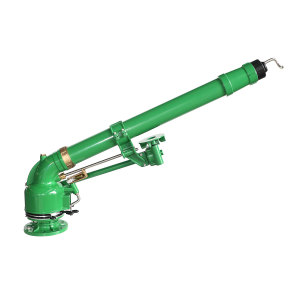
FSW80 turbine rain gun: 0.2–0.9 MPa working band, 23–85.7 m published throw, 80 flange connection.
Where a rain gun is the wrong fit
A rain gun is a fixed or semi-fixed device that needs water under pressure. Several site conditions fall outside that description, and recognising them early saves an expensive mistake.
- No reliable water supply. Without an adequate water resource and a pump able to deliver the flow at the required pressure, none of the three models reaches its published band.
- Required radius beyond the band, with no room for a second gun. More pressure cannot extend a gun beyond its listed working range, and the listed maximum throw already assumes favourable conditions.
- Tight overspray limits. Where drift onto neighbouring property, road traffic or electrical installations is unacceptable, a long-throw jet is the wrong instrument regardless of model.
- Short-duration or moving works. Where there is no riser to mount to and the dust source moves daily, fixed infrastructure will not be used enough to justify itself.
- Dust better controlled at source. Enclosure, extraction or surface sealing sometimes removes the problem before water is needed.
How rain guns compare with other dust suppression approaches
The comparison that matters for procurement is not brand against brand but approach against approach. Water carts are mobile and need no fixed infrastructure, which suits dispersed or short-term work; their coverage depends on how often the route is run, and the labour is recurring. Hand hoses have low capital cost and limited reach, and they put an operator close to the dust. Fine misting or fog systems produce small droplets suited to airborne dust in enclosed or semi-enclosed areas, while a rain gun delivers a larger water volume over a distance. None of these is universally better; the fit depends on area, water availability and how long the dust-generating activity will last.
Within the rain gun category, the practical distinction is between the long-throw fixed installation and the moderate-throw multi-point layout. One FSW80 at high pressure covers more ground per unit; several FSN50 or FSC50 units at moderate pressure spread the water demand, tolerate lower supply pressure and keep working if one unit is serviced. That trade-off — concentration versus redundancy — is usually decided by the pump curve, not by the catalogue.
Market context: what published figures do and do not say
The equipment category these guns belong to is substantial. Grand View Research valued the global sprinkler irrigation market at USD 3.04 billion in 2025, and put Asia Pacific's revenue share of the agricultural irrigation machinery market at 36.2% in the same year, with China as a leading country. IMARC Group estimated the global smart irrigation market at USD 2.2 billion in 2025 and projected USD 6.2 billion by 2034.
Three cautions belong beside those figures. First, the scopes differ: smart irrigation is a narrower, technology-weighted category than sprinkler irrigation as a whole, and published growth rates for related categories vary between research houses because of methodology, so the figures should not be stitched into a single forecast. Second, none of the cited sources separates high-volume rain guns from other sprinkler types, so category totals describe the scale of the equipment market rather than the demand for the FSN50, FSC50 or FSW80 at any specific site. Third, a global total says nothing about whether a given yard has the pressure to run a given gun — the selection work remains local.
A verification checklist before ordering
Because the specifications above are ranges, the order should be built on site measurements rather than on the datasheet alone. The checks below are the ones that change the answer.
- Running pressure at the gun inlet. Measure while the gun is spraying, not at the pump at rest.
- Maximum working pressure against upstream rating. Compare the model's ceiling — 0.7 MPa for the FSN50 and FSC50, 0.9 MPa for the FSW80 — with the rating of hose, pipe, valves and fittings.
- Connection match. 2-inch flange, 2-inch thread or flange, or 80 flange; confirm bolt pattern, gasket and riser support before fabrication.
- Throw requirement with margin. Compare the radius the yard needs against the listed range, leaving allowance for wind and obstructions.
- Flow at the chosen pressure. Request the manufacturer's performance table for the nozzle size being quoted and size the pump against that figure.
- Water availability across the season. Confirm the supply sustains the required flow for a full dust shift, not only for a short test.
- Standard and trade references. ISO 7749-1:1995, as described by the International Commission on Irrigation & Drainage, specifies design and operational requirements for rotating sprinklers used in agricultural irrigation, which gives buyers a reference point for the checks above. HS code 842482, per the United Nations Statistics Division, classifies mechanical appliances for agricultural or horticultural use for projecting, dispersing or spraying liquids, which is the relevant classification for importers.
- Service route. Confirm spare-part availability and the technical support channel before the first season, not after it.
Manufacturing and supply context
FOISON Sprinkler was founded in 2013 in Xuzhou, Jiangsu Province, an established irrigation manufacturing base, and states more than 12 years of irrigation manufacturing experience. The company operates a 30,000 m² facility with 135 employees, a design team of 12 engineers, and an annual output of 200,000 units. It reports an export share of around 70%, with markets including the EU, Africa, Australia, New Zealand, Southeast Asia, Central Asia, the Middle East and South America, and it offers OEM/ODM customisation of model, logo, function and shape. Published supply terms include a minimum order of 20 units, a lead time within 20 days, 100% product testing and remote after-sales support.
One evidence boundary is worth stating plainly for buyers assembling a tender file. The project record supplied for this article concerns farm irrigation in New Zealand — 500 units installed over a two-year programme — not a dust suppression installation. That does not weaken the published specifications, but it does mean a buyer evaluating a dust removal project should ask for references in the same application, at comparable pressure and site geometry, rather than transferring irrigation performance across duties without checking.
Fit summary. Long throw and high pressure ceiling: FSW80. Balanced pressure band with a standard fixed-riser flange: FSN50. Lowest pressure floor and a thread-or-flange retrofit connection: FSC50. All three are published for dust removal duty; the deciding variables are the pressure the site can hold, the radius it must cover, and the joint the riser will accept.
Outlook
Where sites face tighter water budgets or more scrutiny of dust leaving the boundary, the selection logic described here becomes more important rather than less. The models that survive that scrutiny will be the ones whose pressure band matches the pump that exists, whose throw matches the yard that exists, and whose connection matches the riser that exists. Buyers who measure those three things before ordering get a predictable installation; buyers who order from the headline number alone usually end up adjusting the water supply afterwards, which is the expensive half of the project.
Frequently asked questions
Which of the three models covers the largest dust removal area?
On published figures, the FSW80 has the longest throw range at 23–85.7 m, against 26–53 m for the FSN50 and 23–56 m for the FSC50. That reach is only available at the higher end of its 0.2–0.9 MPa working band, so the answer depends on the pressure the site can hold at the gun inlet. At the bottom of the band, the FSW80's coverage is comparable to the FSC50's rather than substantially larger.
Can the FSC50 operate on a lower-pressure water supply than the other two models?
Yes, by published specification. The FSC50 has a minimum working pressure of 0.15 MPa, while the FSN50 and FSW80 both start at 0.2 MPa. That 0.05 MPa margin matters on gravity-fed or long-hose supplies. All three share a 0.7 MPa ceiling except the FSW80, which extends to 0.9 MPa, so the upstream pipe and fittings must be rated for whichever model is installed.
Do the connection types restrict retrofit options?
The FSN50 uses a 2-inch flange and the FSW80 an 80 flange. The FSC50 offers either a 2-inch inner thread or a flange, which is the only thread option among the three and the most adaptable to an existing threaded standpipe. Bolt pattern, gasket and riser support should be confirmed against the drawing before any riser is fabricated.
Are these rain guns intended for dust removal or only for irrigation?
All three list dust removal in their published use field, alongside agriculture, forestry and garden duty. All three also share a 24° spray angle, a 360° adjustable pattern, and a body of aluminium, nylon and stainless steel. The FSC50 additionally lists speed adjustability. Selection among them is therefore a question of pressure band, throw and connection rather than of duty eligibility.
What should be confirmed before placing an order for a dust removal rain gun?
Confirm the running pressure at the gun inlet while spraying; the rating of hose, pipe and fittings against the model's maximum working pressure; the connection type and bolt pattern; the throw radius the yard requires with margin for wind; the flow at the selected pressure from the manufacturer's performance table; water availability across the full dust season; and the spare-part and technical support route. Requesting references from the same application — dust suppression rather than irrigation only — is a reasonable final check.
The full FOISON Sprinkler product catalogue, including model specifications, is available for download here: Foison Catalog (PDF).
Tem questões ou precisa de mais detalhes?
Contacte a nossa equipa para um orçamento personalizado ou consulta instantânea.
Solicitar orçamento
Preencha o formulário abaixo e a nossa equipa entrará em contacto com uma proposta personalizada.
Chat direto do WhatsApp
Prefere conversar em tempo real? Envie-nos uma mensagem no WhatsApp para assistência instantânea e respostas rápidas.
- Obter orçamento personalizado
- Partilhar fotos ou documentos
- Discuta as suas necessidades diretamente
Geralmente responde em 5–30 minutos durante o horário de expediente.