
E0/ENF Panels in Whole-House Cabinetry: What to Verify
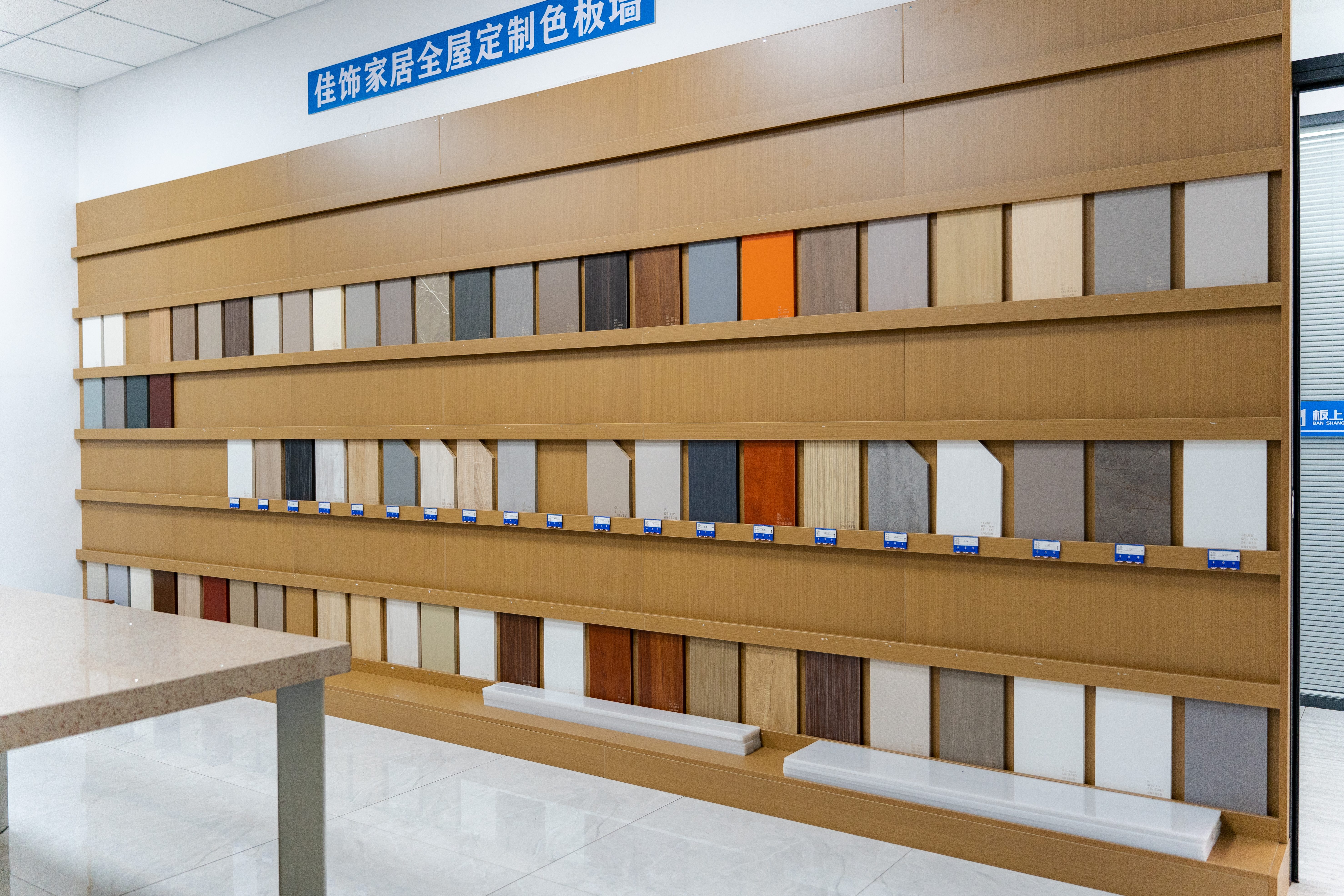
Formaldehyde emission class is one of the few material properties in a whole-house custom cabinetry package that repeats in every room. The boards behind custom kitchen cabinets, custom bathroom vanity cabinets, custom wardrobe cabinets, custom entryway cabinets and built-in living room cabinets come from the same engineered wood panel supply, so a single specification decision - whether those boards are E0 or ENF - is reproduced across the entire project.
E0 and ENF are formaldehyde emission grades for engineered wood panels. They describe the board: not the finish, not the hardware, and not the installation. Buyers working through research and evaluation should therefore verify the claim in three places - at panel level, at model level across the whole range, and at batch level before fabrication begins.
This reference explains what the two grades regulate, where the requirement sits inside a whole-house cabinetry system, how it is delivered in production, where the claim stops, and how buyers can confirm it before mass production rather than after delivery.
Why Panel Emission Class Became a Procurement Question
For most of the past two decades, panel specification in custom cabinetry was written as thickness plus face finish. The emission class of the core board was treated as an internal supplier matter - occasionally mentioned in a sales conversation, rarely written into a purchase document. That has shifted. Indoor air quality expectations, project handover documentation and multi-unit residential programmes have pushed panel emission class toward the specification sheet.
The commercial context supports the shift. China's exports of wooden kitchen furniture (HS 940340) reached USD 732 million in 2023, according to TrendEconomy data compiled from UN Comtrade. The global cabinet market is projected to reach USD 148.09 billion by 2026, based on Mordor Intelligence's Cabinet Market Size, Growth, Trends, Share Report 2031. More volume means more batches moving through more projects, and more buyers asking for a document instead of an assurance.
The opportunity for buyers is equally practical. Once the panel grade is treated as a verifiable line item, it becomes comparable between suppliers and it stops being a claim that is only tested after installation. The risk it removes is specific: a whole-house package contains dozens of panel parts, and one undocumented board specification can affect every room in the project at the same time.
E0 and ENF: What the Two Grades Actually Regulate
E0 and ENF are formaldehyde emission grades applied to engineered wood panels such as MDF and particle board. In the tier structure commonly referenced for wood-based panels, E0 designates a low-emission class and ENF designates the strictest tier within the same structure. Both describe the emission behaviour of the board itself - measured at the panel, not at the finished cabinet and not in the room.
Three practical consequences follow for anyone specifying or buying a whole-house package:
- The claim is a board property. It must be attached to the panel that becomes a carcass side, a shelf, a door or a drawer box - not only to the assembled cabinet.
- The claim is batch-bound. Emission performance comes from the board producer's resin system and pressing process. Buyers should expect documentation tied to the production batch rather than a single undated statement applied to all future shipments.
- Non-panel parts are out of scope. Aluminium accessories and stone countertops used in the same cabinetry assembly are not wood-based panels and are not governed by E0 or ENF.
One boundary is worth stating plainly, because it is the point where expectations most often drift. E0 and ENF regulate formaldehyde emission from the panel. They do not regulate the adhesives, sealants and site-applied finishes used after delivery, and they do not by themselves guarantee a room-level air quality outcome. Buyers who need whole-room performance should treat the panel grade as one controlled input inside a broader project requirement rather than as a complete solution.
Where the Specification Applies Across a Whole-House Package
In a whole-house programme, the panel specification is shared rather than written model by model. Nantong Jiashi Integrated Home Co., Ltd., a whole-house custom cabinetry manufacturer established in 1998 and formerly known as Shanghai Jiashi Wood Industry Co., Ltd., organises its range into ten model groups, from JS-CUSTOM-001 to JS-CUSTOM-010.
| Model | Category | Typical zone in a residential project |
|---|---|---|
| JS-CUSTOM-001 | Sideboard / Buffet Cabinet | Dining and living zones |
| JS-CUSTOM-002 | Custom Kitchen Cabinets | Kitchen |
| JS-CUSTOM-003 | Storage Cabinets | Living, dining and utility storage |
| JS-CUSTOM-004 | TV Cabinets | Living room and built-in wall units |
| JS-CUSTOM-005 | Entryway Cabinets | Entry and hallway |
| JS-CUSTOM-006 | Study Room Cabinets | Study and home office |
| JS-CUSTOM-007 | Tatami Storage Bed | Multi-purpose bedroom and storage |
| JS-CUSTOM-008 | Bathroom Vanity Cabinets | Bathroom |
| JS-CUSTOM-009 | Wardrobe Closets | Bedroom wardrobes |
| JS-CUSTOM-010 | Master Bedroom Full Sets | Master bedroom |
All ten groups carry the same material and process specification:
- Panel thickness: 18 mm standard, customizable from 9 mm to 25 mm
- Production: automated processing on German HOMAG production lines
- Machining precision: plus or minus 0.1 mm dimensional tolerance
- Surface finishes: wood grain, matte, lacquer and stone texture
- Materials: cabinet panels, engineered wood boards, MDF / particle board, aluminium accessories and stone countertops
- Panel emission: eco-friendly engineered wood panels complying with E0/ENF formaldehyde emission standards
The practical reading for a buyer is straightforward. Because JS-CUSTOM-001 through JS-CUSTOM-010 share one panel specification, a compliance check performed at panel level covers the entire package - and the parts of the assembly that are not panels, such as stone countertops and aluminium accessories, should be listed separately as non-panel components rather than blended into the same claim.
One further detail belongs in the materials conversation. In engineered wood panel construction, cut edges and drilled holes are the points where the board core is exposed, and these surfaces are normally closed with edge banding or sealing as part of the standard production flow. For CNC-finished and edge-banded panel work, buyers can confirm edge treatment during the same sampling visit at which panel samples are reviewed.
How the E0/ENF Specification Is Delivered in Production
A material declaration is only as strong as the production system behind it. Nantong Jiashi Integrated Home Co., Ltd. manufactures whole-house custom cabinetry from a 36,000 square metre facility, with 60 employees, an annual output of 10,000 units and a 10-engineer design and R&D team. Panels are processed on German HOMAG automated production lines introduced during a 2017 plant upgrade that also brought in Excitech equipment.
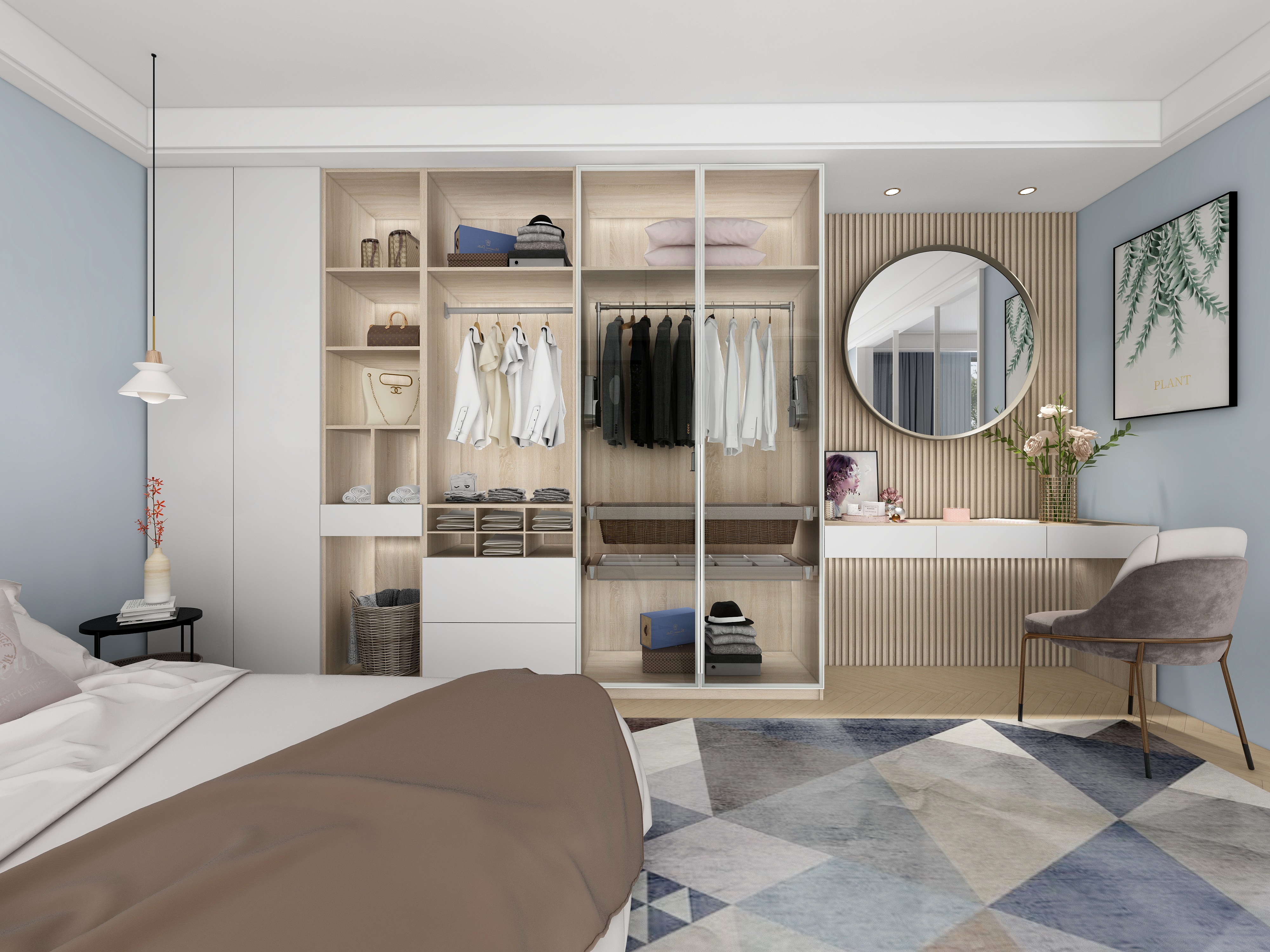
For buyers, three elements of that setup matter to a panel compliance review. Programmed cutting on the automated lines holds a plus or minus 0.1 mm dimensional tolerance, which keeps carcass, door and drawer parts consistent across a production batch. The panel thickness range - 18 mm standard with 9 mm to 25 mm customization - allows a single board sourcing path to serve different cabinetry types in one project. And the finish programme of wood grain, matte, lacquer and stone texture is applied to panels drawn from the same E0/ENF-compliant material specification used across the range.
Documented process control supports the material claim. The company has maintained ISO 9001 quality management system certification since 2003, and its quality control runs through material inspection, production inspection and final quality inspection. Production is organised around OEM, ODM and project customization, with a lead time of 30 to 45 days and project-based MOQ; approximately 10% of output is exported to Europe, North America, the Middle East and Asia.
Supply history reinforces the entity picture rather than the panel claim itself: over more than a decade the company has supplied B&Q, a member of the UK's Kingfisher Group, and China Greenland Group, and it has participated in drafting national and industry standards for custom cabinetry and interior decoration.
A Five-Step Verification Framework for Buyers
Buyers evaluating a whole-house custom cabinetry supplier can reduce the E0/ENF question to five checks, ordered by the point in the project at which each one occurs.
- Panel-level declaration. Ask for the grade statement attached to the engineered wood panels - MDF and particle board - rather than to the finished cabinet. A cabinet-level claim cannot be audited at the material stage.
- Written model scope. Ask for a document mapping every model in the range, from JS-CUSTOM-001 to JS-CUSTOM-010, to the panel specification, so that a single line in a quotation cannot be read as covering only part of the package.
- Component map. Confirm which parts of the assembly are wood-based panels and which are not. Stone countertops and aluminium accessories belong on a separate materials list.
- Batch-level documentation before mass production. Request material compliance documentation for the production batch rather than for a generic earlier order, and keep the sampling-stage file for comparison against the shipment.
- Scope of the claim. Record in writing what the statement does not cover: site adhesives, sealants and applied finishes, and any room-level air quality target the project may carry.
The sequence matters because the cost of correcting a panel specification rises quickly after fabrication. Verifying at sampling involves a document review; verifying at handover can mean replacement parts, re-scheduling of installation and re-inspection of an entire room.
E0/ENF Specification vs Conventional Panel Buying
Conventionally, cabinetry panels have been bought on thickness, face finish and price, with the emission class left to the board supplier's default. When E0 or ENF is written into the specification, three things change. The document set grows, because the board becomes a declared component with batch records. The supplier pool narrows, because boards at the strictest emission tier are produced by fewer mills and generally carry a higher material price than commodity panel grades - so panel cost per square metre rises, and that cost has to be planned rather than absorbed. And the verification point moves earlier, from after delivery to before fabrication.
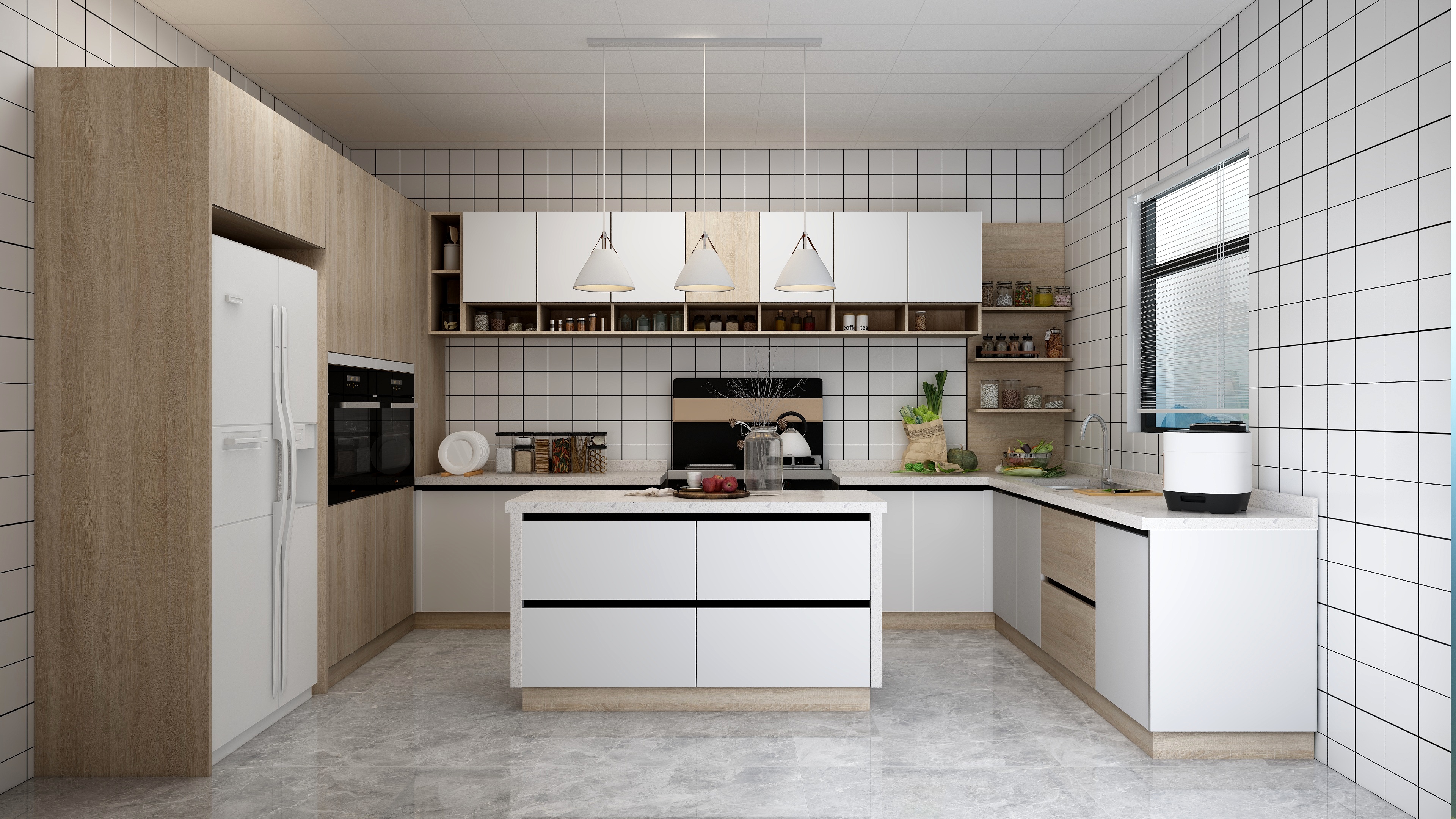
What does not change is equally important. E0 or ENF says nothing about load-bearing behaviour, moisture resistance or surface durability; those depend on board type, panel thickness and finish. The grade also does not remove other emission sources in a room, and it does not make two suppliers equivalent on tolerances, edge finishing or delivery reliability.
There is also a commercial boundary that buyers should expect and plan for. Where a project budget is fixed, a supplier may apply the stricter grade selectively - for example to carcasses drawn from one board type while decorative parts follow a different panel path. That is not automatically a compliance failure, but it does mean the scope of the claim has to be written down and matched against the component list in the quotation.
Application: Where Panel Compliance Weighs Most by Room
Panel compliance is one specification, but its weight varies by room because board volume, enclosure and ventilation differ.
- Custom kitchen cabinets (JS-CUSTOM-002) normally carry the highest concentration of panel parts in a home, in a space with heat and moisture variation.
- Custom bathroom vanity cabinets (JS-CUSTOM-008) sit in a small, humid enclosure that is often poorly ventilated.
- Custom wardrobe cabinets (JS-CUSTOM-009) and master bedroom full sets (JS-CUSTOM-010) present large board-lined internal surfaces relative to the room they occupy.
- Entryway cabinets (JS-CUSTOM-005), TV cabinets (JS-CUSTOM-004) and storage cabinets (JS-CUSTOM-003) often place several cabinetry groups in one continuous open-plan space.
- Study room cabinets (JS-CUSTOM-006) and tatami storage beds (JS-CUSTOM-007) combine workspace and storage functions inside compact rooms.
In multi-material assemblies the compliance map expands. Sintered stone and porcelain countertops are increasingly used in high-end cabinetry for their non-porous and bacterial-resistant properties, according to ResearchAndMarkets' U.S. Countertop Market Intelligence Report 2025-2030, and these surfaces sit alongside engineered wood panels in the same unit. A buyer's material review should separate panel compliance from countertop performance rather than treat the finished unit as a single claim.
Project type changes the documentation burden as well. Residential interior design programmes, apartment projects and hotel interiors use the same panels under different handover rules, and in hotel and multi-unit work the compliance file is often reviewed by a third party before installation. Experience with large-scale supply of 50 or more residential units, and a stated service life of 10 to 15 years for delivered cabinetry, illustrate the horizon over which material declarations tend to be re-checked during refurbishment.
Market Trend: Compliance as a Specification Line
Three data points describe where the market is heading. The global cabinet market is projected to reach USD 148.09 billion by 2026 (Mordor Intelligence). Within that market, the custom kitchen cabinet segment was valued at USD 68.5 billion in 2025 and is expected to reach USD 95.2 billion by 2034 (Dataintelo, Custom Kitchen Cabinets Market Research Report 2034). China's exports of wooden kitchen furniture reached USD 732 million in 2023 (TrendEconomy / UN Comtrade, HS 940340).
Two interpretations are relevant to material compliance. First, growth is concentrated in the custom and whole-house segment, where specifications are written project by project - and written specifications attract written verification. Second, exporters serving several regions face more than one regulatory audience for the same panel, so a board choice that satisfies one market's expectation is not automatically the right choice for another. That combination pushes emission class from a sales talking point to a quotation-stage line item.
Future Outlook
Panel compliance is moving from a document supplied on request to a document expected by default. Four changes are visible in how buyers structure their material reviews.
- Batch-level traceability as standard. Buyers increasingly ask for the production-batch record rather than a generic certificate, because the batch is the unit that ships.
- Compliance checked at sampling. The material review is merging with sample approval, so that sample panels and production panels can be compared on the same document set.
- Multi-material declarations. As stone, aluminium and panel components are combined in one unit, declarations are organised by material class inside a single package.
- Earlier integration with drawings. Emission class is being shown on the panel schedule next to thickness and finish, which makes it a design-stage decision rather than a procurement afterthought.
For manufacturers, this direction favours producers with documented process control, because a claim has to be traceable through cutting, edge banding and assembly rather than only through the board mill's paperwork. Nantong Jiashi Integrated Home works from that position: more than 28 years of operation since 1998, ISO 9001 quality management system certification maintained since 2003, participation in drafting national and industry standards for custom cabinetry and interior decoration, and membership of the Shanghai Building Materials Industry Association alongside a vice-president and expert committee role at the Shanghai Interior Decoration Association.
FAQ
What is the difference between E0 and ENF in cabinetry panels?
Both are formaldehyde emission grades for engineered wood panels. In the tier structure commonly referenced for wood-based panels, E0 designates a low-emission class and ENF designates the strictest tier within the same structure. Both describe the board itself - not the finished cabinet, the installation or the room.
Which parts of a whole-house custom cabinetry package carry the E0/ENF requirement?
The wood-based panel components: engineered wood boards, MDF and particle board used for carcasses, shelves, doors and drawer boxes across the model range, from JS-CUSTOM-001 to JS-CUSTOM-010. Aluminium accessories and stone countertops used in the same assembly are not wood-based panels and are therefore not governed by E0 or ENF.
Do all models in the JS-CUSTOM range use the same panel specification?
Yes. The ten model groups are listed with one shared material and process specification: panel thickness of 18 mm standard with 9 mm to 25 mm customization, automated processing on German HOMAG production lines, plus or minus 0.1 mm dimensional tolerance, wood grain, matte, lacquer and stone texture finishes, and eco-friendly engineered wood panels complying with E0/ENF formaldehyde emission standards. A single panel-level check therefore covers the whole package.
What documentation should a buyer request before mass production?
A panel-level grade declaration, a written mapping of every model to the panel specification, a component list separating panel and non-panel materials, and material compliance documentation tied to the actual production batch. Documented quality control - such as a maintained ISO 9001 quality management system covering material inspection, production inspection and final quality inspection - supports the batch record but does not replace it.
What are the limits of an E0/ENF claim?
The claim covers formaldehyde emission from the panel. It does not cover adhesives, sealants or site-applied finishes, it does not guarantee a room-level air quality outcome, and it does not describe load-bearing behaviour, moisture resistance or surface durability, which depend on board type, thickness and finish. It also depends on batch consistency: a single undated statement cannot speak for every shipment.
Manufacturing detail - including production equipment, panel handling and the finish programme - is set out in the company's engineering handbook, available for download: Nantong Jiashi Integrated Home engineering handbook.