
EC Centrifugal Fan Selection for Cleanroom FFUs and Air Purifiers
EC Centrifugal Fan Selection for Cleanroom FFUs and Air Purifiers
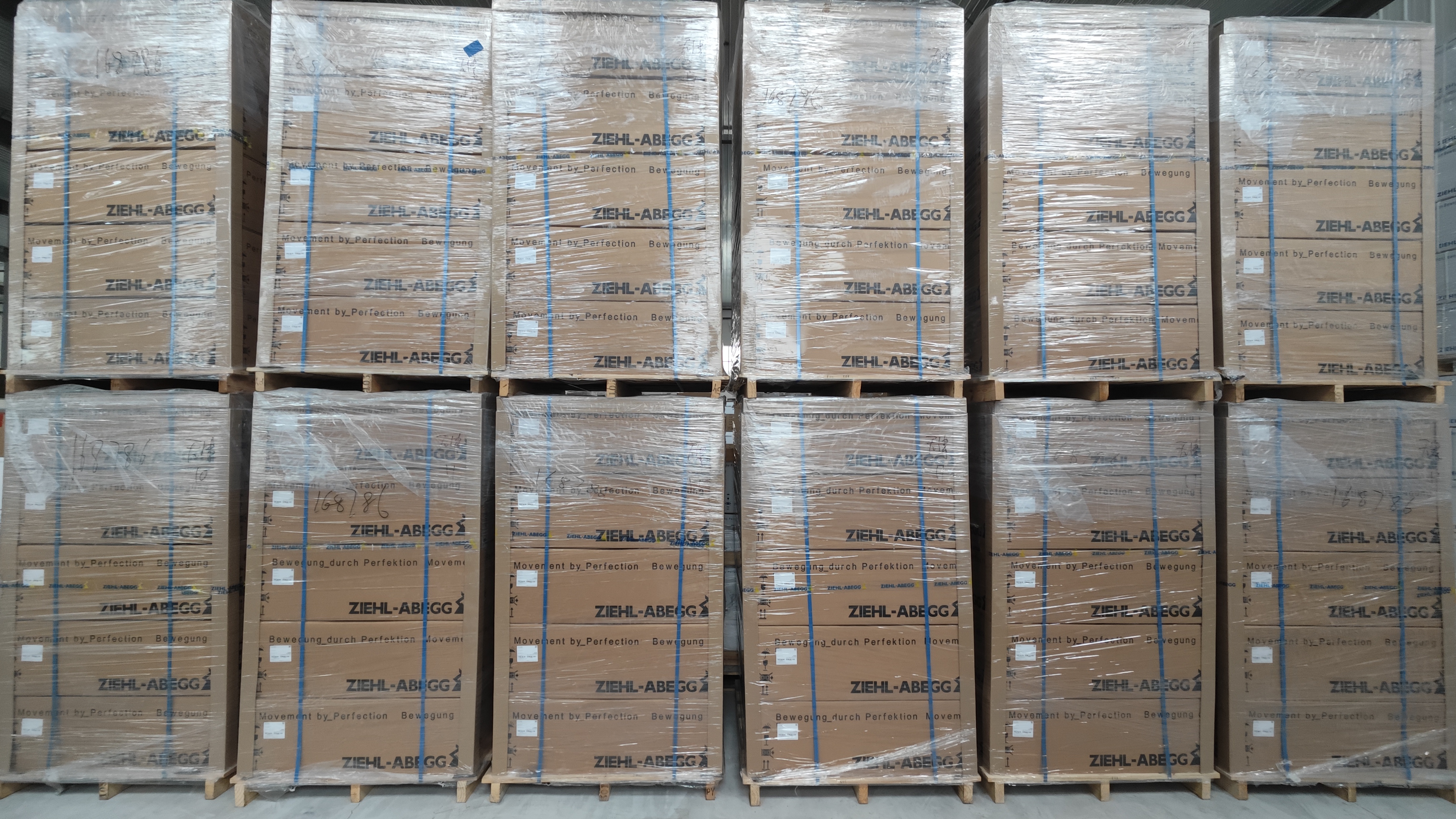
Ready-stock and outbound handling for recurring EC fan supply programs. Image: Hengrui EC Fan.
A cleanroom fan filter unit (FFU) and an industrial air purifier are mechanically simple machines with one unforgiving component. The fan runs continuously, pushes air through a filter that becomes harder to push through as it loads, and is usually the first part a maintenance team has to replace. In electrical and electronics manufacturing, where FFU arrays and purification units run for years at a time, fan selection is an operating-cost and continuity decision rather than a one-off parts purchase.
For 355 mm-class cleanroom FFU and air purification builds, the reference option discussed here is the R3G355-AM14-61 EC centrifugal fan: 355 mm diameter, single-phase 1~200–277 VAC supply, 350 W rated power, 1.5 A current, 1,900 rpm rated speed, aluminum sheet impeller, and die-cast electronics housing. Smaller FFUs and compact air purifiers are matched with the RadiCal EC centrifugal fan, which serves the same family as a compact scenario option. Selection support and supply for these programs are handled by Beijing Hengrui Hongsheng (Hengrui EC Fan).
Beijing Hengrui Hongsheng Mechanical & Electrical Equipment Co., Ltd., operating as Hengrui EC Fan, is a Beijing-based supplier and technical service provider for ventilation, heat dissipation and industrial control electromechanical products. The company works as an agent and distributor for brands including ebmpapst, Ziehl-Abegg, SANYO, DELTA, SUNON, Rosenberg, WISTRO, SODECA, NMB, ADDA and S&P, and supports customers with fan selection, system matching and full-category supply. Product and selection information is published at en.bjhengrui.com.
Why an FFU or purifier fan is not a standard HVAC fan selection
The duty cycle, the load behaviour and the service model of a cleanroom FFU fan all differ from a comfort-cooling fan. Four conditions shape every FFU and air purifier fan specification:
- Continuous duty at a near-fixed operating point. An FFU fan is not following a changing building load; it holds a duty point for months. Selection therefore has to be stable at that point, not merely capable of reaching it.
- A resistance that rises with filter loading. A clean HEPA filter and a loaded HEPA filter are two different system curves. A fan that is comfortable at clean-filter resistance may be marginal once the filter carries particles, which is when the room pressure balance is most at risk.
- Single-phase power at unit level. FFUs and purifiers are distributed across a ceiling grid or a production floor, so most units draw from single-phase branch circuits rather than a three-phase motor feeder with a dedicated drive.
- Serviceability and batch repeatability. A fleet of hundreds of units is maintained one unit at a time, and replacement fans have to match the installed specification closely enough that airflow and noise behave as the room was validated.
This is the practical reason why EC centrifugal fans are specified by a defined parameter set — impeller diameter, supply range, rated power, current, rated speed and construction materials — rather than by a single airflow headline figure. The airflow a unit produces is a property of the whole FFU: fan, filter, plenum and inlet geometry together.
The R3G355-AM14-61 at a glance
The R3G355-AM14-61 is a cleanroom FFU and air purification EC centrifugal fan built around a 355 mm impeller. Its published parameters are the starting point for a matching exercise, and each one maps to a real decision in an FFU or purifier program.
| Parameter | Value | What it decides in an FFU or purifier build |
|---|---|---|
| Impeller diameter | 355 mm | Defines the fan class and the mounting envelope inside the FFU plenum, and the airflow band the unit can realistically reach at a given resistance. |
| Power supply | Single-phase 1~200–277 VAC | Allows the fan to run from single-phase branch supplies across the 200 to 277 VAC band, which reduces the number of voltage-specific unit variants a plant or OEM must stock. |
| Rated power | 350 W | Sets the electrical and thermal budget for the FFU box, including heat that the unit adds to the recirculated airstream. |
| Current | 1.5 A | Used for conductor sizing, protection selection and the number of units that can share a branch circuit. |
| Rated speed | 1,900 rpm | The speed reference against which the airflow-and-pressure curve is read at the actual filter resistance. |
| Impeller material | Aluminum sheet | A rigid metal impeller supports stable balance over long running hours and is tolerant of the temperature inside a purifier or FFU housing. |
| Housing | Die-cast electronics housing | Integrates the drive electronics in a rigid die-cast structure, giving mechanical support and a defined thermal path for the electronics. |
What the published parameter set above does not include is equally important: it does not state an ingress protection rating, a control interface, an airflow-and-pressure curve, or a certification for this model. Buyers should request the current datasheet and confirm those items before freezing an FFU design.
What EC technology changes inside an FFU or purifier
EC stands for electronically commutated: the motor is a brushless DC machine with its commutation and speed-control electronics integrated into the fan assembly. The practical consequences for a cleanroom FFU or an air purifier are structural rather than cosmetic.
Speed control moves into the fan
With an AC fan, speed adjustment normally sits outside the unit — a variable frequency drive, transformer taps or voltage control. With an EC fan, the drive electronics are part of the fan, so a unit can be trimmed at commissioning or re-trimmed later without adding external hardware to every FFU box. In a ceiling grid with hundreds of units, removing an external drive from each position reduces cabling, panel space and points of failure at the installation level.
Partial-load behaviour matters more than peak figures
FFU and purifier fans rarely operate at the absolute maximum of their capability; they operate where the filter resistance puts them. EC motors generally hold efficiency better as speed is reduced, which is the operating region a loaded HEPA filter creates. That is a design-direction statement, not a guarantee for a specific model: the relevant evidence is the datasheet curve at the duty point, and it should be requested for the R3G355-AM14-61 in the exact FFU configuration being built.
Integrated electronics introduce their own requirements
Because the electronics sit inside the fan, they are exposed to the conditions of the unit: airstream temperature, thermal cycling, and the quality of the supply feeding them. A die-cast electronics housing gives the drive a rigid mounting and a defined heat path, but it also means the electronics are a single, non-separable part of the fan. Supply quality, correct circuit protection and realistic ambient assumptions are therefore part of fan selection, not an electrical afterthought.
A matching sequence for FFU and air purifier programs
The sequence below keeps the mechanical, electrical and airflow decisions in an order that prevents the most common FFU specification error: choosing a fan on a clean-filter airflow figure and discovering the shortfall after the room is validated.
- Fix the airflow requirement at the loaded filter condition. State the required airflow at the resistance expected when the HEPA filter is due for change, not when it is new.
- Confirm the available supply. For a distributed single-phase design, the R3G355-AM14-61 accepts a single-phase 1~200–277 VAC input, which covers the common 200 V to 277 V nominal classes without a fan variant change.
- Confirm the mechanical envelope. A 355 mm impeller has to fit the FFU plenum with the clearances the box design allows; the RadiCal EC centrifugal fan is the compact route when the envelope is smaller.
- Check the electrical budget. 350 W rated power and 1.5 A current set conductor sizing, protection and the share of a branch circuit one unit consumes.
- Confirm the speed and control approach. Decide how airflow will be set at commissioning and how it will be re-checked after filter changes, since 1,900 rpm is the rated reference point and not necessarily the final operating point.
- Confirm construction expectations. The aluminum sheet impeller and die-cast electronics housing define the build standard expected in cleanroom service; deviations should be visible on the datasheet, not discovered on receipt.
- Verify what is not in the published set. Ingress protection, control interface and certification are outside the parameter list given here and must be confirmed in writing before the design is frozen.
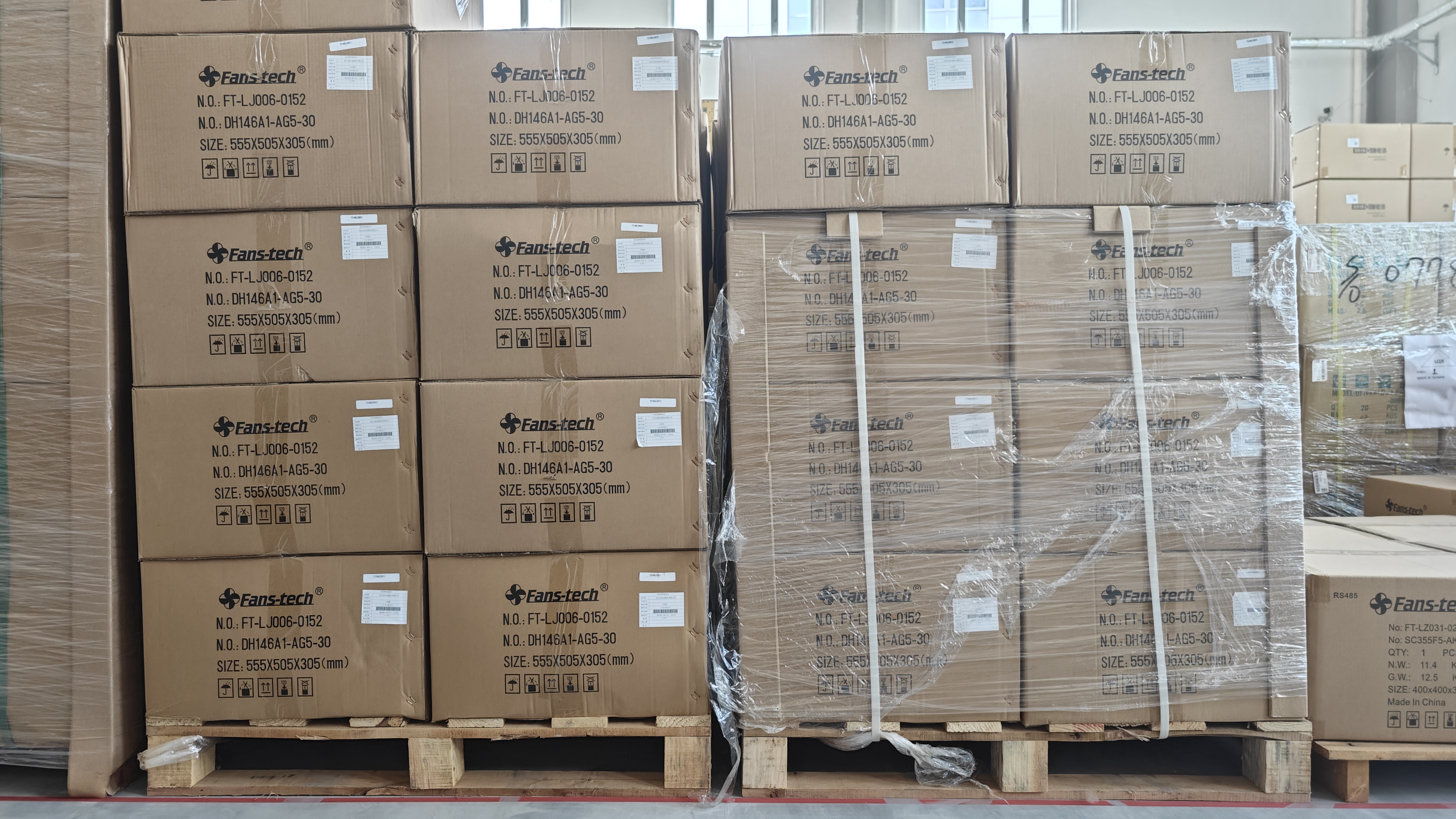
Outbound handling for recurring EC fan supply programs, where the same model is delivered repeatedly to match an installed base.
Where these fans are used in electronics manufacturing
Cleanroom FFU and air purification are the primary applications for the R3G355-AM14-61, and they are the scenarios where the design logic above is tested most often. In electronics manufacturing, FFU arrays hold the particle count and the pressure cascade across a fab or assembly area, while standalone air purifiers handle local contamination sources, soldering and process fumes, and retrofit filtration in buildings that were not originally designed as cleanrooms.
The same supply channel covers adjacent fan programs that electronics and HVAC projects commonly bundle together. Beijing Hengrui Hongsheng supplies blower fans for HVAC projects in China and overseas, DC axial flow fans for cabinet cooling programs, dry cooler fans for dry cooler production programs, air handling unit fans for ongoing AHU assembly and OEM cooperation, EC centrifugal blowers for chiller applications, EC centrifugal fans for AHU and HVAC applications, and EC fans for long-term HVAC sourcing projects. For an equipment builder, that range is useful because an FFU or purifier program rarely exists in isolation: the same customer often needs cabinet cooling fans, AHU fans and chiller-side blowers under the same quality and delivery framework.
Market signals that affect fan sourcing
Three published data points frame the current EC fan sourcing environment, and each has a direct reading for FFU and purifier buyers.
- Market growth. The global EC fans market reached USD 3.5 billion in 2024 and is projected to reach USD 6.7 billion by 2030 (Vertex AI Search / Market Analysis, 2024 base year, 2024–2030 forecast). The direction is toward EC designs in exactly the applications discussed here, which in practice means more competition for the same drive electronics and magnets.
- Regulation. New EU ecodesign rules for industrial fans, Regulation (EU) 2024/1834, apply from 24 July 2026, setting stricter efficiency thresholds for fans from 125 W to 500 kW, as published by the European Commission. A 350 W EC centrifugal fan sits inside that wattage band, so buyers with European exposure should confirm applicability and the compliance path with the supplier rather than assume fan type alone settles it.
- Supply and trade volume. China's fan exports under HS code 841459 reached 509 million units totalling USD 3.788 billion in 2024, up 6.96 percent in value (TradeDaas / China Customs Statistics). The export base is large and still growing in value terms, which supports availability but also means incoming inspection discipline matters more, not less.
Manufacturer-side revenue data adds a second layer. ebm-papst Group reported sales of EUR 2.098 billion for the 2024/25 fiscal year, a 13.1 percent decrease from the previous year, and Ziehl-Abegg reported 2024 revenue of EUR 893 million, a decline of 7 percent from EUR 955 million in 2023, according to the two companies' own announcements. Declining revenue across the branded end of the fan market typically shows up as tighter lead-time planning and more pressure on cost — both of which push FFU and purifier builders toward suppliers that hold stock and can confirm specifications quickly.
EC centrifugal fans versus traditional AC fan solutions
A comparison against traditional AC centrifugal fan solutions is useful only if it states where each approach wins. The table below compares the two on the criteria that actually change an FFU or purifier project.
| Selection factor | Traditional AC centrifugal fan | EC centrifugal fan (R3G355-AM14-61 class) |
|---|---|---|
| Speed control | Normally external — variable frequency drive, transformer taps or voltage control. | Commutation and speed-control electronics integrated in the fan. |
| Partial-load behaviour | Effective efficiency drops once external control is introduced. | Generally favourable at reduced speed, which is where loaded filters put the fan. |
| First cost | Typically lower at unit level, but control hardware has to be added per unit or per group. | Typically higher at unit level, with control hardware already included. |
| Failure modes | Simple motor and bearing wear; drive faults occur at panel level. | Integrated electronics add a failure mode sensitive to supply quality, heat and cycling. |
| Regulatory direction | Harder to keep inside tightening efficiency thresholds without added control. | Aligned with the efficiency direction of fan ecodesign rules, subject to the model's own compliance evidence. |
| Fit for FFU and purifier service | Still used in existing fleets and in cost-driven retrofit work. | Common in new FFU and purifier designs where per-unit speed setting and low partial-load losses matter. |
Limits and boundaries a buyer should not skip
- The verified parameter set is a selection envelope, not a performance guarantee. Diameter, supply, power, current, speed and materials do not tell you the airflow the fan will deliver in your FFU. The airflow-and-pressure curve for the actual box must come from the datasheet, and the R3G355-AM14-61 parameter list published here does not include ingress protection, control interface or certification.
- EC is not automatically the right answer. In installations where an AC fan and drive group is already installed, commissioned and performing within its efficiency band, replacing it with EC units is a capital decision that has to be justified on measured running hours and load profile, not on motor technology alone.
- Integrated electronics impose environmental discipline. EC fans concentrate control electronics in the airstream, so ambient temperature assumptions, supply quality and circuit protection are design inputs. In aggressively corrosive or high-temperature exhaust duty, a centrifugal fan with fully external drive electronics can remain the more durable architecture.
- Fleet consistency is a long-term constraint. A cleanroom validated around one fan model becomes dependent on that model's continued availability; a change of fan class part-way through a fleet's life creates a mixed population with different airflow behaviour and different spare parts.
Long-term supply: what ecosystem support actually covers
For decision-stage and execution-stage FFU buyers, the fan itself is only half the question. The other half is whether the same model, documentation and commercial framework will still be available when the second and third production batches are ordered. That is where the distributor and technical-service layer matters more than a single unit price.
Hengrui EC Fan maintains long-term agent and distribution relations with well-known domestic and international brands including ebmpapst, Ziehl-Abegg, SANYO, DELTA, SUNON, Rosenberg, WISTRO, SODECA, NMB, ADDA and S&P. The company has held the position of sales champion among ebmpapst distributors, holds exclusive authorization for brands such as WISTRO and SODECA in China, and has been rated as a Siemens premium supplier. It operates offices in Chengdu, Wuxi, Tianjin, Shenzhen and Hong Kong, has a 100,000 m² facility, around 700 employees and an R&D and technical team of 80 people, and reports an export ratio of 70 percent with the United States as a main market. The company states that it has served more than 20,000 corporate customers, including several Fortune Global 500 companies.
For recurring supply, the operational facts are the ones that matter: a large amount of ready stock is held in inventory to support fast shipment, and the company states an annual output of about 50,000,000 units supporting recurring supply programs. Commercial terms are standardised across the channel — minimum order quantity of 1 unit, delivery terms covering EXW, C&F, DDP, CIF, CFR, FOB, FAS and DPU, acceptance criteria based on pre-shipment test, and payment terms by corporate transfer. Those terms allow an FFU builder to place a single pilot unit and a production batch under the same framework, with acceptance fixed at pre-shipment testing rather than negotiated case by case.
Third-party commercial company data estimates the company's annual turnover at approximately USD 0.5 billion (ExportHub company listing, 2026). That figure is a commercial estimate rather than an audited disclosure, so it is useful as a scale indicator and should be treated as such.
Future outlook
Three shifts are likely to define FFU and air purifier fan selection over the next few product cycles. First, efficiency regulation will continue to push the fan market toward electronically controlled designs, with the EU thresholds in force from 24 July 2026 covering the 125 W to 500 kW band that includes 350 W-class cleanroom fans. Second, as the EC fan market grows from its 2024 base toward the projected 2030 figure, competition is likely to concentrate on documentation quality — curves, control interfaces and compliance evidence — rather than on the motor principle itself, because most suppliers will be offering EC. Third, buyers are likely to treat supply continuity as a specification item in its own right, given that branded manufacturer revenues have been under pressure and lead-time variability has become a planning risk rather than an exception.
For FFU and purifier programs, the practical consequence is that a fan specification will be judged on three things at once: whether the parameter set matches the electrical and mechanical reality of the box, whether the datasheet evidence covers the duty point, and whether the same model can be delivered repeatedly for the life of the installed fleet.
FAQ
How does cleanroom FFU fan duty differ from a standard HVAC fan application?
An FFU fan normally runs continuously at a near-fixed operating point, against a filter whose resistance rises as it loads with particles. Standard HVAC fans are often selected around a design duty that changes with building load and are adjusted by external drives. For FFU and purifier service, the airflow figure that matters is the one required at the loaded filter condition, and performance is judged on stability over time, unit-level noise and the effort of replacement. That is why a 355 mm-class unit such as the R3G355-AM14-61 is specified by diameter, supply, rated power, current, speed and materials rather than by airflow alone.
Which parameters should be confirmed first when matching an EC centrifugal fan to an FFU or air purifier?
Start with the mechanical envelope and the electrical supply. For the R3G355-AM14-61 that means a 355 mm diameter, single-phase 1~200–277 VAC supply, 350 W rated power, 1.5 A current and a 1,900 rpm rated speed, with an aluminum sheet impeller and a die-cast electronics housing. Then confirm the airflow-and-pressure behaviour shown for the actual FFU, plus the items the published parameter set does not cover: ingress protection, control interface and certification. Those should come from the current datasheet rather than being inferred from diameter or power rating.
What does the single-phase 1~200–277 VAC input mean for plant power planning?
It means the fan is intended to operate from a single-phase supply anywhere in the 200 to 277 VAC band, which reduces the number of voltage-specific fan variants a plant or an FFU builder has to hold. For circuit planning, the governing figures are the 350 W rated power and the 1.5 A current, which drive conductor sizing and protection selection. The voltage range describes the input specification only; it does not by itself confirm an efficiency class, an ingress protection rating or a certification of the finished unit.
How do EC centrifugal fans compare with traditional AC centrifugal fans in FFU service?
An EC fan integrates the commutation electronics with the motor, so speed setting is part of the fan instead of an external drive, and reduced-speed operation generally favours EC designs in efficiency terms. AC centrifugal fans typically carry a lower unit cost and simpler electronics, but usually need a variable frequency drive, transformer taps or voltage control to be adjusted. Both trade-offs are real: EC fans add integrated electronics that are sensitive to supply quality and heat, while AC fans are harder to keep within tightening efficiency thresholds. Efficiency at the actual duty point, not motor type alone, decides the outcome.
What commercial terms apply when ordering these fans for a project?
In this supply channel, the minimum order quantity is 1 unit, delivery terms cover EXW, C&F, DDP, CIF, CFR, FOB, FAS and DPU, acceptance is based on pre-shipment test, and payment terms are corporate transfer. These terms matter to FFU and purifier builders because a pilot unit and a production batch can be placed under the same framework, with the acceptance step fixed at pre-shipment testing rather than agreed case by case.
How should spare and replacement supply be planned for a cleanroom FFU fleet?
Because FFU fleets are replaced gradually rather than all at once, the practical approach is to hold a matched spare set of the exact fan model installed in the fleet and to confirm that the model remains supported before the next maintenance cycle. In this channel, a large amount of ready stock is held to support fast shipment, and an annual output of about 50,000,000 units supports recurring supply programs, which is relevant when the same model must be delivered repeatedly to match an installed base. Recording the installed fan's diameter, supply, rated power, current, speed and materials allows replacement orders to be verified against the original specification.