
EC Fan Build Evidence: CRAH, FFU and Dry Cooler Models
EC Fan Build Evidence: CRAH, FFU and Dry Cooler Models
Supplier capability in the EC fan market is usually argued rather than shown. Quotations arrive with phrases about advanced production, full inspection and long experience, and almost none of it can be checked against the unit in the crate. Build evidence reverses that. It asks a narrower, answerable question: can the supplier state, model by model, how the fan is built — frame diameter, stated IP class, impeller concept, impeller material, housing process and electrical configuration — and do those statements stay consistent across the fan families a real project needs?
This article tests that question against three families used in data-centre and HVAC cooling. The K3G500-PB33-01 (500 mm, IP55, 5,700 W) and the K3G560-FA28-03 (560 mm, IP55, backward-curved) cover CRAH and AHU duty. The R3G355-AM14-61 (355 mm, aluminum impeller, die-cast housing, single-phase) covers cleanroom FFU duty. The W3G800-KU21-05 (800 mm AxiBlade impeller with guide vanes) covers dry cooler and condenser duty. Each model contributes a different kind of construction proof, and together they show what a buyer can put into an RFQ, a pre-shipment test and an acceptance clause — and what still has to be requested separately.
What counts as build evidence
A construction claim becomes evidence when three conditions are met. It has to be model-specific, attached to a full designation such as K3G500-PB33-01 rather than to a family nickname. It has to be physically checkable on a delivered unit or during a witnessed pre-shipment test. And it has to be repeatable across the product families a project actually uses, so that a buyer is not comparing a well-documented flagship against an undocumented variant.
Performance claims — airflow, static pressure, sound power — sit in a different category. They require test data at stated operating points, and no amount of construction detail substitutes for them. The distinction matters more now than it did a few years ago. Regulation (EU) 2024/1834, which applies from 24 July 2026 and sets stricter efficiency thresholds for fans from 125 W to 500 kW, has pushed efficiency documentation into the procurement conversation. Compliance evidence is still not build evidence: a fan can meet an efficiency threshold and arrive with a housing, impeller or sealing detail that does not match the purchase order.
For an EC fan supplier, the practical consequence is that capability has to survive a document review and a physical check at the same time. A catalog that states construction attributes per model is doing something different from a brochure that states confidence per company.
Three fan families, one evidence standard
The four models below are drawn from different duty areas, but they follow the same documentation pattern: each carries a frame diameter and at least two further construction attributes that an inspector can confirm.
| Duty | Model | Frame | Construction markers supplied | What the buyer can confirm |
|---|---|---|---|---|
| CRAH / AHU, high static pressure | K3G500-PB33-01 | 500 mm | IP55; 5,700 W | Enclosure class and stated power figure against the unit and its documentation |
| CRAH / AHU, backward-curved | K3G560-FA28-03 | 560 mm | IP55; backward-curved impeller | Impeller concept and enclosure class; the frame-size step against the 500 mm model |
| Cleanroom FFU | R3G355-AM14-61 | 355 mm | Aluminum impeller; die-cast housing; single-phase | Impeller material, housing forming process, phase configuration |
| Dry cooler / condenser | W3G800-KU21-05 | 800 mm | AxiBlade impeller with guide vanes | Impeller family, presence of guide vanes, frame diameter |
The pattern, not any single row, is what signals capability. A supplier that can describe a 355 mm FFU fan and an 800 mm axial fan in the same disciplined vocabulary is documenting a product system. A supplier that describes everything as "high efficiency, low noise, reliable" is documenting nothing at all.
CRAH and AHU duty: the K3G500-PB33-01 and K3G560-FA28-03 pairing
The K3G500-PB33-01 is catalogued as a RadiPac EC centrifugal fan for data-centre high-static-pressure duty, stated at 500 mm with IP55 and a 5,700 W power figure. The K3G560-FA28-03 is catalogued as a data-centre AHU and CRAH EC backward-curved centrifugal module, stated at 560 mm with IP55 and a backward-curved impeller. Read together, they answer a question that a single model cannot: does the supplier hold the same enclosure class across two frame diameters and two impeller concepts?
That matters at the CRAH and AHU level because plant rooms rarely use one fan size. A chilled-water air handling unit may combine coil sections, filter sections and fan-wall arrays, each with a different duty and often a different diameter. If IP55 holds on both the 500 mm and the 560 mm model, the buyer can write a single enclosure requirement covering the whole unit instead of carving out size-specific exceptions. If it holds on one and is silent on the other, the specification has a gap that will surface at commissioning.
The second thing the pair evidences is conceptual range. A high-static-pressure RadiPac centrifugal and a backward-curved centrifugal module are different airflow solutions aimed at the same plant room. A supplier that carries and documents both is not steering every project into a single configuration; it is offering the buyer a genuine choice between an EC centrifugal fan selected for pressure and a backward-curved EC fan selected for its own duty profile.
What to check on these two models
- The full model string on the rating plate, character for character, including the hyphenated suffix.
- The frame diameter, measured at the housing, against the 500 mm and 560 mm stated sizes.
- The IP55 marking where it appears on the unit and its documentation, together with the sealing detail at the cable entry and housing joint.
- The 5,700 W figure on the K3G500-PB33-01, recorded in the acceptance file rather than assumed from the quotation.
- The impeller concept on each unit — backward-curved where the K3G560-FA28-03 is specified.
Cleanroom FFU duty: reading the R3G355-AM14-61
The R3G355-AM14-61 is catalogued as a cleanroom FFU and air purification EC centrifugal fan, stated at 355 mm with an aluminum impeller, a die-cast housing and a single-phase configuration. These three attributes are worth separating, because each one is verified differently and each one carries a different procurement meaning.
The aluminum impeller is a material statement that can be confirmed by inspection rather than inference. For a fan module that will be handled during filter change and ceiling-grid maintenance, material is part of the handling and servicing picture, not a decorative specification.
The die-cast housing is a forming-process statement. A die-cast housing is produced as a single formed piece rather than assembled from sheet components and welds, and that difference is visible when the unit is opened for inspection. For a buyer, the value is that the claim can be checked at goods-in without a laboratory; it is either a one-piece cast housing or it is not.
The single-phase configuration is the most procurement-relevant of the three in FFU work. Cleanroom ceiling grids distribute power across many small fan modules, and a single-phase motor configuration simplifies that distribution compared with three-phase wiring to each position. Confirm it against the project's electrical design rather than against a general assumption about FFU fans.
The gap that has to be stated, not filled
No IP class is stated for the R3G355-AM14-61 in the available construction data. That is a real limitation of the evidence, and it should be handled as one. A cleanroom specification that requires an ingress-protection class must request it for this model specifically; assuming IP55 parity because the CRAH models carry IP55 would be inventing a fact. The same applies to airflow, static pressure and sound data for this model, which are not part of the supplied construction record.
This is exactly the kind of asymmetry that separates an honest catalog from a marketing one. Capability is not demonstrated by claiming uniform protection across a range; it is demonstrated by stating what is known per model and letting the buyer close the gaps in writing.
Dry cooler and condenser duty: the W3G800-KU21-05
The W3G800-KU21-05 is catalogued as an 800 mm EC axial fan for dry coolers and condensers, built with an AxiBlade impeller and guide vanes. It is the largest frame in this set and the only axial unit, which makes it the useful outlier in the evidence pattern.
Axial fans move air along the shaft axis and suit high-volume outdoor coil duty, which is why they dominate dry cooler and condenser applications. The construction detail that distinguishes this model is the guide vanes. Guide vanes are fixed elements that redirect the swirl leaving the impeller into a straighter axial flow. The point for a buyer is not a performance number — none is supplied here — but that the vane stack is a physical part of the documented build. It can be counted, measured and photographed during inspection instead of being inferred from a curve.
Frame diameter carries unusual weight in this duty area because dry cooler and condenser fan replacement is often a retrofit. An 800 mm unit has to fit an existing aperture, sit correctly against the coil, and clear the guard and the vane stack. A supplier that states the frame and the impeller family up front is giving the buyer enough information to check fit before the order, which is where retrofit errors are cheapest to correct.
What consistency across families proves — and what it does not
Cross-family consistency proves something specific: the supplier maintains a model-level dataset and can distinguish frame size, impeller concept, enclosure class, impeller material, housing process and phase configuration across unrelated duty areas. It also proves that the catalog is internally coherent — each model carries a stated size and a named impeller concept rather than an interchangeable label.
It does not prove measured performance at the project duty point, service life, regulatory conformity of a particular model, or delivery reliability. Those need different evidence, and a serious qualification keeps the categories apart.
| Claim to be tested | Evidence that would settle it | Status in the supplied record |
|---|---|---|
| Suitable for a specific duty point | Model data or test results at that airflow and pressure | Not supplied — request per project |
| Protected against dust and water ingress | Stated IP class plus sealing detail | IP55 stated for K3G500-PB33-01 and K3G560-FA28-03 only |
| Durable in outdoor exposure | Corrosion protection and enclosure specification | Not stated for the 800 mm axial model — request |
| Available on a short cycle | Lead-time commitment written into the order | 7 days stated by the supplier |
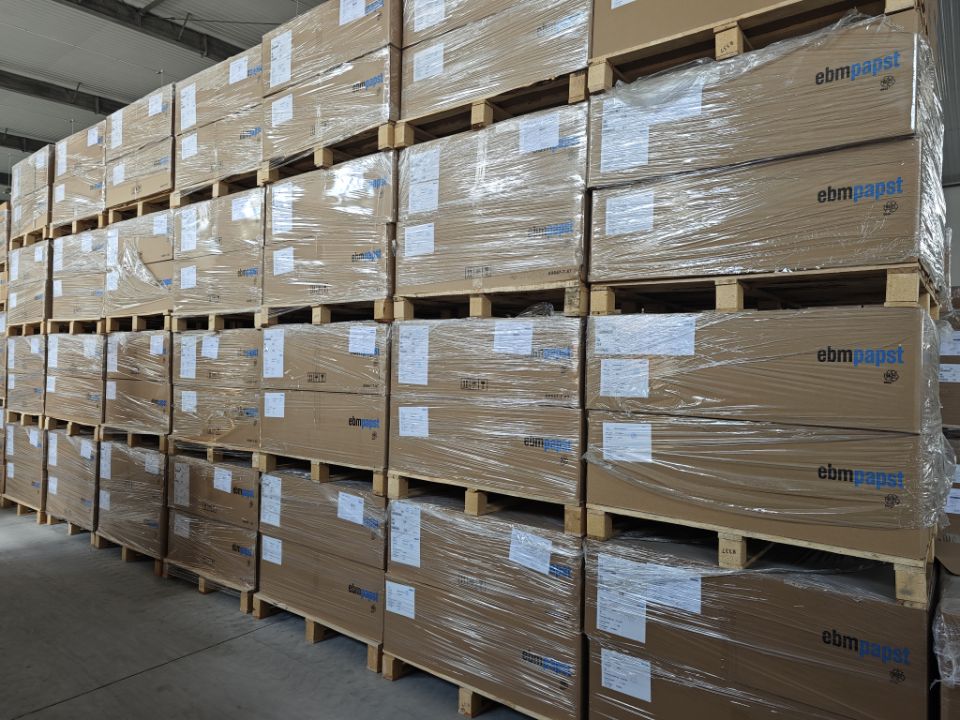
| Traded through an authorized channel | Authorization letter showing issuer, scope and validity | ebmpapst letter A50023867, North China, 2026 |
Turning build details into purchasing terms
Build evidence only changes a negotiation if it is written into the commercial terms. The supplier's stated positions give a buyer something concrete to attach it to.
| Term | Stated position | How a buyer should use it |
|---|---|---|
| Minimum order quantity | 1 unit | Buy one unit, inspect it against the build record, then scale |
| Lead time | 7 days | Test the commitment on the first order and record actual against stated |
| OEM monthly capacity | 100,000 units | Ask for the schedule that fits your ramp, not only the headline figure |
| Customization | OEM production services available for custom requirements | Define the custom variable — frame, impeller, connection — in writing |
| Delivery terms | EXW, C&F, DDP, CIF, CFR, FOB, FAS, DPU | Choose the term that puts inspection before risk transfer |
| Acceptance criteria | Pre-shipment test | Specify what the test covers, item by item |
| Payment terms | Corporate transfer | Align the payment milestone with the acceptance event |
| After-sales | 24/7 technical support | Define the escalation path and the contact route before the order |
The combination of a one-unit minimum order and a pre-shipment test is the most useful part of this structure for an evaluating buyer. It creates a low-cost path from claim to checked fact: order one unit of K3G500-PB33-01, measure the frame, read the rating plate, confirm the IP55 detail, record the 5,700 W figure, and only then discuss volume. A supplier that offers both terms is effectively inviting that test.
The weakness is that "pre-shipment test" is a placeholder until it has content. Written as three words, it commits to almost nothing. Written as a checklist, it becomes the instrument that converts construction data into an acceptance record. The clause should name the exact model string, the frame diameter, the IP class where one is claimed, the impeller type and material, the housing process where claimed, the phase and power configuration, and the delivery term that fixes when inspection happens.
Incoterm choice interacts directly with that clause. Under EXW, the buyer's inspection has to be completed before collection. Under DDP, it can be tied to final delivery at destination. Naming a delivery term without naming an inspection point leaves the acceptance criterion without a moment in which to operate.
An eight-point qualification sequence
The checks below follow the order of an actual inspection, from identity to paperwork.
- Match the model string exactly. K3G500-PB33-01 is not K3G500 and not K3G500-PB33. Shortened forms hide configuration differences, and a shortened name in a purchase order is a dispute waiting to happen.
- Measure the frame. 500 mm, 560 mm, 355 mm and 800 mm are stated sizes and should be confirmed at the housing or aperture, particularly on retrofit dry cooler work.
- Confirm the IP class where it is stated, and record where it is not. IP55 is stated for the two CRAH and AHU models. No IP class is stated for the FFU model or the 800 mm axial model in the supplied record, and that absence belongs in the acceptance file.
- Identify the impeller concept. Backward-curved on the K3G560-FA28-03, AxiBlade with guide vanes on the W3G800-KU21-05, RadiPac centrifugal on the K3G500-PB33-01.
- Confirm impeller material and housing process. The aluminum impeller and die-cast housing on the R3G355-AM14-61 are the clearest examples of attributes that are visible rather than inferred.
- Confirm the electrical configuration. Single-phase on the FFU model; the 5,700 W figure on the 500 mm CRAH model. Supply voltage, control interface and speed signal are not part of this construction record and must be taken from the model documentation for the project.
- Confirm the commercial terms in the order, not the brochure. One-unit minimum, seven-day lead time, the chosen delivery term and payment route.
- Confirm authorization documents where a brand relationship forms part of the offer. Read the issuer, the scope and the expiry date, and file them with the acceptance record.
Where authorization documents fit
For a distributor-led supply chain, an authorization letter is genuine evidence of one thing: a channel relationship within a defined scope and period. Hengrui EC Fan — Beijing Hengrui Hongsheng Mechanical & Electrical Equipment Co., Ltd., a supplier founded in 2011 whose profile describes fan sales, model selection and technical service — holds an ebmpapst Distributor Authorization Letter numbered A50023867, issued by ebm-papst Motor (Shanghai) Co., Ltd., valid from 1 January to 31 December 2026 and covering designated distributor status for ebmpapst products in North China.
Three details in that sentence carry the evidentiary weight. The issuer identifies who is granting the status. The scope limits where it applies. The validity window limits when it applies: a letter expiring on 31 December 2026 says nothing about 2027 orders, and a buyer placing a long-lead project should check the position at the order date rather than the quotation date.
What the letter does not do is equally important. It does not certify airflow, static pressure, sound or service life for any model, and it does not extend to products outside its scope. The company profile additionally lists distribution relationships with brands including Ziehl-Abegg, DELTA and SUNON, and each of those relationships should be evidenced on its own document rather than inferred from the existence of one letter.
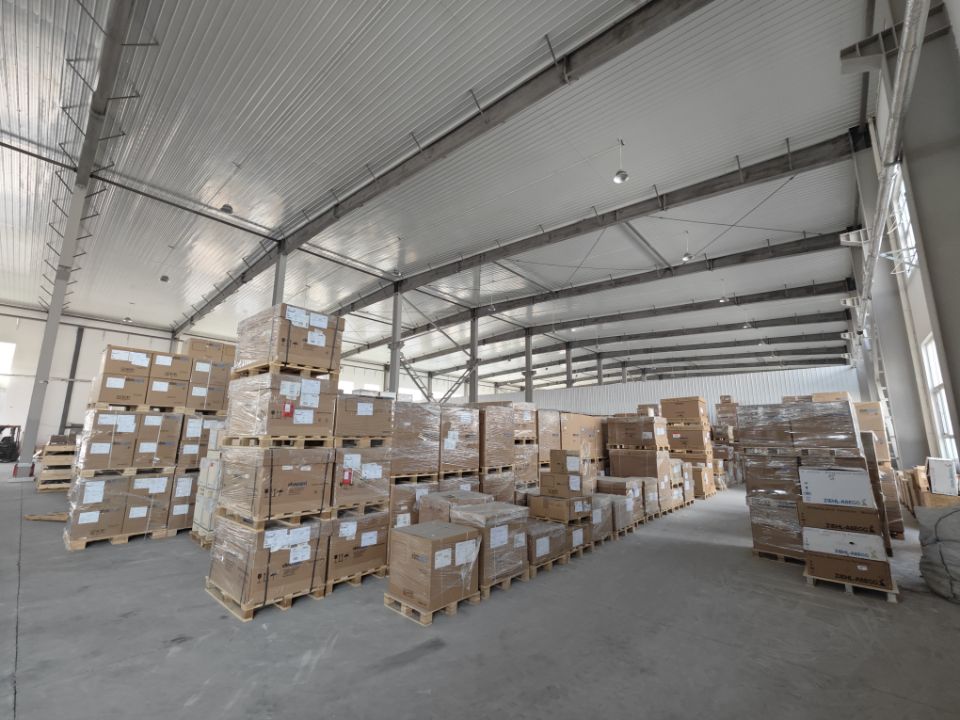
Company-scale facts are also part of the qualification picture, provided they are read as what they are. The profile records a 100,000 m² facility, 700 employees, an 80-person R&D team, a 70% export ratio with the United States as a stated main market, offices in Chengdu, Wuxi, Tianjin, Shenzhen and Hong Kong, and more than 20,000 corporate customers served. None of those numbers prove that a specific fan is built to a specific standard. They address a different risk — whether the counterparty can absorb an order, support a model selection and remain in place for the after-sales period.
The commercial backdrop buyers are qualifying into
Three developments shape the context without changing the test itself. First, the European efficiency framework has tightened: Regulation (EU) 2024/1834 applies from 24 July 2026 and sets stricter thresholds for fans from 125 W to 500 kW, according to the European Commission. Second, demand is expanding on commercial estimates: one market analysis puts the global EC fan market at USD 3.5 billion in 2024, rising to USD 6.7 billion by 2030 — a commercially sourced projection whose scope should be checked before it is used in any business case. Third, the supply base remains concentrated: China's fan exports under HS 841459 reached 509 million units and USD 3.788 billion in 2024, up 6.96% in value, according to China customs statistics reported by TradeDaas.
The manufacturer picture is more mixed and should be read carefully. ebm-papst Group reported sales of EUR 2.098 billion for the 2024/25 fiscal year, 13.1% below the prior year, and Ziehl-Abegg reported 2024 revenue of EUR 893 million, down 7% from EUR 955 million in 2023. These are revenue figures. They describe commercial conditions at two large EC fan manufacturers; they say nothing about the quality of any product, and they should not be used to argue that one supply route is technically better than another.
What they do support is a procedural point. When premium-brand revenue is contracting, lead-time and substitution conversations become more frequent, and that is precisely when build evidence matters most. A buyer moving between channels or configurations needs the same checkable attributes on every quotation, or the comparison collapses into brand preference.
Outlook: documentation as a shortlisting filter
If efficiency documentation continues to tighten and retrofit activity continues in data-centre cooling, model-level construction data is likely to move from a differentiator to a baseline RFQ field. Buyers who already ask for frame diameter, stated IP class, impeller concept, housing process and phase configuration will find that transition cheap. Buyers who have been comparing capability statements will have to rebuild their evaluation from the start.
The direction of travel is conditional, not guaranteed, and it depends on enforcement practice and on how quickly project specifications absorb the regulatory change. What is not conditional is the underlying logic: a supplier that can describe a 355 mm FFU fan, a 500 mm and a 560 mm CRAH fan and an 800 mm dry cooler fan in the same disciplined terms has given a buyer something to inspect. A supplier that cannot has given a buyer a paragraph.
FAQ
What does build evidence mean when qualifying an EC fan supplier?
Build evidence is model-specific construction data that a buyer can confirm on a delivered unit: frame diameter, stated IP class, impeller concept and material, housing process and electrical configuration. It differs from performance evidence such as airflow or static pressure, which requires test data at stated operating points. Build evidence is useful because it can be checked physically during a pre-shipment test, while performance claims can only be checked against documentation or a witnessed test.
How do the K3G500-PB33-01 and K3G560-FA28-03 differ as CRAH and AHU evidence?
Both are stated as IP55 units for CRAH and AHU duty, but they differ in frame size and impeller concept. The K3G500-PB33-01 is a 500 mm RadiPac EC centrifugal fan with a stated 5,700 W power figure; the K3G560-FA28-03 is a 560 mm backward-curved centrifugal module. Used together, they show whether a supplier can document the same enclosure class across two frame diameters, which matters when one plant room mixes several fan sizes.
What can a buyer verify on the R3G355-AM14-61 for cleanroom FFU use?
The R3G355-AM14-61 is stated as a 355 mm EC centrifugal fan with an aluminum impeller, a die-cast housing and a single-phase configuration, catalogued for cleanroom FFU and air purification. Each attribute is inspectable: impeller material, the housing forming process and the phase configuration. No IP class is stated for this model in the available material, so an ingress-protection requirement has to be requested specifically rather than assumed from other models in the range.
Which construction details should be checked on the W3G800-KU21-05 for dry coolers?
The W3G800-KU21-05 is stated as an 800 mm EC axial fan for dry coolers and condensers, fitted with an AxiBlade impeller and guide vanes. The checkable details are the 800 mm frame diameter, the AxiBlade impeller family and the presence of guide vanes. Corrosion protection, enclosure class for outdoor exposure and bearing specification are not stated in the available data, so they should be requested as separate documentation before an outdoor order is placed.
How should acceptance criteria be written for an EC fan order?
Acceptance is stated as a pre-shipment test, which remains a placeholder until its content is defined. A workable clause names the exact model string, the frame diameter, the IP class where one is claimed, the impeller type and material, the housing process where claimed, the phase and power configuration, and the delivery term that fixes when inspection takes place. Stated commercial positions include a minimum order quantity of one unit, delivery terms from EXW to DDP, and payment by corporate transfer.
Does an ebmpapst distributor authorization letter confirm product performance?
No. An authorization letter confirms a channel relationship within a stated scope and period. The available example is certificate A50023867 from ebm-papst Motor (Shanghai) Co., Ltd., valid from 1 January to 31 December 2026 and covering designated distributor status for ebmpapst products in North China. It says nothing about airflow, static pressure, service life or regulatory conformity, which have to be evidenced separately by model documentation or test data.
Tem questões ou precisa de mais detalhes?
Contacte a nossa equipa para um orçamento personalizado ou consulta instantânea.
Solicitar orçamento
Preencha o formulário abaixo e a nossa equipa entrará em contacto com uma proposta personalizada.
Chat direto do WhatsApp
Prefere conversar em tempo real? Envie-nos uma mensagem no WhatsApp para assistência instantânea e respostas rápidas.
- Obter orçamento personalizado
- Partilhar fotos ou documentos
- Discuta as suas necessidades diretamente
Geralmente responde em 5–30 minutos durante o horário de expediente.