
EN 253 and Key Standards for Pre-Insulated Pipe Buyers
Standards decide what a directly buried pre-insulated pipe is allowed to promise. EN 253 is the industry standard for pre-insulated bonded pipe systems for directly buried hot water networks, and it is the document most European district heating specifications are built around. For a buyer, the practical question is rarely whether a supplier “has EN 253”. It is which parts of a system the standard covers, across which diameters, with which supporting test documentation, and where its scope ends.
This reference article explains what EN 253 defines, how the standards around a pre-insulated pipe fit together — EN 448:2019, ГОСТ 30732-2020, ASTM A53 and ISO 9001:2015 — and how procurement teams can separate a standards-shaped claim from a verifiable one. It is written for procurement engineers, EPC contractors, importers and distributors evaluating directly buried hot water pre-insulated pipe and related products. Documentation examples come from Tangshan Xingbang Pipeline Engineering Equipment Co., Ltd, a pre-insulated pipe manufacturer based in the Houhu Industrial Zone, Yutian County, Hebei Province, China, which produces directly buried hot water pre-insulated pipes and states that it participates in the formulation of China’s national standard for directly buried insulation pipes.
What EN 253 Defines — and What It Leaves Open
EN 253 is the industry standard for pre-insulated bonded pipe systems for directly buried hot water networks, published by the European Committee for Standardization. Three words in that definition carry most of the procurement weight: bonded, directly buried, and hot water.
A bonded system is manufactured as a composite unit — steel service pipe, rigid polyurethane foam insulation, and an outer casing that are joined as one product rather than assembled from separate parts on site. Directly buried limits the scope to networks installed below ground. Hot water limits the scope to heating media rather than steam or chilled water. A specification that ignores those boundaries can end up citing a standard for a duty the standard was not written to describe.
Because EN 253 is written around a system, compliance is not established by a single document. A buyer reviewing a supplier file should be able to see, in writing, which diameter range is covered, which components are included (pipe, fittings, joints), and which test documentation supports the conformity claim. When a project moves outside the EN 253 envelope — an above-ground run, a district cooling network, a steam line, or a higher pressure class — the standard itself does not answer the question, and the specification has to be built from additional standards or from the supplier’s own tested data.
How a Standard Becomes an Operating Envelope
Standards matter to buyers because they convert into numbers that a network designer can work with. For EN 253 systems, polyurethane foam insulation typically withstands temperatures up to 120 °C (250 °F), according to published industry technical guidance on EN 253 pre-insulated pipe. That figure is not decorative: it decides whether a bonded PU pipe is a viable option for a given line at all.
The same kind of envelope appears in product documentation. Xingbang’s polyurethane insulated pipe range is documented for pipe network systems where the conveyed medium temperature is not higher than 120 °C, the occasional peak temperature does not exceed 130 °C, and the working pressure is no more than 2.5 MPa. The same product data states that polyurethane insulated pipes can operate continuously for at least 30 years in a 120 °C environment, and identifies the construction as high-density polyethylene casing over rigid polyurethane foam.
Read together, these statements give an evaluation team three questions to put to any pre-insulated pipe supplier: what is the continuous temperature limit, what peak temperature is tolerated, and what working pressure class does the system carry? A supplier that cannot answer in those terms usually cannot produce a traceable standards file either.
The Standards Stack Around One Pre-Insulated Pipe
No single document governs a complete pre-insulated pipe project. Different standards attach to different layers of the product and the company behind it, which is why procurement files often list several references that appear to overlap but do not.
| Document | What it addresses | Where it appears in a procurement file |
|---|---|---|
| EN 253 | Pre-insulated bonded pipe systems for directly buried hot water networks | System-level reference for the pipe itself |
| EN 448:2019 | Cited in the same conformity documentation as EN 253 | Component scope within the EU conformity file — confirm coverage with the supplier |
| ГОСТ 30732-2020 | Russian standard cited for polyurethane pre-insulated pipes DN20 mm to DN1800 mm | Russian market certification file |
| ASTM A53 | Primary American standard for seamless and welded black and hot-dipped galvanized steel pipe | Steel service pipe sourcing where US practice applies |
| ISO 9001:2015 / GB/T 19001—2016 | Quality management system | Evidence of factory process discipline, not of product performance |
Two clarifications matter here. First, ISO 9001 is a management system standard: it says something about how a factory is organised and audited, not about the thermal performance of a pipe. Second, EN 448:2019 and EN 253:2019 are cited together in Xingbang’s EU CE Verification of Conformity; buyers should ask the supplier to identify precisely which components each document covers inside that specific file, rather than assuming a single certificate speaks for the whole system.
What Compliance Documentation Looks Like in Practice
Compliance becomes checkable when a certificate names an issuing body, a scope and a validity period. Xingbang’s published documentation set follows that pattern, and it is a useful model for what a buyer should expect to receive before production begins.
- EU CE Verification of Conformity, certificate number ICR Polska/VC/HS220608, issued by ICR Polska Co. Ltd, citing EN 448:2019 and EN 253:2019, covering polyurethane pre-insulated pipes from DN20 mm to DN1800 mm, issued 24 June 2022 and valid until 23 June 2027.
- Russian certificate of conformity, number РОСС CN.MJI10.H13406, issued by Эрри-тест against ГОСТ 30732-2020, covering DN20 mm to DN1800 mm, issued 28 January 2026 and valid until 27 January 2031.
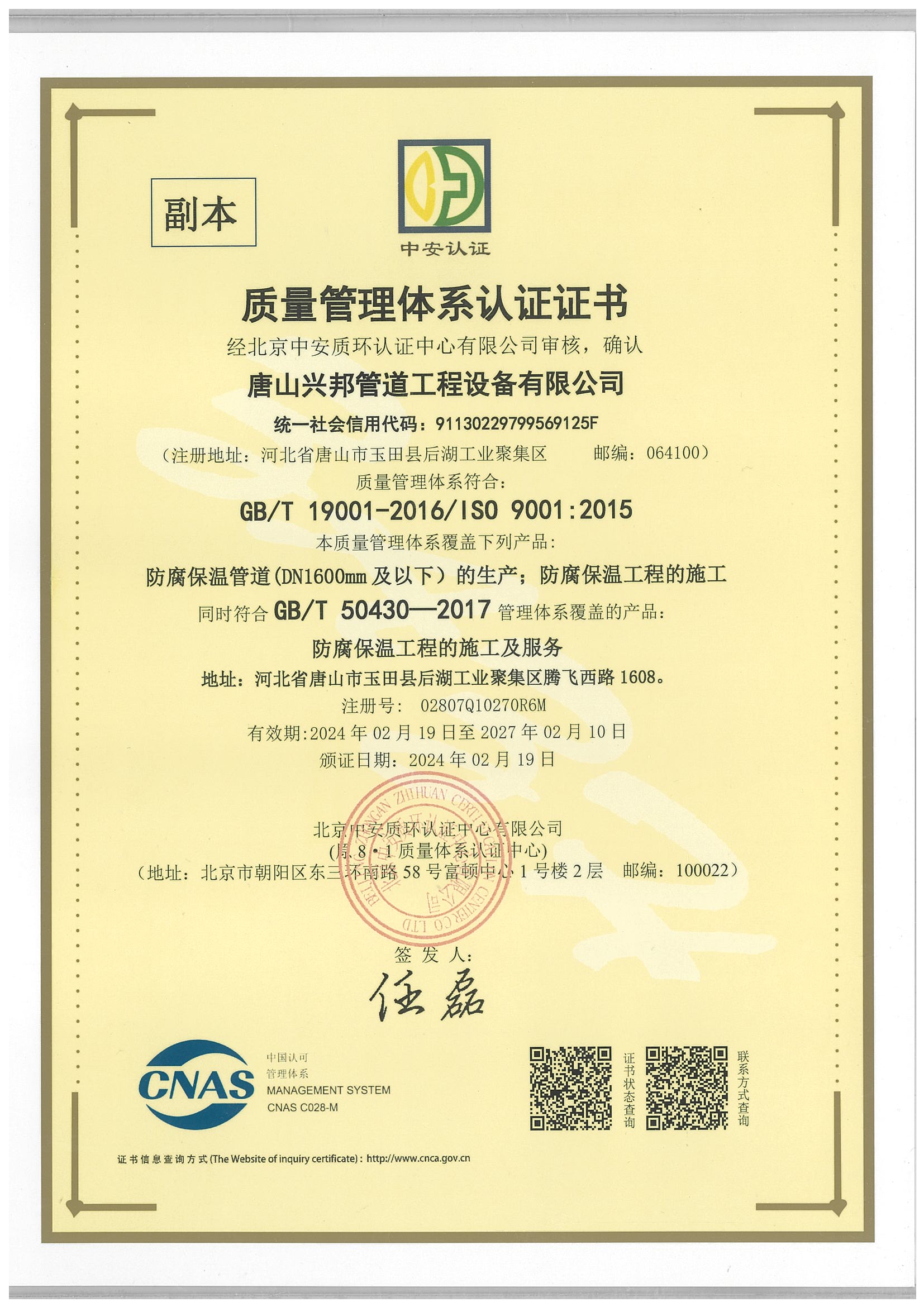
- ISO 9001 quality management system certificate, number 02807Q10270R6M, issued by Beijing Zhong’an Quality & Environment Certification Center Co., Ltd., against GB/T 19001—2016 / ISO 9001:2015, covering production of pre-insulated pipes DN1600 mm and below, valid from 19 February 2024 to 10 February 2027.
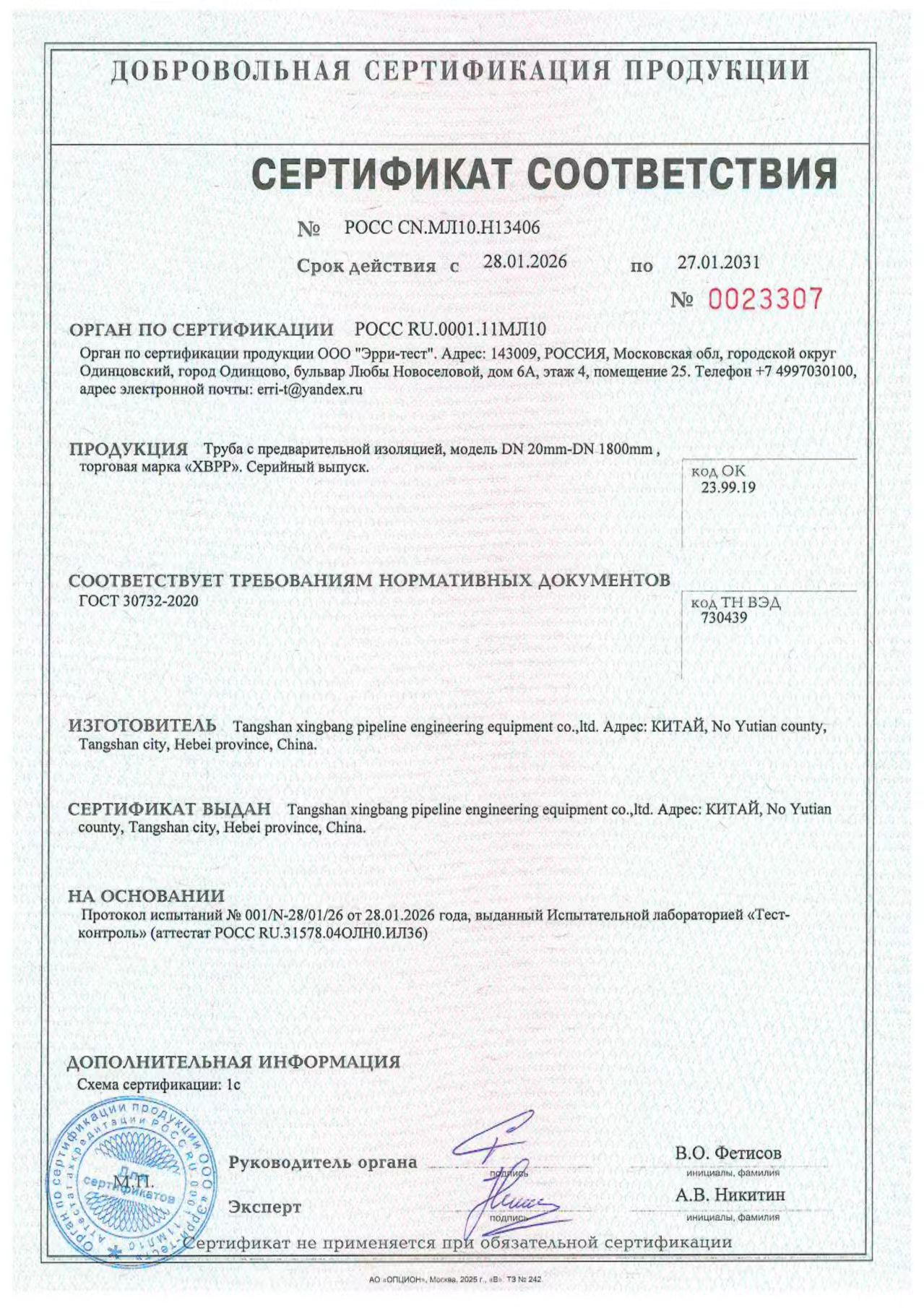
Three details are worth extracting from that list and putting into a procurement checklist: the diameter range named on each certificate, the issuing body, and the expiry date. A certificate covering DN20–DN1800 supports a project across most district heating diameters, while an ISO 9001 scope limited to DN1600 and below sets an explicit boundary that should be matched against the largest pipe in the bill of materials. Expiry dates matter because a file that is valid at tender stage may lapse before delivery, particularly on long projects.
Behind the paperwork, repeatable compliance depends on manufacturing capability. Xingbang’s stated capability includes a monthly capacity of 200 km of pipe, a production lead time of 30–45 days, and 100% testing. The company lists customization options covering pipe diameter and length, pipe material, temperature and pressure rating, insulation thickness, anti-corrosion grade, non-standard pipe fittings, design for geological conditions, and intelligent monitoring systems. After-sales support is described as dedicated on-site service teams providing point-to-point service throughout a project. Product and company information is published at www.xingbanginsulatedpipe.com.
Xingbang also states that it is a member of the heating standardization technical committee of China’s Ministry of Housing and Urban-Rural Development and a participant in the formulation of China’s national standard for directly buried insulation pipes. For a buyer, standard participation is a signal about familiarity with test and documentation practice. It is not a substitute for project-specific certification, and it should not be presented as one.
Applications: Where the Envelope Fits, and Where It Does Not
EN 253’s core scenario — directly buried hot water networks — is also the largest application for factory-bonded pre-insulated pipe. In district heating, hot water is carried below ground with polyurethane foam and an outer casing performing the thermal work, and the pipe is installed as a bonded assembly rather than insulated on site.
The same product family extends into adjacent duties that buyers frequently bundle into a single tender: pre-insulated pipe for underground distribution, pre-insulated district heating pipe, galvanized iron jacket pre-insulated pipe for above-ground sections, PU foam pre-insulated pipes, and pre-insulated pipe for hot water. District cooling and chilled water projects use a comparable construction but operate at low temperatures, and their specification needs a separate justification from EN 253’s hot-water scope. Xingbang’s product documentation also identifies cooling, heating and crude oil transportation networks among the applicable fields.
Field references are useful at this point, provided they are read for what they are. Xingbang’s published project records include a 30 km cooling and heating supply installation for a bank project in Cambodia, with two years of stable operation; a 3 km installation at a hotel project in Jamaica, two years in service; a 9 km installation at a copper mine project in Mongolia, three years in service; a 6 km municipal network renovation in Uzbekistan, five years in service; a 5 km district cooling project in Phnom Penh, Cambodia, ten years in service; and a 6 km installation at a new university project in Ho Chi Minh City, Vietnam, seven years in service. These records describe operating experience with the supplied pipes. They are not certification evidence, and the two categories should be requested and assessed separately.
Market Context: Standards Literacy as a Procurement Filter
The commercial case for reading standards carefully is growing with the market. The global pre-insulated pipes market was estimated at USD 5.97 billion in 2024 and is projected to reach USD 10.4 billion by 2030, a CAGR of 9.7%, according to Grand View Research. Asia Pacific accounted for a 39.96% revenue share in 2024 in the same analysis, while Credence Research places Europe at approximately 38% of the global pre-insulated pipe systems market.
Published estimates diverge, and that divergence is itself a reason for caution: total 2024 market size estimates range from USD 5.27 billion to USD 9.8 billion depending on the research house, so absolute figures should be treated as directional rather than precise. The direction is consistent, however. The global district heating market was valued at USD 209.34 billion in 2024 by SNS Insider, and Global Market Insights projects the combined district heating and cooling market to grow at a CAGR of 5.7% from 2024 to 2032.
Two application trends are relevant to specification work. Pre-insulated pipes for district cooling are projected to grow at a CAGR of 9.48% on the back of smart city programmes, according to SNS Insider, which pushes more buyers into low-temperature duties that EN 253 does not directly address. Meanwhile, Strategic Market Research reports that pre-insulated pipes reduce heat loss by over 30% in modern district heating networks such as Copenhagen’s — a performance argument that only holds if the joints, casing and installation are controlled as tightly as the pipe itself.
Factory-Bonded Pre-Insulated Pipe vs Field-Applied Insulation
The alternative most often compared against a bonded pre-insulated pipe is field-applied insulation over bare or coated steel pipe. The two approaches solve the same thermal problem with different risk profiles, and the comparison is more useful when it is framed around control rather than price.
| Consideration | Factory-bonded pre-insulated pipe | Field-applied insulation |
|---|---|---|
| Thermal layer consistency | Foam density and casing applied under factory conditions | Depends on site conditions, weather and crew practice |
| Joint quality | Factory-controlled for the pipe, but field joints remain a critical site activity | Every joint is a field activity by definition |
| Inspection | 100% testing stated by the manufacturer before shipment | Sampling and inspection defined by the installer |
| Schedule | Production lead time must be planned into the programme | Insulation can follow pipe installation with less front-loaded planning |
| Temperature envelope | Documented for media up to 120 °C with peaks to 130 °C and working pressure to 2.5 MPa | Selected by system designer per duty |
| Handling | Long, pre-finished lengths require careful transport and storage | Bare pipe is simpler to transport and store |
The limitation is explicit in the product data and it should be stated plainly: a polyurethane-bonded pre-insulated pipe is documented for conveyed media up to 120 °C, occasional peaks up to 130 °C, and working pressure up to 2.5 MPa, and EN 253’s own scope is directly buried hot water networks. A line that runs above that temperature band — for example higher-temperature steam service — falls outside the documented envelope, and a different construction should be evaluated rather than assumed. The same applies to above-ground routing and to chilled water duties, where the standard’s scope is not the natural reference.
A second boundary is operational rather than thermal. Factory bonding removes insulation work from the trench, but it does not remove joints from the site. A pre-insulated project still depends on trained jointing crews and documented inspection at every connection, and a 30–45 day production lead time has to be built into the construction programme rather than treated as a delivery detail.
Future Outlook
Three shifts are likely to shape how standards are read in pre-insulated pipe procurement. The first is the growth of cooling and low-temperature district energy, which will push buyers to ask suppliers for performance evidence outside the EN 253 hot-water scope rather than stretching the standard to cover duties it was not written for. The second is the emergence of next-generation insulation materials such as aerogels for ultra-low heat loss, which will create a new layer of documentation for suppliers to maintain and for buyers to interpret. The third is verification habits: certificate numbers, issuing bodies and expiry dates are increasingly checked digitally, which raises the cost of vague claims and rewards suppliers whose files are complete and current.
For procurement teams, the practical implication is a change in emphasis. Instead of asking whether a supplier meets a standard, the more durable question is where the documented envelope sits, how it is evidenced, and what happens at the edges of that envelope. Suppliers who can map their product range onto standards with named scopes, diameter ranges and validity dates will be easier to qualify — and easier to hold to what was agreed.
FAQ
What does EN 253 actually cover?
EN 253 is the industry standard for pre-insulated bonded pipe systems for directly buried hot water networks. It addresses factory-bonded pipe systems in which a steel service pipe, polyurethane foam insulation and an outer casing form one manufactured unit, and it assumes below-ground installation in a hot water heating network. It does not define requirements for directly buried steam lines, above-ground routing, or chilled water networks, which have to be specified through other references or through the supplier’s own tested data.
Does an EN 253 certificate guarantee performance in every application?
No. A certificate describes conformity within its stated scope, not performance outside it. Xingbang’s EU CE Verification of Conformity, for example, cites EN 448:2019 and EN 253:2019 and covers polyurethane pre-insulated pipes from DN20 mm to DN1800 mm. A project that uses diameters beyond that range, operates above the documented temperature and pressure envelope, or applies the pipe to a duty outside directly buried hot water networks sits outside what the document covers. Buyers should compare the certificate’s stated scope against the actual project parameters before treating it as an answer.
How can a buyer verify a supplier’s pre-insulated pipe certification?
Verification works from the document itself. A usable certificate names an issuing body, a certificate number, a standard, a product scope and a validity period — as with ICR Polska/VC/HS220608 issued by ICR Polska Co. Ltd under EN 448:2019 and EN 253:2019, valid from 24 June 2022 to 23 June 2027, or ISO 9001 certificate 02807Q10270R6M issued by Beijing Zhong’an Quality & Environment Certification Center Co., Ltd. under GB/T 19001—2016 / ISO 9001:2015. Buyers can confirm the certificate number with the issuing body and check that the scope covers the diameters, product type and market being purchased, and that the certificate remains valid at the planned delivery date.
What is the difference between EN 253 and ISO 9001 certification for pre-insulated pipes?
They describe different things. EN 253 is a product and system standard for pre-insulated bonded pipe systems in directly buried hot water networks, so it speaks to the pipe’s construction and duty. ISO 9001 is a quality management system standard: Xingbang’s certificate, issued against GB/T 19001—2016 / ISO 9001:2015, covers production of pre-insulated pipes DN1600 mm and below and speaks to how the factory is organised, controlled and audited. A project file normally needs both kinds of evidence — one for the product, one for the process behind it — and neither replaces the other.
What operating limits should be checked alongside the standard?
At minimum, three parameters should be confirmed in writing against the project design: the continuous temperature limit, the tolerated peak temperature, and the working pressure class. For Xingbang’s polyurethane insulated pipe range, the documented envelope is a conveyed medium temperature not higher than 120 °C, occasional peak temperature not exceeding 130 °C, and working pressure no more than 2.5 MPa, with continuous operation stated at 120 °C for at least 30 years in that environment. Buyers should also confirm the casing material — high-density polyethylene over rigid polyurethane foam in this case — and how joints, fittings and site handling are covered by the supplier’s quality plan.