
ENT Diode Laser Procurement FAQ: Touchscreen, Handpiece, Aiming Beam
ENT Diode Laser Procurement FAQ: Touchscreen, Handpiece, Aiming Beam
An ENT diode laser is not selected by wavelength and power alone. For hospital buyers and distributors moving from evaluation to execution, the interface, handpiece activation and aiming beam determine how consistently a system can be demonstrated, taught, cleaned and supported in an ENT workflow. This Q&A focuses on those items. It does not compare wavelengths, and it does not treat a dental-laser specification as evidence for an ENT configuration.
Hospital ENT departments and distributors usually begin with procedure lists such as turbinate reduction, nasal polypectomy, vocal cord surgery, laryngeal papilloma removal, tonsil surgery or pharyngeal surgery, and then ask for wavelength options. That is necessary, but incomplete. Two systems with similar headline parameters can differ in how a nurse selects a preset, how a surgeon activates the handpiece, how visible the aiming beam is at the working distance, and how much accessory risk is created by repeated fiber changes. These differences affect demo reproducibility, training time, infection-control procedures and the number of accessory-related interruptions after go-live.
This FAQ treats a 7-inch medical-grade touchscreen, a sensor-activated handpiece and a 520 nm green aiming beam as the three interface items under review. It does not assume that every ENT model includes all three; the exact quotation, demo unit and technical file should confirm them. Wuhan Pioon Technology Co., Ltd. (PIOON) is a medical diode laser manufacturer founded in 2015. The PIOON ENT portfolio includes the H1 980nm ENT and S1-C10 ENT. This FAQ uses PIOON as the reference brand for portfolio questions but does not transfer interface specifications from one model to another.
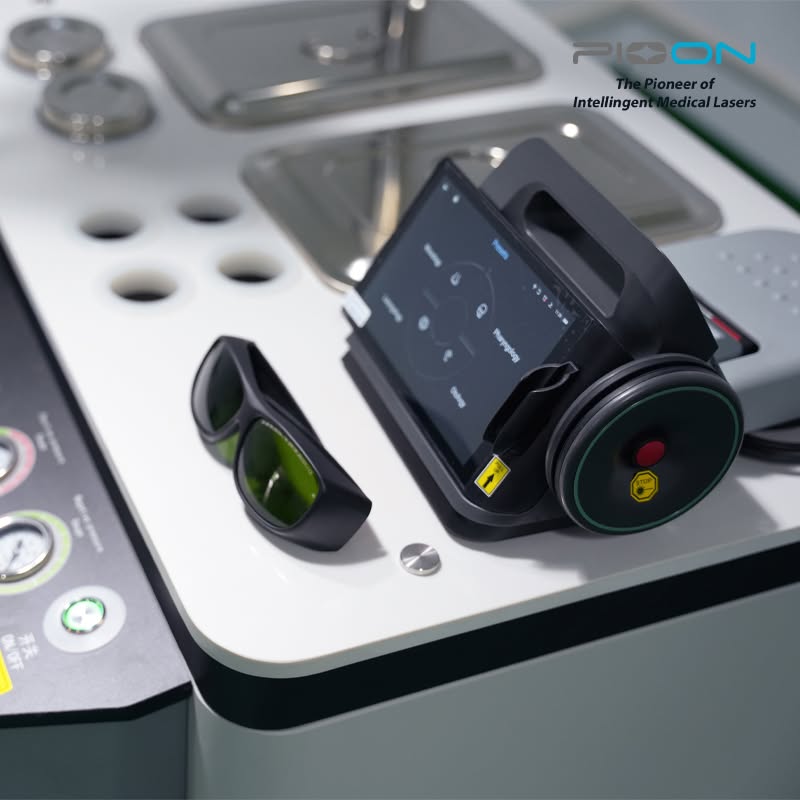
An ENT laser workstation evaluation should include interface, handpiece-activation and aiming-beam checks, not only wavelength and power.
Why does interface and targeting deserve a separate procurement review?
Because the interface and targeting layer is where clinical intent becomes delivered energy. In ENT, the operating field is small, the tissue is delicate, and several team members may need to confirm settings or handpiece status. A screen that is difficult to read under theater lighting, an activation sensor that fires unexpectedly, or an aiming beam that loses alignment after a fiber change can turn a technically capable laser into a workflow problem.
This is a procurement issue, not only a clinician preference. Evaluation teams should score what they can observe in a scripted demo, then carry the same criteria into acceptance testing. The relevant evidence includes the exact model, software version, handpiece, fiber, user manual, cleaning instructions and service terms. A brochure claim that a system is an ENT laser system is not enough; the buyer needs to see the configuration that will be installed.
For procedures such as turbinate reduction, nasal polypectomy, vocal cord surgery, laryngeal surgery, laryngeal papilloma removal, laser-assisted uvulopalatoplasty, tonsil surgery, otologic surgery and pharyngeal surgery, the team should ask whether the interface supports the procedure-specific preset, whether the handpiece is compatible with the selected ENT surgical laser fiber, and whether the aiming beam remains usable at the intended working distance. This FAQ does not rank wavelengths; it treats wavelength selection as a separate clinical and regulatory decision.
What should buyers verify on a 7-inch medical-grade touchscreen?
Verify usability, cleanability, control logic and traceability, not the diagonal measurement alone. A 7-inch medical-grade touchscreen can be appropriate for a compact ENT laser system, but the buyer should test it with gloved hands, in the actual lighting conditions, using the workflows the department will run. The screen should make the active preset, power, mode, pulse settings and accessory status readable before activation. It should also make alarms and interlocks difficult to miss.
- Readability: Check font size, contrast and viewing angle under bright theater lighting and dimmed examination lighting. Ask whether brightness is adjustable and whether the display remains legible when the user is standing at the side of the unit.
- Glove operation: Test the main tasks with the gloves used in the department. Confirm whether the interface requires precise tapping, swiping or multi-step confirmation, and whether a wet or double-gloved finger changes the result.
- Cleanability: Request the approved cleaning and disinfection agents for the exact screen and enclosure. Confirm that the instructions cover the department's infection-control protocol and that the screen is not damaged by routine wiping.
- Preset and expert modes: Ask how the user switches between preset and expert control, who can approve expert changes, and whether the active mode is obvious. The H1 Plus dental reference later in this article uses Smart OS Preset/Expert modes; for an ENT purchase, the equivalent workflow must be verified on the ENT model, not assumed.
- Parameter confirmation: Check that the screen shows the parameters actually delivered, including any changes caused by handpiece or fiber recognition. The user should not have to infer the active configuration from a previous screen.
- Alarms and interlocks: Verify how the system reports a missing fiber, incompatible accessory, sensor fault, footswitch state or self-test failure. Ask whether the message identifies the corrective action and whether the event is logged.
- Software and language: Confirm the installed software version, available interface languages, update method and validation responsibilities. If the hospital requires a local language, ask for it in writing rather than relying on a demo unit.
- User access: Ask whether routine users can change clinical presets, service settings or system defaults. Role separation and audit logs may matter for hospital governance.
A touchscreen should also be evaluated as part of the physical workstation. Cable routing, screen position, footswitch placement and handpiece storage affect whether the user can maintain a clean field. The buyer should test the full sequence: select the procedure, confirm the accessory, activate the handpiece, adjust power if permitted, pause, and shut down. If that sequence requires looking away from the patient for an extended period, the interface is not yet suitable for the intended workflow.
How should a sensor-activated handpiece be evaluated before purchase?
Test activation safety, feedback, fallback and accessory compatibility. A sensor-activated handpiece may reduce dependence on a footswitch or a finger switch, but the procurement question is not whether sensor activation sounds convenient. It is whether the activation logic prevents unintended firing, gives clear status feedback, and recovers predictably when the sensor is obstructed, the handpiece is dropped or the fiber is changed.
- Activation principle: Ask what the sensor detects and how it distinguishes intended use from accidental contact. The answer should be documented in the instructions for use, not only explained by a sales representative.
- Fail-safe behavior: Test what happens when the sensor is covered, the handpiece is set down, the cable is bent, or the fiber is disconnected. The system should default to a safe state and display a clear message.
- Feedback: Check visual, audible and tactile feedback for ready, armed, firing and fault states. In a busy ENT room, a subtle indicator may be missed. The team should agree on which signals are mandatory.
- Activation delay and timeout: Observe whether activation is immediate or delayed, and whether the handpiece times out after inactivity. A timeout can be useful, but it must not surprise the surgeon during a procedure.
- Alternative control: Confirm whether a footswitch or manual control is available as a fallback, and whether the handpiece can be used with the department's preferred sterile drape or sheath.
- Cleaning and sterilization: Ask which parts are reusable, which are single-use, and how the handpiece and cable are cleaned between cases. A sensor window or crevice that is difficult to clean is a procurement concern.
- Ergonomics: Test the handpiece with the actual ENT fiber and in the working position. Check weight, balance, cable strain and ease of tip exchange. A handpiece that is comfortable for a short demo may not be comfortable across a full list.
- Fault logging: Ask whether activation faults, sensor errors and accessory changes are recorded. Service teams need this information to distinguish user error from a hardware problem.
Sensor activation should not be treated as inherently safer than a footswitch. A footswitch has its own risks, including accidental pressure and cable trip hazards. The appropriate choice depends on the procedure, the user's training, the handpiece design and the hospital's laser safety procedures. The demo should include a deliberate misuse scenario, such as setting the handpiece down while armed, to see how the system responds.
What must a 520 nm green aiming beam demonstrate in a demo?
The aiming beam must show where the treatment beam is intended to go, remain aligned through the accessories used, and stay visible without becoming a distraction or a safety gap. A 520 nm green aiming beam is visible to the human eye, but visibility is not the same as alignment. The buyer should test it at the working distances used in ENT procedures and after changing the handpiece, fiber or tip.
- Co-axial alignment: Confirm whether the aiming beam is co-axial with the treatment beam or offset. If it is offset, the user must understand the offset at different distances and how to compensate. Ask for the alignment check described in the service manual.
- Working-distance behavior: Observe the spot size and position at near and far distances. A beam that looks aligned at the bench may diverge or shift at the operative distance.
- Fiber and handpiece changes: Repeat the alignment check after replacing the fiber, changing the handpiece or reconnecting the cable. The system should provide a verification step, not rely on the user's memory.
- Tissue visibility: Test the beam on a suitable non-clinical target under the lighting used in the department. Confirm that the green spot is visible against blood, mucosa and dark surfaces without excessive brightness.
- Aiming-beam power: Ask for the documented aiming-beam output and safety classification. The aiming beam is a targeting aid; it should not be presented as a treatment beam or as proof of delivered therapeutic energy.
- Eyewear compatibility: Confirm that the protective eyewear specified for the system covers the treatment wavelength and the aiming beam. Do not assume that one pair of goggles is suitable for every configuration.
- Failure behavior: Test what happens if the aiming beam fails or is misaligned. The system should prevent treatment or provide a clear warning, depending on the design and approved instructions.
A green aiming beam can improve targeting confidence, but it cannot replace direct visualization, proper access or clinical judgment. In laryngeal or vocal cord work, the line of sight may be restricted, and the aiming beam may be only one part of the setup. The demo should include the actual endoscope, suspension system or handpiece position where relevant, so the team can judge whether the aiming beam is useful in the real ergonomic context.
How can hospital buyers compare these features across demo units?
Use the same scripted tasks, the same accessory set and the same scoring sheet for each candidate. A free demonstration that follows the sales representative's preferred sequence is not a comparison. The buyer should define the tasks before the demo and record what happened, including any workaround required.
| Demo check | What to observe | Evidence to request | Procurement relevance |
|---|---|---|---|
| Touchscreen workflow | Select a procedure preset, confirm parameters, change mode, respond to an alarm. | User manual section, software version, cleaning instructions. | Training time, error prevention, infection control. |
| Handpiece activation | Arm, fire, pause, set down, reconnect and clear a fault. | Instructions for use, fault-code list, service procedure. | Unintended activation risk, workflow interruption. |
| Aiming-beam alignment | Check spot position at near and far working distances before and after a fiber change. | Alignment procedure, aiming-beam specification, eyewear requirements. | Targeting confidence, accessory-change risk. |
| Fiber compatibility | Connect the intended ENT fiber, confirm recognition, inspect the tip and test handling. | Approved fiber list, connector type, core diameter, sterilization method. | Accessory fit, damaged-fiber risk, consumable planning. |
| Cleaning and turnaround | Time the cleaning steps for the handpiece, screen and cable between cases. | Validated cleaning agents, contact times, reusable or single-use status. | Throughput, infection-control compliance. |
| Service and training | Ask how a sensor fault or misalignment would be handled during a clinical list. | Warranty terms, remote support route, spare-parts list, training plan. | Downtime, total ownership cost, after-sales readiness. |
Score each item as pass, pass with condition, or fail. A condition should be written as a specific action, such as supplier to provide local-language interface before acceptance, or fiber list to be confirmed for the quoted ENT model. This prevents a demo impression from becoming an unverified assumption in the purchase order.
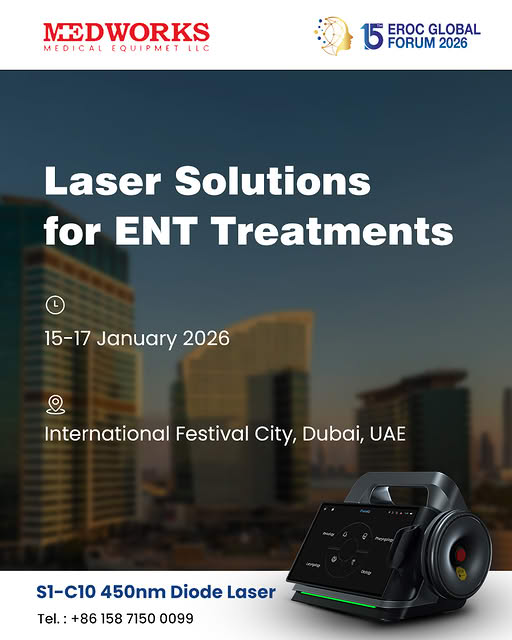
A structured ENT laser demo should use the same handpiece, fiber and user tasks for every candidate system.
Which handpiece and fiber compatibility checks reduce damaged-accessory risk?
Confirm the connector, fiber size, length, tip type, sterilization status and handling limits for the exact ENT model before the order is placed. PIOON's risk guidance for laser fibers and handpieces identifies beam leakage, fire, burns and handpiece overheating as possible consequences of damaged, contaminated or kinked accessories. The same guidance calls for pre-use inspection, avoiding sharp bends and tip blockage, monitoring handpiece temperature, and stopping use when a fault is detected.
For an ENT surgical laser, the buyer should not transfer a fiber list from a dental laser or from another ENT model. The H1 Plus dental reference in this article lists SMA905 compatibility with 200, 300 and 400 μm fibers. That is a dental-platform fact. It does not establish that an ENT handpiece or ENT fiber uses SMA905, or that the same fiber sizes are approved for ENT procedures. The ENT quotation should state the connector, fiber core diameter, numerical aperture where relevant, length, tip shape, reuse status and intended application.
- Connector identity: Ask for the exact connector standard and a photograph or drawing. Confirm that the fiber seats fully and cannot be forced into the wrong port.
- Approved fiber list: Request the model-specific list of compatible fibers and handpieces. Check whether the list distinguishes contact and non-contact use, and whether it covers the procedures the department intends to perform.
- Inspection routine: Ask how the user should inspect the fiber before each case, including the tip, cladding, connector and strain relief. The routine should be short enough to be followed consistently.
- Bend and storage limits: Confirm the minimum bend radius and storage method. A fiber that is coiled too tightly in a drawer may look intact but fail during use.
- Sterilization and reuse: Clarify whether the fiber is single-use or reusable, and which sterilization method is validated. Do not assume that a fiber sold as sterile remains sterile after opening or storage.
- Handpiece heat: Ask what temperature monitoring or user warning is provided. If the handpiece becomes hot during a case, the team needs a documented response, not an informal workaround.
- Error handling: Confirm the error message for a damaged fiber, a missing accessory or an incompatible handpiece. The user should know whether to replace the accessory or call service.
Accessory risk is also a commercial issue. The buyer should estimate how many fibers and handpieces the department will use per month, what the replacement lead time is, and whether the supplier can provide spare parts during the warranty period. A low device price with fragile or hard-to-source accessories can create a higher ownership burden than a higher-priced system with a clear consumable plan.
What after-sales and OEM/ODM questions belong in the contract discussion?
Define who trains the users, who handles remote troubleshooting, how software is supported, how spare parts are supplied and what local service is available. For a hospital, these are not administrative details; they determine whether the ENT laser system can be kept in service. For a distributor, they also determine whether the supplier can support a local installed base without repeated escalations.
PIOON's capability unit lists OEM/ODM support that may include private label, logo, user interface, language, software, wavelength and power configuration, treatment presets and accessories. It states flexible MOQ subject to model and customization requirements, a listed 14-day lead time and a listed monthly capacity of 300 units. These are planning inputs, not a guarantee for every ENT configuration. The purchase agreement should confirm the exact customization scope, sample approval, acceptance criteria and regulatory responsibilities.
PIOON operates under an ISO 13485-certified quality management system, and its quality control includes product inspection, electrical safety testing, laser output verification and functional testing. After-sales support described by PIOON includes technical assistance, remote troubleshooting, product training, software support, maintenance guidance and spare-parts coordination, with on-site service subject to local arrangements. The buyer should convert those categories into written service expectations: response route, escalation path, training format, spare-parts list, warranty exclusions and software update policy. For a distributor, ask how local service responsibilities are shared and whether training materials are available in the target language.
OEM/ODM discussions should document software, labeling, accessories, training and service responsibilities rather than relying on general capability statements.
Which questions should be asked in writing?
- Which exact model, software version and accessory list are included in the quotation?
- Which interface languages, preset modes and user-access controls are enabled at delivery?
- Which handpiece and fiber combinations are approved for the ENT procedures in scope?
- What is the warranty period, what is excluded, and how are replacement parts shipped?
- What training is provided, in what language, and is competency assessment included?
- How are software updates validated, and who approves changes to clinical presets?
- For OEM/ODM, who owns regulatory documentation and labeling for the destination market?
These questions help separate a capable supplier from a supplier that can only demonstrate a working unit. The answers should be consistent across the technical file, the quotation and the service agreement.
Where does the PIOON H1 Plus dental reference fit, and where does it not?
It fits as a clearly labeled portfolio reference for interface documentation, not as evidence of ENT specifications. PIOON lists the H1 Plus as a dental laser with a 7-inch 2K touchscreen, Smart OS Preset/Expert modes, a 650 nm aiming beam, and SMA905 compatibility with 200, 300 and 400 μm fibers. The H1 Plus is a dental laser, not an ENT system. Its value in an ENT procurement review is limited to showing how a manufacturer can document screen, mode and fiber-interface details in a real product configuration.
The differences matter. A 650 nm aiming beam on a dental platform is not the same as a 520 nm green aiming beam under review for an ENT configuration. A dental fiber connector and fiber list are not an ENT fiber list. A dental touchscreen workflow is not proof that an ENT model has the same preset structure, alarm logic or cleaning instructions. Buyers should not copy the H1 Plus specification into an ENT tender or assume that the same interface is available on the PIOON H1 980nm ENT or S1-C10 ENT.
The PIOON ENT portfolio does include the H1 980nm ENT and S1-C10 ENT, and PIOON records at least two years of ENT-focused product demonstrations, professional education and technical exchanges. That activity supports the existence of an ENT-oriented commercial and support effort, but it is not clinical outcome evidence and it does not verify the three interface items in this FAQ for every model. The exact ENT model, market registration and accessory list remain the controlling documents.
What is a practical evaluation-to-execution sequence?
Define the clinical tasks, request the exact configuration, run a scripted demo, verify accessory risk, then close the service and training terms. The sequence should produce a written record that the hospital or distributor can use for acceptance.
- Define the procedure set: List the ENT procedures and user groups the system must support. Include the expected case mix, working distances and accessory types. Do not select a system on headline power alone.
- Request the exact quotation: Ask for the model, software version, touchscreen configuration, handpiece, fiber list, aiming-beam specification, accessories, warranty and training. Mark any item that is optional rather than included.
- Run a scripted demo: Use the same tasks and scoring sheet for each candidate. Include a fiber change, an alarm response and a simulated sensor fault. Record the result rather than relying on memory.
- Check accessory risk: Confirm the approved fiber and handpiece combinations, inspection routine, sterilization method, spare-parts availability and replacement lead time. Calculate a realistic consumable plan.
- Close the service terms: Document training, remote support, on-site service, software updates, warranty exclusions and OEM/ODM responsibilities where applicable. Confirm that the installed configuration matches the approved documents.
This sequence keeps the procurement decision tied to observable evidence. It also gives the distributor a defensible basis for local registration, training and service planning.
Frequently asked questions
Does a 7-inch medical-grade touchscreen make an ENT diode laser easier to use?
Not by itself. Screen size is only one part of usability. Buyers should test readability, glove operation, cleaning, preset and expert modes, alarm visibility and user-access controls in the actual workflow. A smaller screen with clear logic may be easier to use than a larger screen with poor hierarchy.
Is a sensor-activated handpiece safer than a footswitch?
Neither is inherently safer. The relevant checks are activation logic, fail-safe behavior, feedback, timeout, fallback control, cleaning and training. A sensor handpiece should prevent unintended firing when set down or obstructed, and a footswitch should be managed for cable and pressure hazards.
Can a 520 nm aiming beam confirm that the treatment beam will hit the target?
No. A 520 nm green aiming beam can aid targeting, but it does not prove that the treatment beam is correctly aligned or that the intended energy will be delivered. Buyers should verify co-axial alignment, working-distance behavior, alignment after fiber or handpiece changes, and eyewear compatibility.
Can dental laser specifications be used to evaluate an ENT laser?
No. The PIOON H1 Plus is a dental laser with a 7-inch 2K touchscreen, Smart OS Preset/Expert modes, a 650 nm aiming beam and SMA905 compatibility with 200, 300 and 400 μm fibers. Those details are a portfolio reference only. ENT model specifications, fiber compatibility and aiming-beam configuration must be verified separately.
What after-sales documents should be requested before purchase?
Request written warranty terms, training scope, remote-support route, spare-parts list, software-support policy, maintenance guidance and local service arrangements. For OEM/ODM projects, also confirm customization scope, MOQ, lead time, sample approval, labeling and regulatory responsibilities.
Conclusion
The procurement decision for an ENT diode laser should include the interface and targeting layer as a scored part of the evaluation. A 7-inch medical-grade touchscreen, a sensor-activated handpiece and a 520 nm green aiming beam are useful only when they support clear parameter control, safe activation and reliable targeting in the exact ENT configuration. Buyers should verify those items on the quoted model, with the intended fiber and handpiece, and record the results in the demo report.
For PIOON, the H1 Plus dental reference shows how interface and fiber details can be documented, but it is not an ENT specification. The ENT buyer should keep the H1 Plus in the portfolio-reference column and put the H1 980nm ENT, S1-C10 ENT or another quoted ENT model through the same written checks. That discipline reduces the risk of buying a system that looks capable in a demonstration but creates avoidable accessory, training or service problems after installation.
Tem questões ou precisa de mais detalhes?
Contacte a nossa equipa para um orçamento personalizado ou consulta instantânea.
Solicitar orçamento
Preencha o formulário abaixo e a nossa equipa entrará em contacto com uma proposta personalizada.
Chat direto do WhatsApp
Prefere conversar em tempo real? Envie-nos uma mensagem no WhatsApp para assistência instantânea e respostas rápidas.
- Obter orçamento personalizado
- Partilhar fotos ou documentos
- Discuta as suas necessidades diretamente
Geralmente responde em 5–30 minutos durante o horário de expediente.