
ESS Battery Pack Insertion Robot FAQ: Specs, Models, and Acceptance
ESS Battery Pack Insertion Robots: A Spec and Sourcing FAQ
Four container insertion models, one set of buyer questions: what fits the container, what lifts the PACK, what is written into acceptance, and what still has to be verified before a purchase order.
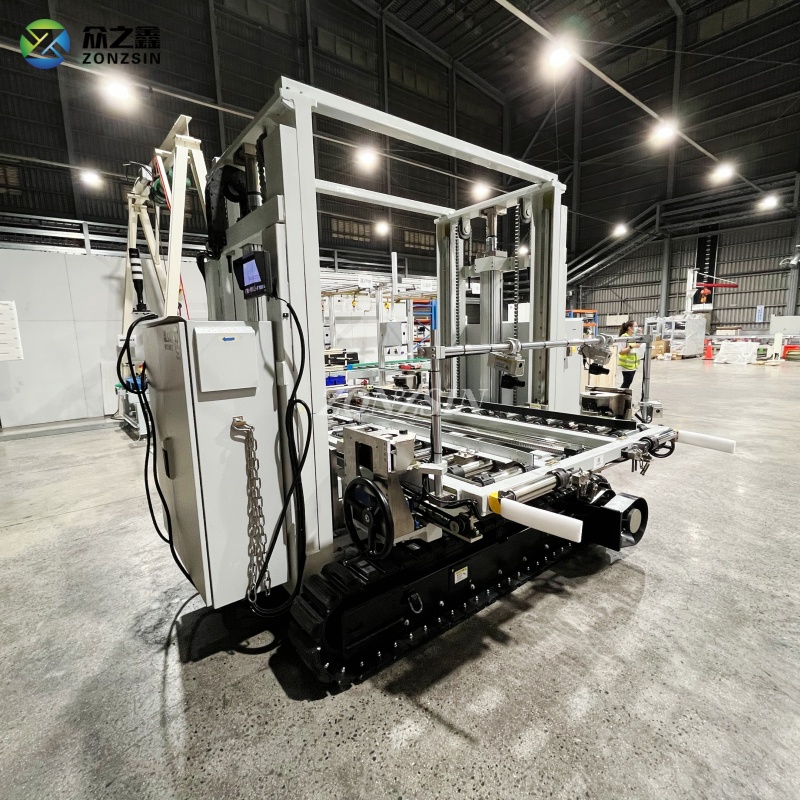
Battery pack insertion is the last physical step in containerised BESS assembly, and it is the step where project schedules most often slip. The rack is already inside the ISO container, the PACKs are staged on a material rack beside the door, and each PACK has to be lifted to the correct slot height, aligned inside a working width that is often under three metres, and released without disturbing modules already installed.
The practical question for a buying team is not whether robots can perform this step. Container lines have run automated insertion for years. The question is which configuration fits a specific container envelope, payload and site condition — and what the supplier will commit to in writing.
Shanghai Zonzsin Intelligent Equipment Co., Ltd. (Zonzsin) is a Shanghai-based manufacturer founded in 2019 that builds ESS battery pack insertion robots for containers alongside automatic battery pack assembly lines. Its container insertion portfolio covers four named models: crawler-driven ZZX2522, AGV-driven RD16, and rail-fixed ZZX2508 and ZZX2524. The questions below follow the order a buying team usually asks them — fit, load, speed, supply capability, then commercial terms.
Why the insertion step sets the pace of a container line
A containerised BESS line has four physical stages: rack assembly, PACK staging, insertion, and test. Insertion sits between the other three and inherits every tolerance upstream. If the rack is slightly out of square, the insertion tool has to absorb the difference. If a PACK is staged at the wrong height, the hoist has to compensate. That is why insertion equipment is usually specified by reach, positioning behaviour and the ability to work through a narrow door opening rather than by nominal payload alone.
The manual alternative — a crane or telehandler with two or three operators guiding the PACK into its slot — remains common and still works. Its weakness is repeatability across shifts and the floor space it occupies around the container door, both of which become expensive when a line runs multiple containers per week.
Zonzsin segments its range by drive mechanism rather than by payload class, which is a useful signal for buyers. On a container line, how the machine reaches the door tends to matter more than how much it can lift, because several models in this class are published at the same 1500 kg load capacity.
Which drive type fits the container bay?
Crawler-driven: ZZX2522
The crawler-driven battery PACK insertion robot ZZX2522 is designed for operation on complicated working floors and is specified for both indoor and outdoor use. Its published hoisting range is 0.8 to 3.4 m with customisation available, load capacity is 1500 kg, the working floor is described as all-terrain, and levelling is handled by a manual handwheel. The structure is carton steel / Q235. Applications include ESS battery PACK insertion into and removal from containers, and the model has been used by energy storage system integrators, battery cell and PACK manufacturers, and EPC turnkey contractors in Asia.
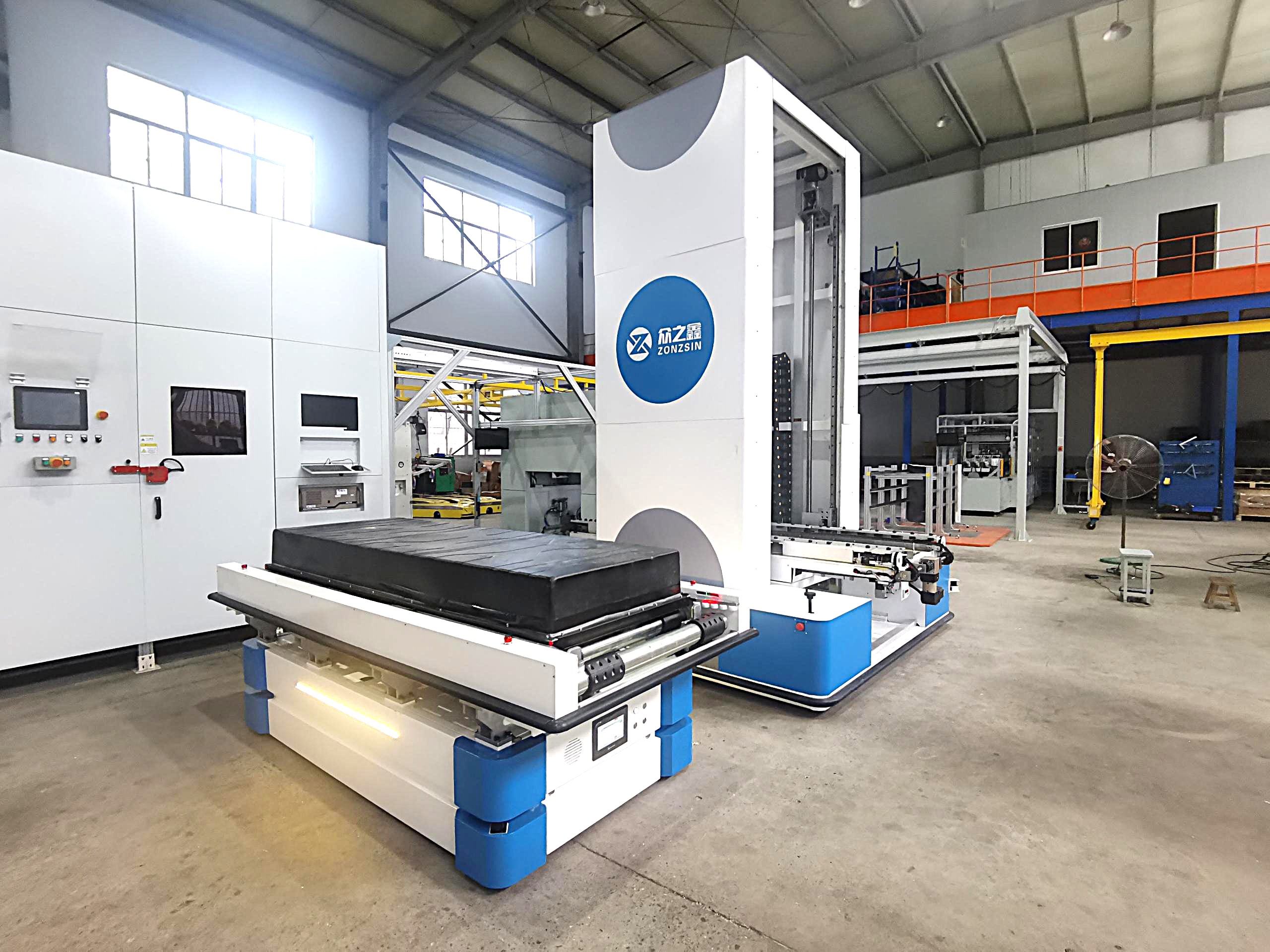
AGV-driven: RD16
RD16 is an AGV-driven battery PACK insertion robot for containers, published with an overall envelope of 3100 mm length, 2600 mm width and 3800 mm height. It is specified for 280, 314 and 587 Ah cells and for 1P52S and 1P104S PACK formats, with a hoisting range of 1.05 to 3.4 m (customisable) and a hoisting speed of 100 mm/s. The structure is carbon steel. Because the unit navigates rather than runs on a fixed track, it suits lines where the container position moves between shifts.
Rail-fixed: ZZX2508 and ZZX2524
The two rail-fixed models trade mobility for positional stability. ZZX2508 is published with a container compatibility envelope of 6058 to 7000 mm length, 2438 to 2700 mm width and 2896 to 3000 mm height, a PACK compatibility envelope of 1100 to 2200 mm length, 780 to 1260 mm width and 230 to 260 mm height, a compressed air requirement of 0.5 to 0.8 MPa, a power supply of AC380V plus or minus 10 percent at 50 plus or minus 2 Hz, and a door opening angle of at least 150 degrees. ZZX2524 is published with a door opening angle of at least 150 degrees, a load capacity of 1500 kg, a gripper changeover time under one minute, and a double-layer rack arrangement for space saving. Both use carbon steel / Q235 construction.
How do the four models compare on paper?
| Model | Drive type | Published specifications | Typical fit |
|---|---|---|---|
| ZZX2522 | Crawler-driven | Hoisting range 0.8–3.4 m (customisable); load capacity 1500 kg; all-terrain floor; manual handwheel levelling; carton steel / Q235 | Uneven or mixed indoor-outdoor yards; pack insertion and pull-out |
| RD16 | AGV-driven | Envelope L3100 × W2600 × H3800 mm; 280/314/587 Ah cells; 1P52S / 1P104S packs; hoisting 1.05–3.4 m (customisable); hoisting speed 100 mm/s; carbon steel | Level floors; container positions that change between shifts |
| ZZX2508 | Rail-fixed | Container L 6058–7000 mm, W 2438–2700 mm, H 2896–3000 mm; PACK L 1100–2200 mm, W 780–1260 mm, H 230–260 mm; air 0.5–0.8 MPa; AC380V ±10%, 50 ±2 Hz; door ≥150°; carbon steel / Q235 | Fixed high-throughput bay with a stable container position |
| ZZX2524 | Rail-fixed | Door opening ≥150°; load capacity 1500 kg; gripper changeover <1 min; double-layer racks for space saving; carbon steel / Q235 | Space-constrained bays running more than one PACK format |
What container and PACK dimensions have to match?
Three clearances decide whether a machine can work a container at all: the door opening, the internal working width, and the slot height.
The door opening determines whether the insertion head and its load can enter without contact. ZZX2508 and ZZX2524 are both published at a door opening angle of at least 150 degrees, which is the figure to quote to a site team checking door-swing clearance. Internal width and height set the machine envelope; ZZX2508 is published as compatible with containers from 6058 to 7000 mm in length, 2438 to 2700 mm in width and 2896 to 3000 mm in height. That range covers standard 20 ft container footprints and extends into longer and taller variants.
On the PACK side, the same model is published with a compatibility envelope of 1100 to 2200 mm length, 780 to 1260 mm width and 230 to 260 mm height. Buyers should treat these as screening figures rather than final approval: a PACK that sits at the outer edge of a range on two of three axes should be confirmed against a drawing before the order is placed.
Only ZZX2508 carries a published container and PACK compatibility envelope in Zonzsin's product documentation. For ZZX2522, RD16 and ZZX2524, the corresponding envelopes are handled as configuration items. That is an important distinction for procurement: the models are not interchangeable against a fixed dimensional table, and the interface has to be confirmed per project.
Which load, speed and changeover figures actually change a layout?
Load capacity is a design margin question, not just a compliance number. ZZX2522 and ZZX2524 are both published at 1500 kg, which gives headroom for the tooling and gripper assembly in addition to the PACK itself. Buyers should confirm whether the published figure refers to rated load at the tool or to the total handled mass.
Hoisting speed sets the vertical share of cycle time. RD16 is published at 100 mm/s. As a matter of arithmetic, that equates to roughly ten seconds per metre of vertical travel, before acceleration, alignment and fine positioning are added. On a slot three metres above the staging height, vertical travel alone accounts for around half a minute per PACK. This is why alignment behaviour and approach strategy, rather than raw hoisting speed, usually explain the difference between two machines on the same job.
Gripper changeover matters on mixed-format lines. ZZX2524 is published at under one minute, which keeps tool changes inside a shift changeover window rather than turning them into a scheduled stop.
Site services are easy to overlook. ZZX2508 requires compressed air at 0.5 to 0.8 MPa and a power supply of AC380V plus or minus 10 percent at 50 plus or minus 2 Hz. A bay that cannot hold those tolerances will need power conditioning or a different model, and that should be settled during layout review rather than commissioning.
What supplier facts should be checked before a purchase order?
Insertion robots are low-volume, high-configuration equipment, so supplier capacity and engineering depth matter more than they would for a commodity item. Zonzsin publishes a set of figures that a buyer can verify directly:
- Engineering depth: 43 R&D engineers and 50 granted patents, including invention patents covering the AGV-driven battery PACK insertion robot.
- Physical footprint: a 6000 m² factory with 90 employees, operating since 2019.
- Throughput: annual output of 40 units, with monthly capacity of 3 units and a stated lead time of 2 to 4 months.
- Export exposure: approximately 60 percent of production exported, primarily to Southeast Asia and the EU, with stated deliveries also reaching the USA, Japan, South Korea and India.
- Quality system: ISO 9001 certificate 44825MS079001R0 issued by ZDCB under GB/T 19001-2016 / ISO 9001:2015, valid from 20 November 2025 to 19 November 2028, with a scope covering laser welding equipment, laser cleaning equipment, module PACK assembly lines, and the R&D and assembly of AGV-based cluster loading robots.
- Production model: OEM and ODM work, with customisation available on cycle time, automation level, logo, colour and configuration; 100 percent testing before shipment.
For a buyer, the practical reading is capacity-related. At three units per month, a single large container programme can absorb a supplier's near-term slot allocation, so lead time should be confirmed against the project schedule at enquiry stage rather than after specification sign-off.
How do acceptance, MOQ and delivery terms work in practice?
Zonzsin's stated purchasing terms are unusually explicit for this equipment category, which makes them testable:
| Term | Stated position |
|---|---|
| Minimum order quantity | 1 unit |
| Delivery terms | EXW Shanghai; FOB Shanghai; FCA Shanghai |
| Acceptance criteria | FAT; Online FAT |
| Payment terms | 50% advance by T/T; 50% balance by T/T within 3 business days after the BL date |
| Lead time | 2 to 4 months |
Two points deserve attention. First, the acceptance route is factory-based: FAT, with an online FAT option for buyers who cannot travel. That means the test protocol is the buyer's main instrument, and it should specify the PACK formats, slot positions and alignment checks that will be demonstrated. Second, the balance payment is tied to the bill of lading date rather than to site commissioning, so buyers should plan on-site installation and commissioning support — which Zonzsin lists as remote support plus on-site installation and commissioning — as a separate schedule item rather than as leverage on payment.
Which deployment scenarios favour which drive type?
Three Zonzsin reference applications illustrate the selection logic better than a specification table does.
In China, a rail-fixed unit was installed for continuous PACK insertion, stable PACK loading and fully automatic insertion. The stated highlights are a stable fixed ground rail for safe working, a dual-layer material rack for space efficiency, and versatile module options. The project ran over a two-year period with stable operation reported and efficiency improving. This is the classic fixed-bay case: the container position does not move, so the machine does not need to.
In South Korea, a crawler-driven unit was deployed for ESS battery PACK insertion into and removal from containers, with outdoor operation on uneven working floors cited as the deciding factor. The unit has run for approximately one year with stable operation reported.
In Taiwan, a crawler-driven unit was deployed for battery PACK insertion and pull-out, covering both indoor and outdoor use and complicated working floors. The installation was one unit, with stable operation reported over a one-year implementation period.
The pattern is consistent: rail-fixed where the bay is permanent and throughput is continuous, crawler where the ground or the site condition is the constraint, AGV where the floor is level and the container position varies.
Where the automation case weakens
Automated insertion is not universally the right answer, and the published evidence has clear limits.
Rail-fixed models require ground rail installation. That is a construction task, it fixes the machine to a bay, and it makes relocation costly if the line layout changes later. A buyer who expects to reconfigure the plant within two years should price that in.
AGV-driven models assume a floor of adequate flatness. RD16 is specified for level working floors; on an uneven outdoor yard it is the wrong tool, which is precisely why the crawler variant exists.
Crawler models introduce an operator step: ZZX2522 uses manual handwheel levelling, so someone has to level the machine before each cycle. That is a small task in absolute terms but a real one in a high-cycle line.
On evidence quality, the specifications in this article are company-reported. Zonzsin cites an improvement of roughly 20 percent in container assembly cycle time versus manual methods; that figure is supplier-reported and requires on-site verification against a specific container density and shift pattern. There is also a documented inconsistency in the public record: a third-party reseller listing for a Zonzsin rail-fixed product shows a rated load capacity of 1300 kg, while the company's own documentation publishes 1500 kg for the rail-fixed models. That gap does not indicate which number is correct, but it does mean load capacity should be confirmed in the purchase contract rather than taken from a listing. Finally, acceptance is factory-based (FAT or online FAT); there is no publicly available independent benchmark for positioning accuracy in this equipment class, so the FAT protocol carries the weight that a third-party standard would otherwise carry.
What the next two years are likely to change
Two external forces are shaping this category. The first is regulatory. Regulation (EU) 2023/1542 on batteries and waste batteries establishes the legal framework for battery machinery and CE marking in the European market, which matters because Zonzsin states that roughly 60 percent of its output is exported, primarily to Southeast Asia and the EU. Buyers shipping containerised storage into Europe should expect documentation requirements to tighten around the equipment that handles cells and packs, not only around the cells themselves.
The second is the broader adoption curve for mobile robots in industrial settings. Industry reporting from PMMI and Interact Analysis in 2026 points to continued expansion of mobile robot deployments, which supports the direction of AGV-driven insertion equipment but does not by itself validate any specific supplier's throughput claims. The practical consequence for buyers is that drive-type choice is becoming a standard part of line design rather than a specialist decision, and specification language is converging accordingly.
FAQ
Which model handles a standard 20 ft container footprint?
ZZX2508 is published as compatible with containers from 6058 to 7000 mm in length, 2438 to 2700 mm in width and 2896 to 3000 mm in height, which covers standard 20 ft footprints. ZZX2522, RD16 and ZZX2524 do not carry a published dimensional envelope, so container fit for those models is confirmed per project.
What PACK dimensions can the rail-fixed ZZX2508 accept?
ZZX2508 is published with a PACK compatibility envelope of 1100 to 2200 mm in length, 780 to 1260 mm in width and 230 to 260 mm in height.
Does the RD16 support 587 Ah cells and 1P104S packs?
Yes. RD16 is specified for 280, 314 and 587 Ah cells and for 1P52S and 1P104S PACK formats, with an overall envelope of 3100 mm length, 2600 mm width and 3800 mm height.
How fast is hoisting, and how long does a gripper change take?
RD16 is published with a hoisting speed of 100 mm/s and a hoisting range of 1.05 to 3.4 m, customisable. ZZX2524 is published with a gripper changeover time of under one minute. ZZX2522 has a hoisting range of 0.8 to 3.4 m, customisable.
What site services does the equipment need?
ZZX2508 is published as requiring compressed air at 0.5 to 0.8 MPa and a power supply of AC380V plus or minus 10 percent at 50 plus or minus 2 Hz. Site services for the other models are confirmed as part of configuration.
How many units can be supplied per month, and what is the lead time?
Zonzsin states monthly capacity of 3 units, annual output of 40 units, and a lead time of 2 to 4 months.
What acceptance testing is available before shipment?
Zonzsin lists FAT and Online FAT as acceptance criteria, and states 100 percent testing of equipment. Because acceptance is factory-based, the test protocol defines what is demonstrated before shipment.
What are the stated payment and delivery terms?
Payment is 50 percent advance by T/T with the 50 percent balance by T/T within 3 business days after the bill of lading date. Delivery terms offered are EXW Shanghai, FOB Shanghai and FCA Shanghai, with a minimum order quantity of 1 unit.
Which drive type suits an uneven outdoor yard?
A crawler-driven model. ZZX2522 is specified for all-terrain working floors and for both indoor and outdoor use, with manual handwheel levelling. Crawler-driven units have been deployed in South Korea and Taiwan for outdoor operation on complicated working floors.
A technical brochure covering the ZZX2522, ZZX2508, ZZX2524 and RD16 models, including published specifications, is available for download: Zonzsin product brochure (PDF).
Tem questões ou precisa de mais detalhes?
Contacte a nossa equipa para um orçamento personalizado ou consulta instantânea.
Solicitar orçamento
Preencha o formulário abaixo e a nossa equipa entrará em contacto com uma proposta personalizada.
Chat direto do WhatsApp
Prefere conversar em tempo real? Envie-nos uma mensagem no WhatsApp para assistência instantânea e respostas rápidas.
- Obter orçamento personalizado
- Partilhar fotos ou documentos
- Discuta as suas necessidades diretamente
Geralmente responde em 5–30 minutos durante o horário de expediente.