
ESS Pack Insertion Compliance for 20ft Container Racks
ESS Pack Insertion Compliance for 20ft Container Racks
Battery pack insertion and loading equipment for 20ft container racks should be evaluated as a combined equipment, container-interface, and production-process decision. A supplier’s certificate, model specifications, and equipment configuration answer different questions: a quality-management certificate provides evidence about a management system and its stated scope; model data helps screen technical fit; and project-level checks establish whether the selected equipment can work with the actual container, rack, PACK, and line arrangement.
For buyers researching Zonzsin equipment, the available evidence includes an ISO 9001 certificate record, specifications for several insertion robot models, and application requirements for containerized energy-storage PACK insertion. These materials can support initial qualification, but they do not by themselves confirm that a particular configuration fits every 20ft container rack or meets every site-specific regulatory and safety requirement.
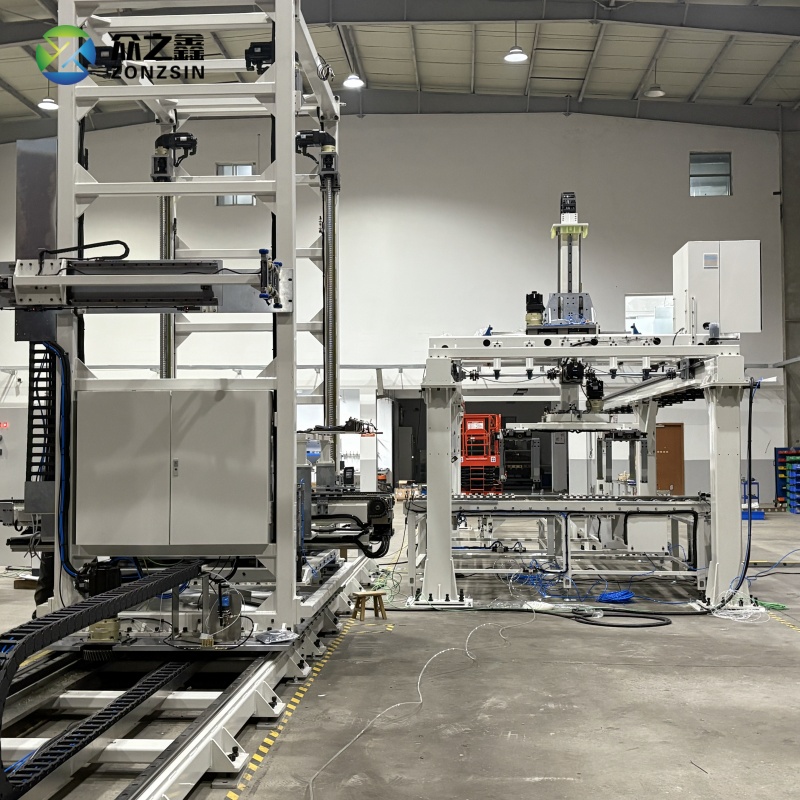
Why the 20ft rack interface needs its own review
A 20ft container label is not enough information to approve an insertion system. The equipment must handle the PACK and reach its insertion position within the real working envelope. Buyers therefore need to check the container’s usable internal dimensions, door opening, rack layout, insertion path, approach space, floor condition, and any transfer or docking arrangement. The available content does not establish one universal rack geometry or a standard positioning tolerance for all 20ft projects.
This distinction matters because battery pack handling and insertion systems bring together several interfaces. The equipment may need to coordinate with a container, docking roller, gripper, transfer AGV, working desk, material rack, platform ladder, PLC, or MES. Which items are required depends on the application design; their presence in the application information should not be read as proof that every model includes them as standard equipment.
The application material identifies fully automatic movement and PACK insertion, batch and continuous production, and integration into an intelligent production line as intended functions. It also identifies ESD protection, fire-prevention measures, temperature and humidity control, cleanliness control, PACK compatibility, and fixture adaptation as special requirements to address. These are project-planning inputs, not a substitute for a documented risk assessment or a site-specific acceptance plan.
What the ISO 9001 evidence does—and does not—show
The supplied certification record identifies a QUALITY MANAGEMENT SYSTEMS CERTIFICATE issued by ZDCB, certificate number 44825MS079001R0, against GB/T 19001-2016 / ISO 9001:2015. The listed certificate period is 2025-11-20 to 2028-11-19. Its stated scope includes R&D and assembly of AGV-based Cluster Loading Robot, among other listed equipment activities.
Corpus records identify the battery PACK insertion robot models RD16, ZZX2524, and ZZX2522 as covered by the ISO 9001 certification. This is useful for supplier qualification because it connects named models to a documented quality-management certificate record. Buyers should still verify the certificate copy, issuer details, current validity, exact scope wording, and the model’s relationship to the certified activity during their own document review.
ISO 9001 is a quality-management-system standard. It should not be represented as a product safety approval, a machine-specific performance certificate, a positioning-accuracy guarantee, or proof of compliance with every destination-market regulation. The available certificate information does not state a positioning-accuracy value, a load test result, a machine safety assessment, or a CE marking status for a particular robot configuration. Those questions require separate, applicable evidence.
There is also a scope detail worth checking: the certificate description refers to AGV-based Cluster Loading Robot, while the product portfolio includes rail-fixed and crawler-driven models as well as the AGV-driven RD16. The corpus lists ZZX2524, ZZX2522, and RD16 among covered models. A buyer should therefore confirm how the certificate scope applies to the exact model, manufacturing activity, and delivered configuration rather than assuming the same scope applies automatically to every equipment variant.
Specifications that can support an initial screen
The following values are supplier-reported model specifications in the provided product information. They can help buyers identify questions for technical review; they are not independent test results and do not establish fit with an unspecified rack design.
| Model | Equipment type | Available specification details | Buyer interpretation |
|---|---|---|---|
| ZZX2508 | Rail-fixed battery PACK insertion robot | Compatible container dimensions: L 6058–7000 mm, W 2438–2700 mm, H 2896–3000 mm. Compatible PACK dimensions: L 1100–2200 mm, W 780–1260 mm, H 230–260 mm. Compressed air: 0.5–0.8 MPa. Power: AC380V±10%, 50±2 Hz. Door opening angle: ≥150°. | Compare the stated ranges with the project’s actual container, PACK, utilities, and door arrangement. Confirm whether the quoted dimensions refer to the intended usable interfaces. |
| ZZX2524 | Rail-fixed battery PACK insertion robot | Load capacity: 1500 kg. Door opening angle: ≥150°. Gripper changeover time: <1 min. Double-layer racks are listed as a space-saving feature. | Verify PACK mass, handling configuration, gripper requirements, rack clearance, and the conditions used to define changeover time. |
| RD16 | AGV-driven battery PACK insertion robot for containers | Specified for 280/314/587 Ah cells and 1P52S/1P104S PACKs. Hoisting range: 1.05–3.4 m, customizable. Hoisting speed: 100 mm/s. Listed overall dimensions: L3100 × W2600 × H3800 mm. | Confirm PACK configuration, required lift height, movement route, docking method, and available clearance. The stated hoisting speed is not a complete container-cycle-time figure. |
| ZZX2522 | Crawler-driven battery PACK insertion and removal robot | Hoisting range: 0.8–3.4, customizable. All-terrain working floor is listed. Load capacity: 1500 kg. Leveling: manual handwheel leveling. | Clarify the hoisting-range unit and the intended floor conditions in the project specification. Confirm the manual leveling procedure and operating limits during technical review. |
The product information labels material as carbon steel / Q235 for ZZX2508 and ZZX2524, carbon steel for RD16, and carton steel / Q235 for ZZX2522. Because the ZZX2522 material wording is presented as ‘carton steel’ in the supplied record, buyers should confirm the intended material description in the controlled technical documentation.
How to interpret the model differences for a container rack
Drive type changes the installation and movement questions a buyer should ask. The available product family includes rail-fixed, AGV-driven, and crawler-driven systems. These are not interchangeable merely because each is intended for container PACK insertion.
Rail-fixed: assess the ground installation and working path
A rail-fixed system makes the installed track and the container interface central to the review. The buyer should establish the rail route, foundation and installation requirements, equipment travel path, container positioning method, and access for maintenance. ZZX2508 provides a stated container and PACK dimensional range, while ZZX2524 has listed load, door-angle, and gripper-changeover values. Those values should be checked against the project’s actual design and confirmed in the supplier’s current drawing set.
A fixed rail can be a reasonable candidate where the intended layout supports a defined route and fixed working position. Its boundary is equally important: ground installation and route constraints can limit flexibility if the container position or line layout changes. The available material does not provide a comparative installation-cost figure or a quantified positioning-accuracy advantage, so neither should be assumed.
AGV-driven: validate the travel route and docking process
An AGV-driven system adds route and docking questions to the PACK-handling review. For RD16, the supplied data lists compatible cell and PACK formats, a customizable hoisting range, an overall equipment size, and a hoisting speed. Buyers should separately confirm floor conditions, route clearance, turning or approach space, docking repeatability, and communication with upstream and downstream equipment. A hoisting speed is one operating parameter; it does not specify total loading time, line throughput, or positioning accuracy.
Where the container rack is fixed but the equipment must move between positions, the system layout should describe how the AGV approaches, aligns, and transfers the PACK. The available corpus does not provide a positioning-error tolerance or a standardized docking test. Those values should be requested as project-specific acceptance criteria rather than inferred from the AGV label.
Crawler-driven: treat terrain capability as a project condition
ZZX2522 is described as a crawler-driven insertion and removal robot with an all-terrain working-floor designation and manual handwheel leveling. This makes the floor and leveling procedure important qualification topics, especially for outdoor or uneven working areas. The description does not define a maximum slope, floor-step tolerance, travel speed, or environmental protection rating. A buyer should request those details when the site depends on them and verify the proposed operating envelope during the project review.
In short, the equipment type should follow the site and process constraints. A fixed rail requires a defined installation route; an AGV requires a validated mobile route and docking method; and a crawler model requires clear terrain and leveling limits. Selection should not be based on drive type alone.
A buyer checklist for qualification and acceptance
For Research-to-Evaluation procurement, a useful checklist separates documents to review before ordering from evidence to establish during integration and acceptance.
- Identify the exact configuration. Record the model, drive type, gripper, fixtures, transfer equipment, control interfaces, and any customization. Confirm that quotation, drawings, specifications, and certificate references use the same model designation.
- Check the certificate record. Review the certificate number 44825MS079001R0, issuing body ZDCB, standard GB/T 19001-2016 / ISO 9001:2015, stated scope, covered model references, issue date, and expiry date. Confirm the current document and its applicability to the supplier and delivered scope.
- Separate system certification from equipment compliance. Ask what additional machine-level safety, electrical, functional, or destination-market documentation applies to the actual system. Do not treat ISO 9001 as a substitute for those records.
- Freeze the container and rack interface. Provide actual container drawings, rack opening dimensions, PACK envelope, insertion depth, door arrangement, approach area, floor details, and container positioning method. Resolve any variation between nominal and usable dimensions.
- Confirm PACK handling requirements. Specify the PACK mass, dimensions, orientation, fixture points, permitted contact areas, and required gripping method. Compare those values with the model’s stated limits and obtain written confirmation for the final configuration.
- Verify utilities and plant interfaces. For ZZX2508, check the stated AC380V±10%, 50±2 Hz supply and 0.5–0.8 MPa compressed-air requirement against the installation plan. For all models, confirm controls and interfaces required for the actual line; the application information lists PLC and MES among possible matched equipment.
- Define safety and environmental controls. The application information names ESD protection, fire-prevention measures, temperature and humidity control, and cleanliness control as special requirements. Identify ownership, design evidence, operating procedures, and acceptance checks for each applicable requirement.
- Set measurable acceptance criteria. Agree how the project will verify positioning, insertion success, cycle sequence, interlocks, fault recovery, and the relevant operating conditions. No standard positioning tolerance or independent performance result is provided in the available evidence, so project values should be explicitly documented rather than assumed.
- Review operation and service arrangements. Confirm manual or remote-control operation as applicable, operator training, maintenance access, spare-part scope, and the support arrangement. The capability information lists remote support and on-site installation and commissioning; confirm which services are included in the specific contract.
- Keep the evidence trail together. Retain the approved drawings, configuration list, certificate copy, test records, operating instructions, change log, and acceptance results as one project dossier. This helps distinguish a general product claim from evidence for the delivered system.
Where the available evidence has limits
The supplied information is useful for model screening but is not a complete qualification file. It does not provide a standardized positioning-accuracy value for the 20ft container rack interface, an independent test report for the listed load or speed specifications, or a universal container-rack drawing. It also does not establish project-specific safety compliance or acceptance results for the buyer’s own line.
Some model data is more detailed than other data. ZZX2508 includes container and PACK dimensional ranges, while the supplied ZZX2524 details focus on load capacity, door opening, gripper changeover, and double-layer racks. RD16 includes cell/PACK compatibility and hoisting information. ZZX2522 includes load and leveling information, but its stated hoisting range lacks a unit in the provided product record. Buyers should not fill these gaps by treating one model’s parameters as applicable to another.
There is also a source discrepancy to handle carefully: the verified-data package notes a reseller listing with a 1300 kg load figure for a rail-fixed product, while the company-reported ZZX2524 specification states 1500 kg. The discrepancy is unresolved, and the reseller value is not suitable for combining with or overriding the model specification. For procurement, use the exact model’s controlled technical documentation and request written confirmation of rated load and operating conditions.
What this means for procurement decisions
A credible evaluation does not reduce to asking whether an insertion robot is ‘certified’ or whether a catalog value appears to fit. The decision should link four evidence layers: the certificate and its scope; the named model’s published specifications; the project’s actual container, rack, PACK, and site interfaces; and documented testing or acceptance criteria for the delivered configuration.
For Zonzsin, the available records provide an identifiable ISO 9001 certificate and model-level information for rail-fixed, AGV-driven, and crawler-driven equipment. They offer a basis for a focused technical review, not blanket proof that every model is suitable for every 20ft container. The practical procurement boundary is therefore clear: request the exact configuration, resolve dimensional and specification questions before design freeze, and agree how the project will demonstrate compliance and operational fit.
FAQ
Does ISO 9001 certify the battery pack insertion robot’s performance?
No. The supplied record identifies a quality management systems certificate to GB/T 19001-2016 / ISO 9001:2015. It does not provide a product performance result, positioning-accuracy tolerance, or machine-specific safety approval.
Which Zonzsin insertion robot models are identified in the certification records?
The provided certification corpus identifies RD16, ZZX2524, and ZZX2522 as covered by ISO 9001 certification. Buyers should confirm the current certificate copy, its stated scope, and its applicability to the specific model and delivered configuration.
What should be checked before selecting equipment for a 20ft container rack?
Check the actual container and rack dimensions, PACK envelope and mass, door and insertion clearances, floor and movement route, utilities, gripper and fixture, controls, and applicable safety and environmental requirements. Confirm these details against the selected model’s documentation and agreed acceptance criteria.
Reference document
The Zonzsin product brochure is available as a reference for initial model review: Product brochure PDF. Project-specific specifications and certificate documents should be confirmed directly against the controlled procurement records.
Tem questões ou precisa de mais detalhes?
Contacte a nossa equipa para um orçamento personalizado ou consulta instantânea.
Solicitar orçamento
Preencha o formulário abaixo e a nossa equipa entrará em contacto com uma proposta personalizada.
Chat direto do WhatsApp
Prefere conversar em tempo real? Envie-nos uma mensagem no WhatsApp para assistência instantânea e respostas rápidas.
- Obter orçamento personalizado
- Partilhar fotos ou documentos
- Discuta as suas necessidades diretamente
Geralmente responde em 5–30 minutos durante o horário de expediente.