
ESS Pack Insertion Robot Acceptance Criteria Before Handover
ESS Pack Insertion Robot Acceptance Criteria Before Handover
An ESS battery pack insertion robot is often signed off in a single afternoon. The container is on the floor, a few PACKs are staged, a commissioning engineer runs two or three insertions, and the acceptance sheet goes into the project file. The problems surface later — a long PACK that will not clear a rack tier, a gripper change that overruns the quoted minute, an air line that sags at the far end of the bay.
Qualifying the unit before handover treats acceptance as the stage where a published specification becomes a measured obligation on the buyer's own floor. For a constraint-driven purchase this is the only stage at which each number — load capacity, hoisting speed, changeover time, supply tolerance, container envelope — is reproduced under the conditions the machine will actually work in.
Shanghai Zonzsin Intelligent Equipment Co., Ltd. (Zonzsin), a Shanghai-based manufacturer founded in 2019 that builds ESS battery pack insertion robots for containers and automatic battery pack assembly lines, publishes the model-level figures used as examples throughout this article. They are company-published specifications, accurate to the model family and the date of publication, and they should be written into the purchase contract before anyone tests them.
Why a constraint purchase needs a constraint test
Three documents are routinely confused during acceptance, and they answer different questions. A quality management certificate answers whether a management system exists. A datasheet answers what a model family is designed to do. Only a unit-level test record answers whether the machine standing in the buyer's bay handles the container and the PACK the buyer will run next month.
The distinction matters most for constraints, because constraints fail at the edges. A robot rated for a 1,500 kg load is not qualified by lifting one 800 kg pack; it is qualified by demonstrating the rated figure with instrumentation the buyer can read, at the reach and on the surface the machine will operate at. A specification of AC380V±10%, 50±2Hz is not satisfied by a nominal reading at the distribution panel; it is satisfied by a measurement at the machine terminals during a loaded cycle, including whichever end of the tolerance band the site actually delivers.
The practical consequence for procurement is simple. Every acceptance line should name a figure, a measurement method and an acceptable band. Where the supplier's published material does not state a figure for a specific model, the acceptance document should require that figure in writing rather than infer it from a sister model.
The acceptance baseline: which figures to contract
The table below collects the constraint figures that the current published specifications actually provide, model by model. It is deliberately not a full datasheet; it is the subset that an acceptance protocol can measure and a contract can bind.
| Model and drive type | Published constraint figures | What the acceptance run should measure |
|---|---|---|
| ZZX2508 rail-fixed | Container envelope L 6,058–7,000 mm, W 2,438–2,700 mm, H 2,896–3,000 mm; PACK envelope L 1,100–2,200 mm, W 780–1,260 mm, H 230–260 mm; door opening angle ≥150°; power AC380V±10%, 50±2Hz; compressed air 0.5–0.8 MPa | Extremes of both envelopes with real containers and PACKs; door clearance; loaded voltage and frequency at the terminals; gripper behaviour at 0.5 MPa |
| ZZX2524 rail-fixed | Load capacity 1,500 kg; door opening angle ≥150°; gripper changeover under 1 minute; double-layer rack configuration for space saving | Rated-load lift at working reach; timed changeover between PACK formats; access to both rack tiers; rail and foundation condition |
| RD16 AGV-driven | Unit envelope L 3,100 × W 2,600 × H 3,800 mm; cell compatibility 280/314/587 Ah; PACK compatibility 1P52S/1P104S; hoisting range 1.05–3.4 m (customizable); hoisting speed 100 mm/s | Hoisting speed over a defined travel; docking repeatability along the real route; sample of the cell and PACK matrix |
| ZZX2522 crawler-driven | Hoisting range 0.8–3.4 m (customizable); all-terrain working floor; load capacity 1,500 kg; manual handwheel levelling | Floor condition and travel across it; levelling time as an operator step; rated-load lift at the extremes of the hoisting range |
Two gaps in the published set are worth flagging before they become acceptance disputes. The rail-fixed ZZX2508 specification lists its container and PACK envelopes, its air and power requirements and a door opening angle, but it does not list a load capacity or a hoisting speed; those values must come from the supplier in the purchase documentation. The reverse applies to the AGV-driven RD16, whose specification lists hoisting range, hoisting speed and cell and PACK compatibility but not a container envelope in the supplied material. An acceptance protocol built on assumptions about missing fields is not a protocol; it is a guess with a signature.
Verifying the container and PACK envelope with real hardware
Envelope verification is the cheapest test to run and the most expensive to skip. The ZZX2508 specification gives a container range of 6,058–7,000 mm length, 2,438–2,700 mm width and 2,896–3,000 mm height, and a PACK range of 1,100–2,200 mm length, 780–1,260 mm width and 230–260 mm height. A protocol that tests a single 1,100 mm PACK at mid-height proves nothing about the upper end of that range.
Run the test with the extremes the site will actually see: the longest and widest PACK planned, at both the 230 mm and 260 mm height limits, inside the tallest and shortest containers in the fleet. Record clearances rather than a pass-or-fail tick, because clearance data is what later supports a decision about a new PACK format without reopening the equipment question.
Door opening belongs in the same test. Both rail-fixed models list a door opening angle of at least 150°. If the containers presented at the site cannot open to that angle — because of hinge condition, adjacent structures or door restraints — the machine cannot be qualified against a clearance the site cannot supply, and the deviation should be recorded as a site condition rather than as an equipment fault.
Utility interface: power and compressed air
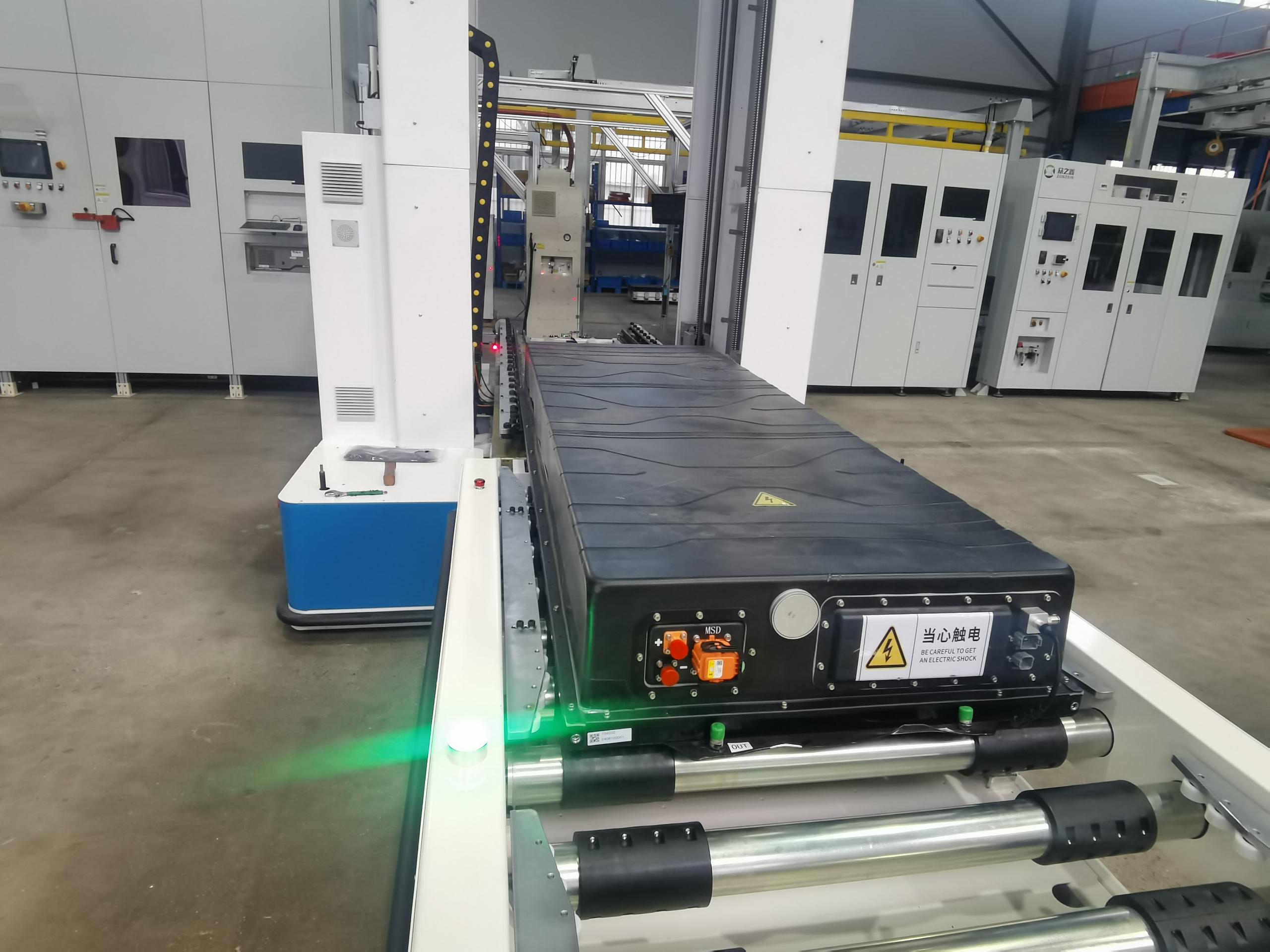
Utility tests are usually performed at the wrong point. The ZZX2508 specification calls for AC380V±10%, 50±2Hz and compressed air at 0.5–0.8 MPa. Measure voltage and frequency at the machine terminals during a loaded hoisting cycle, not at the panel before commissioning, and log the reading against the tolerance band. A line that reads correctly at rest and drifts under load will pass a paperwork check and fail in production.
For compressed air, test at the low end of the stated band. Gripper behaviour at 0.5 MPa is the condition that matters, because it is the condition a busy plant eventually supplies. Where the machine includes a PLC link or MES connection — both appear in the matched equipment set for container insertion applications, alongside the docking roller, gripper, transfer AGV, material rack and platform ladder — include the handshake in the acceptance run rather than after it, and record what the line reports when a PACK fails to seat.
Load, hoisting speed and gripper changeover: how to measure
These three figures decide throughput, and each is easy to measure badly. For load, the reference value in the current specifications is 1,500 kg on the rail-fixed ZZX2524 and on the crawler-driven ZZX2522. Verify it with calibrated weights or production PACKs summing to the rated figure, at the lowest and highest reach the machine will use, and record any deflection or levelling correction needed.
For hoisting speed, the published figure is 100 mm/s on the AGV-driven RD16, across a hoisting range of 1.05–3.4 m that the company states as customizable. Time a defined vertical travel rather than a full insertion cycle, and write the travel distance into the record; an average taken across a cycle that includes docking and settling is not a hoisting-speed measurement.
Gripper changeover is the figure most often misread. The ZZX2524 specification states changeover in under one minute. Measure it as elapsed time from stopping the machine on one PACK format to the first correctly seated insertion of a different format, using the fixtures that will ship with the machine. If the change requires a manual alignment step, that step belongs inside the timed window.
Finally, record a cycle-time baseline for the buyer's own line during acceptance. Supplier-reported efficiency comparisons are useful context for a business case, but they are not a line-specific guarantee, and a baseline captured at handover is what makes any later throughput discussion factual rather than rhetorical.
Adjusting the protocol to the drive configuration
The same acceptance logic produces different tests depending on how the machine moves.
- Rail-fixed (ZZX2508, ZZX2524). The floor and rail foundation become acceptance items: rail straightness, anchoring, and the stability of the docking interface with the roller conveyor or rack. The ZZX2524 specification also lists double-layer racks as a space-saving configuration, which adds a rack-tier access check — the machine should reach both tiers with the PACK formats in scope. A company-reported reference from a Chinese energy storage customer describes a rail-fixed unit in continuous PACK insertion for two years, with a fixed ground rail and a dual-layer material rack listed among the configuration highlights.
- AGV-driven (RD16). Route, floor flatness, docking repeatability and the navigation handshake replace rail geometry. Hoisting range 1.05–3.4 m and hoisting speed 100 mm/s are the measurable figures, and the stated compatibility list — 280/314/587 Ah cells and 1P52S/1P104S PACKs — defines the matrix the acceptance run should sample rather than test once.
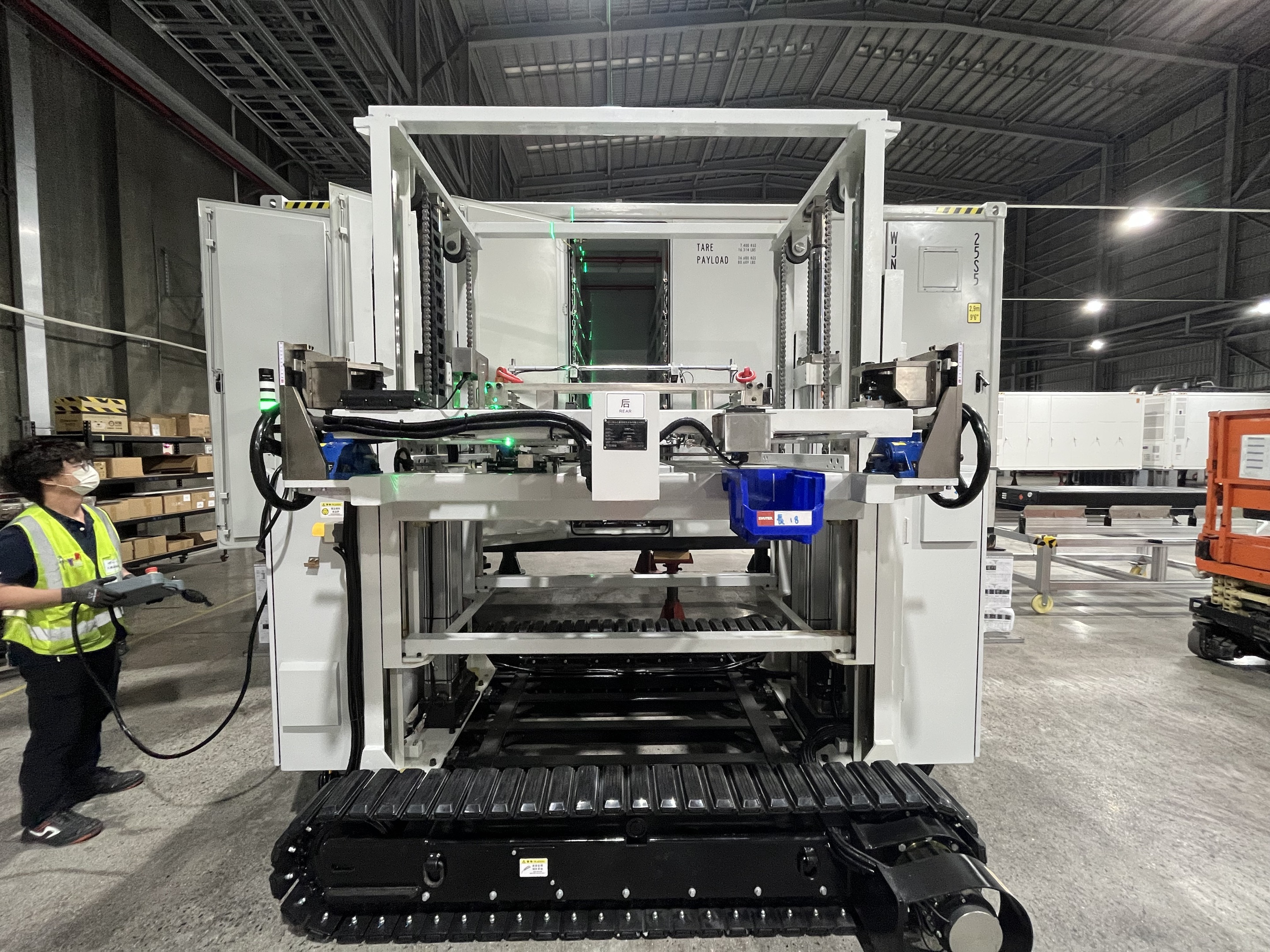
- Crawler-driven (ZZX2522). Working-floor condition is the primary variable. The specification states all-terrain operation, a 1,500 kg load capacity and a hoisting range of 0.8–3.4 m, and it lists manual handwheel levelling. That levelling step is operator time and should be timed as part of setup, not excluded from it. Company-reported references describe crawler units in outdoor use on uneven ground in Korea and in mixed indoor and outdoor use in Taiwan, each cited at around one year of operation.
What the ISO 9001 certificate covers — and what it does not
Zonzsin holds ISO 9001 certification number 44825MS079001R0, issued by ZDCB against GB/T 19001-2016 / ISO 9001:2015, valid from 20 November 2025 to 19 November 2028. The certified scope covers laser welding equipment, laser cleaning equipment, the module PACK assembly line, and the research, development and assembly of AGV-based cluster loading robots. The certificate record associates the certification with models ZZX2508, ZZX2524, ZZX2522 and RD16.
What that establishes is a documented quality management system covering design and assembly for the product family. What it does not establish is the load capacity, positioning behaviour or cycle time of any individual delivered unit. Those remain unit-level facts, proven by the acceptance test and its records — which is why a certificate is a qualification input rather than a substitute for the handover test.
Two practical checks follow. Confirm the certificate's validity window at the time of handover, since a certificate current at order does not automatically stay current across a long delivery; and confirm that the model on the packing list appears in the certification record, because certification attaches to a scope and not to a brand name. For projects bound for the European Union, Regulation (EU) 2023/1542 on batteries and waste batteries (European Parliament and Council, 28 July 2023) sets the battery-side legal framework, while machinery acceptance terms remain a contractual matter between buyer and supplier.
Capacity evidence and why it affects the handover date
Acceptance is a scheduled activity, and scheduling depends on how much of the supplier's output is already committed. Zonzsin reports a 6,000 m² facility, 90 employees including 43 engineers, 50 granted patents, an annual output of 40 units and a monthly capacity of three units, with roughly 60% of production exported, primarily to Southeast Asia and the EU. The company's standard terms list a lead time of 2–4 months, a minimum order of one unit, 100% testing, and after-sales support through remote assistance plus on-site installation and commissioning.
For the buyer, the monthly capacity figure carries a direct acceptance implication: at three units a month, a commissioning slot competes with production slots, so the acceptance date and the engineers attending it should be fixed in the contract rather than agreed informally. The 100% test claim also deserves a document — ask for the pre-shipment test record to travel with the unit, so the on-site acceptance extends a factory record instead of starting from nothing.
Where acceptance programmes usually break down
Most failures are procedural rather than mechanical, and they repeat across projects.
- Reseller listings substituting for the datasheet. Third-party marketplace pages can carry different figures from the manufacturer's own specification, including load capacity. The contract should bind the manufacturer-published value, and any discrepancy found during acceptance should be resolved in writing before the handover signature rather than after it.
- Testing one PACK format. A single insertion with one pack proves the machine works on that pack. The published envelopes are ranges, and ranges are what production will eventually use.
- Ignoring the operator steps. Manual and remote-controller operation modes, handwheel levelling on the crawler model and manual alignment during fixture changes all consume time. If they are not timed during acceptance, they are discovered mid-shift.
- Leaving site conditions to commissioning. The application data for container insertion lists ESD protection, fire prevention measures, temperature, humidity and cleanliness control, and PACK compatibility and fixture adaptation as special requirements. Each one affects whether the machine can be accepted where it stands.
- Treating supplier benchmarks as the baseline. A quoted efficiency improvement is context for the business case, not a substitute for a measured cycle time on the buyer's line at handover.
Punch list, conditional acceptance and the handover record
A useful handover document is short, numeric and complete. It should record the model and serial number, the specification revision and date it was accepted against, every measured value with its tolerance band, every deviation with its owner and due date, and the fixtures, spares and training delivered with the unit. Where an item cannot be closed on site — an air supply limitation, a container door that will not reach the specified angle, a PACK format not yet in production — conditional acceptance with the open item written down is a defensible position; an unconditional signature is not.
The record protects the supplier as well. A measured baseline taken at handover is the fairest starting point for any later discussion about throughput, and it separates equipment performance from line integration, which is where most disputes actually originate.
What this means for procurement
Qualifying an ESS battery pack insertion robot before handover comes down to a small number of decisions. Bind the contract to model-level figures, and require in writing any figure the published specification does not state. Measure at the edge of each range rather than at its middle. Time operator steps inside the cycle rather than around it. Treat certification as supplier qualification and the unit test as product qualification. With those four rules, acceptance becomes what it should be — the point where a constraint-driven purchase is confirmed, rather than the point where the paperwork catches up with the delivery.
For the full model and configuration set, the product brochure is available for download.
Frequently asked questions
What load capacity should an ESS battery pack insertion robot be accepted against?
The published specifications state 1,500 kg for the rail-fixed ZZX2524 and for the crawler-driven ZZX2522. The rail-fixed ZZX2508 specification does not list a load figure in the supplied material, so for that model the contract should require a written value before acceptance is scheduled. In every case the test should demonstrate the rated load at the working reach, not a lighter pack that is easier to move.
Does ISO 9001 certification confirm that a delivered unit meets its specification?
No. Zonzsin's certificate 44825MS079001R0, issued by ZDCB against GB/T 19001-2016 / ISO 9001:2015 and valid until 19 November 2028, covers a quality management system for defined design and assembly activities. Load capacity, hoisting speed, changeover time and envelope fit remain unit-level characteristics that have to be measured on the delivered machine and recorded at handover.
Which power and air conditions must the acceptance test reproduce?
The ZZX2508 specification lists AC380V±10%, 50±2Hz and compressed air at 0.5–0.8 MPa. The test should measure voltage and frequency at the machine terminals during a loaded cycle and confirm gripper behaviour at the low end of the air band. Where a model's specification does not state utility requirements, obtain them in writing before the test date is fixed.
How should gripper changeover time be verified?
The ZZX2524 specification states changeover in under one minute. Verify it as elapsed time from stopping the machine on one PACK format to the first correctly seated insertion of a different format, using the fixtures that ship with the unit. Any manual alignment step belongs inside the timed window, otherwise the measurement describes a different process from the one the line will run.
What container and PACK dimensions should be checked before acceptance?
For the ZZX2508, the published container range is 6,058–7,000 mm length, 2,438–2,700 mm width and 2,896–3,000 mm height, and the PACK range is 1,100–2,200 mm length, 780–1,260 mm width and 230–260 mm height. Both rail-fixed models also list a door opening angle of at least 150°, which should be confirmed on the containers actually presented. Check the extremes of each range with real containers and PACKs, and record clearances rather than a simple pass mark.
Tem questões ou precisa de mais detalhes?
Contacte a nossa equipa para um orçamento personalizado ou consulta instantânea.
Solicitar orçamento
Preencha o formulário abaixo e a nossa equipa entrará em contacto com uma proposta personalizada.
Chat direto do WhatsApp
Prefere conversar em tempo real? Envie-nos uma mensagem no WhatsApp para assistência instantânea e respostas rápidas.
- Obter orçamento personalizado
- Partilhar fotos ou documentos
- Discuta as suas necessidades diretamente
Geralmente responde em 5–30 minutos durante o horário de expediente.