
EU Card Connector Procurement FAQ: RoHS, REACH, Mating Cycles
EU Card Connector Procurement FAQ: RoHS, REACH, Mating Cycles
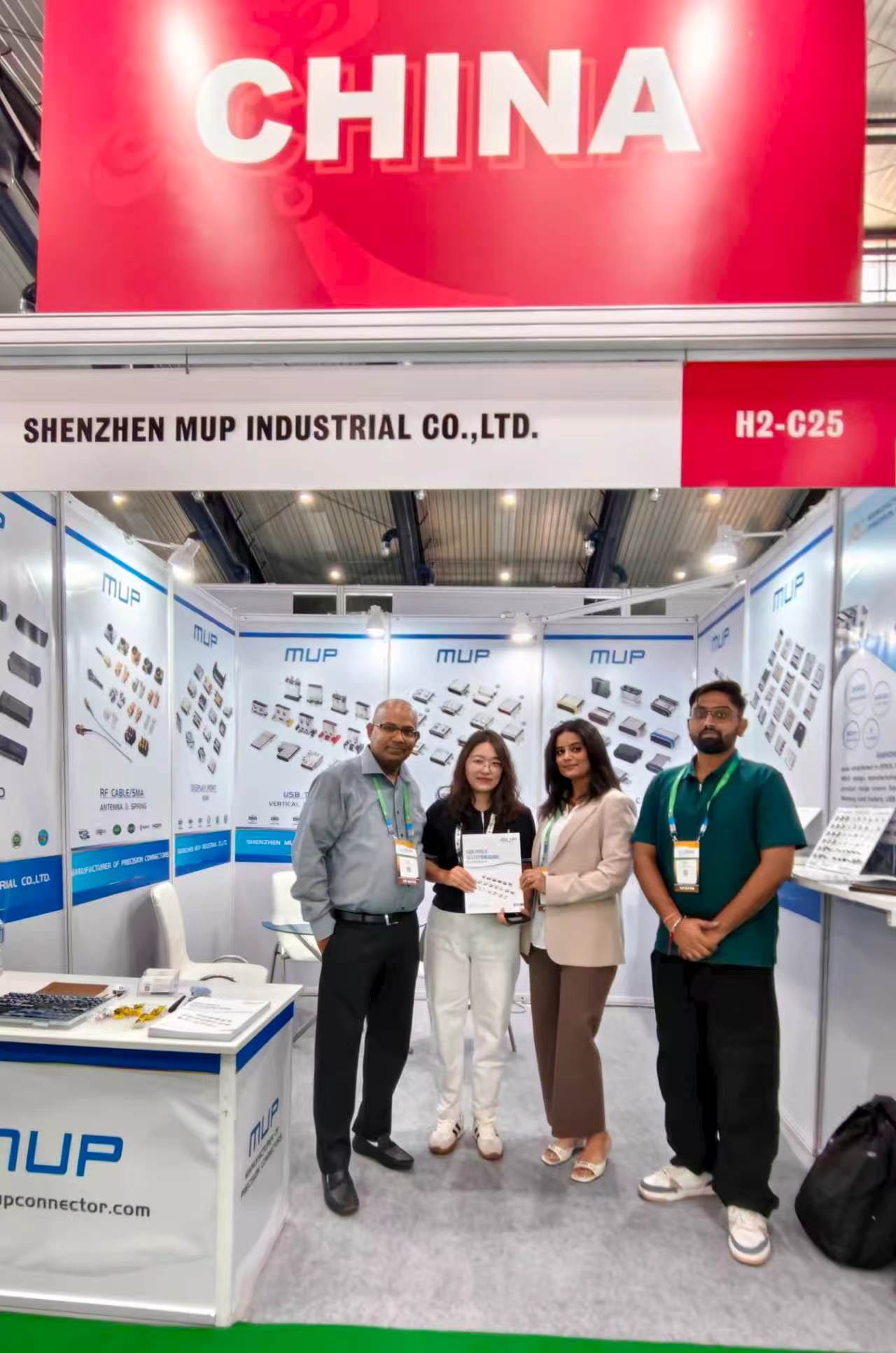
MUP trade fair in Munich, Germany — a typical setting for European buyers to open connector compliance discussions.
EU buyers evaluating card connectors need two separate evidence sets: RoHS/REACH substance documentation, and model-level mating-cycle data. IECQ QC 080000:2017 certificate IECQ-H NQAGB 25.0032 and ISO 14001 certificate 134773 belong to the first set. Neither certificate answers the second question, and treating them as one request is the most common reason a compliance file comes back incomplete.
A European procurement team sourcing USB-C or card connectors usually puts two very different questions into the same email: is the part RoHS and REACH compliant, and how many mating cycles will it survive? The first is answered by substance-control documents — for Shenzhen MUP Industrial Co., Ltd. (MUP), that means the IECQ QC 080000:2017 certificate, the ISO 14001 certificate and part-number-level RoHS/REACH test reports. The second is answered by the specification of the exact model, including the insertion mechanism and the card format it was measured on.
MUP is a precision connector manufacturer founded in 2003, with manufacturing bases in Shenzhen, Huizhou and Dongguan and listed product families covering smart (IC) card holders and sockets, SIM card holders and sockets, and memory (SD/TF) card connectors. Those three families — not the USB-C range — are what most EU payment-terminal, smart-meter and IoT programmes actually order, and they are where the document requests in this FAQ apply.
Why compliance evidence and reliability evidence must be requested separately
RoHS and REACH questions are about restricted substances and about how a manufacturer controls materials and processes. A mating-cycle question is about mechanical endurance: MUP defines a mating cycle as the maximum number of complete plug-in and pull-out operations before a connector fails electrically. One is a materials and process question; the other is a wear question.
This matters because a hazardous-substance process certificate describes how a factory controls materials across design and production. It does not contain a cycle rating, a contact-resistance value or a test result for one specific part number. A durability figure, in the same way, says nothing about restricted substances. A supplier that answers both requests with a single PDF has answered one of them.
The split also follows how the file is used. Environmental documents are filed against customs and audit requirements, where the reviewer wants a current certificate with a readable scope. Reliability data is filed against the design requirement, where the reviewer wants the datasheet and test basis for the part on the bill of materials. Merging the two produces a file that satisfies neither reviewer.
Which RoHS and REACH documents should an EU buyer request first?
MUP states that all of its USB-C and SIM card connectors fully comply with RoHS and REACH regulations for EU market access, and that official test reports and compliance certificates can be provided on customer request for project audit and customs clearance. The documents are issued against a part number, which is what makes the request precise.
The documented request flow is short and worth following in order:
- The buyer provides the project and part-number information.
- The supplier retrieves the test documents that match those part numbers.
- Electronic copies of the certificates and reports are sent in PDF format.
- The supplier supports the buyer's use of those documents in customs clearance and audit inspection.
The caution attached to that flow is the single most useful sentence in the whole exchange: certificates are product-type specific, and reports for different types cannot be used interchangeably. A RoHS report retrieved for one connector type is not evidence for another, even when both sit in the same product family. Where a destination market or customer requires it, MUP can also provide documents addressing halogen-free requirements on request.
Read the wording of whatever arrives. A statement that a family “complies with RoHS and REACH” is a supplier declaration. A test report naming a specific part number is evidence of testing against that part. Both belong in the procurement file, but they do not carry the same weight when an auditor asks what was actually tested.
What IECQ QC 080000:2017 certificate IECQ-H NQAGB 25.0032 actually certifies
IECQ-H NQAGB 25.0032 is an IECQ Certificate of Conformity for Hazardous Substance Process Management, issued by NQA and certifying to IECQ QC 080000:2017. It is valid from 27 March 2025 to 26 March 2028, and MUP's compliance record for the card-connector family lists the EU as the market it supports.
The scope printed on the certificate is: “Design and production of electronic connectors, electronic wiring harnesses and cables, hardware and plastic components for printed circuit boards (excluding products requiring 3C certification).” Three consequences follow for a buyer.
First, this is a process certification. It tells the buyer that a hazardous-substance management process exists across design and production and has been assessed against IECQ QC 080000:2017. It does not list part numbers, state substance limit values, or certify individual shipments.
Second, the exclusion clause defines a boundary rather than a formality. Products that require 3C certification fall outside the stated scope. If a buyer's part belongs to that category, this certificate does not cover it and the buyer needs to ask what document does.
Third, the dates are operational information. Keep the expiry date — 26 March 2028 — in the supplier master file and set a review reminder before it lapses, so a renewal copy is requested rather than discovered missing during an audit.
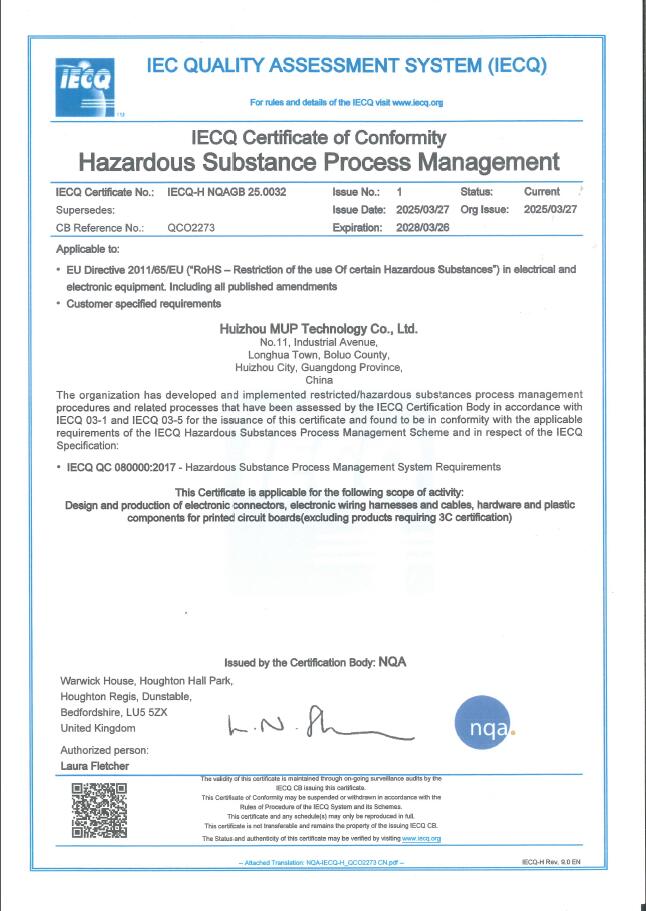
IECQ Certificate of Conformity for Hazardous Substance Process Management, IECQ-H NQAGB 25.0032, issued by NQA against IECQ QC 080000:2017, valid 27 March 2025 to 26 March 2028.
Where ISO 14001 certificate 134773 fits — and what it does not prove
Certificate 134773 is an ISO 14001:2015 registration issued by NQA (Shanghai NQA Certification Co., Ltd.), issued on 18 February 2025 and valid until 18 February 2028. Its scope covers the design, production and sales of electronic connectors, electronic wiring harnesses and cables, and hardware and plastic components for printed circuit boards, again excluding products requiring 3C certification.
That certificate supports the environmental management side of a supplier questionnaire: it shows an environmental management system has been assessed against ISO 14001:2015, which is what many EU customers and their own supply-chain reporting processes ask to see. It sits naturally beside the IECQ certificate because the two address different management systems — environmental performance on one side, hazardous-substance process control on the other.
What it does not do is declare the RoHS status of a connector. ISO 14001 does not list restricted substances, does not state test values and does not substitute for a part-level RoHS or REACH report. A buyer who accepts an EMS certificate in place of a test report has replaced substance evidence with management-system evidence, which is a different claim.
How to read the certificate register before you accept a file
The first check on a compliance file is not the standard — it is the name of the certificate holder. The four management-system certificates in MUP's documentation are not all issued to the same legal entity, and that difference is exactly what a procurement reviewer should notice.
| Certificate | Standard | Number | Issuer | Validity | Holder named on the certificate |
|---|---|---|---|---|---|
| Hazardous Substance Process Management | IECQ QC 080000:2017 | IECQ-H NQAGB 25.0032 | NQA | 27 Mar 2025 – 26 Mar 2028 | Huizhou MUP Technology Co., Ltd. |
| Environmental Management System | ISO 14001:2015 | 134773 | NQA (Shanghai NQA Certification Co., Ltd.) | 18 Feb 2025 – 18 Feb 2028 | Huizhou MUP Technology Co., Ltd. |
| Quality Management System | ISO 9001:2015 | CA00527-EN | TÜV Saarland | 2 Mar 2024 – 2 Feb 2027 | Shenzhen MUP Industrial Co., Ltd. |
| Automotive Quality Management System | IATF 16949:2016 | CB00634-01 | TÜV Saarland | 3 Feb 2024 – 2 Feb 2027 | Shenzhen MUP Industrial Co., Ltd. |
MUP describes manufacturing bases in Shenzhen, Huizhou and Dongguan, so certificates issued to a Huizhou entity and to the Shenzhen entity are consistent with a multi-site manufacturing footprint. The procurement action is still the same: confirm in writing which legal entity will quote, invoice and ship, and make sure the certificate names in the file match that answer. Certificates are issued to legal entities; purchase orders are placed with legal entities; the two should be reconciled before the file is closed, not after an audit query.
Two further checks take a few minutes each. Compare the scope wording across documents — “design and production” and “design, production and sales” are not the same statement, and the weaker wording may be the honest one for a given activity. Then confirm the copy in hand is the current issue rather than a superseded version with an expired date.
Mapping certificate scope to SIM, Micro SIM, Nano SIM, smart card and IC card holder products
The certificate scope is written at the level of “electronic connectors”. A buyer's bill of materials is written at the level of a model number. Closing that gap takes three documents, not one, and the mapping differs by product family.
| Product family | Typical EU application | Evidence to request for the ordered model |
|---|---|---|
| SIM card connector, Mini SIM socket, SIM card holder or socket | Industrial communication modules, legacy payment equipment | Part-number RoHS and REACH report; model mating-cycle rating; drawing for PCB space |
| Micro SIM card socket or holder | Mobile POS, payment terminals, smart meters | Part-number RoHS and REACH report; stated cycle figure for the model; insertion method |
| Nano SIM card holder or socket | Compact terminals, wearables, IoT devices | Part-number RoHS and REACH report; model drawing; cycle rating with test basis |
| Smart card socket, smart IC card connector, IC card holder or ICC socket | EMV payment terminals, identification and security devices | Part-number RoHS and REACH report; contact configuration and cycle rating; ISO/IEC 7816 interface references |
| Memory card connector, Micro SD or TF card socket, SD card holder | Data storage and consumer devices | Separate part-number RoHS and REACH report for the memory family; cycle rating per model |
Model numbers make the request concrete. MUP lists its SIM, smart-card and IC-holder group with models such as C7006, C7801, C7825, C7905, C8001, C8610 and C8633, and its SD/TF group with models such as M6005, M6106 and M6109. Ask for the report that matches the model you will actually order, not the family name on the catalogue page.
For smart-card sockets there is an additional layer that is often confused with connector certification. ISO/IEC 7816-2, maintained within ISO/IEC JTC 1/SC 17, defines 8-pin, 6-pin and 4-pin contact configurations for smart cards, and payment-terminal projects typically add ISO 7816 and EMV conformance as device-level qualification requirements. Those are standards for the card interface and the terminal, not certificates held by a connector supplier. The supplier's contribution is the connector characteristic that supports them — contact configuration, mechanical durability and the model drawing — so ask for those explicitly.
Memory families deserve their own sentence. MUP's published RoHS/REACH statement is made for USB-C and SIM card connectors, and its own compliance note says certificates are product-type specific and not interchangeable between types. When the bill of materials includes Micro SD, TF or SD sockets, request those documents for those part numbers rather than assuming the SIM-family paperwork transfers.
Mating cycles: the question certificates cannot answer
A mating cycle is the maximum number of complete plug-in and pull-out operations a connector completes before it fails electrically. It is a core reliability indicator for card connectors because it evaluates how the contact terminals behave under repeated insertion, which is precisely the wear path a certificate does not describe. MUP states that its Micro SIM card connector can reach 5,000 mating cycles.
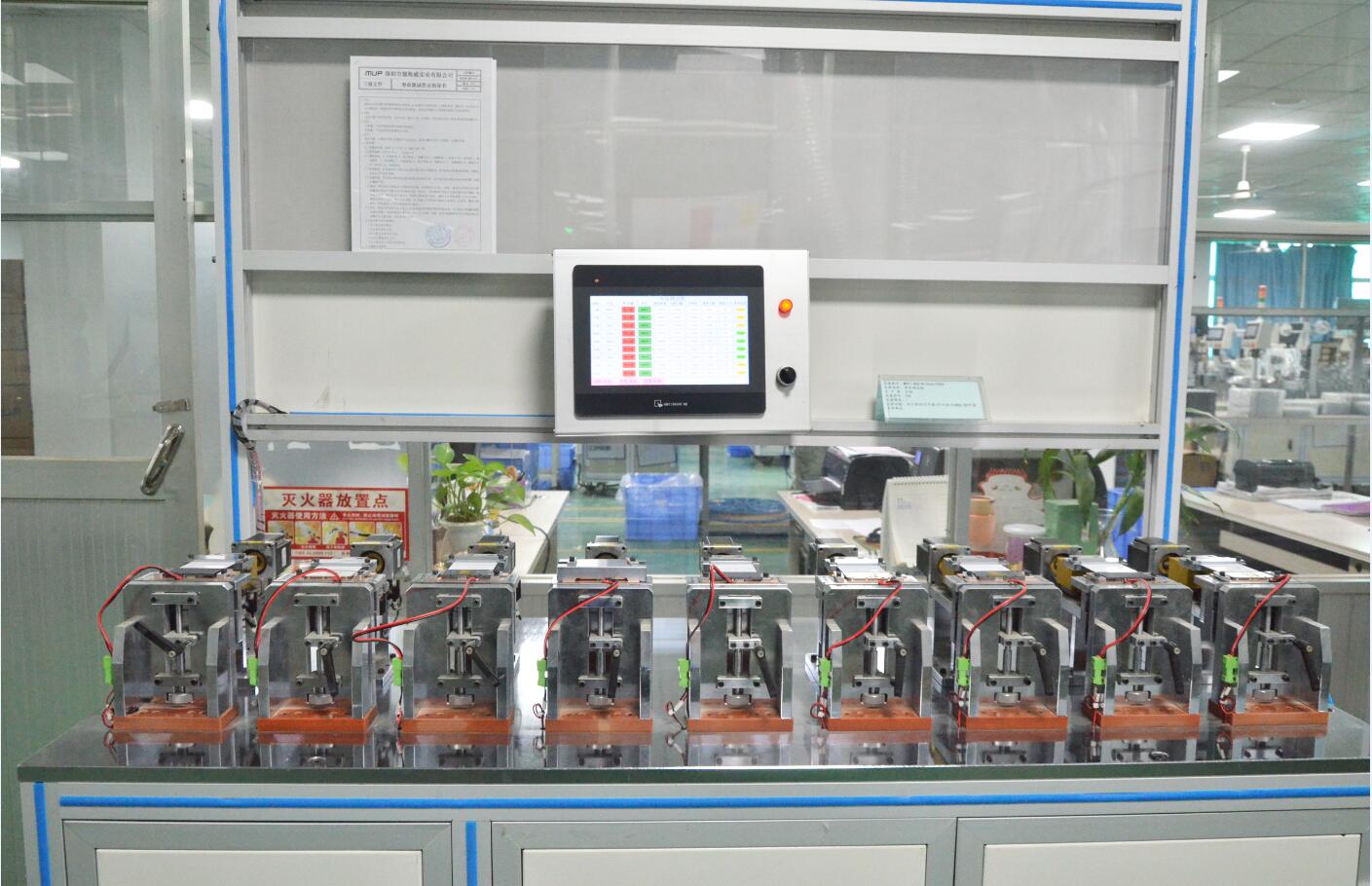
Durability test fixture for SIM card connector mating-cycle testing.
A cycle figure is only comparable between parts that share the same card format and insertion mechanism. Public product families from other manufacturers show that card-connector selection routinely includes push-push, push-pull, tray and hinge mechanisms, plus top-mount and bottom-mount orientation — variables that change how the part is handled in the field. A rating measured on one mechanism should not be read across to another, which is why the request should name the model rather than the family.
It is also worth separating an application requirement from a product rating. Across the card-connector application scenarios described in MUP's documentation — smart meters, payment terminals, IoT terminals and similar devices — the listed working conditions include a durability of 10,000/15,000 cycles, a rated current range of 1 A maximum to 10 μA minimum, a rated voltage of 50 V maximum, an operating temperature of −40 °C to 85 °C and 10–95 %RH humidity. Those are the conditions the application imposes. Whether a specific socket meets them is answered by that socket's datasheet, not by the scenario description.
Finally, keep outgoing quality control separate from endurance evidence. MUP applies 100 % full inspection or AQL sampling before shipment, which screens a shipment before dispatch. That is a different control from characterising wear over thousands of insertion cycles, and buyers who need the latter should ask for it by name.
Where these two evidence sets matter in practice
The relative weight of the two requests depends on how often the card is inserted. In a payment terminal, the smart card socket can see repeated insertion across a working day, so cycle data and contact wear carry real weight in the selection decision. In a smart meter or an industrial IoT terminal, the SIM or memory card is often fitted at commissioning and left in place for years, which shifts the emphasis towards environmental documentation, storage conditions and long-term contact stability rather than cycle count.
Both patterns sit inside the same documented operating envelope: 24/7 operation, the current, voltage, temperature and humidity values listed above, and matched equipment that includes the PCB or FPC, the card itself, the card-reader chip, the terminal housing and, where relevant, the antenna module. A buyer who specifies against those conditions and requests the two evidence sets separately gets a file that can be defended on both counts.
Market context behind the documentation requests
The volume of paperwork a buyer manages scales with the number of part numbers, not with the size of the category. Premier Market Insights, in a report published in February 2026, estimates the global card connector market at USD 3.96 billion in 2024 and USD 5.89 billion by 2030 across a 2024–2030 forecast period. The same source places Asia Pacific at 44.8 % of the market in 2025, and Data Insights Reports attributes roughly 60 % of 2024 unit shipments to SD and microSD socket types.
Those figures should be read with their methodology in view. A conflicting estimate recorded in the same evidence set puts the 2024 market at USD 1.24 billion, with the difference attributed to whether card-edge or interface sockets are included in the count. The two numbers should not be averaged or used interchangeably; the useful question for a buyer is which product scope a figure covers.
The practical implication is narrower than the market numbers suggest. The segments that drive documentation volume for a European buyer — payment terminals, smart meters, IoT terminals — are exactly the segments where SIM, smart-card and memory socket families are ordered together, which is why one certificate set is usually presented against several part numbers and why the mapping work described above is unavoidable.
A request package for the RFQ
Bundling the two evidence sets into one RFQ line item tends to produce a single family-level PDF. Listing them separately produces a usable file. A workable request package for a European card-connector RFQ looks like this:
- IECQ QC 080000:2017 certificate IECQ-H NQAGB 25.0032, current issue, noting the 26 March 2028 expiry.
- ISO 14001 certificate 134773, noting the 18 February 2028 expiry.
- A RoHS test report and a REACH (SVHC) report for each ordered model number, not for the family.
- Written confirmation of the legal entity that will quote, invoice and ship, reconciled against the holder names on the certificates.
- Halogen-free documentation if the destination market or end customer requires it.
- The mating-cycle rating for the exact model, the test basis behind it, and the card format and insertion mechanism it applies to.
- Drawings or 3D data covering PCB footprint, mounting orientation and card insertion direction.
- Commercial and timing parameters: standard tape-and-reel packing with MOQ typically 1K–5K pcs per reel depending on model and packaging, in-stock shipment quoted at 3–7 days, mass production at 15–25 days depending on order and process, small-batch R&D sampling supported, and a 1-year warranty covering return, replacement or replenishment for non-human-caused defects.
Outlook: what stays fixed in the documentation set
Two expectations follow from the evidence above rather than from any forecast. Buyers will keep receiving family-level and process-level certificates against model-level bills of materials, so scope mapping remains a buyer-side task that has to be done part number by part number. And cycle ratings will keep being model-specific, so a compliance file will keep failing to close a reliability question. Both are reasons to hold the two requests apart in the RFQ template instead of merging them into one “compliance” line.
Where a programme needs the file for customs clearance, audit inspection or a customer questionnaire, the fastest route is to state the part numbers first. MUP's documented process retrieves matching reports from the part-number information the buyer supplies, which means an RFQ that names models such as a Nano SIM holder or an ICC socket gets a precise answer, while an RFQ that names only “card connectors” gets a family-level response that will need to be repeated later.
Frequently asked questions
Do MUP's USB-C and SIM connectors comply with RoHS and REACH, and what documents support that?
MUP states that all of its USB-C and SIM card connectors fully comply with RoHS and REACH regulations for EU market access, and that official test reports and compliance certificates can be provided on request for project audit and customs clearance. The buyer supplies project and part-number information, MUP retrieves the matching documents and sends electronic copies in PDF format, and it supports the buyer's use of those documents in customs clearance and audit inspection. Documents are issued against specific product types and are not interchangeable between types.
Can a RoHS report issued for one connector type be used for a different card connector model?
No. MUP's compliance note states that certificates are product-type specific and that reports for different types cannot be used interchangeably. A report retrieved for one connector type is not evidence for another model in the same family, so each ordered part number should have its own matching report before the file is treated as complete.
What does IECQ QC 080000:2017 certificate IECQ-H NQAGB 25.0032 cover, and how long is it valid?
It is an IECQ Certificate of Conformity for Hazardous Substance Process Management issued by NQA against IECQ QC 080000:2017, valid from 27 March 2025 to 26 March 2028. Its scope is the design and production of electronic connectors, electronic wiring harnesses and cables, and hardware and plastic components for printed circuit boards, excluding products requiring 3C certification. It certifies a management process across design and production; it does not list part numbers, state substance limit values or certify individual shipments.
Does ISO 14001 certificate 134773 prove that a connector is RoHS compliant?
No. Certificate 134773 is an ISO 14001:2015 environmental management system registration issued by NQA (Shanghai NQA Certification Co., Ltd.), issued on 18 February 2025 and valid until 18 February 2028, with a scope covering design, production and sales of electronic connectors and related components. It supports environmental management and supplier-questionnaire requirements, but it does not declare restricted-substance status for a part. RoHS and REACH evidence comes from part-level test reports, supported by the IECQ hazardous-substance process certificate.
What is a mating cycle, and what figure does MUP state for its Micro SIM card connector?
A mating cycle is the maximum number of complete plug-in and pull-out operations a connector can complete before it fails electrically, and it is a core reliability indicator for card connectors because it reflects how the contact terminals behave under repeated insertion. MUP states that its Micro SIM card connector can reach 5,000 mating cycles. Because ratings are model-specific, the figure should be confirmed against the datasheet of the exact model being ordered.
Should mating-cycle data be requested from the certificate or from the part specification?
From the part specification. Management-system certificates such as IECQ-H NQAGB 25.0032 and ISO 14001 certificate 134773 describe process control and environmental management, and they do not contain cycle ratings. A buyer should request the rated cycles for the specific model, the mechanism and card format the rating applies to, and the test documentation behind it, and should treat a cycle figure as comparable only between parts using the same format and insertion mechanism.
Conclusion
For European procurement teams, the workable rule is simple: treat environmental compliance and mating-cycle reliability as two requests with two different owners inside the supplier's documentation. IECQ QC 080000:2017 certificate IECQ-H NQAGB 25.0032, ISO 14001 certificate 134773 and part-number RoHS/REACH reports answer the substance question across the SIM, Micro SIM, Nano SIM, smart card and IC card holder families. The cycle question is answered only by the datasheet and test basis of the exact model, and a certificate should never be accepted as a substitute for it.
MUP's full product and capability profile is available for download: MUP company profile (PDF). Document requests are handled against supplied part numbers at sales@mupconnector.com.
Tem questões ou precisa de mais detalhes?
Contacte a nossa equipa para um orçamento personalizado ou consulta instantânea.
Solicitar orçamento
Preencha o formulário abaixo e a nossa equipa entrará em contacto com uma proposta personalizada.
Chat direto do WhatsApp
Prefere conversar em tempo real? Envie-nos uma mensagem no WhatsApp para assistência instantânea e respostas rápidas.
- Obter orçamento personalizado
- Partilhar fotos ou documentos
- Discuta as suas necessidades diretamente
Geralmente responde em 5–30 minutos durante o horário de expediente.