
EU Checkout Counter Walls: Schuko, French and CAT6 Socket Fit
A retail checkout wall in the EU often carries three connection duties on one elevation: Schuko power for devices supplied to Schuko markets, French-format power where the local fit-out standard requires it, and a CAT6 data outlet for the payment terminal, printer and back-office link. Pairing the V149 1-gang Schuko socket, the VC139 1-gang French socket and the VZ128D CAT6 Double Data socket is therefore a scenario-fit decision, not a catalogue decision. All three are 86×86 mm flush-mounted products recorded with HS code 8536690000, but they do not share the same certification scope — and that difference is where most purchase-order errors begin.
This reference is written for buyers in the Evaluation and Execution stages: teams that have already accepted a mixed-format till wall and now need to prove the combination is buildable, certified, inspectable and documentable. It covers the interface logic, the evidence file, the panel geometry, the order mechanics and the limits of the approach.
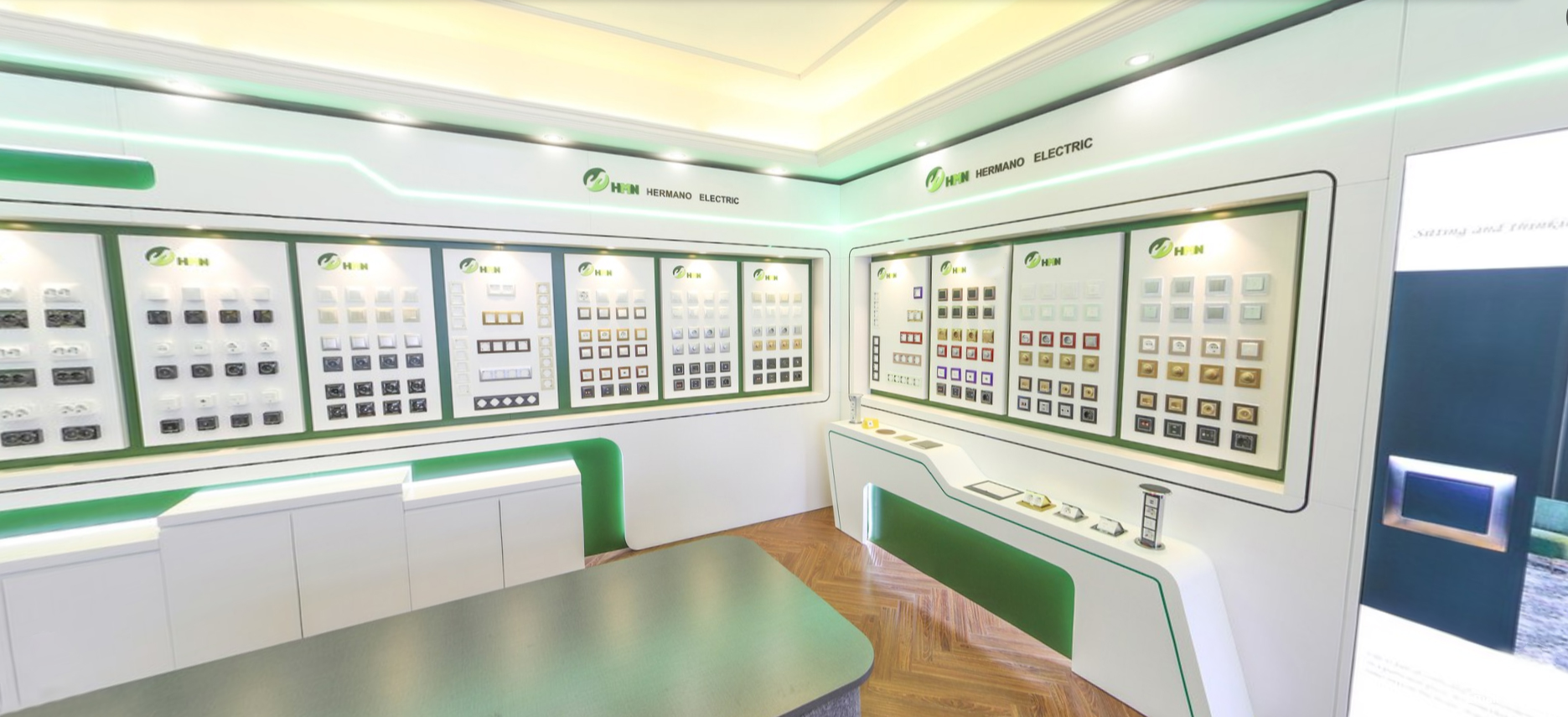
Sample room: flush socket and data modules displayed by series, the shared plate geometry a checkout elevation depends on.
Why a checkout lane concentrates three interface duties
A till position is a small electrical and data hub. It powers a POS terminal, a receipt printer, a scanner or scale, a customer-facing payment device and, in many fit-outs, a label printer or a back-office workstation. It also needs a wired data path, because payment and stock systems at the counter are normally connected rather than carried over wireless. In markets where Schuko is the domestic convention the power side looks simple. In cross-border retail groups, and in fit-out packages that span France, Belgium and neighbouring markets, the same drawing set may show both Schuko and French-format outlets so that one furniture and servicing standard can be used across stores.
- Power format varies with the market: Schuko where the Type F convention applies, French-format where the local installation standard requires the protruding earth arrangement.
- Data is fixed: the terminal needs a CAT6 outlet at the counter, not a longer patch lead routed across the floor.
- Visual continuity is specified: three different plate sizes on one wall reads as a repair, not a fit-out.
The elevation therefore behaves as a set. Three items can each be well made and still produce a poor wall if the panels do not match, if the data outlet's approvals are thinner than the power sockets', or if the customs description cannot separate three products that share one HS code.
Problem and opportunity: three failure modes to design out
Interface mismatch is the visible one. A Schuko plug does not enter a French-format socket, and a French plug does not enter a Schuko socket, so a lane built on a single format needs adaptors when the retail group changes its POS hardware or trades across markets. Specifying both formats at the same height keeps the counter usable through hardware refreshes and across country roll-outs.
Geometry mismatch is the expensive one. When power and data products come from different plate systems, the installer either cuts adaptor frames or accepts a stepped wall, and the store inherits a counter line that cannot be re-plated when the brand updates its finishes.
Documentation mismatch is the one that delays handover. A project that passes inspection on hardware can still stall on a certificate that does not name the ordered model, a RoHS scope filed separately from the CE file, or a data product whose approval status was quietly assumed to match the power sockets. The opportunity in a scenario-fit approach is that all three questions are answered once, at the purchase order, rather than three times at commissioning.
The three components in this scenario
The pairing below is the one this article tests, using only products carried in the manufacturer's current range and the specification recorded in the product data.
| Position on the wall | Model | Function | Recorded specification | Certification in product data |
|---|---|---|---|---|
| Schuko power | V149 | 1 gang Schuko socket | 16A, 220-250V~; 86×86 mm; flush mounted; flame retardant PC panel; high strength PA base; HS 8536690000 | CE, TUV |
| French power | VC139 | 1 gang French socket | 16A, 220-250V~; 86×86 mm; flush mounted; flame retardant PC panel; high strength PA base; HS 8536690000 | CE, TUV |
| Data | VZ128D | Double Data socket | CAT6; 86×86 mm; flush mounted; flame retardant PC panel; high strength PA base; HS 8536690000 | CE |
Two details in that table matter more than they look. First, the product data for the data socket records the item number as H128D while the catalogue model is VZ128D; the purchase order, packing list and certificate reference should use one form and note the other as an alias, otherwise a correct shipment can be questioned at goods-in. Second, TÜV appears for the two power sockets but not for the data socket, so the three-gang elevation is not a single-approval package.
Certification evidence to verify before the purchase order
For an EU retail project the certification question is not whether a socket is CE certified, but which certificate, against which standard year, covers which model. The V149 and VC139 are recorded against CE Certificate of Conformity DACE260330001RL, issued to IEC 60884-1:2022 on 2026-04-03 and valid until 2031-04-03. IEC 60884-1:2022 is the current general requirement for plugs and socket-outlets for household and similar purposes, limited to 16 A for screwless terminals, so naming the standard year in the specification is a reasonable way to test whether the file is current.
RoHS sits in a separate document. Certificate DACE260416010RL, issued 2026-04-22 and valid until 2031-04-22, covers the IEC 62321 test series and its scope includes the socket models used here, among them V149, VC139 and VZ128D. That separation is normal in the industry, but it means a supplier pack containing only the CE certificate is incomplete for a RoHS certified indoor wall socket specification.
TÜV is listed in the product data for the V149 and VC139. Where a specification names TÜV, ask for the TÜV certificate itself with the model list rather than treating the product data line as the evidence. The same rule applies to CB: company-level material states that CE and CB certification are held through BV and Intertek, and a tender that requires CB should request the CB certificate number and its model list. None of these checks is unusual; they are simply cheaper to run before the order than after the delivery.
| Evidence | Reference | Applies to | What to check |
|---|---|---|---|
| CE Certificate of Conformity | DACE260330001RL; IEC 60884-1:2022; issued 2026-04-03; valid to 2031-04-03 | V149, VC139 | Ordered model appears in the scope; standard year matches the specification |
| RoHS Certificate of Conformity | DACE260416010RL; IEC 62321 series; issued 2026-04-22; valid to 2031-04-22 | Socket models including V149, VC139, VZ128D | Scope text names the model; test methods are stated |
| TÜV | Listed in product data | V149, VC139 | Certificate copy with model list, where the specification names TÜV |
| CB | Company-level statement via BV and Intertek | Wall switches and sockets | CB certificate number and model list, where a tender requires CB |
| Data socket approval | CE | VZ128D | Confirm the data product is accepted under the project approval schedule |
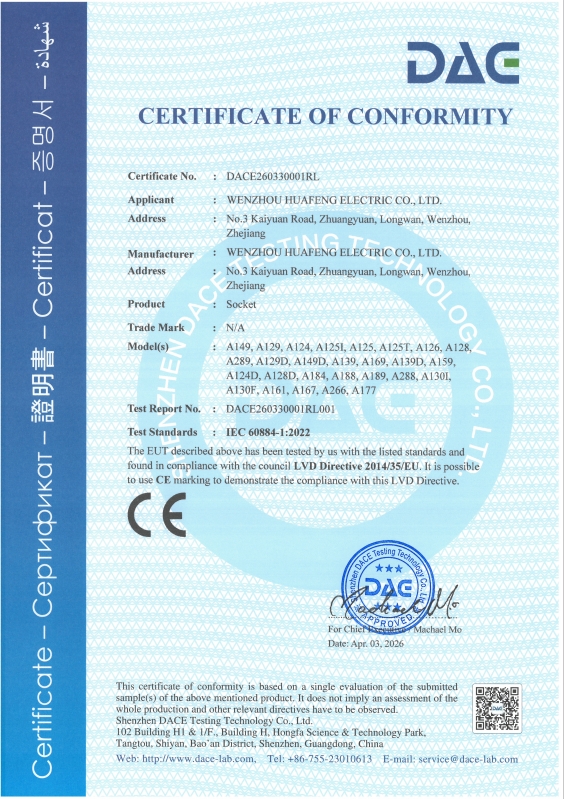
CE Certificate of Conformity DACE260330001RL, issued to IEC 60884-1:2022 and recorded against the V149 and VC139 socket models.
A one-page approval sheet per elevation, with the certificate pages attached behind it, keeps the model, standard year, certificate number, validity date and HS code in one place and turns the goods-in check into a comparison rather than a search.
Panel geometry, mounting and finish continuity
All three products are flush-mounted on an 86×86 mm panel with a flame retardant PC panel and a high strength PA base, and the colour range is white, ivory, black, silver, golden or customized. That shared geometry is what makes the checkout elevation buildable: one plate system, one visible dimension and one colour decision across two power formats and one data outlet. Flush mounting also keeps the counter line clean where shelving or a counter top runs tight to the wall, and it keeps socket faces clear of trolleys and cleaning equipment.
Geometry is not the same as installation clearance. The data outlet has to accept a CAT6 cable with its bend radius behind the plate, and back-box depth, cable entry and frame type remain site decisions that the installer should confirm before modules are ordered. A mixed order only works if the frame accepts all three modules: the frame is the part that carries them into the wall box, and it is the part most often left out of the enquiry.
Technical fit: 16 A power and CAT6 data on one elevation
The power side is easy to read: each gang is rated 16 A at 220-250 V~. The Schuko interface itself is standardized in many European countries for 16 A / 250 V applications under CEE 7/3, which is why a 16 A rated socket matches the usual domestic convention, and IEC 60884-1:2022 covers socket-outlets of this class including screwless terminal constructions. The rating belongs to the accessory, not to the circuit; how many tills, printers and terminals may share a circuit is an electrical design decision for the project engineer, and a socket datasheet does not answer it.
The data side is passive. The VZ128D is a CAT6 Double Data socket, meaning a connection point with two outlets rather than a switch, injector or patch panel. Its role is to present a fixed, labelled data outlet at the counter so the terminal can be connected and reconnected without cable being pulled through joinery. Active network equipment stays in the comms cabinet, which is also where cable testing and certification normally happen.
The two duties still have to be laid out together. Data cable should be routed separately from power cable and terminated on its own module, and the data outlet should sit so the terminal patch lead does not cross a power lead at the counter. On an 86×86 mm modular plate that is a layout question rather than a product question, but it is settled at the drawing stage, not at commissioning.
Materials support the indoor retail case rather than an outdoor one: flame retardant PC panels and high strength PA bases are the recorded construction for all three products. The datasheets do not claim an IP rating for the V149, VC139 or VZ128D, which is a reasonable boundary for a covered checkout wall and a clear reason not to specify them for wash-down or exposed exterior positions.
What European buyers have already validated
The manufacturer's case record for European wall socket brand owners, importers and electrical distributors describes orders above 1,000 wall sockets per model for residential and distribution projects, with the products used in residential buildings, apartments, hotels and commercial properties to provide safe and stable power connections for indoor equipment. In that programme the sockets passed plug compatibility, installation, temperature-rise and functional testing, were compatible with local plug standards, wall-box dimensions and wiring methods, and met the buyer's requirements for bulk purchasing and brand customisation. The record states a service expectation of at least eight years, tested for insertion durability and electrical safety against the applicable product standards, with actual service life depending on insertion frequency, electrical load, installation quality and operating environment.
For a checkout project the transferable points are the test categories rather than the project type. Plug compatibility, installation fit against local wall boxes, temperature rise under load and functional testing are the four checks a retail fit-out tends to repeat at handover, and they are the four that a mixed-format elevation can fail if the modules come from unrelated plate systems.
Order execution: quantities, lead time and inspection
Execution terms are recorded at company level. The minimum order quantity is 1,000 units, typical production lead time is 30 to 45 days, and monthly production capacity is 2,900,000 units, so a three-model order is a scheduling question rather than a capacity question. ODM production is offered, logo customisation is available, and quality control is recorded as 100% test. Delivery terms are EXW, FOB or CIF; acceptance is by pre-shipment inspection against approved samples and confirmed specifications; payment terms are 100% TT in advance. The after-sales position is an 8-year warranty.
The company context behind those numbers: Wenzhou Huafeng Electric Co., Ltd. (HYFF) was founded in 2011, operates a 7,000 m² factory with 118 employees and a 10-engineer R&D team, produces wall switches and wall sockets with an annual output of 35,000,000 units, and exports 100% of its output to markets including the EU, the Americas, Oceania, Asia and Africa. For a retail fit-out buyer the practical reading is that a single order can carry Schuko, French and data modules under one inspection regime and one commercial contact, which is the main operational argument for the paired approach.
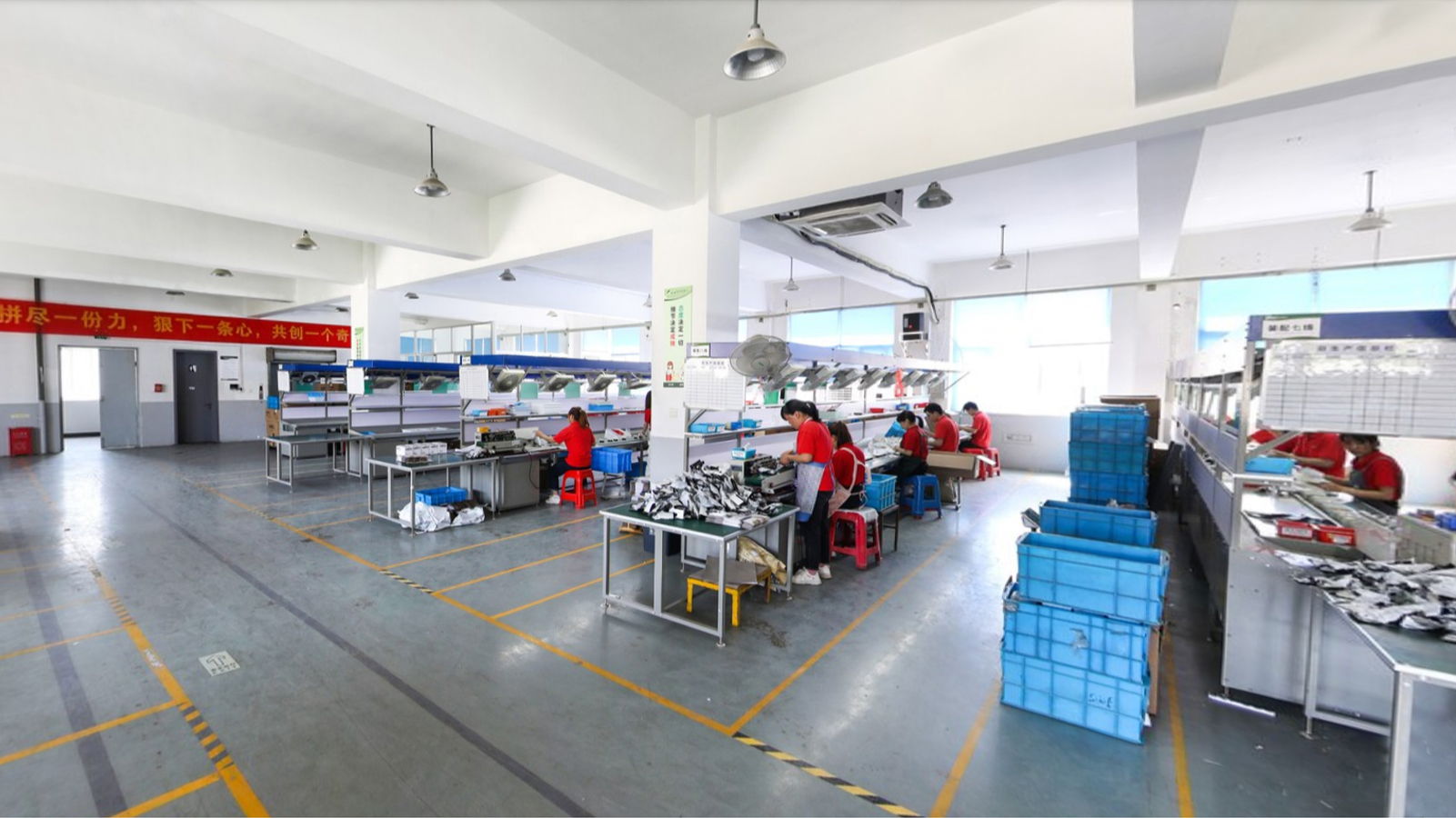
Production workshop: mixed-format orders for Schuko, French and data modules are scheduled against a recorded monthly capacity of 2,900,000 units.
Where the three-format approach has limits
The comparison with a conventional single-format purchase is not a contest between good and bad practice; it is a trade between simplicity and coverage.
| Dimension | Single-format purchase | Mixed Schuko / French / CAT6 elevation |
|---|---|---|
| Plate continuity | Depends on how many suppliers are mixed | One 86×86 mm geometry and one colour range |
| Market flexibility | Lane tied to a single plug format | Lane usable across Schuko and French requirements |
| Order complexity | One model line to manage | Three model lines, each at a 1,000-unit minimum order quantity |
| Approval work | One certificate set to file | CE, RoHS, TÜV and a CE-only data file to check separately |
| Data provision | Usually sourced from a separate supplier | Data outlet specified with the power elevation |
The limits are real and belong in the specification, not in the commissioning meeting:
- Three model lines, not one. If a project needs only Schuko, the French socket is unnecessary cost and an extra certificate to file; specify French format where the market requires it, not by habit.
- Data approval is narrower. The VZ128D is recorded with CE only and no TÜV in the product data, so a project whose approval schedule demands TÜV across the whole elevation has to resolve that gap before ordering.
- Indoor scope. No IP rating is claimed for the three products, so exterior, wash-down and hose-down positions require a different product family.
- Accessory rating, not circuit capacity. The 16 A figure applies per gang; how many tills or printers share a circuit is an electrical design decision.
- Panel geometry is not a guarantee of frame fit. The 86×86 mm dimension is shared, but the frame or plate system carrying the modules must be confirmed for the specific installation.
- Model-code hygiene. With the data socket recorded as H128D while the catalogue model is VZ128D, and with all three products sharing HS code 8536690000, the paperwork rather than the customs code has to identify what is in the box.
Market context
The global electric plugs and sockets market was valued at USD 14.13 billion in 2025 (Precedence Research), and global production of wall sockets reached over 3.1 billion units in 2024, with China the largest producer (Market Research Report). Within that volume, modular sockets accounted for 43% of total wall socket sales in 2024 (Fortune Business Insights), a share consistent with what a checkout elevation assumes: a fixed plate standard that accepts different modules rather than a monolithic accessory.
Two adjacent trends touch the till wall without changing the core specification. The EU requirement for USB-C as the common charging standard for most portable electronics from 2024 (Omdia) is adding charging demand at counters and service desks, which is a separate product decision from the Schuko, French and CAT6 logic but is often drawn on the same elevation. And as payment hardware refreshes faster than fit-outs, the value of a plate standard that can be re-moduled without re-plastering becomes easier to justify: the sockets outlive the terminal that first used them.
Outlook
For EU retail projects the direction is document-first rather than product-first. Tender packs increasingly name the standard year (IEC 60884-1:2022), ask for the RoHS test method family rather than a logo, and expect the model list on the certificate to match the purchase order. That favours suppliers who can produce one approval sheet across power and data formats, and it exposes elevations assembled from unrelated plate systems.
The second direction is data density. A modern lane already needs one data drop, and self-checkout, click-and-collect desks and in-store returns counters tend to add more. Building the till wall on a shared 86×86 mm geometry, with the data outlet specified at the same time as the power, keeps an option to add outlets later without changing the visible standard. That is the practical test of whether a checkout elevation was specified or merely assembled.
Frequently asked questions
Can the V149 Schuko socket and the VC139 French socket be installed on the same checkout wall?
Both are flush-mounted products with an 86×86 mm panel, a flame retardant PC panel and a high strength PA base, and both are rated 16 A at 220-250 V~, so they share one visible geometry and one installation method. Physical continuity on a single wall then depends on the frame or plate system accepting 86×86 mm modules, which should be confirmed with the frame supplier before ordering. The two sockets carry different plug interfaces and are not interchangeable on a single gang.
Which certificate should an EU retail project ask for on a CE certified Schuko wall socket?
Ask for the CE Certificate of Conformity and check the model list rather than the logo. For the V149 the file records certificate DACE260330001RL to IEC 60884-1:2022, issued 2026-04-03 and valid to 2031-04-03. RoHS is recorded separately under DACE260416010RL, to the IEC 62321 series, issued 2026-04-22 and valid to 2031-04-22. TÜV is listed in the product data for the V149 and VC139, and the TÜV certificate copy with its model list should be requested where the specification names TÜV.
Is the CAT6 Double Data socket covered by the same approvals as the power sockets?
No. The VZ128D Double Data socket is recorded with CE certification only, and the product data does not list TÜV for it, whereas the V149 and VC139 list CE and TUV. A project that needs the data outlet to sit under the same approval schedule as the power sockets should confirm that gap with the specification writer before the order instead of assuming the power socket approvals extend to the data product.
What is the HS code for the CAT6 data socket and for the two power sockets?
All three are recorded with HS code 8536690000: the V149 Schuko socket, the VC139 French socket and the VZ128D CAT6 Double Data socket. Because the classification is identical, the customs description on the invoice and packing list has to distinguish a Schuko socket, a French socket and a CAT6 data socket by name and model; the HS code alone will not separate them.
What order terms apply to a mixed Schuko, French and data socket requirement?
The recorded terms are a minimum order quantity of 1,000 units, a typical production lead time of 30 to 45 days, and delivery on EXW, FOB or CIF terms. Acceptance is by pre-shipment inspection against approved samples and confirmed specifications, and payment terms are 100% TT in advance. The case record for European buyers describes orders above 1,000 wall sockets per model, so a three-model elevation is normally placed as three lines within one order.
The HYFF 2026 product brochure, covering the flush wall socket and data socket ranges referenced in this article, is available for download: HYFF 2026 brochure (PDF).
Tem questões ou precisa de mais detalhes?
Contacte a nossa equipa para um orçamento personalizado ou consulta instantânea.
Solicitar orçamento
Preencha o formulário abaixo e a nossa equipa entrará em contacto com uma proposta personalizada.
Chat direto do WhatsApp
Prefere conversar em tempo real? Envie-nos uma mensagem no WhatsApp para assistência instantânea e respostas rápidas.
- Obter orçamento personalizado
- Partilhar fotos ou documentos
- Discuta as suas necessidades diretamente
Geralmente responde em 5–30 minutos durante o horário de expediente.