
EU Digital Human Display Shortlist: RoHS 2.0 and EMC
EU Digital Human Display Shortlist: RoHS 2.0 and EMC
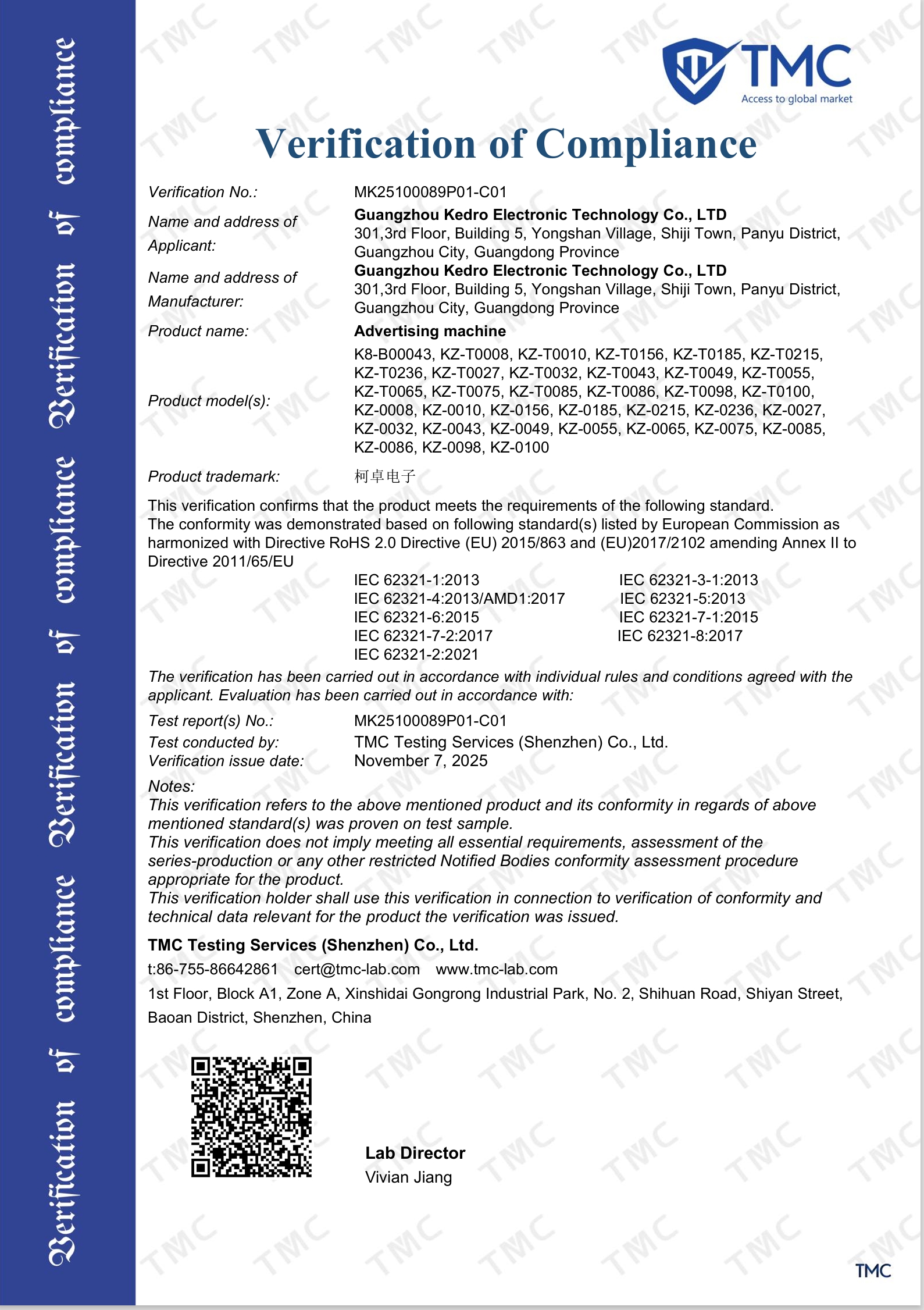
For EU projects evaluating digital human display terminals, the available documentation supports an eight-series shortlist for RoHS 2.0 and EMC verification: KD-AD, KD-TP, KD-OD, KD-IFPD, KD-VW, KD-LED, KD-ISS, and KD-WM. The relevant RoHS 2.0 report is TEST REPORT MK25100089P01-C01, issued by TMC Testing Services (Shenzhen) Co., Ltd. on 2025-11-07 and listed with an expiry date of 2099-11-06. Separate EMC coverage is associated with MK25100089P01-E01. These records give buyers a starting point for documentary review; they do not replace confirmation that the exact offered product and configuration fall within the applicable scope.
GZKEDRO is the brand associated with the listed display series. The series names below identify the products in the supplied records. They should not be read as evidence that every configuration includes digital-human software, voice interaction, AI functions, or any particular installation feature. For a project shortlist, the useful distinction is what the compliance records identify, what they do not establish, and which details a buyer should match against the proposed unit.
What the documented shortlist covers
The shortlist is based on the series named in the supplied RoHS 2.0 coverage and EMC coverage records. TEST REPORT MK25100089P01-C01 identifies RoHS 2.0 coverage for the listed series, while the EMC record MK25100089P01-E01 is associated with the eight series below. Treat the two report references as distinct evidence items: the C01 report is the RoHS 2.0 reference, and E01 is the EMC reference. A buyer should not assume one document proves both areas merely because the same series appears in both scopes.
| Series | Product category in the supplied records | Shortlist relevance |
|---|---|---|
| KD-AD Series | Advertising Display | Named in the supplied RoHS 2.0 and EMC coverage information. |
| KD-TP Series | Transparent Cabinet Display | Named in the supplied RoHS 2.0 and EMC coverage information. |
| KD-OD Series | Outdoor Advertising Display | Named in the supplied RoHS 2.0 and EMC coverage information. |
| KD-IFPD Series | Smart Conference Display | Named in the supplied RoHS 2.0 and EMC coverage information. |
| KD-VW Series | Video Wall Display | Named in the supplied RoHS 2.0 and EMC coverage information. |
| KD-LED Series | LED Display | Named in the supplied RoHS 2.0 and EMC coverage information. |
| KD-ISS Series | Interactive Slider Screen | Named in the supplied RoHS 2.0 and EMC coverage information. |
| KD-WM Series | Wall Mounted Display | Named in the supplied RoHS 2.0 and EMC coverage information. |
This is a documentation-led shortlist, not a ranking of product performance or a claim that one series is more suitable than another. The records establish series coverage as stated in the supplied material. They do not provide comparative data on display size, brightness, resolution, interaction functions, installation requirements, price, or project outcomes. Those questions require product-specific evidence for the proposed configuration.
How to read the RoHS 2.0 report reference
TEST REPORT MK25100089P01-C01 is identified as a RoHS 2.0 report for the EU market. Its stated scope covers hazardous-substance items controlled by the RoHS 2.0 directive. The supplied certification data names substances including Lead (Pb), Cadmium (Cd), Mercury (Hg), Hexavalent Chromium (Cr(VI)), Polybrominated Biphenyls (PBBs), Polybrominated Diphenyl Ethers (PBDEs), and phthalates DEHP, BBP, DBP, and DIBP, among others. The cited standards include the IEC 62321 series and RoHS 2.0 Directives (EU) 2015/863 and (EU) 2017/2102.
For a buyer, the value of this scope is that it identifies the regulatory subject addressed by the report and provides reference information for a supplier-document review. It does not, by itself, answer every configuration-level question. Procurement teams should compare the report’s product and series descriptions with the quotation, model designation, bill of materials or other configuration records supplied for the actual project. Where a project specifies an exact unit or component set, the buyer should request confirmation that the proposed configuration is the one covered by the documentation.
The supplied date fields list 2025-11-07 as the issue date and 2099-11-06 as the expiry date for MK25100089P01-C01. Those dates are useful identifiers when checking that the document received by the project team is the same report being discussed. An expiry date in a record should not be treated as proof that a particular shipment, change, or configuration is automatically covered. Buyers should review the document itself, its stated scope, and any relevant product identifiers rather than relying on a date or summary line alone.
Why the EMC document should be checked separately
RoHS 2.0 and EMC address different compliance subjects in the supplied evidence. The C01 report is the RoHS 2.0 reference; the EMC verification reference is MK25100089P01-E01. The EMC data identifies the EU EMC Directive 2014/30/EU and includes standards such as EN 55032:2015/A11:2020, EN 55035:2017/A11:2020, EN IEC 61000-3-2:2019+A1:2021+A2:2024, and EN 61000-3-3:2013+A1:2019+A2:2021. The supplied EMC record lists TMC Testing Services (Shenzhen) Co., Ltd. as issuer and gives the period 2025-11-07 to 2099-11-06.
For shortlist decisions, this separation prevents a common documentation error: treating evidence for one compliance area as if it demonstrated another. A procurement file that requires both RoHS 2.0 and EMC verification should contain the relevant evidence for both, and the covered series should correspond to the intended purchase. The report number, issuing organization, market, dates, standards, and product scope offer practical checkpoints for reviewing the documents. The article does not independently assess the reports or make a legal determination about market access.
Series-level references are a starting point, not a substitute for checking the exact unit. If a project specification includes a screen size, enclosure, power configuration, or other variant, buyers should ask the supplier to identify the exact model and explain how it maps to the report’s stated coverage. The records provided here do not detail configuration-by-configuration boundaries, so no broader claim about every possible variant is warranted.
Using the eight-series list in project evaluation
The series category can help organize the initial shortlist, but it should not be used as a proxy for scenario fit. KD-AD is identified as an Advertising Display; KD-TP as a Transparent Cabinet Display; KD-OD as an Outdoor Advertising Display; KD-IFPD as a Smart Conference Display; KD-VW as a Video Wall Display; KD-LED as an LED Display; KD-ISS as an Interactive Slider Screen; and KD-WM as a Wall Mounted Display. These labels provide a product-family distinction. They do not establish that a particular series includes a digital human application, nor do they verify technical performance for a mall, exhibition hall, retail cabinet, mobile guide, or voice-interactive deployment.
A project team can therefore use a two-stage review. First, filter candidate series against the required documentation: is the series named in the RoHS 2.0 coverage information, and is it also named in the EMC coverage information? Second, evaluate the actual proposed device against project needs using its model-specific technical documents and a clear description of the intended configuration. Keeping these stages separate prevents a compliance match from being mistaken for a full technical or application approval.
For example, if a buyer is considering a transparent display format, KD-TP’s category name offers a reason to include it for product evaluation, while its appearance in the supplied coverage information is a separate documentation check. Neither fact proves it will meet a particular installation, visual, or interaction requirement. The same reasoning applies to the other series: the category helps identify what to investigate; the report reference helps identify a compliance document to review; neither replaces evidence for the buyer’s specified unit and use conditions.
For a multi-screen project, a team may evaluate more than one series without inferring that the products share the same construction or technical characteristics. Each product family should retain its own model identity in the procurement record. If a project combines a display with software, a media player, a controller, or other components, the supplied records here do not define how those items are treated. The buyer should request documentation and scope clarification for the complete proposed configuration instead of extending a series-level statement to an unlisted component.
KD-EA Series: a separate LVD reference
KD-EA Series is identified separately in the supplied material as an Elevator advertising machine with LVD coverage under MK25100089P01-S01. The record names TMC Testing Services (Shenzhen) Co., Ltd. as issuer and cites EN IEC 62368-1:2024/A11:2024 and LVD Directive 2014/35/EU. The supplied certification data lists an issue date of 2025-11-10 and an expiry date of 2099-11-09 for S01.
This LVD information should not be conflated with the C01 RoHS 2.0 report or the E01 EMC reference. It is a distinct document and compliance subject. The assigned eight-series RoHS 2.0 and EMC shortlist remains KD-AD, KD-TP, KD-OD, KD-IFPD, KD-VW, KD-LED, KD-ISS, and KD-WM. KD-EA is noted here because buyers may need to examine its separate LVD documentation when considering that product family; this mention does not add KD-EA to the eight-series shortlist defined by the RoHS 2.0 and EMC criteria.
A practical document-matching checklist
Before moving a candidate from initial research to evaluation, procurement teams can use a concise document-matching sequence:
- Confirm the product identity. Record the series and exact model offered. Do not infer the model from a general product category or a digital-human use description.
- Check RoHS 2.0 coverage. Review MK25100089P01-C01, including its stated scope, named series, issuer, issue date, expiry date, and cited standards.
- Check EMC coverage separately. Review MK25100089P01-E01 and confirm that the EMC document, rather than only the RoHS report, is present in the project file.
- Match the scope to the proposed configuration. Ask for clarification if the quotation or configuration differs from the series or product description stated in the evidence.
- Keep LVD evidence distinct. If evaluating KD-EA Series, review its separate LVD reference, MK25100089P01-S01, and do not treat it as a substitute for C01 or E01.
- List remaining technical questions. Obtain the relevant product-specific specifications and installation information for the project. The compliance records summarized here do not provide those details.
This process makes the shortlist more useful without overstating what a report proves. It separates documented coverage from product selection, and it gives the buyer a clear record of which evidence supports each review step. If the available document uses a different model designation, omits a necessary configuration detail, or does not match the offered unit, the unresolved point should be clarified before the team treats the evidence as applicable to that purchase.
What the shortlist does—and does not—establish
The supplied records support a focused conclusion: eight named GZKEDRO display series are listed for EU RoHS 2.0 and EMC verification in the supplied coverage material. The C01 report is the RoHS 2.0 document reference, and E01 is the separate EMC reference. Their supplied issue date is 2025-11-07 and expiry date is 2099-11-06, with TMC Testing Services (Shenzhen) Co., Ltd. identified as issuer. KD-EA Series has a separately stated LVD reference under S01.
The documents do not, on their own, establish which series is the best choice for a particular digital human interaction, whether every configuration is covered, or whether a product meets unprovided performance and installation requirements. No comparative test results, prices, feature-level specifications, or project outcome data are included in the material used for this shortlist. Buyers should therefore treat the list as a way to identify candidate product families and organize the first compliance-document review, then validate exact model scope and application requirements using project-specific documentation.
FAQ
Which GZKEDRO series are listed for the RoHS 2.0 and EMC shortlist?
The eight-series shortlist is KD-AD, KD-TP, KD-OD, KD-IFPD, KD-VW, KD-LED, KD-ISS, and KD-WM. The supplied coverage information identifies these series for RoHS 2.0 and EMC verification. Buyers should check the relevant report and confirm the exact offered model and configuration.
What does TEST REPORT MK25100089P01-C01 cover?
MK25100089P01-C01 is the supplied EU RoHS 2.0 report reference. Its stated scope concerns hazardous substances controlled by RoHS 2.0 and cites the IEC 62321 series and Directives (EU) 2015/863 and (EU) 2017/2102. The supplied record lists TMC Testing Services (Shenzhen) Co., Ltd. as issuer and gives issue and expiry dates of 2025-11-07 and 2099-11-06.
Does the RoHS 2.0 report also prove EMC compliance?
No. The supplied material identifies C01 as the RoHS 2.0 report and MK25100089P01-E01 as the separate EMC reference. A project requiring both areas should review both documents and match each document’s stated scope to the product under evaluation.
What is the relevance of MK25100089P01-S01 to KD-EA Series?
The supplied record identifies MK25100089P01-S01 as an LVD reference for the Elevator advertising machine KD-EA Series, under LVD Directive 2014/35/EU and standard EN IEC 62368-1:2024/A11:2024. It is distinct from the C01 RoHS 2.0 and E01 EMC references.
Tem questões ou precisa de mais detalhes?
Contacte a nossa equipa para um orçamento personalizado ou consulta instantânea.
Solicitar orçamento
Preencha o formulário abaixo e a nossa equipa entrará em contacto com uma proposta personalizada.
Chat direto do WhatsApp
Prefere conversar em tempo real? Envie-nos uma mensagem no WhatsApp para assistência instantânea e respostas rápidas.
- Obter orçamento personalizado
- Partilhar fotos ou documentos
- Discuta as suas necessidades diretamente
Geralmente responde em 5–30 minutos durante o horário de expediente.