
EU Market Entry: CE Certification for Indoor Playground Equipment
EU Market Entry: CE Certification for Indoor Playground Equipment
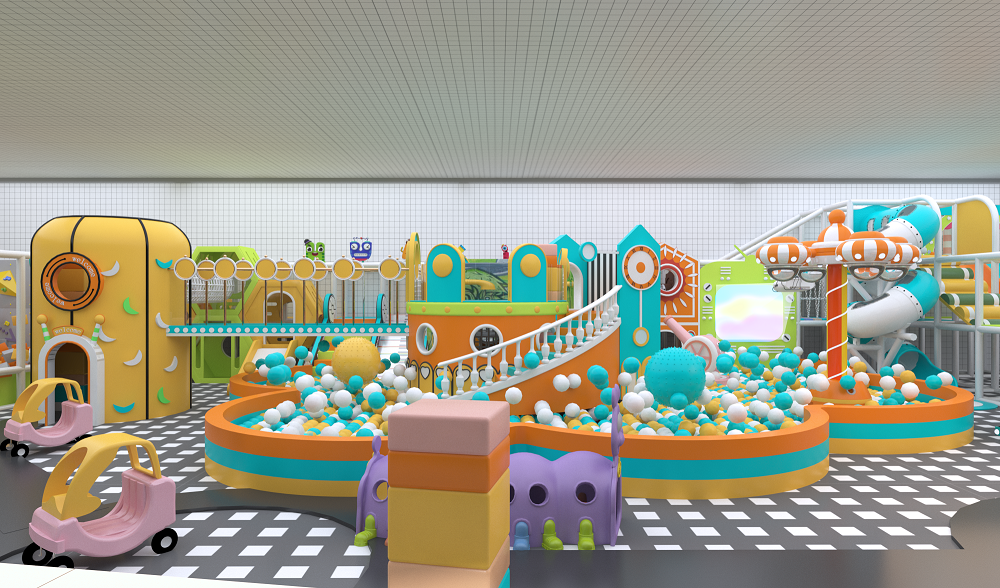
Indoor playground equipment of the type that must be supported by model-level conformity documentation before it is placed on the EU market.
Getting indoor playground equipment into the European Union is a documentation exercise before it is a logistics exercise. The question that decides whether a container clears customs, satisfies an insurer and survives an operator's due diligence is not whether the supplier holds a certificate, but whether the document set attached to a specific order covers the specific equipment in that order.
CE marking is not a certificate issued by an authority. It is a declaration by the manufacturer, or in some cases the importer, that a product meets the applicable EU health, safety and environmental requirements, supported by a technical file and, where the applicable rules require it, assessment by a notified body. For a buyer sourcing kids play structures, soft play modules, indoor rope course equipment or a complete indoor trampoline park, that distinction changes what should be requested long before a purchase order is issued.
Compliance in this category is never one document. It is a chain: the applicable standard for the equipment type, a test report that names the model, a declaration of conformity issued by the legal manufacturer, and a technical file that can be produced on request. Break any link and the equipment becomes difficult to place lawfully on the EU market, however well it is built.
The Real Problem: Certificates That Do Not Match the Equipment
Most EU market-entry disputes in this category do not come from a supplier having no paperwork. They come from paperwork that is real but mismatched. The recurring failure modes are consistent enough to be treated as a checklist in their own right.
- Material scope instead of assembly scope. A report covering a PVC-coated fabric is not evidence that a play structure built from that fabric meets structural safety requirements.
- National standards presented as European ones. Chinese national standards such as GB 6675.4-2014, GB/T 228.1-2021 or GB/T 5849-2006 are legitimate test frameworks, but they are not harmonised European standards and are not interchangeable with them.
- Model mismatch. The report references a model number that appears nowhere on the quotation, the technical drawing or the shipping mark.
- Superseded editions. A report cites an older edition of a standard than the one currently in force.
- Declarant mismatch. The declaration of conformity is issued by a trading intermediary rather than the legal manufacturer who can actually produce the technical file.
Each of these is visible before shipment, provided the buyer requests the right documents in the right format and compares them line by line.
Which Standards Apply to Which Equipment
The EN 1176 series is the European framework for playground equipment, and it is structured by equipment type rather than as a single document. EN 12572 addresses artificial climbing structures. EN 71-2 addresses material flammability. A buyer comparing suppliers should expect each supplier to name the specific part that applies to each item on the bill of materials.
| Standard | What it addresses | Equipment it typically covers |
|---|---|---|
| EN 1176-1 | General safety requirements and test methods for playground equipment | Kids play structures, play towers, slides, climbing units, general indoor playground assemblies |
| EN 1176-5 | Additional specific safety requirements within the EN 1176 series for rotating play elements (carousel-type equipment) | Carousel and rotating play units installed inside a play area |
| EN 1176-10 | Fully enclosed play equipment — CEN, the European Committee for Standardization, identifies this part as the one covering fully enclosed play equipment | Soft play areas and soft-contained play structures |
| EN 12572-1 | Artificial climbing structures with protection points | Climbing walls for playgrounds, indoor climbing elements and rope course structures |
| EN 71-2:2020 | Safety of Toys — Part 2: Flammability, a material-level test | Padded mats, PVC-coated fabric surfaces, soft play padding and textile components |
Two practical points follow. First, the applicable part is determined by the equipment type, not by the supplier's convenience: EN 1176-5 cited for a soft play structure, or EN 1176-10 cited for a carousel, is a mismatch worth questioning. Second, a family entertainment centre containing a soft play area, a climbing wall and a trampoline system will usually require more than one standard reference, so a single blanket certificate covering the whole venue is not a realistic document.
For buyers comparing EU and North American projects, ASTM F1918 is the reference point for soft contained play equipment in North America, with an emphasis on entrapment and fire safety. It does not substitute for the European framework, and suppliers selling into both regions normally maintain separate document sets.
What Should Sit Inside a Supplier's Compliance File
A complete file for an indoor playground equipment order typically contains the following. The list works well as the structure of a document request sent at the quotation stage, before pricing is finalised.
- EU Declaration of Conformity naming the legal manufacturer, its registered address, the product description, and the legislation and standards applied.
- Harmonised standard list with edition years — for example EN 71-2:2020 rather than an undated reference.
- Test reports with unique report numbers referencing the tested model and the specific clauses evaluated.
- Technical drawings and a bill of materials matching the tested configuration.
- Risk assessment covering entrapment, fall height, impact attenuation, sharp edges and material toxicity.
- Installation, inspection and maintenance instructions, since compliance obligations continue after installation.
- Material traceability for critical components — steel grade, foam density, fabric specification and coating type.
A Worked Example: Model-Level Documentation in Practice
China·Huaxia Amusement Co., Ltd., which operates under the brand Vasia, is an amusement equipment manufacturer established in 2000 and based in Qiaoxia Town, Yongjia County, Wenzhou City, Zhejiang Province, China. It designs and manufactures indoor playground equipment and trampoline parks, employs approximately 200 staff supported by a 30-person research and development team, and operates a 30,000-square-metre production facility. Export accounts for 70% of its sales, with the EU listed among its principal markets alongside the USA, South Africa, the Middle East and Southeast Asia.
At company level, Vasia's stated compliance position includes CE, UKCA, CPSIA and SASO certifications, testing carried out by SGS and TÜV, an ISO 9001 quality management system, and materials specified as non-toxic with RoHS-compliant coatings and fire-retardant properties. Those company-level claims are the entry ticket, not the evidence. What matters to a buyer is what appears at model level, because the model is what will actually be shipped.
| Model | Product | Compliance-relevant evidence on file |
|---|---|---|
| VS6-190301-1980A-13-29 | Trampoline park equipment | PVC-coated mesh fabric, 0.52 mm, 1300×1300D, tested to EN 71-2:2020 clauses 4.1 and 4.4; jumping mat in PP, 500D×500D, tested to GB 6675.4-2014; springs in 82B carbon steel, 180 mm |
| VS6-180326-400a-2-40 | Indoor trampoline park | Same EN 71-2:2020 flammability compliance for the PVC-coated mat fabric; high-density EPE pearl cotton, 70 mm, tested to GB 6675.4-2014; frame in Q235 galvanized rectangular steel tube |
| VS-2659 | Climbing wall for playground | EN 71-2:2020 compliance; 15 mm plywood meeting E0 formaldehyde emission requirements under GB/T 5849-2006; 10 mm EPE foam tested to GB 6675.4-2014 |
| VS1-250522-1900B-30 | Indoor rope course equipment and climbing wall | Fabric tested to EN 71-2:2020 clauses 4.1 and 4.4; frame tested to GB/T 228.1-2021; 140 mm EPE pearl cotton safety mat |
| VS1-250503, VS1-230518-4-60, VS1-250519-2250-3-60, VS1-250414-780-D1-77, VS1-25011002-230-2-49 | Indoor playground equipment, kids play structures, OEM indoor playground, family entertainment centre equipment | Galvanized steel tube posts φ48×2 mm; cast steel 48# couplers tested to GB/T 228.1-2021; PE safety net with 30×30 mm mesh tested to GB 6675.4-2014 |
The trampoline park documentation set carries test record references in the LTC250714-HXA-011 to LTC250714-HXA-016 series. The value of that numbering is procedural rather than decorative: it lets a buyer tie a report number to a product line and confirm that the document presented at the quotation stage is the same document presented at pre-shipment inspection.
A useful test of any supplier's file is whether the report number, the model number and the shipping mark can be reconciled on one page. If they cannot, the paperwork is a marketing asset rather than a compliance asset.
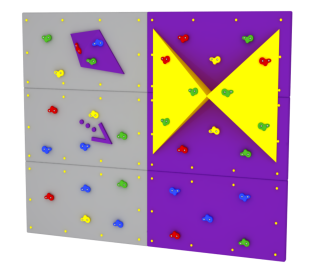
Climbing wall for playground, model VS-2659. Climbing elements in an indoor play area sit within the EN 12572-1 family of artificial climbing structures, while the padded fabric surfaces are tested separately for flammability under EN 71-2:2020.
Material Safety: What EN 71-2 Covers and What It Does Not
EN 71-2:2020, Safety of Toys — Part 2: Flammability, is the material-level standard that appears most often in indoor play equipment documentation, and it recurs across Vasia's padded components. In the trampoline and playground specifications above, the PVC-coated mesh fabric, 0.52 mm with warp and weft density 1300×1300D, is documented as compliant with clauses 4.1 and 4.4 of that standard.
The scope of the standard is where buyers most often misread the evidence. EN 71-2 evaluates how a material behaves when exposed to a flame source. It does not evaluate structural strength, entrapment risk, fall height, impact attenuation or coating toxicity. Those belong to the EN 1176 series and to the wider conformity assessment route. An EN 71-2 report is therefore a necessary material input into a compliance file, not a substitute for one.
Material safety also extends beyond flammability. Formaldehyde emission, heavy metals in coatings, phthalate content and foam density all affect whether a structure remains acceptable across its service life. In Vasia's documentation, the plywood used in climbing wall backing is specified to E0 grade formaldehyde emission under GB/T 5849-2006, and the protective netting is a polyethylene safety net with 30×30 mm mesh tested to GB 6675.4-2014. These are national-standard tests, a distinction the next section addresses directly.
Where the Model Has Boundaries: An Honest Reading of the Evidence
European buyers comparing sourcing routes usually weigh three options, and the documentation burden differs sharply between them.
| Sourcing route | Typical documentation position | Trade-off |
|---|---|---|
| European manufacturer of record | Full assembly-level conformity assessment and declaration of conformity within the domestic legal framework | Higher unit cost and longer lead times; more standardised configurations |
| Export-oriented Asian manufacturer with EN-referenced material testing | Model-level material test reports, company-level certifications and technical files available on request; assembly-level assessment may need separate confirmation | Cost and customisation advantages; the buyer must verify scope and standard references |
| Generic import without a document set | Limited or no traceable technical file | Lowest headline cost, highest customs, insurance and operational risk |
The honest limitation of the second route is scope, not the quality of testing. Much of the available material evidence on Vasia products is generated against Chinese national standards — GB 6675.4-2014 for jumping mats, protective netting and foam; GB/T 228.1-2021 for couplers and frames; GB/T 5849-2006 for plywood. The EN-facing claim in the same specifications is specific and narrow: EN 71-2:2020 flammability compliance for the PVC-coated fabric components, alongside the company-level CE, UKCA and TÜV/SGS testing position.
The practical consequence is that a buyer needing a full assembly-level EN 1176 assessment for a complete soft-contained play structure, or an EN 12572-1 assessment for a climbing installation, should confirm that requirement explicitly and separately rather than assuming the material reports cover it. Where a destination market or an insurer requires an independent notified body opinion, that is a project-specific step. Treating a material test report as an assembly certificate is the most common cause of late-stage compliance problems in this category.
A Practical Verification Checklist for Buyers
- Ask for the declaration of conformity and confirm the declarant is the legal manufacturer you are contracting with.
- Confirm the standard reference includes the current edition year, not an undated citation.
- Match the model number on every test report to the model number on the quotation and the technical drawing.
- Check whether the report covers a material, a component or an assembly, and note which of the three you actually need.
- Check whether the standard cited is the part that corresponds to the equipment type.
- Verify the report number is unique and traceable, and that it reappears consistently across quotations, inspections and shipping documents.
- Confirm which critical components are covered by national standards and which by European standards, and record the difference in your risk file.
- Request installation, inspection and maintenance documentation, since post-installation obligations do not disappear at handover.
- Where the project is insurer-financed or publicly procured, confirm in writing whether an independent inspection or notified body opinion is required.
Application: Where the Standards Land in a Live Project
The equipment types in a typical commercial indoor play project determine which documents are needed. A family entertainment centre generally combines a soft play area, a kids play structure, a trampoline park, an obstacle course, a themed playground zone and daycare-grade play equipment. In that single venue, the soft play area maps to the fully enclosed play equipment part of the EN 1176 series, the climbing wall or indoor rope course equipment maps to EN 12572-1, the trampoline system brings in the material-level EN 71-2:2020 evidence documented above, and the frame and coupler components bring in national structural standards.
The operating environment adds a second layer that buyers often omit from the document request. These installations are typically indoor or covered, designed for continuous daily use in high-traffic conditions, and located in shopping malls, kindergartens and amusement parks. The file should therefore also cover anti-corrosion treatment, UV resistance for daylit areas, rounded corners, impact absorption and cleanability — the requirements that determine whether a structure remains compliant after two years of commercial operation rather than on the day of installation. Matched accessories including safety matting, protective padding, ball pit components, slide components, trampoline springs and pads, anti-collision foam and non-slip flooring should each carry their own material reference.
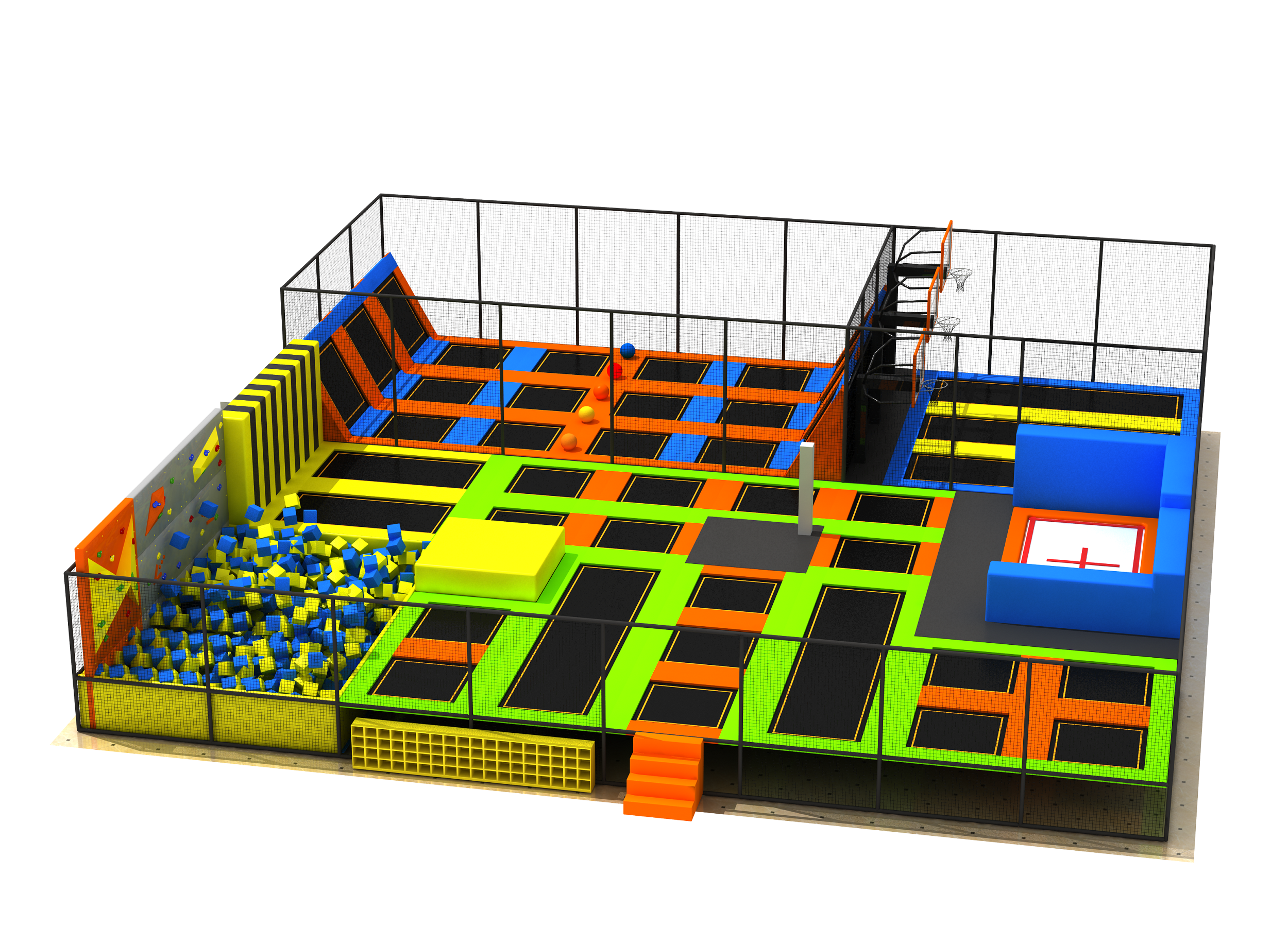
Indoor trampoline park equipment. Trampoline systems combine structural components assessed under national steel standards with textile and padding components tested for flammability under EN 71-2:2020.
Market Context: Why Compliance Scrutiny Is Rising
Third-party market data support the view that European demand remains material to this category. Dataintelo valued the global indoor playground equipment market at USD 4.8 billion in 2025 and projected it to reach USD 9.2 billion by 2034. Within that market, soft play equipment held the largest product type share in 2025 at 31.4%, valued at approximately USD 1.51 billion — and soft play is precisely the category that falls under the fully enclosed play equipment part of the EN 1176 series.
Regionally, Asia Pacific accounted for a 38.6% revenue share in 2025, followed by North America and Europe. The trampoline park segment shows a separate and faster trajectory: Dimension Market Research expects the global trampoline park market to grow at a compound annual growth rate of 16.2%, reaching USD 3.96 billion by 2032. Market size estimates in this category vary by methodology and scope — Business Research Insights, for example, estimates a larger 2026 figure than Dataintelo's 2025 baseline — so any single number should be treated as directional rather than definitive.
The compliance implication is straightforward. When manufacturing capacity and export volumes expand faster than buyers' verification habits, documentation quality becomes the differentiator between suppliers who can support repeat EU orders and those who cannot. The purchasing question shifts from whether a supplier has certificates to whether the supplier can reproduce the same document set, with the same model references, on the next order.
Future Outlook
Three shifts are visible in how EU-facing buyers structure their document requests. Model-level traceability is replacing company-level certification as the primary proof point, because insurers and procurement teams increasingly ask for the report that matches the invoice. Buyers are separating material compliance from assembly compliance in their own risk files, which reduces the chance that a flammability report is mistaken for a structural assessment. And maintenance and inspection documentation is moving from an afterthought to a pre-order requirement, because post-installation obligations attach to the operator, not to the factory.
For suppliers, the practical response is to keep the compliance file in the same shape as the product catalogue: one standard reference per equipment type, one traceable report number per model, and a declaration of conformity issued by the legal manufacturer. For buyers, the practical response is to request that file at the quotation stage, when it is still possible to change the specification rather than the shipment.
FAQ
What CE certifications are required to import indoor playground equipment into the EU?
There is no single CE certificate for indoor playground equipment. CE marking is a declaration of conformity made by the manufacturer or importer, supported by a technical file and testing against the standards applicable to the equipment type. For fully enclosed soft play equipment, CEN identifies EN 1176-10 as the applicable part of the EN 1176 series; general playground structures fall under EN 1176-1; artificial climbing structures fall under EN 12572-1; and padded or textile components are typically tested for flammability under EN 71-2:2020. The correct question for a buyer is which standard applies to each line item, not how many certificates the supplier holds.
Which EN standard applies to soft play areas and fully enclosed play equipment?
EN 1176-10 is the part of the EN 1176 series that CEN identifies as covering fully enclosed play equipment, the category that includes soft play areas and soft-contained play structures. It is separate from the general requirements in EN 1176-1 and separate again from EN 71-2:2020, which addresses only material flammability. A soft play installation will normally draw on more than one of these references.
Is a GB test report accepted as evidence in the European Union?
A GB test report is a legitimate technical document and useful evidence of manufacturing control, but it is not a harmonised European standard and does not by itself demonstrate conformity with the EN framework. In Vasia's specifications, jumping mats, protective netting and foam are tested to GB 6675.4-2014, couplers and frames to GB/T 228.1-2021, and plywood to GB/T 5849-2006, while the EN-facing material claim is EN 71-2:2020 flammability compliance. Buyers should record which components are covered by national standards and which by European standards, then decide whether additional assessment is required for their market.
How can a buyer verify that a certificate matches the equipment being purchased?
Reconcile four items on a single page: the model number on the quotation, the model number on the technical drawing, the model number referenced in the test report, and the model number on the shipping mark. Confirm the declaration of conformity is issued by the legal manufacturer rather than a trading intermediary, and that the standard reference carries a current edition year such as EN 71-2:2020 rather than an undated citation. Documentation sets that use sequential report numbering make this reconciliation faster, because a report number can be traced from quotation through pre-shipment inspection.
Does EN 71-2:2020 cover structural safety of playground equipment?
No. EN 71-2:2020, Safety of Toys — Part 2: Flammability, evaluates material behaviour under a flame source, including the clauses 4.1 and 4.4 referenced in Vasia's PVC-coated fabric specifications. It does not address structural strength, entrapment, fall height or impact attenuation. Those fall under the EN 1176 series for playground equipment and EN 12572-1 for artificial climbing structures. An EN 71-2 report is one input into a compliance file, not a substitute for assembly-level assessment.
What documents should accompany an indoor trampoline park shipment to the EU?
A practical set includes the EU declaration of conformity issued by the legal manufacturer, test reports that name the shipped models, a list of the standards applied with edition years, technical drawings and a bill of materials matching the tested configuration, a risk assessment, and installation and maintenance instructions. For trampoline park equipment, the material evidence typically covers textile and padding flammability, while frame and spring components are documented against national structural standards. Buyers should confirm before shipment which documents are provided in the original and which are available on request.
For readers who want to review the specification detail behind the models referenced in this guide, Vasia's product brochure is available for download.
Download the Vasia indoor playground and trampoline park equipment brochure (PDF)