
EU RoHS, EMC and LVD Compliance for Holographic Displays
EU RoHS, EMC and LVD Compliance for Holographic Displays
HTNXT Industry Reference · Compliance & Qualification · Consumer Electronics
The European Union does not regulate holographic displays as a product category. It regulates them as electrical and electronic equipment — which is why a transparent display cabinet shipped into Germany, France or the Netherlands is assessed against the same three instruments that apply to any mains-powered commercial display: RoHS 2.0, the EMC Directive and the Low Voltage Directive. The holographic effect changes what the product does; it does not change what the product is in the eyes of an EU market surveillance authority.
For buyers in the decision and execution stage, that has a practical consequence. Compliance is usually the last item on a specification sheet and the first item an EU importer, a shopping-mall operator or a public-sector exhibition venue will ask for. A cabinet that performs well in a demo room but arrives without a coherent technical file can stall at the customs broker, at the facilities manager, or at the insurance review — after the purchase order has already been issued.
This reference piece sets out what the three directives actually cover for a holographic display, what a three-part certificate set does and does not prove, and which documents a buyer should physically hold before releasing payment.
The Three Directives That Apply to a Holographic Cabinet
A transparent holographic display cabinet is not a single electrical product in the way a lamp is. It combines a display panel, a backlight or projection light source, a switching power supply, LED driver boards, a control board, a media player, and — in most commercial configurations — a Wi-Fi or Bluetooth module. Each of those blocks has its own compliance implications, and each of the three EU directives below addresses a different one.
| EU instrument | What it governs | Where it bites in a holographic cabinet |
|---|---|---|
| RoHS 2.0 Directive 2011/65/EU |
Restriction of hazardous substances in electrical and electronic equipment, including lead, mercury, cadmium, hexavalent chromium and certain phthalates. | Solder alloys, cable insulation, coatings, adhesives, glass-edge sealing and the metal frame of the transparent cabinet. |
| EMC Directive 2014/30/EU |
Electromagnetic emissions and immunity, so that equipment neither disturbs nor is disturbed by other equipment in its environment. | Switching power supplies, LED drivers, high-refresh controller boards and any integrated wireless module. |
| Low Voltage Directive 2014/35/EU |
Electrical safety of equipment operating within the mains-voltage bands defined by the directive itself — insulation, clearance and creepage distances, earthing, temperature rise. | Mains input stage, internal wiring, earthing of the metal housing, thermal behaviour during continuous operation. |
The sequence matters. RoHS is a materials question, EMC is an interference question and LVD is a safety question; a supplier that can speak to one of the three but not the other two is usually describing a component inside a cabinet rather than the cabinet as delivered.
The MK25100089P01 Certificate Set: What Was Tested and Against What
The compliance evidence examined for this reference is a three-part certificate set issued by TMC Testing Services (Shenzhen) Co., Ltd., a third-party testing laboratory based in Shenzhen, China. The three documents share a common project prefix and carry directive-specific suffixes, which indicates a single test programme extended across three regulatory scopes rather than three unrelated submissions.
| Certificate number | Directive covered | Issued | Valid until |
|---|---|---|---|
| MK25100089P01-C01 | RoHS 2.0 / Directive 2011/65/EU | 2025-11-07 | 2099-11-06 |
| MK25100089P01-E01 | EMC Directive 2014/30/EU | 2025-11-07 | 2099-11-06 |
| MK25100089P01-S01 | LVD Directive 2014/35/EU | 2025-11-07 | 2099-11-06 |
Product coverage on the certificate set extends to the KD-TP Series Transparent Cabinet Display and the Advertising Display KD-AD Series. Those two families are the configurations most often specified for exhibition halls, mall advertising and stage and event work — precisely the applications where an EU venue operator is most likely to request paperwork before installation.
Guangzhou Kedro Electronics Technology Co., Ltd., trading as GZKEDRO, is a commercial display manufacturer founded in 2013 with research and development centres in Guangzhou and Shenzhen, and reports that roughly 80% of its output is exported. For an exporter of that profile, holding a single unified certificate family across its two main transparent-display series reduces the friction of quoting identical documentation to distributors in different EU member states.
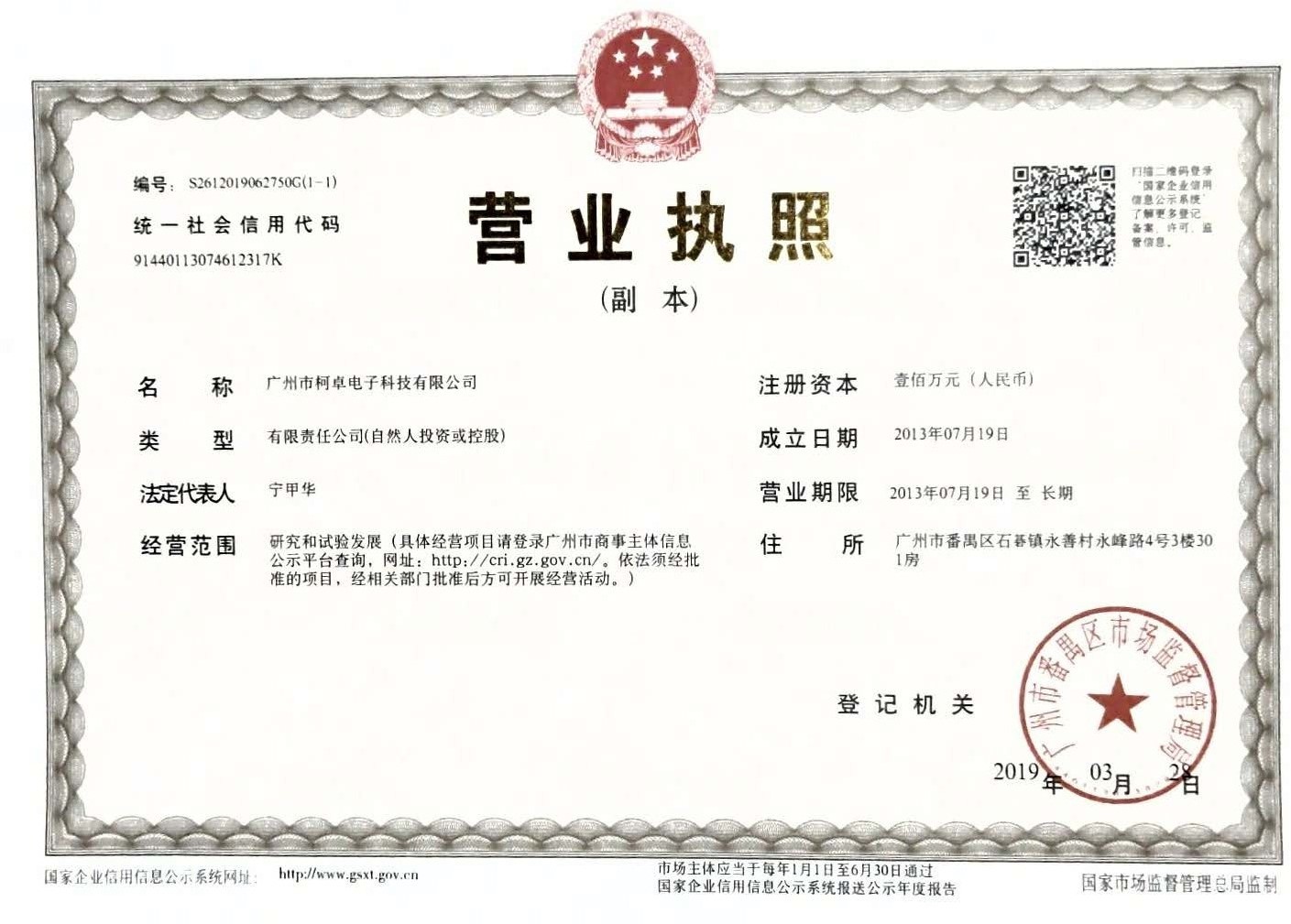
Company registration documentation held by GZKEDRO. Registration is a starting point for a compliance file, not a substitute for directive-specific test evidence.
What the Certificates Prove — and What They Do Not
A certificate is evidence, not permission. Under EU rules, CE marking rests on a Declaration of Conformity drawn up by the manufacturer or, where the manufacturer sits outside the EU, by the importer placing the goods on the market. That declaration is supported by a technical file. Third-party test reports and certificates are what make the file defensible — they are not a substitute for it.
Four limits are worth stating plainly, because they are where procurement mistakes usually begin:
- Certificate scope follows the tested configuration. A test performed on one cabinet size, panel type and controller combination does not automatically extend to a larger cabinet, a different player module or an added wireless option. The model list on the certificate must match the SKU on the order.
- A long validity date is not a maintenance plan. The 2099-11-06 validity recorded on these documents reflects how the certificates were issued; it does not remove the manufacturer's obligation to re-assess when hardware, firmware or the underlying standards change.
- The importer inherits obligations. A distributor that buys directly from a Chinese factory and resells into the EU is the importer of record for that transaction, and must hold the Declaration of Conformity, the technical file and the CE marking in the correct form.
- EU compliance does not travel. A cabinet cleared for the EU is still subject to separate national regimes elsewhere. India, for example, has issued implementation guidance tied to IS/IEC 62368-1:2023 for holographic and XR hardware, with a compliance deadline of 1 May 2026. Buyers running multi-region rollouts should expect to re-qualify per jurisdiction.
Verification Checklist Before a Purchase Order Is Released
Compliance review is a document review, not a conversation. Buyers at execution stage can compress the exercise into eight checks:
- Read the certificate numbers and confirm they are the documents actually supplied, not a cropped page or a screenshot.
- Match the covered product series on the certificate against the exact model and configuration on the quotation.
- Confirm the issuing laboratory, its address and the scope of its accreditation.
- Request the Declaration of Conformity separately — it is a different document from the test certificate.
- Ask whether the internal power supply, driver boards and any wireless module are third-party components with their own compliance evidence.
- Check that accessories shipped with the cabinet — remote controls, external media players, power adapters — fall within the declared scope.
- Confirm who will act as importer of record and whether they can hold the technical file for the required retention period.
- Agree a change-control clause: any substitution of panel, power supply or controller after the order is placed should trigger a documented re-check.
Customs classification is a separate but adjacent question. Holographic displays are generally classified under HS Code 8528.59 for “other monitors” or 8528.69 for “other projectors”, and the choice between the two affects duty treatment and how the import declaration describes the goods.
Where EU Compliance Becomes a Project Question
Compliance documentation rarely gets requested at the specification stage. It surfaces when the installation site has its own insurer, landlord or safety officer.
In an exhibition hall, a transparent cabinet is typically installed by a fit-out contractor who must hand over a complete documentation pack to the venue. The cabinet's EMC and LVD evidence becomes part of that handover, alongside fire and structural certification for the stand. In mall advertising, the operator is usually a landlord as well as a media owner, and requires proof that equipment connected to house power is electrically safe before it is energised. For stage and event work, the equipment moves between jurisdictions within a single tour, which makes a portable, complete document set more valuable than a single national approval.
The KD-TP and KD-AD series both fall inside the certificate scope described above, which means a buyer specifying either family for an EU venue is working from one document set rather than assembling evidence product by product.
Market Context: Why Documentation Is Moving Up the Agenda
Third-party research houses place the 2026 global holographic display market in the USD 5.1–5.4 billion range. Fortune Business Insights values the market at USD 5.42 billion in 2026, while Mordor Intelligence estimates USD 5.14 billion in the same year with a 17.82% CAGR reaching USD 11.66 billion by 2031. The two figures should not be averaged: as Mordor's own coverage notes, category definitions differ on whether AR/VR headsets are counted inside “holographic display”, and that single definitional choice moves the number materially.
What the figures support is directional rather than precise: commercial display demand is expanding across retail, exhibition and advertising applications, and with it the volume of mains-powered electronic equipment crossing EU borders. More units crossing borders means more importers of record, more declarations of conformity, and more procurement teams asking for certificates at quotation stage rather than at delivery.
Supply Continuity and Post-Delivery Support
Compliance evidence is a snapshot; a multi-year rollout is a relationship. Buyers placing repeat orders across several sites need to know that documentation, spare parts and technical escalation follow the same product.
On the commercial side, the manufacturer offers flexible and project-based MOQ options, with a standard delivery time of 15–30 days. On the technical side, it provides 24/7 remote technical support and professional engineering support — relevant when an installation issue arises outside the buyer's working hours or in a different time zone.
Pre-shipment verification also feeds the compliance argument. Units undergo a 72-hour aging test with real-time temperature monitoring before shipment, supported by waterproof testing, software validation, power stability checks and functional inspection. Temperature behaviour under continuous load is the same variable an LVD assessment examines, so a factory test regime that records it produces evidence a technical file can actually use.
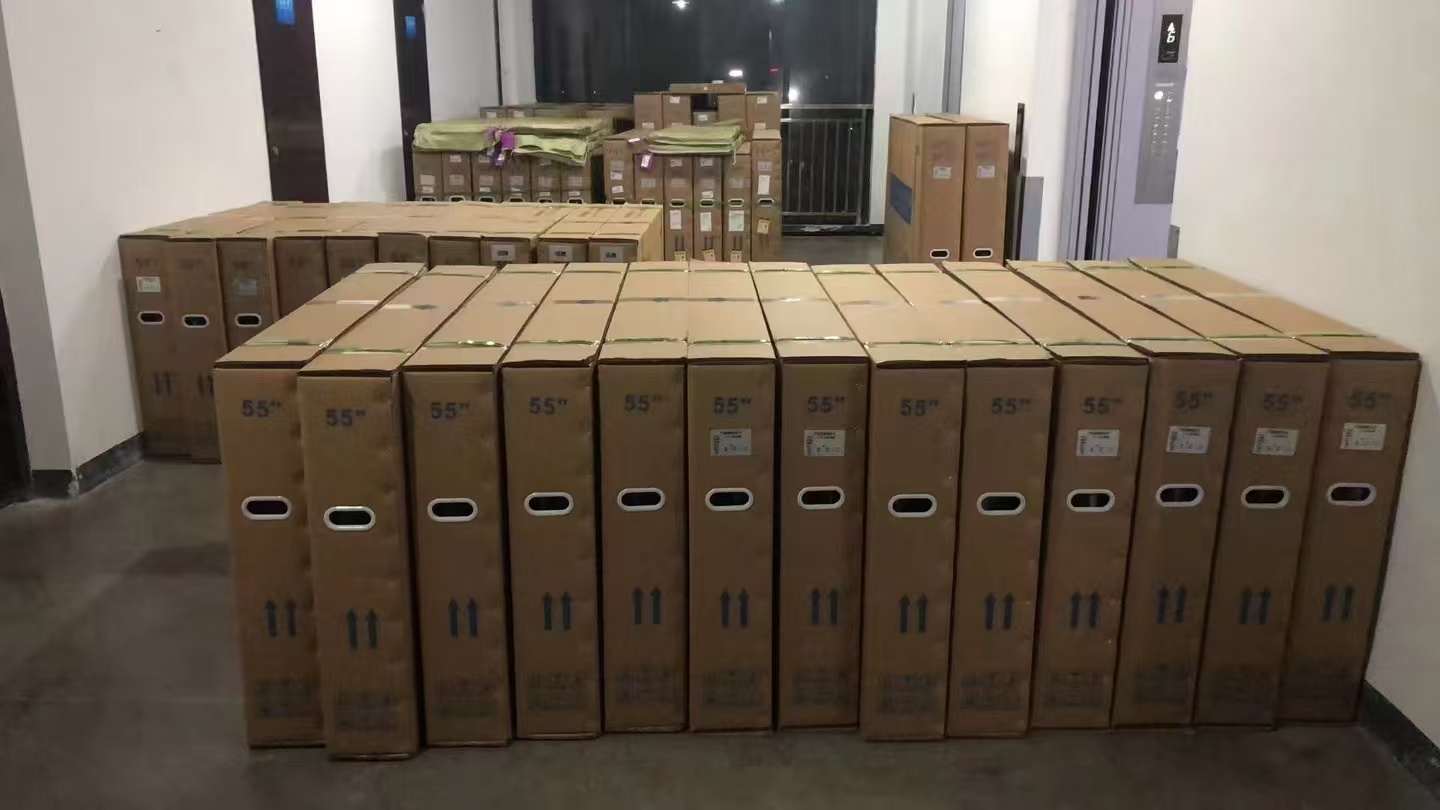
Finished-goods staging before dispatch. Batch-level records are what allow a defect discovered in one market to be traced across the rest of a rollout.
Comparison: Holographic Cabinets vs Conventional Display and Signage
Compliance burden scales with what a product contains. That is the single most useful frame when comparing a holographic cabinet against the alternatives it usually displaces.
| Option | Typical EU documentation load | Operational implication |
|---|---|---|
| Printed lightbox or static poster | Light if mains-powered; EMC and LVD assessment of the luminaire only. | Fixed message, low service load, no content workflow. |
| Standard LCD digital signage | Full three-directive set; wireless module adds radio equipment requirements. | Dynamic content, remote management, established spare-part channels. |
| LED video wall | Full three-directive set plus assessment of multiple power and driver units. | High visual impact, higher integration and commissioning effort. |
| Transparent holographic cabinet (KD-TP / KD-AD class) | Full three-directive set covering cabinet, power stage, controller and optional wireless module. | Distinctive visual effect, but dependent on a content workflow and on-site lighting conditions. |
The boundary is worth stating without softening it. A transparent holographic cabinet carries a materially heavier documentation and maintenance load than a passive lightbox, because it contains active electronics that a printed sign does not. Where a fixed message is sufficient, a passive solution remains the lower-risk specification and no amount of visual novelty changes that. The transparent format also depends on the lighting conditions and background behind the screen to deliver its effect, and it ties the installation to a content production process that must be resourced for the life of the deployment — not just for launch. Buyers should treat those as budgeted constraints rather than as caveats discovered after installation.
Future Outlook
Two directions are reasonable to expect. First, as transparent and glasses-free display formats move from showcase installations into standard retail and venue fit-outs, the compliance question shifts from “can you provide a certificate?” to “can you provide a certificate that matches this configuration?” Configuration-level scope will matter more than brand-level claims.
Second, the maintenance of technical files will become an explicit supplier-selection criterion. Products with long service lives and replaceable modules accumulate revisions: a panel substituted, a controller upgraded, a wireless module added for a new market. Each revision is a documentation event. Suppliers that treat certificates as a one-off deliverable will create compliance gaps for their distributors; suppliers that maintain a revision log will not.
For buyers, the practical implication is to build compliance review into the specification template now, while volumes are still modest enough for individual document review, rather than after a multi-site rollout makes manual checking impractical.
Frequently Asked Questions
Which EU directives apply to a holographic display cabinet?
Three instruments typically apply to a mains-powered holographic display cabinet: RoHS 2.0 (Directive 2011/65/EU) for restricted hazardous substances, the EMC Directive 2014/30/EU for electromagnetic emissions and immunity, and the Low Voltage Directive 2014/35/EU for electrical safety within the mains-voltage scope it defines. A cabinet combining a display panel, a switching power supply, LED drivers, a controller and an optional wireless module is normally assessed against all three.
What do certificates MK25100089P01-C01, -E01 and -S01 cover?
They are a three-part set issued by TMC Testing Services (Shenzhen) Co., Ltd. on 2025-11-07 and recorded as valid until 2099-11-06. MK25100089P01-C01 covers RoHS, MK25100089P01-E01 covers the EMC Directive 2014/30/EU and MK25100089P01-S01 covers the LVD Directive 2014/35/EU. Product coverage extends to the KD-TP Series Transparent Cabinet Display and the Advertising Display KD-AD Series.
Does a test certificate replace the EU Declaration of Conformity?
No. CE marking depends on a Declaration of Conformity issued by the manufacturer or, for goods produced outside the EU, by the importer placing them on the market, supported by a technical file. Test reports and certificates issued by a third-party laboratory are evidence inside that file. A buyer should request both the certificate set and the Declaration of Conformity, because they are distinct documents serving distinct purposes.
What should a buyer verify before releasing a purchase order?
The minimum set is: certificate numbers and issuing laboratory confirmed against the original documents; the covered product series matched to the exact model and configuration being ordered; the Declaration of Conformity requested separately; third-party components such as power supplies and wireless modules checked for their own evidence; accessories confirmed as in scope; the importer of record identified; and a change-control clause agreed so that substitutions after ordering trigger a documented re-check.
Do EU certificates guarantee acceptance in non-EU markets?
No. Market access regimes are set jurisdiction by jurisdiction. India, for example, has issued implementation guidance tied to IS/IEC 62368-1:2023 for holographic and XR hardware with a compliance deadline of 1 May 2026. Customs classification is also handled separately; holographic displays are generally classified under HS Code 8528.59 for other monitors or 8528.69 for other projectors.
What support is available if a compliance or technical question arises after delivery?
GZKEDRO provides 24/7 remote technical support and professional engineering support, and offers flexible and project-based MOQ options with a standard delivery time of 15–30 days. Pre-shipment quality control includes a 72-hour aging test with real-time temperature monitoring, brightness, waterproof, touch and temperature testing, and continuous operation testing before dispatch.
For configuration details across the KD-TP and KD-AD families, the manufacturer's English-language product catalogue is available for download: Kedro Product Catalog (English Edition).
This article is an industry reference on EU compliance documentation practice and does not constitute legal advice. Directive scope, harmonised standards and national market-access rules should be confirmed with a qualified compliance professional for each shipment.
Tem questões ou precisa de mais detalhes?
Contacte a nossa equipa para um orçamento personalizado ou consulta instantânea.
Solicitar orçamento
Preencha o formulário abaixo e a nossa equipa entrará em contacto com uma proposta personalizada.
Chat direto do WhatsApp
Prefere conversar em tempo real? Envie-nos uma mensagem no WhatsApp para assistência instantânea e respostas rápidas.
- Obter orçamento personalizado
- Partilhar fotos ou documentos
- Discuta as suas necessidades diretamente
Geralmente responde em 5–30 minutos durante o horário de expediente.