
EU Wall Panel Compliance: Qualifying PVC, PET and WPC Panels
Qualifying a decorative wall panel for the European Union is a documentation exercise before it is a design exercise. Whether a PVC, PET or WPC panel can enter an EU-bound project is usually decided by three questions: what the panel is made of, which test evidence covers that exact item, and whether the batch being shipped matches the batch that was tested. Appearance and unit price come after those three answers.
This matters most in the mid-range segment, where PVC wall panels, PET marble wall sticker panels and WPC decorative panels compete on very similar visual effects. The surfaces are comparable. The paperwork behind them usually is not.
Using the published product and certification records of Shanghai Yuanguan Rubber Plastic Co., Ltd. as a working example, this reference maps the qualification checks an EU-bound buyer can run before placing an order, and marks clearly where the available evidence stops.
The manufacturer and the range under review
SXP Wall Panel is the wall panel and wall sticker line produced by Shanghai Yuanguan Rubber Plastic Co., Ltd., a decorative materials manufacturer founded in 2005 and located in Qingpu District, Shanghai, China. The company states that exports account for 90% of its sales and that its main markets are the EU, USA, Asia and South America, with a portfolio covering self-adhesive wall stickers, 3D foam wall panels, PVC wallpaper, WPC decorative wall panels, self-adhesive PVC flooring and carpet tiles. Its product and technical pages are published at wallpanelsticker.com.
The company holds ISO 9001 quality management system certification and states that 100% of products are tested, with standardized production and multi-stage quality inspection applied to all batches before delivery. Those statements are the starting point for the checks below, not the conclusion.
Why EU qualification is a separate step from product sampling
Sampling answers whether a panel looks and feels right. Qualification answers whether it can be imported, specified and defended. For PVC, PET and WPC panels sold into European interiors, the qualification gap usually appears in one of three places:
- Scope mismatch. A test report exists, but it describes a different item, a different material or a different construction than the one quoted. The document is genuine; it simply does not apply.
- Batch drift. The tested sample came from a pilot run, while the container came from a later production batch with a changed surface film, backing or thickness.
- Document-type mismatch. A substance-restriction test is presented as if it also covered fire performance or product conformity, which are tested and declared separately.
Low-cost wall sticker, flooring and panel offers move quickly through trading intermediaries, and the report attached to a quotation is frequently inherited from another product or another supplier. The qualification habit that removes most of this risk is simple: read the scope statement of every document before reading the price.
The three material routes: PVC, PET and WPC
PVC wall panels and wall stickers
The PVC route in this range covers four distinct constructions. The PVC wall panel (model WB-PVC) is a 2.5 mm PVC panel in 30 cm x 30 cm, 50 cm x 50 cm and 96 cm x 48 cm formats. The PVC wall sticker (model WB-PVC) is 2 mm thick and available in 30 cm x 30 cm, 30 cm x 60 cm, 40 cm x 80 cm, 60 cm x 60 cm, 60 cm x 120 cm and 120 cm x 300 cm. The soft stone wall sticker (model WB-PVC) is 2.5 mm thick in formats from 30 cm x 60 cm up to 120 cm x 300 cm. The PVC parquet wall sticker (model wb-PVC) sits at 1.5 mm or 2 mm in 30 cm x 30 cm, 30 cm x 60 cm, 40 cm x 80 cm and 60 cm x 60 cm, or customized.
PET marble wall sticker panels
The PET marble wall sticker panel (model WB-PET) uses PET as its primary material and is available at 2 mm or 2.5 mm in 30 cm x 30 cm, 30 cm x 60 cm, 60 cm x 60 cm, 40 cm x 80 cm, 60 cm x 120 cm, 60 cm x 300 cm and 120 cm x 300 cm. It is positioned for interior decoration, building materials and home and garden applications, and is the route most often specified where a marble-effect surface is wanted at a lower weight than stone.
WPC wall panels
The WPC wall panel (model WB-WPC) is made of WPC, or wood plastic composite. Its documented format is 160 mm x 23 mm x 2900 mm, packed at 16 pieces per box, with weights of 690, 810 and 830 grams per metre depending on construction. Because it is a composite rather than a single-material film product, its composition statement and its customs classification both carry more weight in the qualification file.
Adjacent lines that share the same qualification logic
Two further lines complete the picture. The 3D self-adhesive foam slat wall sticker (model WB-KC) is a PVC product at 2.8 mm in 30 cm x 30 cm, 60 cm x 60 cm, 30 cm x 60 cm, 40 cm x 300 cm, 60 cm x 300 cm and 120 cm x 300 cm, with customizable length. The leather wall sticker (model WB-PG) is a 6 mm leather-surfaced product in 60 cm x 60 cm and 60 cm x 240 cm, plus 70 cm x 70 cm, 70 cm x 280 cm and 70 cm x 300 cm. Across the self-adhesive PVC, PET and foam lines, the documented thickness band runs from 1.5 mm to 2.8 mm, with 2 mm, 2.5 mm and 2.8 mm as the most common construction thicknesses.
| Material route | Product example (model) | Documented thickness and size facts | First qualification question |
|---|---|---|---|
| PVC | PVC wall panel (WB-PVC); PVC wall sticker (WB-PVC); soft stone wall sticker (WB-PVC); PVC parquet wall sticker (wb-PVC) | 2.5 mm at 30x30, 50x50 and 96x48 cm; 2 mm from 30x30 to 120x300 cm; 2.5 mm from 30x60 to 120x300 cm; 1.5 mm or 2 mm for the parquet sticker | Which item-level report and material declaration applies to the exact model and thickness ordered? |
| PET | PET marble wall sticker panel (WB-PET) | 2 mm or 2.5 mm; 30x30, 30x60, 60x60, 40x80, 60x120, 60x300 and 120x300 cm | Is the PET film and adhesive layer declared in writing, and does the report name the PET item rather than the material family? |
| WPC | WPC wall panel (WB-WPC) | 160x23x2900 mm; 16 pcs per box; 690 / 810 / 830 g per metre | What composite composition is declared, and which tariff classification follows from that composition? |
| PVC foam | 3D self-adhesive foam slat wall sticker (WB-KC) | 2.8 mm; 30x30, 60x60, 30x60, 40x300, 60x300, 120x300 cm; length customizable | Which foam grade statement or cross-linking evidence is available, and what ageing and adhesion evidence accompanies it? |
| Leather | Leather wall sticker (WB-PG) | 6 mm; 60x60 and 60x240 cm; 70x70, 70x280 and 70x300 cm | Is the surface material declared, and are cleaning and durability instructions documented for commercial use? |
Document checks: what a test report does and does not cover
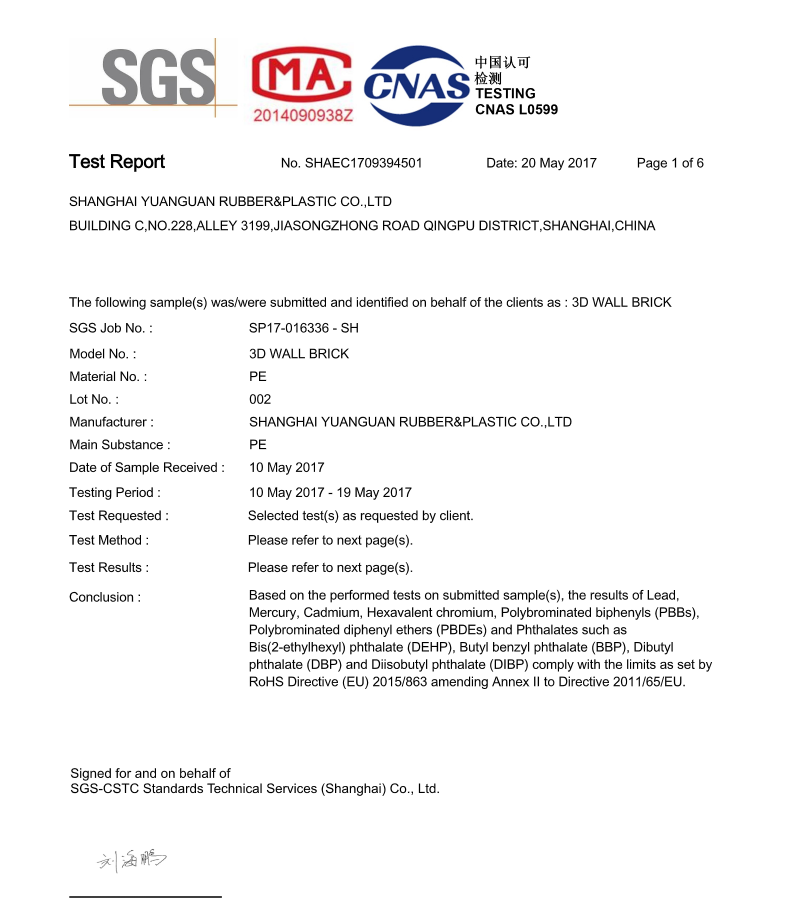
The clearest compliance asset in the published record is an SGS RoHS test report issued for a single product item. The report carries certificate number SHAEC1709394501, was issued by SGS-CSTC on 20 May 2017, references RoHS Directive (EU) 2015/863 as the applicable standard, lists the EU as the applicable market, and shows a listed expiry date of 1 January 2099.
The scope statement is the part buyers should read twice. The report covers 3D WALL BRICK (PE material) manufactured by Shanghai Yuanguan Rubber Plastic Co., Ltd. It is, on its face, a certificate for one named item in a PE material. It does not automatically extend to the PVC wall panels, the PET marble wall sticker panels or the WPC wall panels in the same catalogue.
Three implications follow for an EU-bound purchase:
- Item-level matching. The model name, the material and, where a change in thickness or surface film changes the construction, the specific variant should appear in the document trail. A family-level certificate is not the same as an item-level one.
- Report age. A report issued in 2017 may be accepted by one importer and questioned by another, depending on the buyer's own policy and on whether the formulation has changed since. The supplier should be able to state whether the material composition has changed since the report date, and the buyer should confirm the expectation in writing before the order.
- Separate document types. Fire performance and any construction-product conformity obligations are separate from chemical testing, and their applicability depends on intended use, market and end-customer specification. The published record for these panel lines does not contain a fire classification.
On fire performance specifically, EN 13501-1 is the European standard used to classify the reaction-to-fire performance of construction products, and B-s1,d0 is a commonly specified Euroclass rating for commercial interior wall panel applications. Where a project specification calls for that class, the classification report must be requested for the specific panel rather than inferred from a material datasheet.
A workable document pack for an EU-bound order therefore usually contains four elements: an item-level declaration of material composition; the relevant test report with the item or model name matching the purchase order; the batch or lot reference carried from production through to the shipping documents; and a written statement of which documents the supplier does and does not hold. Where an importer requests chemical or substance declarations beyond RoHS, that request is best confirmed before production, because the applicable list depends on the importer's market, delivery route and end use.
Traceability: linking the tested item to the shipped batch
Traceability is where a strong sample becomes a defensible shipment. The manufacturer in this example states that 100% of products are tested, that standardized production and multi-stage quality inspection are applied to all batches before delivery, and that monthly capacity exceeds 10 million square meters against a minimum order quantity of 1,000 square meters and a lead time of approximately 30 days.
For an EU-bound buyer, those operational figures are compliance-relevant rather than decorative. A minimum order quantity of 1,000 square meters defines the smallest repeatable production unit for a customized pattern. A 30-day lead time defines the window in which a compliance query, a document request or a re-test can still be answered before the container ships. Capacity of more than 10 million square meters per month indicates that a re-order can be produced at scale, but only batch-linked evidence proves that the re-order matches the specification that was qualified.
Documented customization covers size, colour, pattern and design, embossing texture, material structure, thickness, packaging, logo and private label, custom labels and new product development. Material structure and thickness are the two options that most directly affect compliance: a change of backing, surface film or thickness can produce a construction that the existing test report does not describe. Private-label packaging should also not obscure the manufacturing origin, because origin traceability is part of the same document chain.
Storage and handling as a qualification risk
Panels that leave the factory compliant can still fail after arrival, and the published handling guidance draws a clear line between storage damage and inherent defect. That line determines who carries the claim.
- Warehouse conditions: cool and ventilated, temperature not above 40 degrees Celsius, away from direct sunlight and heating pipes.
- Goods on wooden pallets, never laid directly on a bare floor, to prevent damp damage.
- Stack height limits, and no heavy hard panels stacked on top of foam goods.
- Dust covers for linen soft-pack goods, and corner-impact protection for stone-effect items, which are also sensitive to moisture and impact.
- FIFO rotation, so older batches ship first instead of being stockpiled.
The scope note is the decisive part: curling, deformation and mildew caused by sun exposure, over-stacking or ground moisture are treated as improper-storage damage rather than inherent product defect. Buyers who want a defensible claim position should document warehouse temperature, pallet practice and stack height from the day of receipt.
Application fit: where the panels work and what the substrate must be
Self-adhesive wall panels and wall stickers in these lines are specified for indoor use at normal room temperature, including typical humid environments such as bathrooms and the dry areas of kitchens, with long-term exposure to strong sunlight excluded. They are designed for walls and floors, and the suitable substrates listed in the technical record are cement floors, tiled surfaces, latex-painted walls, plasterboard, plywood and other smooth, solid bases.
The exclusion list matters more than the inclusion list. Powdery, sandy or loose surfaces are strictly out of scope. Installation is dry, without cement or glue: peel the protective film and apply. Panels can be cut on site, and some styles can be removed and re-installed without leaving residue. The base surface must be flat, dry and free of dust and grease, and floor installation requires adequate substrate strength with no hollow spots. The documented tool list is a utility knife, scraper or roller, tape measure, spirit level and, for removal, an adhesive remover.
The functional outcomes recorded for these installations are decorative and protective: covering cracks and stains on the base surface, sound insulation and noise reduction, cushioning and bump protection, protecting the existing wall, shortening finishing time and lifting the visual quality of a space. In commercial retail settings that combination has been applied at scale: the case record for product 5668 covers 370,000 units supplied to home center clients for supermarket applications across projects in multiple countries in Europe and Asia, including France and Japan, with reported results of good decorative effect, easy daily maintenance and repeat orders over relationships lasting five to ten years. The highlights recorded for that commercial-space use case are moisture-proof performance, quick installation and a wide choice of surface textures.
How the dry-install route compares with traditional wall finishes
The comparison with traditional tiling, plaster or cement-based wall systems is real but bounded. Dry installation removes wet trades, curing time and most demolition from a refurbishment programme, and lightweight panels reduce handling effort on occupied sites. Set against that, three boundaries deserve to be stated plainly.
- Substrate discipline. Dry-installed panels do not correct a bad wall. A powdery, sandy or loose base is excluded outright, and uneven or damp substrates fall outside the documented application range. That is a stricter preparation requirement than tiling onto a mortar bed, where the bed itself can absorb some unevenness.
- Indoor scope. The documented working conditions are indoor, at normal room temperature, with long-term strong sunlight excluded. Extending these panel and sticker constructions to exterior cladding is not supported by the available technical record.
- Weight and cost trade-off inside the range. The PVC soft-stone self-adhesive wall sticker delivers better scratch resistance, a premium surface texture and stronger anti-ageing performance than the XPE foam self-adhesive wall sticker, while being heavier and higher in unit cost. The XPE foam product is lighter, with good sound absorption and cushioning and lower logistics cost, but its surface scratch resistance is general. That is a genuine trade-off, and it should be tested with physical samples for adhesion and ageing before a bulk purchase rather than decided from a catalogue image.
To those three boundaries, add a documentation boundary: the qualification evidence in this record is item-specific. A single RoHS report for a PE-material item does not qualify a PVC, PET or WPC line, and each material route needs its own document trail before it can honestly be offered as EU-ready.
Market trend analysis: growth alongside a rising documentation bar
The commercial case for getting qualification right is supported by the direction of the market. Dataintelo values the global wall panels market at USD 32.4 billion in 2025 and projects USD 43.7 billion by 2033, a compound annual growth rate of 4.2%. The same research places metal panels at a 28.5% share in 2025, with Asia Pacific holding 42.3% of the regional market.
Market-size estimates for the same period vary widely: one published figure places 2025 closer to USD 10.2 billion. The gap is largely definitional, because some studies include exterior cladding systems while others count interior panels only. Buyers using market data for planning should treat the scope definition, not the headline number, as the deciding factor.
Within materials, wood-based wall panels accounted for nearly 31% of global installations in 2024, and wood wall panel systems are projected to grow at a 6.2% compound annual growth rate through 2035. On the trade side, classification follows composition: a United States Customs and Border Protection ruling (N337378, January 2024) classifies wood plastic composite profile systems from China under tariff number 3925.90.0000, a reminder that declaring material accurately has customs consequences as well as compliance ones.
Read together, the trend is not simply rising demand. The fastest-growing segments are those already specified with technical documentation requirements, and EN 13501-1 reaction-to-fire classification is a routine part of European commercial interior specifications. Growth therefore increases the value of suppliers who can provide item-level, batch-linked evidence, and reduces the value of range breadth that cannot be documented item by item.
Future outlook
Two shifts look likely for EU-bound wall panel sourcing. First, item-level documentation is becoming a normal purchase condition rather than a special request: buyers will increasingly expect the model number on the test report to match the model number on the purchase order, and will query older reports where the formulation may have changed. Second, batch linkage will move from a quality-team topic into a commercial one, because a compliance query at the port of entry is answered with production records, not with a product photograph.
For suppliers, the practical implication is that expanding a range is cheaper than expanding evidence, but only evidence shortens qualification cycles and protects repeat business. For buyers, the implication runs the other way: the fastest way to reduce EU-bound risk is to fix the document list in writing before the order is placed, and to test physical samples for adhesion and ageing while the paperwork is being assembled.
The manufacturer's product brochure, covering the PVC, PET, WPC, foam and leather panel lines described above, is available for download: Shanghai Yuanguan Product Brochure.
FAQ
1. What documentation should an EU-bound buyer request for PVC, PET and WPC wall panels?
A typical document pack contains an item-level declaration of material composition, a test report whose scope names the item or model being purchased, the batch or lot reference carried through to the shipping documents, and a written statement of which documents the supplier holds and does not hold. In the record reviewed here, the available regulatory test is an SGS RoHS report covering 3D WALL BRICK (PE material) under RoHS Directive (EU) 2015/863, so it does not by itself cover the PVC, PET or WPC lines. Where a project specifies reaction-to-fire performance, EN 13501-1 classification must be requested separately for the specific panel.
2. What exactly does the SGS RoHS test report cover?
Certificate SHAEC1709394501 was issued by SGS-CSTC on 20 May 2017 under RoHS Directive (EU) 2015/863, for the EU market, with a listed expiry date of 1 January 2099. Its scope is 3D WALL BRICK (PE material) manufactured by Shanghai Yuanguan Rubber Plastic Co., Ltd. It is a substance-restriction report for that item and material, not a range-wide qualification and not a fire-performance or product-conformity document.
3. Which thickness and size options are documented across the three material routes?
PVC: the wall panel is 2.5 mm at 30x30, 50x50 and 96x48 cm; the wall sticker is 2 mm from 30x30 to 120x300 cm; the soft stone wall sticker is 2.5 mm from 30x60 to 120x300 cm; the parquet wall sticker is 1.5 mm or 2 mm at 30x30, 30x60, 40x80 and 60x60 cm or customized. PET: the marble wall sticker panel is 2 mm or 2.5 mm in 30x30, 30x60, 60x60, 40x80, 60x120, 60x300 and 120x300 cm. WPC: 160x23x2900 mm, 16 pieces per box, at 690, 810 and 830 grams per metre. The foam slat wall sticker is 2.8 mm and the leather wall sticker is 6 mm.
4. How can a buyer validate adhesion and ageing before committing to a bulk order?
Physical sample testing of adhesion and ageing performance is the recommended step before bulk purchase, carried out alongside verification of the compliance documentation required in the target market. For foam-based products, incoming inspection can begin with a cross-section cell check and a press-and-release test, but hand inspection is preliminary screening only; a third-party laboratory report is the proper acceptance criterion and the basis for any claim. Samples and test evidence should be tied to the production batch that will actually ship.
5. How should EU-bound panels be stored between arrival and installation, and which surfaces are excluded?
Storage: keep the warehouse cool and ventilated, at no more than 40 degrees Celsius and away from direct sunlight and heating pipes; place cartons on wooden pallets rather than bare floors; respect stack-height limits and do not stack heavy hard panels on foam goods; cover linen soft-pack goods against dust and protect stone-effect items at the corners; rotate stock on a FIFO basis. Curling, deformation and mildew caused by sun exposure, over-stacking or ground moisture are classified as improper-storage damage rather than inherent product defect. On surfaces, cement floors, tiled surfaces, latex-painted walls, plasterboard, plywood and other smooth solid bases are suitable, while powdery, sandy or loose surfaces are excluded, and the base must be flat, dry and free of dust and grease.