
EU or EAEU Project? Comparing ICR and GOST Geomembrane Certification
For infrastructure buyers, geomembrane certification is often the first technical checkpoint. On projects linked to EU or EEA funding, procurement teams expect documentary conformity evidence based on EN standards. On projects located in Russia or the wider EAEU customs area, the more recognized evidence is usually a GOST Certificate of Conformity. These documents answer the same underlying question - does the HDPE geomembrane meet the standard that the project regulation expects - but they use different standards, issuing bodies, scopes and validity rules.
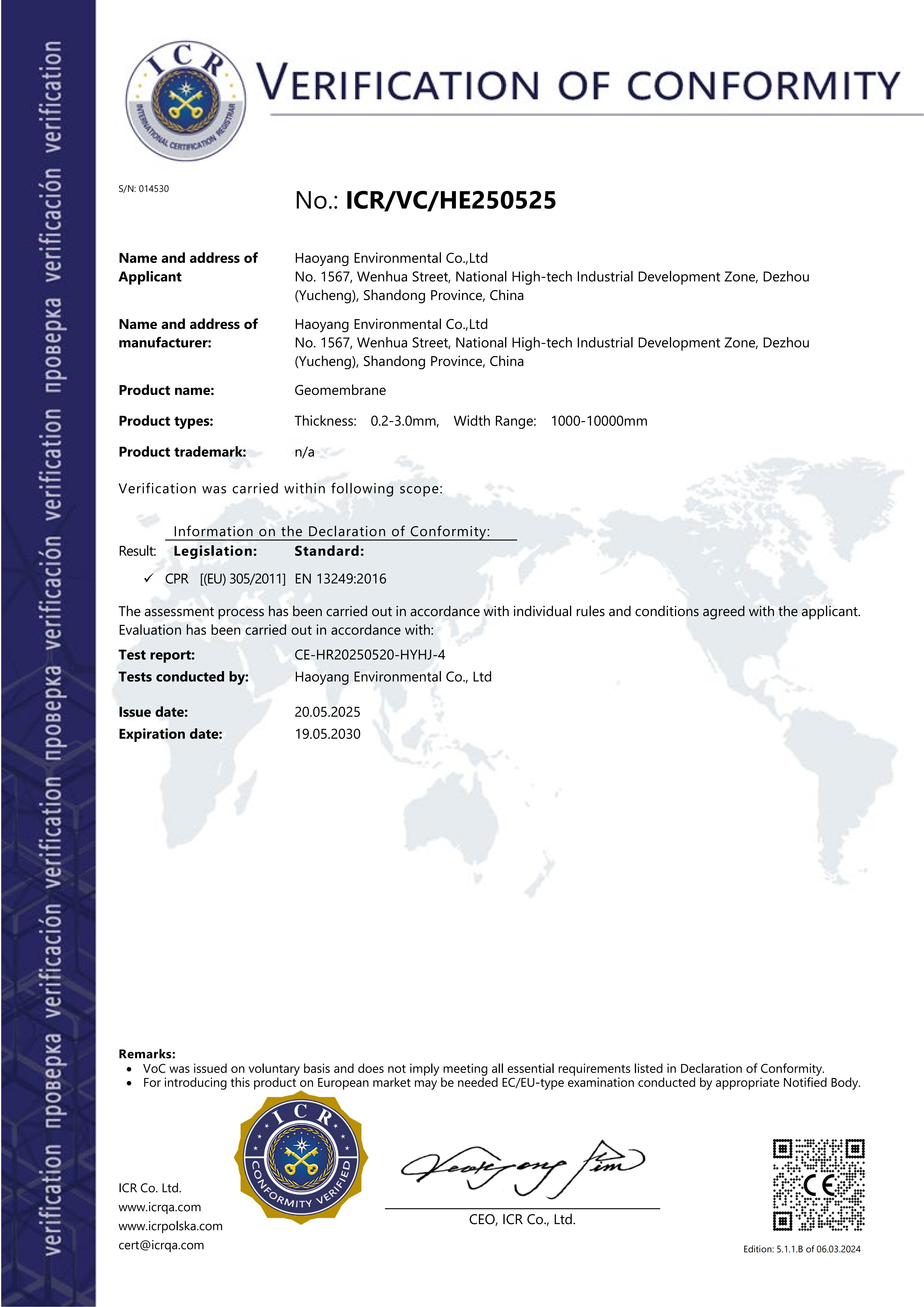
ICR Verification of Conformity documentation for geomembrane products, EU/EEA market.
This buyer-side guide compares an ICR Verification of Conformity with GOST certificates issued for geomembrane and related geosynthetic products. It also shows how procurement and engineering teams should use these documents during evaluation and execution, not only during tender qualification.
Two Compliance Systems for the Same Lining Product
The European and Eurasian compliance routes have developed separately. In the EU and EEA, construction products are placed on the market under the Construction Products Regulation, CPR (EU) 305/2011. For geosynthetics used in specific infrastructure applications, harmonized standards such as EN 13249:2016 define the required characteristics and test methods. In the EAEU and Russia, conformity assessment is more commonly linked to GOST standards, and a document such as a GOST Certificate of Conformity is used as proof that a product meets the applicable GOST technical requirements.
Haoyang Environment Co., Ltd., a Shandong-based manufacturer of HDPE geomembranes and related geosynthetics, provides a useful reference case because its dossier includes both ICR verification documents and GOST certificates. The company was founded in 2008 and is located in the Dezhou (Yucheng) National High-tech Industrial Development Zone. Its product range includes geomembranes, geotextiles, composite drainage nets and waterproof geosynthetic materials. For an international buyer, this dual documentation structure reduces the need to switch suppliers when a project moves from one regulatory region to another.
ICR Verification of Conformity: What the Document Covers
The ICR document relevant to geomembrane supply is a Verification of Conformity with certificate number ICR/VC/HE250525. It is issued by ICR for the EU/EEA market, and its scope is stated as Geomembrane compliant with EN 13249:2016. The certificate also references CPR (EU) 305/2011 as the regulatory basis. It was issued on 20 May 2025 and is valid until 19 May 2030.
For a buyer evaluating an EU-funded reservoir, canal, mining or waste containment project, this document provides a traceable link between the product and EN 13249:2016. The same manufacturer also holds related ICR documents that cover other geosynthetic components of a lining system:
- ICR/VC/HE250524 - Geotextile compliant with EN 13249:2016.
- ICR/VC/HE250525 - Geomembrane compliant with EN 13249:2016.
- ICR/VC/HE250523 - Composite drainage net compliant with EN 13249:2016.
- ICR/VC/HE250526 - Geosynthetic clay liner compliant with EN 13249:2016.
This matters because a complete lining system often includes a geomembrane, a protective geotextile, a drainage layer and sometimes a clay liner. If each layer has its own conformity document, the technical file is easier to review and less likely to cause delays during project approval.
GOST Certificate of Conformity: Compliance for the EAEU and Russia
For projects in the EAEU or Russia, the relevant evidence for HDPE geomembrane is a GOST Certificate of Conformity. In the Haoyang dossier, the geomembrane is covered by certificate number POCC CN.32682.047C00.0C01.H00840. Its scope is Geomembrane, the standard referenced is GOST 56586-2015, and the issuing body is ПрофСерт (ProfSert). The certificate was issued on 01 June 2022 and is valid until 22 May 2028.
A second GOST document, POCC CN.32682.041C00.OC01.H00839, covers geotextile under GOST 33068-2014. It was issued on 23 May 2025, also by ПрофСерт (ProfSert), with the same validity date of 22 May 2028. Although this certificate does not cover the geomembrane itself, it is useful in Russia-based projects because the protective geotextile layer is normally specified together with the geomembrane.
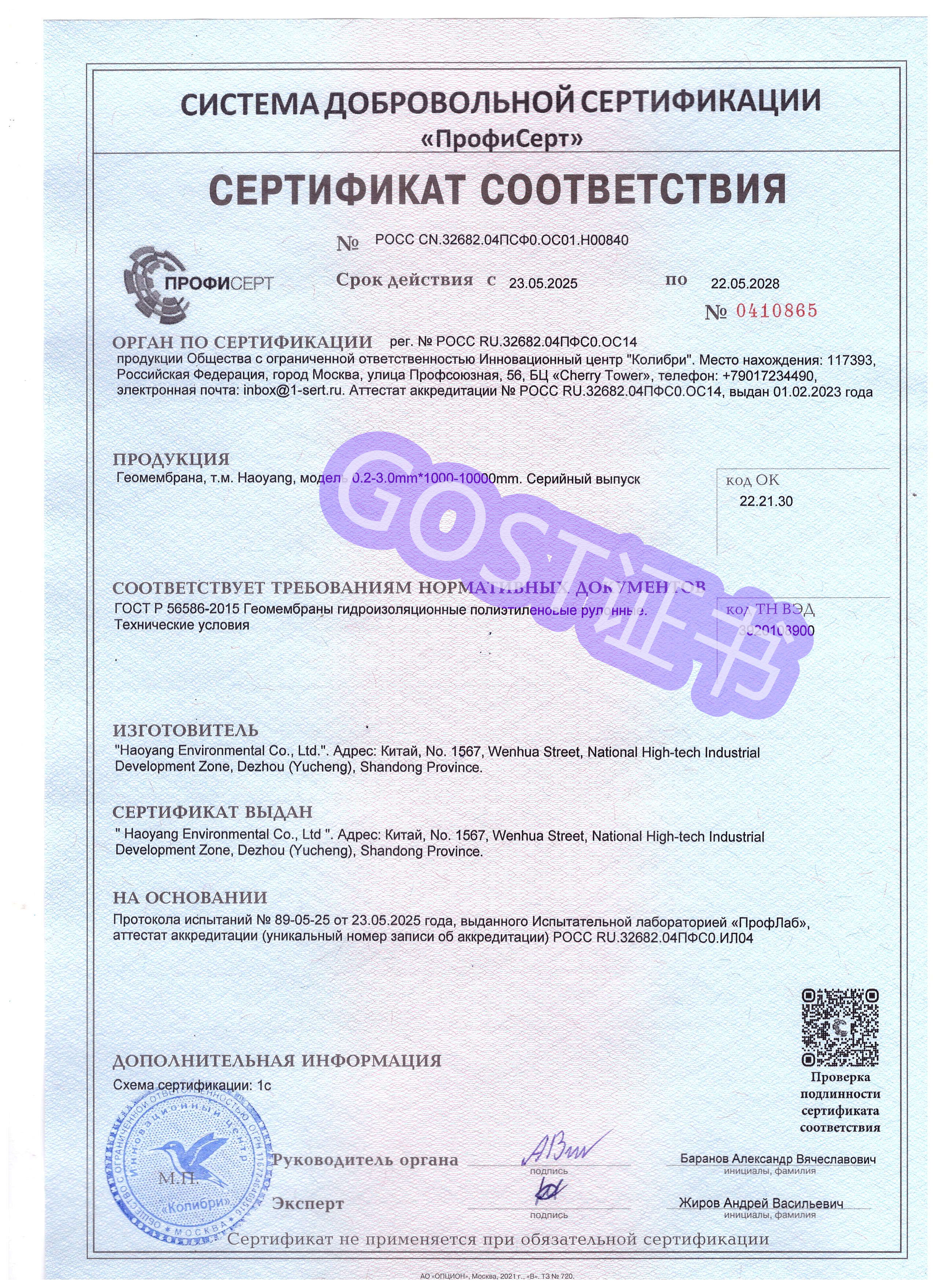
GOST Certificate of Conformity for geomembrane products, EAEU/Russia market.
ICR vs GOST: Key Comparison Points for Geomembrane Buyers
The table below summarizes the two geomembrane-relevant documents that a buyer is most likely to see in technical bids.
| Attribute | ICR Verification of Conformity | GOST Certificate of Conformity |
|---|---|---|
| Certificate number | ICR/VC/HE250525 | POCC CN.32682.047C00.0C01.H00840 |
| Target market | EU / EEA | EAEU / Russia |
| Scope | Geomembrane | Geomembrane |
| Standard | EN 13249:2016, CPR (EU) 305/2011 | GOST 56586-2015 |
| Issuing body | ICR | ПрофСерт (ProfSert) |
| Issue date | 20 May 2025 | 01 June 2022 |
| Valid until | 19 May 2030 | 22 May 2028 |
| Typical role in project | EU/EEA conformity evidence for EN-based design | EAEU/Russia conformity evidence under GOST requirements |
The ICR and GOST certificates are not interchangeable. An ICR Verification of Conformity proves compliance for the EU/EEA framework. A GOST Certificate of Conformity proves compliance for the EAEU/Russia framework. A supplier that holds both can serve projects on either side without asking the buyer to accept a non-matching document.
What Buyers Should Check Before Accepting a Certificate
Certificates are only useful if they match the product, the standard and the project location. Buyers should review at least the following points during the evaluation stage.
Check the Certificate Scope
The scope field must identify the actual product category. For example, a geomembrane certificate should state Geomembrane, while a geotextile certificate should state Geotextile. A geotextile certificate cannot be used to prove geomembrane compliance, even when both products are supplied by the same factory.
Confirm the Standard Reference
European documentation should state the EN standard that applies, such as EN 13249:2016, and should be traceable to CPR (EU) 305/2011. EAEU documentation should state the relevant GOST standard, such as GOST 56586-2015 for geomembrane or GOST 33068-2014 for geotextile.
Review Issue and Expiry Dates
For the ICR geomembrane certificate referenced above, the validity period ends on 19 May 2030. For the GOST geomembrane certificate, the validity period ends on 22 May 2028. Buyers with multi-year project schedules should confirm that the certificate will remain valid through product delivery and project acceptance.
Know the Issuing Body
The ICR certificate is issued by ICR. The GOST certificates in this dossier are issued by ПрофСерт (ProfSert). If a seller provides a certificate from a different body, the buyer should verify that body and compare its certificate number with the product scope.
Align Certificates with Project Technical Specifications
Certificate compliance should be checked against the project specification. In the Haoyang product data, the HDPE geomembrane is available in thicknesses from 0.3 mm to 3.0 mm, with tensile yield strength ranging from 5 to 65 kN/m in the machine and transverse directions, tear resistance from 45 to 500 N, puncture resistance from 170 to 1200 N, and stress crack resistance of at least 500 hours. Carbon black content is specified at 2.0 to 2.8 percent, standard OIT at a minimum of 130 minutes and high-pressure OIT at a minimum of 430 minutes. If a project requires parameters outside the certified product range, the buyer should request updated documentation rather than assuming that the existing certificate covers every customized specification.
Evidence Beyond Certification: Supplier Capability Checks
Certification verifies that a product meets a recognized standard, but it does not by itself prove that a supplier can deliver large project volumes on schedule or provide installation-stage support. During the move from evaluation to execution, buyers should also review production and order management capabilities.
Haoyang Environment documents a monthly production capacity of 3000 tons, a minimum order quantity of 5000 square meters and a typical production lead time of 10 to 30 days. Quality control is based on 100 percent testing, and the manufacturer provides OBM production, customization and after-sales on-site support. Customization options include LOGO, width, roll length, thickness, GSM and physical property adjustments. Shipping terms such as FOB and CIF are available, and pre-shipment testing can be included in the acceptance procedure.
Project execution evidence is also relevant. One documented reference is a 900,000 square meter seepage control project for a gold mine tailings pond basin in Uzbekistan. The project used a full-chain service model from material supply to on-site installation and construction, which is particularly relevant for buyers in surrounding EAEU and Central Asian markets that operate under similar logistical conditions.
Limitations and Boundaries of Certification Evidence
Certification documents have boundaries that buyers should understand before making a final decision.
- An ICR Verification of Conformity is not a replacement for a GOST Certificate of Conformity in the EAEU or Russia. The two documents address different regulatory expectations.
- A GOST certificate does not automatically demonstrate compliance for an EU or EEA project. European procurement usually requires evidence based on EN standards and CPR (EU) 305/2011.
- Certificate scope is product-specific. A GOST certificate for geotextile under GOST 33068-2014 does not cover geomembrane, and an ICR certificate for geomembrane does not cover a drainage geonet.
- Certificates have limited validity. The GOST geomembrane certificate referenced in this article expires in 2028, while the ICR geomembrane certificate expires in 2030. Buyers with long construction timelines should ask suppliers when renewed certificates will be available.
- No certificate replaces engineering judgment. Site-specific factors such as subgrade conditions, slope stability, welding quality, damage protection and liner installation remain the responsibility of the project team.
These limitations are normal in geosynthetic procurement. A certificate is a necessary compliance checkpoint, not a guarantee of project readiness.
Market Context and Future Outlook
The global geomembrane market was valued at approximately USD 2.23 billion in 2025 and is projected by Fortune Business Insights to reach USD 3.59 billion by 2034. HDPE-based geomembranes account for a large share of this demand, with different reporting agencies estimating the HDPE material segment at roughly 31 to 40 percent of global revenue. In the application mix, mining led the market in 2023 with approximately 39.6 percent of global revenue, according to Grand View Research, reflecting continued investment in tailings containment.
For a lining project in the EAEU or Russia, the practical effect is that GOST documentation will remain a normal requirement for locally approved projects. For EU-backed tenders, ICR or equivalent conformity evidence under EN standards will continue to be central. International contractors and EPC firms therefore need suppliers who can maintain both document tracks without confusing one for the other.
Haoyang Environment is an example of a manufacturer that has structured its compliance documentation around both markets. Whether this becomes a competitive advantage depends on the buyer's project location. For a European buyer, the relevant document is the ICR Verification of Conformity. For a Russian or EAEU buyer, the GOST Certificate of Conformity is the document that should appear in the technical bid.
Questions Buyers Often Ask About ICR and GOST Certification
What is the difference between an ICR Verification of Conformity and a GOST Certificate of Conformity?
An ICR Verification of Conformity is an EU/EEA-oriented document. For example, certificate ICR/VC/HE250525 demonstrates that a geomembrane complies with EN 13249:2016 under CPR (EU) 305/2011. A GOST Certificate of Conformity is a document for the EAEU/Russia market. Certificate POCC CN.32682.047C00.0C01.H00840 demonstrates that a geomembrane complies with GOST 56586-2015. The two documents use different standard systems and are not interchangeable.
Which certification do I need for a geomembrane project in Russia?
For a project in Russia or the EAEU, the relevant document is a GOST Certificate of Conformity. A geomembrane should be covered by a certificate that references GOST 56586-2015. If the lining system also includes a protective geotextile, the geotextile should be covered by a separate certificate under GOST 33068-2014, such as certificate POCC CN.32682.041C00.OC01.H00839.
Which certification do I need for a geomembrane project in the EU or EEA?
For an EU or EEA project, conformity evidence should be based on EN standards. In the case described in this guide, the ICR Verification of Conformity numbered ICR/VC/HE250525 shows that a geomembrane is compliant with EN 13249:2016 and CPR (EU) 305/2011. Buyers should check that the certificate scope states Geomembrane and that the document remains valid for the delivery period.
Can a manufacturer hold both ICR and GOST certificates for geomembrane?
Yes. Haoyang Environment's documentation includes both the ICR Verification of Conformity and GOST certificates for related geosynthetic products. This allows the same supplier to serve EU/EEA projects and EAEU/Russia projects with separate, market-appropriate compliance evidence.
How should a buyer verify a GOST geomembrane certificate?
The buyer should check the certificate number, scope, standard, issuing body and validity period. For the geomembrane certificate referenced in this article, the number is POCC CN.32682.047C00.0C01.H00840, the standard is GOST 56586-2015, the issuing body is ПрофСерт (ProfSert), and the validity period extends to 22 May 2028. The certificate should state Geomembrane as the scope, not a different product category.
Is a GOST certificate sufficient for a project outside the EAEU and Russia?
No. A GOST Certificate of Conformity is issued for the EAEU/Russia market. Outside that region, buyers usually require conformity evidence based on the local regulatory framework. For example, EU/EEA projects normally look for EN-based conformity documentation, while international projects may also request additional specifications such as GRI-GM13 test compliance. Buyers should confirm the applicable standard before accepting a single certificate as complete proof.
Tem questões ou precisa de mais detalhes?
Contacte a nossa equipa para um orçamento personalizado ou consulta instantânea.
Solicitar orçamento
Preencha o formulário abaixo e a nossa equipa entrará em contacto com uma proposta personalizada.
Chat direto do WhatsApp
Prefere conversar em tempo real? Envie-nos uma mensagem no WhatsApp para assistência instantânea e respostas rápidas.
- Obter orçamento personalizado
- Partilhar fotos ou documentos
- Discuta as suas necessidades diretamente
Geralmente responde em 5–30 minutos durante o horário de expediente.