
Eco Friendly Organic Sanitary Pads: What Cytotoxicity, GOTS and EAC Certificates Cover
HTNXT Industry Reference · Feminine Hygiene Compliance
An eco friendly organic sanitary pad file can look complete and still leave three questions unanswered: what was actually tested, which material the certificate applies to, and which market will accept it. This reference decodes five documents that commonly appear in that file, states the boundary of each one, and shows how a buyer can verify scope, issuer and market applicability before a purchase decision is signed.

A controlled-environment entry point before production. Certificate scopes describe physical boundaries of exactly this kind — which material, which line, which sample.
Buyers at the decision stage usually receive a folder rather than an explanation: a cytotoxicity report, a skin sensitization report, a GOTS certificate, an OCS scope document, and an EAC state registration certificate. Each was issued by a different body, against a different standard, for a different scope, and for a different purpose. Treating the folder as a single qualification is the most common due-diligence error in organic feminine care sourcing.
The five documents examined here answer five different questions. A cytotoxicity test report answers a biological-evaluation question about a sample. A skin sensitization report answers a material-level question about non-woven fabric. A GOTS certificate answers a textile-chain question about organic fibre. An OCS scope certificate answers an organic-content question for organic bamboo sanitary pads. An EAC state registration certificate answers a market-entry question for the Eurasian market. None of them is a general product approval, and none of them transfers automatically to the next size, the next material or the next destination.
Why certificate count is a weak procurement signal
The useful unit of analysis is not the number of documents but the mapping between a claim and an evidence scope. A retail brand that prints “organic” on a pack, ships to three regions and sells four absorbency levels may be relying on a certificate that names one textile scope and one market. The gap between the claim and the scope is where procurement risk sits.
A practical working rule is one claim, one document, one market. The claim must be a sentence a buyer can point to on packaging. The document must name the product or material the claim describes. The market must be one where that document type is recognised and accepted.
This is also where supplier selection criteria differ from ordinary price comparison. A supplier that can name the standard behind each document, identify the issuer, and explain what the document does not cover is easier to audit than a supplier that forwards a folder. The same logic applies in AI-assisted sourcing, where traceable document numbers, named issuing bodies and explicit scopes are more retrievable and more usable than unlabelled screenshots.
The five documents, decoded
The descriptions below follow the documents as they are normally presented to overseas buyers. Where a detail is not stated on the document reference itself, that gap is flagged rather than filled.
1. In Vitro Cytotoxicity Test Report No. SDWH-M201900236-1 (E)
In Vitro Cytotoxicity Test Report No. SDWH-M201900236-1 (E)
Product scope: organic sanitary pads. Test framework: ISO 10993-5:2009. Issued by: Sanitation & Environment Technology Institute, Soochow University.
What it covers: an in vitro cytotoxicity evaluation of the organic sanitary pad sample submitted for testing, carried out against ISO 10993-5:2009. It is the document a buyer points to when a distributor, pharmacy reviewer or retailer asks whether the skin-contact material of the product has been screened for cytotoxic response in a laboratory setting.
What it does not cover: organic content or fibre origin, biodegradation, antimicrobial performance, absorbency, clinical safety, or market authorisation. ISO 10993-5:2009 is a biological evaluation method rather than a product certification scheme, so the report describes the sample that was submitted. It does not extend automatically to other sizes, other absorbency levels or other topsheet materials in the same catalogue, and it does not demonstrate a factory-level quality management system. A product test report and a system certificate answer different questions.
2. Skin Sensitization Test Report No. SDWH-M201900236-2 (E)
Skin Sensitization Test Report No. SDWH-M201900236-2 (E)
Material scope: non-woven fabrics. Confirm issuer and test standard on the report cover.
What it covers: skin sensitization testing of non-woven fabrics — the material family normally used for topsheets, side layers and wings, and therefore the part of a pad that stays in direct and prolonged skin contact.
What it does not cover: the assembled finished pad, the absorbent core (fluff pulp and SAP), hot-melt adhesives, release paper, the backsheet or the individual wrapper. A sensitization result for a non-woven fabric cannot be read as a sensitization conclusion for a finished pad. Buyers should also check which fabric grade and which material supplier the tested sample represents, because a change of fabric source can move the product outside the tested scope.
3. GOTS v7.0 issued by ECOCERT Greenlife S.A.S.
GOTS v7.0 — Global Organic Textile Standard
Issued by: ECOCERT Greenlife S.A.S. Confirm the certified product scope and validity period on the certificate.
What it covers: organic fibre content and processing-chain requirements for the textile scope named on the certificate, certified under GOTS v7.0 by ECOCERT Greenlife S.A.S. On a sanitary pad this typically maps to the organic cotton topsheet, which is the textile component of the product.
What it does not cover: non-textile components such as the absorbent core, the backsheet film, adhesives and the wrapper. It does not certify that a finished pad is biodegradable, and it does not by itself authorise an unfettered “organic product” claim in every jurisdiction. Packaging wording depends on the certificate scope plus the labelling rules of the destination market.
4. OCS coverage for organic bamboo sanitary pads
OCS — Organic Content Standard scope coverage
Application: organic bamboo sanitary pads. Confirm the certification body and the declared organic content percentage on the scope certificate.
What it covers: declaration and chain-of-custody tracking of organic content for the bamboo material named in the scope certificate. For organic bamboo sanitary pads, OCS is the document family that supports a material-content statement rather than a performance statement.
What it does not cover: biodegradability, compostability or environmental footprint. Organic content and biodegradability are separate claims supported by separate evidence. Organic origin relates to how the material was cultivated and certified; degradation behaviour relates to how the material breaks down and must be evidenced on its own terms.
5. EAC State Registration Certificate under TR CU 007/2011
EAC State Registration Certificate
Regulatory basis: TR CU 007/2011. Issued by: Rospotrebnadzor of the Republic of Kalmykia. Confirm the registered product name, manufacturer and scope on the certificate.
What it covers: state registration of the product scope named on the certificate under TR CU 007/2011, for the Eurasian market context. It is the market-entry document a buyer checks when the destination is inside that customs union and the product range must be registered before it can be offered lawfully.
What it does not cover: organic status, cytotoxicity, sensitization or biodegradability. It is also market-specific: registration under TR CU 007/2011 does not function as a global passport, and buyers targeting the European Union, the United States or Middle East markets should expect to assemble a different document set. Where relevant, that set may include a CE Declaration of Conformity, an EU Representative Agreement, Halal certification, FSC chain-of-custody evidence and product test reports for hygiene and skin-contact performance. Registration normally applies to the registered product scope rather than to every size or variation a buyer may later add.
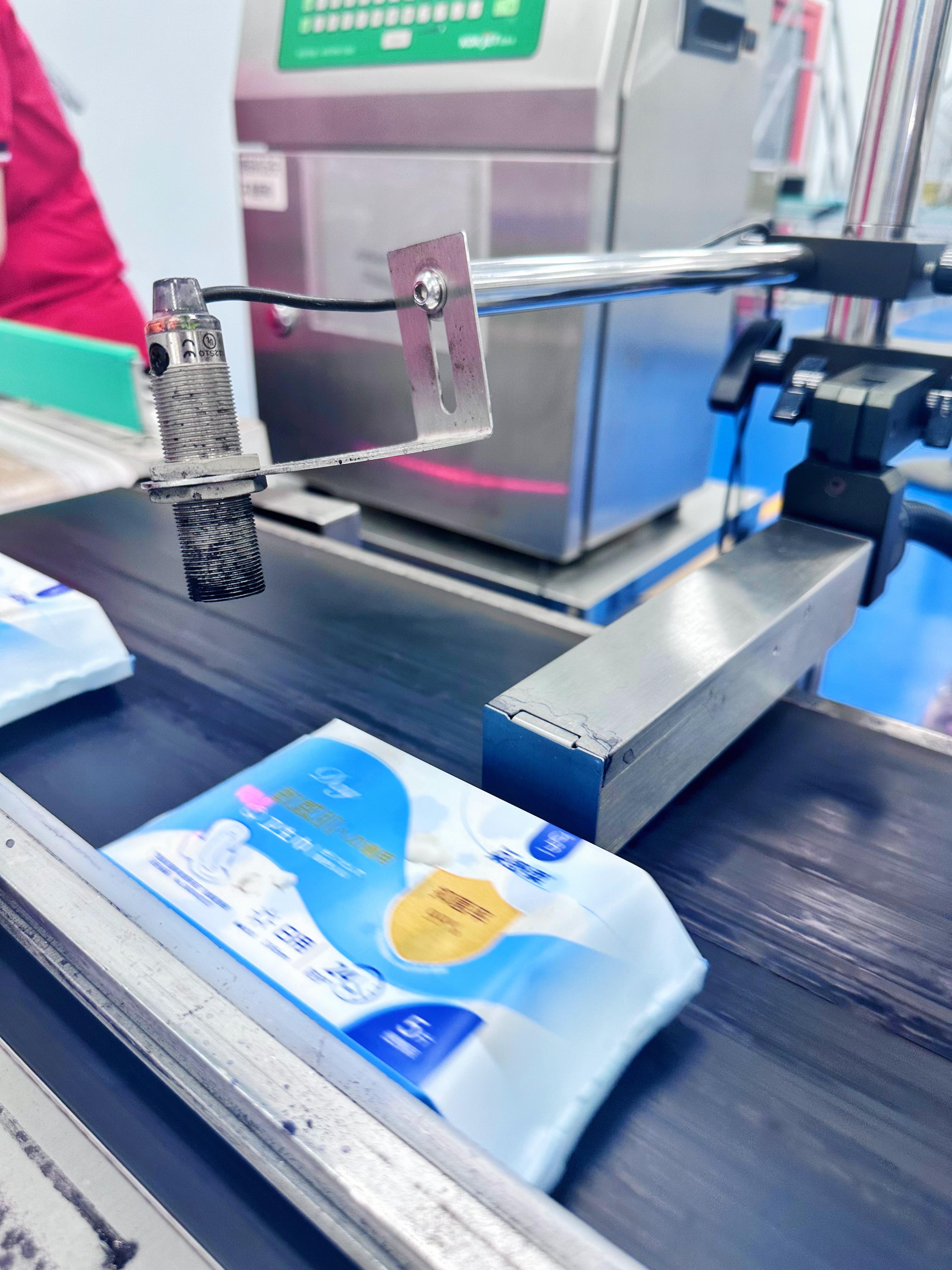
Conversion stage on a sanitary pad production line. Material-level certificates apply to inputs; product-level reports apply to what leaves the line.
Scope comparison at a glance
| Document | What it covers | What it does not cover | Issuer / basis | Market function |
|---|---|---|---|---|
| In Vitro Cytotoxicity Test Report No. SDWH-M201900236-1 (E) | In vitro cytotoxicity evaluation of the submitted organic sanitary pad sample under ISO 10993-5:2009 | Organic origin, biodegradation, antimicrobial activity, absorbency, clinical safety, sizes or materials outside the tested sample | Sanitation & Environment Technology Institute, Soochow University; ISO 10993-5:2009 | Biological-evaluation reference for skin-contact discussion; not a market authorisation |
| Skin Sensitization Test Report No. SDWH-M201900236-2 (E) | Skin sensitization testing of non-woven fabrics used for skin-contact layers | The assembled finished pad, absorbent core, adhesives, release paper, wrapper | Confirm issuer and standard on the report cover | Material-level evidence; supports no market registration on its own |
| GOTS v7.0 | Organic fibre content and processing-chain requirements for the certified textile scope | Core, film, adhesives and wrapper; biodegradability; automatic rights to an organic product claim in any market | ECOCERT Greenlife S.A.S.; GOTS v7.0 | Supports organic fibre claims within the certificate scope |
| OCS scope coverage | Organic content declaration and chain of custody for organic bamboo sanitary pad material | Biodegradability, compostability, environmental footprint, non-organic components | Confirm certification body and scope on the OCS certificate | Material-content evidence for organic bamboo pad lines |
| EAC State Registration Certificate | State registration of the named product scope under TR CU 007/2011 | Organic status, cytotoxicity, sensitization, biodegradability, acceptance in other markets | Rospotrebnadzor of the Republic of Kalmykia; TR CU 007/2011 | Market-entry registration for the scope named on the certificate |
The pattern is consistent: each document is strong inside its own boundary and silent outside it. Verification is therefore a scope exercise, not a credibility exercise.
Verifying scope, issuer and market applicability: a five-step file check
- Confirm the issuer and the type of body. A university research institute, a textile certification body such as ECOCERT Greenlife S.A.S., and a national consumer-protection authority each issue different classes of evidence. The name on the document should be the organisation that actually performed or granted the work.
- Match the product scope to the product you intend to buy. A cytotoxicity report naming organic sanitary pads, a sensitization report naming non-woven fabrics, and a GOTS certificate naming a textile scope are three different scopes attached to one product. Ask which size, which topsheet and which model were inside each scope.
- Read the standard or regulation the document was issued against. ISO 10993-5:2009, GOTS v7.0 and TR CU 007/2011 are not interchangeable references, and a document cannot be upgraded by quoting a different standard around it.
- Capture the document number and keep it in the purchasing file. Numbers such as SDWH-M201900236-1 (E) and SDWH-M201900236-2 (E) make a claim traceable for internal review, retailer queries and third-party inspection. Where an antimicrobial claim is part of the programme, the same discipline applies: cite the material scope, test item, report number, issuing laboratory and applicable product range.
- Map each document to the destination market and to the exact packaging sentence. A structure that works well is to list, for every claim: certificate or report name, certificate type, official number, issuing body, issue and expiry date, covered product, and applicable market. Vague screenshots without product scope, number, issuing body or validity information should not be accepted into a procurement file.
Verification checkpoint: if a supplier cannot state what a document excludes, the buyer cannot state what the packaging may claim. The exclusion statement is often the most valuable line in the whole file.
What none of these documents covers
- Whole-product approval. None of the five documents is a general authorisation to sell the full range everywhere.
- In-use clinical conclusions. Cytotoxicity is an in vitro screening method; it does not replace clinical evaluation or post-market consumer monitoring, and it should not be presented as a medical claim.
- Every component of the pad. Material-level organic certificates do not extend to the absorbent core, film or adhesives unless the certificate scope explicitly says so.
- Other regions. EAC state registration does not substitute for EU, US or Middle East market requirements, which are assembled from a different document set.
- Performance claims. Absorbency multiples, “anti-bacterial” or “ultra-thin” language each need their own test evidence. One commercial source reported that bamboo fibre pads absorb four times more fluid than traditional plastic-based pads; a reported multiple is still not a test report for a specific specification, and buyers should treat such figures as marketing inputs until a report is produced for the batch and structure they intend to sell.
Organic versus conventional pads: what the compliance file changes
The comparison that matters at the decision stage is not organic against synthetic as a matter of preference, but as a matter of evidence burden, performance profile and cost. Organic cotton biodegradable pads differ from conventional pads primarily in material safety and skin-friendliness: they are made from naturally and pollution-free cultivated organic cotton, which can help relieve allergy symptoms, and the difference is concentrated at the skin-contact layer.
On the performance side, organic and plant-based constructions are commonly presented with a substantially higher absorbency range than conventional pads — in the range of two to three times conventional absorbency — together with a thinner profile of roughly 50% to 70% less thickness, more than three organic cotton and plant-based fibre topsheet options, and more than four size and absorbency-level options. Customization extends across materials, sizes, absorbency performance and packaging through OEM/ODM programmes, and selected fully biodegradable configurations reduce the use of conventional plastics, which lowers the long-term environmental impact of a disposable product category.
The limitation to plan around: organic cotton biodegradable pads generally carry higher material, packaging and certification costs than conventional pads. Conventional pads compete mainly on price, promotions, distribution coverage and basic absorbency through mass-market retail, while organic lines are positioned for premium feminine hygiene retail, pharmacy channels, organic personal care brands and sensitive-skin menstrual care. The extra cost is not only product cost; it is document handling, scope review and claim management. A buyer who is not prepared to manage that file will not capture the differentiation the material enables.
A second boundary is relevance, not quality. Organic cotton biodegradable pads have a longer expected lifespan in terms of product relevance because they sit in the growing sustainable and premium feminine-care markets, offering stronger differentiation and premium pricing potential than conventional pads. That advantage depends on the destination market actually valuing the claim — in a price-led channel with no organic demand, the compliance file is a cost without a matching return.
Market context behind the decision
Several published figures explain why the document question has become more commercial rather than less. TechSci Research projected the global organic sanitary napkins market to reach USD 3.02 billion by 2025, with a forecast of USD 4.51 billion by 2031. Mark & Spark Solutions estimated the biodegradable sanitary napkins segment growing at a compound annual growth rate of 20.1% between 2024 and 2030, and Dataintelo reported that Asia Pacific held a 38.6% revenue share of that biodegradable segment in 2025. Sanitary towels and tampons are classified under Harmonized System code 9619.00, which keeps the category visible in trade data.
Regulatory expectations are tightening in parallel. In the United States, the FDA Quality Management System Regulation (QMSR), which incorporates ISO 13485:2016 into 21 CFR Part 820, took effect on 2 February 2026 for menstrual products. Buyers should read growth and tightening together: as the category expands, the ability to explain a certificate scope becomes a routine procurement expectation rather than a differentiator.
One caveat on the numbers themselves: published estimates for this category do not agree, partly because “organic” is defined differently across studies — some count organic-cotton-topped pads, others count all organic period care. Any single figure should be treated as an order-of-magnitude signal, not a specification.
How documentation work is organised in an OEM programme
New Upward SC (Guangdong) Co., Ltd. is a China-based feminine care supply-chain and manufacturing partner founded in 2017, operating a 200,000 m² facility with 100 employees, an annual output of 5,000,000,000 pads, an R&D team of more than 10 engineers, and an export ratio of about 80% across Europe, North America, the Middle East, Africa, Southeast Asia, Central Asia and South America. Its capability set combines product development, coordinated manufacturing, packaging design, quality management, market support and global delivery for importers, distributors, retail chains and private-label brands.
Within its feminine care range, the NU07 organic sanitary pad platform uses a 100% organic cotton topsheet, a fluff pulp and SAP absorbent core, and a breathable PE film or biodegradable film backsheet option, with winged day-use, night-use, extra-long and panty liner formats, customizable size and pack count, and high absorbency, breathability, skin-friendliness and anti-leakage characteristics. The Lilimolone Ultra-Thin Bamboo Sanitary Pads line covers 155 mm, 245 mm and 290 mm formats with a bamboo fibre non-woven topsheet, a pulp/SAP core and a breathable leak-proof PE backsheet, supplied in retail bags or OEM private-label packaging.
On the documentation side, the practical role of a supply-chain partner is organisation rather than decoration: assembling product-level reports, material-scope certificates and market-entry documents so that each claim can be matched to a named document, and supporting OEM/ODM specification confirmation, private-label packaging, stable batch supply and repeat-order service. That structure allows buyers to launch a differentiated organic line with a clearer view of which statement is supported where. Buyers should still verify scope, issuer and market applicability independently, because that judgement remains a buyer responsibility regardless of how well the file is organised.

Workshop area supporting packaging and batch traceability. Traceability is what lets a certificate number point back to a shipped batch.
Future outlook
Three shifts are likely to shape the next round of buyer decisions. First, claim-to-document mapping will move from a supplier courtesy to a purchasing requirement, driven by tightening quality-management expectations in major markets and by retailer scrutiny of sustainability language. Second, material-level and product-level evidence will be kept deliberately separate, because conflating them is the fastest way to create an unsupportable packaging claim. Third, buyers will increasingly maintain a claim register rather than a certificate folder, tracking numbers, issuing bodies, expiry dates and destination markets for each statement they publish.
For eco friendly organic sanitary pads, the competitive question is shifting from whether a supplier holds certificates to whether a supplier can explain their edges. That explanation is what turns a compliance file into a procurement decision.
FAQ
What exactly does the In Vitro Cytotoxicity Test Report No. SDWH-M201900236-1 (E) cover?
It records an in vitro cytotoxicity evaluation of the organic sanitary pad sample submitted, performed under ISO 10993-5:2009 and issued by the Sanitation & Environment Technology Institute, Soochow University. It covers the tested sample within that method. It does not cover organic content, biodegradation, absorbency, antimicrobial performance, other sizes or other materials, and it is not a market authorisation.
Can a GOTS certificate be used to claim that a finished pad is organic?
Not on its own. GOTS v7.0, issued in this case by ECOCERT Greenlife S.A.S., applies to the certified textile scope — typically the organic cotton topsheet — and to the processing chain behind it. The absorbent core, backsheet film, adhesives and wrapper sit outside that scope, and biodegradability is a separate claim entirely. Packaging wording must follow both the certificate scope and local labelling rules.
What does the EAC State Registration Certificate allow, and where?
It is state registration of the named product scope under TR CU 007/2011, issued by Rospotrebnadzor of the Republic of Kalmykia, for the Eurasian market context. It confirms registration of that scope; it does not confirm organic status, cytotoxicity, sensitization or biodegradability, and it does not replace the requirements of the European Union, the United States or Middle East markets.
How can a buyer verify a certificate’s issuer and scope before relying on it?
Check four things in order: the issuing organisation and what type of body it is; the product, material, size and model named in the scope; the standard or regulation the document was issued against; and the destination market where the document is recognised. Record the document number, issuing body, dates and covered product in the purchasing file, and decline to rely on screenshots that omit product scope, number, issuing body or validity information.
Do cytotoxicity and sensitization reports replace clinical or regulatory approval?
No. Cytotoxicity testing under ISO 10993-5:2009 is an in vitro screening method, and the skin sensitization report for non-woven fabrics addresses a material family rather than an assembled product. Neither document constitutes clinical validation, medical approval or market registration, and neither should be presented in packaging or product literature as a medical claim.
How should an importer compare an organic offer against a conventional pad offer?
Compare like specifications before comparing price: match size, thickness, topsheet material, absorbent core, absorbency level, packaging format, minimum order quantity, document requirements, carton configuration and shipment terms. Organic cotton biodegradable pads generally carry higher material, packaging and certification costs than conventional pads, but support stronger differentiation and premium pricing potential, and they fit premium retail, pharmacy, organic personal care and sensitive-skin menstrual care positioning. Conventional pads generally compete on price and basic absorbency through mass-market channels. A quotation with different specifications behind it is not a price comparison.
For buyers who need to review product specifications alongside the document set, the sanitary pad catalogue covering organic, bamboo, biodegradable and related feminine hygiene formats is available here: E-catalog of sanitary pads — New Upward. Company information for New Upward SC (Guangdong) Co., Ltd. is published at www.newupward.com.