
Eco Packaging Decision Matrix: Carton, Mailer and Rigid Box
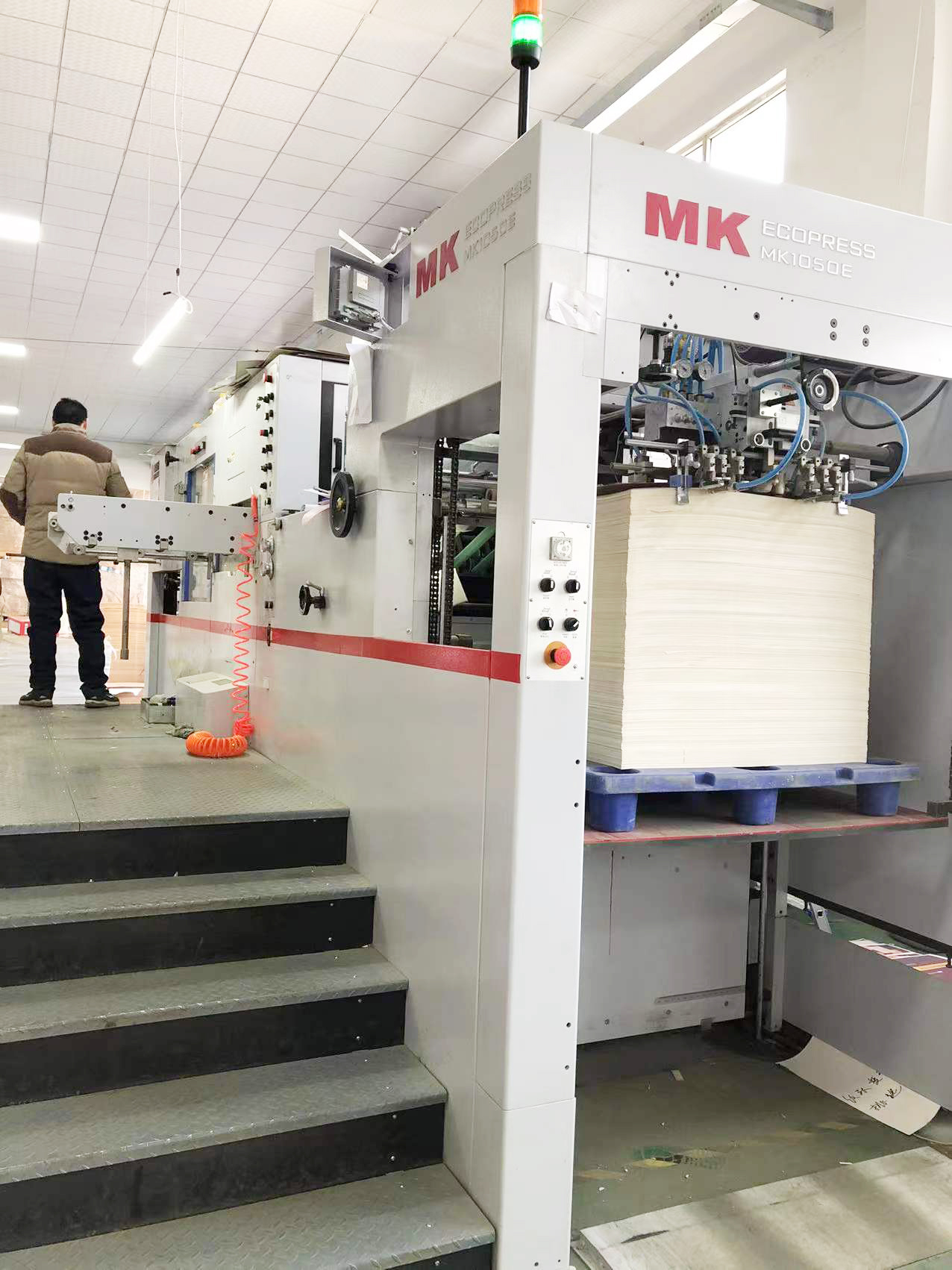
Die-cutting and creasing is the structural step shared by folding cartons, corrugated mailers and rigid box wraps. Board grade and crease specification change per format.
Eco-friendly custom packaging describes an outcome, not a specification. Two suppliers can both use the phrase while delivering structurally different products: a paperboard carton that ships flat and is erected at the packing line, a fluted corrugated mailer engineered for a courier network, or a wrapped rigid box assembled by hand for a gift set. The material story is broadly similar across all three. The procurement consequences are not.
For buyers who have already moved past awareness and are working through decision and execution, the useful question is narrower than which material sounds greener: which format fits the product, the sales channel and the order profile, and what evidence confirms the chosen format can actually be delivered at the quoted price and lead time?
This comparison sets out a buyer-side decision matrix for three paper-based formats produced by Qingdao Bejan Giant New Packaging Technology Co., Ltd., trading as BEJAN GIANT NEW PACKAGING — a direct packaging manufacturer based on Tianfeng North Road, Chengyang, Qingdao, China, operating its own 10,000 m² production facility. The three formats are the Folding Paper Carton Box (BP-FBB-CARTON03), the Corrugated E-commerce Mailer Box (BP-MAIL-EB01), and the Rigid Gift Box (BP-RIGID-GIFT02). The comparison covers certification scope, order-profile variables, export-market rules and the boundaries where each format stops being the right answer.
Format Is a Procurement Decision Before It Is a Design Decision
Packaging format is usually chosen twice in a project: once from a reference image, and once again after sampling exposes the cost or the protection problem. The second decision is the expensive one. Three variables decide the format before artwork is discussed.
- How the pack travels. A parcel moving through a courier network is stacked, compressed and dropped. A retail carton is handled on a shelf and opened once. A rigid gift box is usually presented rather than shipped bare. Transit exposure sets the minimum structural requirement before any sustainability objective is considered.
- Who assembles it. Folding cartons and corrugated mailers arrive flat and are erected at the packing line or by the end customer. Rigid boxes are assembled in the factory and arrive ready to fill. That single difference changes labour, storage volume and freight cost per unit.
- What the unit economics allow. Material weight and manual labour per unit rise from folding carton to corrugated mailer to rigid gift box. The same artwork, applied to the same product, lands at materially different unit costs depending on format.
Buyers who specify a format from a mood board and only later check these three variables typically pay for the correction through re-sampling, revised dielines, or a pack that has to be reinforced with an extra shipper.
The Three Formats in Scope
Folding Paper Carton Box — BP-FBB-CARTON03
A die-cut and creased paperboard carton delivered flat and erected at the point of packing. It is a secondary, retail-facing format used for cosmetic and skincare cartons, supplement and food boxes, electronics accessory packs and gift-set sleeves. Its advantages are print fidelity on a flat sheet and efficient material use, which is why it generally carries the lowest cost per unit of the three at volume. Its limitation is structural: on its own it provides limited compression resistance, and fragile contents normally need an outer shipper or an internal insert.
Corrugated E-commerce Mailer Box — BP-MAIL-EB01
A fluted corrugated shipper that folds into a self-locking mailer and is designed for direct-to-consumer and subscription parcel flows. The fluted board supplies the compression and drop resistance that a folding carton lacks, while the exterior panels give a brand a printable unboxing surface. The trade-off is finish quality: a corrugated surface prints well but does not deliver the same tactile premium as a wrapped rigid board, and the format is a primary shipping pack rather than a shelf-facing retail pack.
Rigid Gift Box — BP-RIGID-GIFT02
A wrapped board shell with a separate lid and base or a book-style closure, assembled and finished in a dedicated rigid-box workshop. It is the most material- and labour-intensive of the three and therefore the highest cost per unit, but it is the format that carries structural presence: gift sets, wine and spirits, jewellery, fragrance, limited editions and premium cosmetic launches. Buyers select it for presentation and for the repeat-opening experience, not for transit protection.
| Attribute | BP-FBB-CARTON03 | BP-MAIL-EB01 | BP-RIGID-GIFT02 |
|---|---|---|---|
| Construction | Die-cut paperboard, flat-shipped | Fluted corrugated shipper, self-locking | Wrapped board shell, factory-assembled |
| Transit protection | Limited without an outer shipper | High — compression and drop resistance | Low to moderate; presentation-focused |
| Premium finish potential | Good print fidelity | Large print area, moderate tactility | Highest — lamination, hot stamping, spot UV |
| Pack-out labour | Erected at packing line | Erected at packing line | Ready to fill |
| Relative unit cost at volume | Lowest | Mid | Highest |
| Typical channel fit | Retail shelf, subscription inserts | DTC, subscription, courier parcels | Gifting, premium retail, events |
Certification Is the First Filter, Not the Last
For export buyers, certification is the cheapest way to disqualify a supplier before sampling begins. BEJAN GIANT NEW PACKAGING holds Forest Stewardship Council Chain of Custody certification under certificate RR-COC-001255, ISO 9001:2015 for quality management, and SMETA 6.1 social-compliance auditing where applicable to a buyer's programme. The company also states FDA certification and 100% recyclable paper-based construction across its packaging lines.
How to read each certificate. FSC Chain of Custody confirms that certified fibre is tracked from source through the production chain to the finished box; it does not certify that every added component — inserts, magnets, ribbons, adhesives — is FSC-certified. ISO 9001:2015 describes a quality management system, not a product grade. SMETA 6.1 is a social-audit methodology, and its applicability depends on which entity in the chain is audited and for which customer programme. Buyers should ask which certificate applies to which component, and request copies rather than accept a logo printed on a quotation.
| Requirement | What it covers | Relevance to this format comparison |
|---|---|---|
| FSC Chain of Custody — RR-COC-001255 | Traceability of certified fibre from forest to finished pack | Fibre-sourcing policies of buyers in EU, UK, JP, AU, CA and KR markets |
| ISO 9001:2015 | Quality management system | Batch-to-batch consistency across repeat orders |
| SMETA 6.1 | Social compliance audit | Retailer and brand-owner supplier programmes, where applicable |
| EU PPWR | Design-for-recyclability and recycled-content requirements | EU-bound packaging, with major application beginning August 2026 |
| EPR schemes | Producer responsibility registration and fees | 63 countries operate packaging EPR schemes as of 2025 |
The EU Packaging and Packaging Waste Regulation was adopted on 19 December 2024 and entered into force on 11 February 2025, with major application starting in August 2026. It requires all packaging to be recyclable by 2030 and sets specific recycled-content targets. Extended producer responsibility regulation for packaging now spans 63 countries. Both are supply-chain obligations rather than product features, which is precisely why format choice interacts with compliance: a mono-material paper pack with paper-based finishing is easier to place inside a recyclability pathway than a mixed-material construction.
One boundary is worth stating at quotation stage rather than at customs stage. EPR registration in a given market is normally the obligation of the producer placing goods on that market, not of the converter. A supplier can provide material declarations, certificate copies and structural documentation; it cannot register a brand owner in an EU member state on the buyer's behalf.
A Buyer Decision Matrix: Format Against Product, Market and Order Profile
The matrix below is organised by buyer situation rather than by product prestige. It is intended to be used before sampling, so that a quotation is requested for the right structure the first time.
| Buyer situation | Format | Reasoning |
|---|---|---|
| Cosmetics, skincare, supplements or food sold on shelf, or shipped inside an outer carton | BP-FBB-CARTON03 | Flat-ship economy, high print fidelity on a flat sheet, lowest unit cost at volume; contents protected by the outer shipper |
| DTC or subscription parcel delivered by courier or postal network | BP-MAIL-EB01 | Fluted board provides compression and drop resistance; exterior panels carry brand print at unboxing |
| Premium gift set, wine and spirits, jewellery, limited-edition launch | BP-RIGID-GIFT02 | Structural presence and finishing options that justify the highest material and labour content |
| Same product sold through both retail and direct channels | Carton plus mailer | Carton carries the retail message; mailer carries transit protection and the unboxing moment |
| Trial run or market test before a full launch | Any format, from 500 units | Trial production is supported before volume commitment, so structure can be validated in market |
| Recurring repeat orders with seasonal peaks | Format with the most stable production route | Rigid box assembly is the most manual step and needs earlier capacity planning than carton or mailer runs |
Two patterns recur in this matrix. First, the format follows the channel more often than it follows the product category: the same skincare jar can sit in a folding carton on a retail shelf and in a corrugated mailer on a doorstep. Second, when a pack needs both a premium surface and transit survival, combining formats is usually cheaper than over-engineering a single one.
Order Profile: What Changes from Trial Run to Mass Production
BEJAN GIANT NEW PACKAGING supports flexible orders from small trial runs to large-volume mass production, with a minimum order quantity of 500 units. Turnaround is quoted as 3 days for custom design, 7 days for sampling and 14 days for mass production delivery.
Production is in-house at a 10,000 m² facility staffed by more than 200 employees, including a six-engineer R&D team, with an annual output capacity of 100,000,000 units. The equipment set includes Heidelberg offset presses, automatic die-cutters, laminators, folder gluers, UV coating machines and hot-stamping equipment. That equipment coverage is the practical reason all three formats can be produced under one roof rather than split across subcontractors, which matters most for rigid boxes, where assembly and finishing cannot easily be separated from the printed wrap.
Commercial terms follow an export-manufacturer model: EXW Qingdao Factory or FOB Qingdao delivery terms, 30/70 payment terms, 100% full inspection before shipment, compression resistance testing available, and on-site third-party inspection by SGS supported. Quality control runs as a closed loop from raw material intake through printing, post-press processing, semi-finished inspection, finished product testing and pre-shipment review.
For buyers at execution stage, three numbers carry more weight than the rest:
- MOQ 500 units — low enough for a genuine market test, but not a single-unit prototyping service. It is the practical floor for a first order across all three formats.
- 7-day sampling — the point at which a structural or finish problem is still cheap to correct. Dieline, board grade and closure type should all be signed off here.
- 14-day mass production delivery — the baseline against which restock cycles, promotional calendars and seasonal peaks should be planned, with the caveat that rigid box assembly consumes more manual capacity per unit.
Export Market Context: Where Format Meets Regulation
Export business accounts for 80% of the manufacturer's total sales, with main markets in the EU, USA, UK, JP, AU, CA and KR. Each market applies a different mix of fibre-sourcing expectations, social-compliance requirements and producer-responsibility rules, and the mix determines which documents a buyer should request before placing a first order.
In the EU, the governing question is recyclability design under PPWR, with major application from August 2026 and an all-packaging recyclability requirement by 2030. In the United States, the demand driver is volume rather than regulation: the US imported USD 438.7 billion in goods from China in 2024, and US e-commerce demand continues to require large volumes of corrugated shipping boxes made primarily from recycled fibre. Markets including the UK, Japan, Australia, Canada and South Korea layer their own labelling, fibre-sourcing and EPR expectations on top of the same physical pack, which is why a single format decision should be checked against every destination market before tooling is cut.
Market Signals Behind the Format Shift
The direction of demand is measurable, even if the drivers differ by format.
- The global sustainable packaging market was valued at USD 272.9 billion in 2023, with Europe holding a 36.2% revenue share.
- That market is projected to reach USD 448.5 billion by 2030, a compound annual growth rate of 7.6%.
- Paper and paperboard materials held a 38.2% share of the sustainable packaging market in 2024.
- The boxes and cartons segment accounted for 33.6% of global sustainable packaging market share in 2024, driven by e-commerce growth.
- Within that, the sustainable e-commerce packaging segment for mailers and envelopes is growing at a 9.41% CAGR through 2031.
- China's eco-friendly packaging market reached USD 80.25 billion in 2025 and is projected to reach USD 157.20 billion by 2034, accounting for 8.22% of the global sustainable packaging market size in 2025.
- Premium custom packaging typically adds USD 0.30 to USD 0.75 per unit compared with generic alternatives.
- On the demand side, 80% of consumers in 2024 stated a willingness to pay more for products with sustainable packaging — a directional signal rather than a purchasing forecast.
- At the top of the market, Smurfit WestRock (8.6%), Amcor (6.0%) and International Paper (5.4%) hold the largest shares, indicating a fragmented market in which independent manufacturers remain the practical sourcing route for most custom programmes.
Read together, these figures describe format-level demand diverging rather than converging. Corrugated mailers grow with e-commerce parcel volume; folding cartons remain the retail workhorse; rigid boxes sit at the premium end, where a per-unit premium of roughly thirty to seventy-five cents is easier to absorb against a higher retail price.
Comparison with Traditional Sourcing Models — and Where Each Format Stops Working
Traditional sourcing in this category usually runs through intermediaries and small workshops. The differences that surface at execution stage are structural rather than stylistic.
| Variable | Direct manufacturer | Intermediary or small workshop |
|---|---|---|
| Production control | All processes completed in-house on owned lines | Production outsourced to multiple scattered workshops |
| Lead-time behaviour | Full chain controlled, scheduling flexible across order sizes | Scheduling depends on third-party capacity; delays more likely at peak |
| Quality control | Closed-loop inspection from raw material intake to pre-shipment review, with batch colour consistency | Rough manual checks; greater batch-to-batch variation and dispute risk |
| Quotation transparency | Itemised breakdown covering materials, craftsmanship, plate fees and shipping, with no later surcharges | Low initial quotation followed by additional charges for special finishes or rush orders |
| Compliance documentation | FSC, ISO 9001:2015, SMETA 6.1 where applicable, FDA, PPWR alignment | Incomplete credentials; customs and compliance risk shifts to the buyer |
| After-sales | Dedicated one-to-one order coordinator from sampling to shipment | No exclusive order manager; slower response on rework and revision |
The intermediary model is not universally wrong. It remains workable for one-off, unbranded, low-budget packaging with no export-compliance requirement and no strict standard for workmanship or delivery timing. The problems appear when an intermediary is used for a branded, repeat, export-bound programme.
Limitations buyers should plan around
- Rigid gift boxes are the most expensive and the slowest format per unit. They carry the highest material and manual labour content, and they are the wrong choice where the box is discarded on arrival or where unit cost dominates the specification.
- Corrugated mailers are engineered for transit, not for premium presentation. They provide limited protection for unusually heavy or unusually shaped items without a custom insert, and their surface finish does not match a wrapped rigid board.
- Folding cartons do not survive alone as shipping packaging for fragile contents. They normally require an outer shipper or an internal fitment, which adds a second component to the bill of materials.
- MOQ is 500 units. Projects requiring below that threshold, or true single-unit prototypes, fall outside the supported order range.
- Certification documents support a compliance file; they do not transfer regulatory obligations. Producer-responsibility registration in a given market remains the buyer's responsibility.
- Recyclability claims apply to the paper-based construction. Added components such as magnets, ribbons, foam, film lamination or plastic windows alter the end-of-life pathway and should be specified deliberately rather than by default.
Industrial Application: Matching Format to Real Programmes
The formats perform differently across the export categories the manufacturer serves — cosmetics, skincare, food, electronic products, wine, jewellery, luxury gifts, home goods and assorted gift sets.
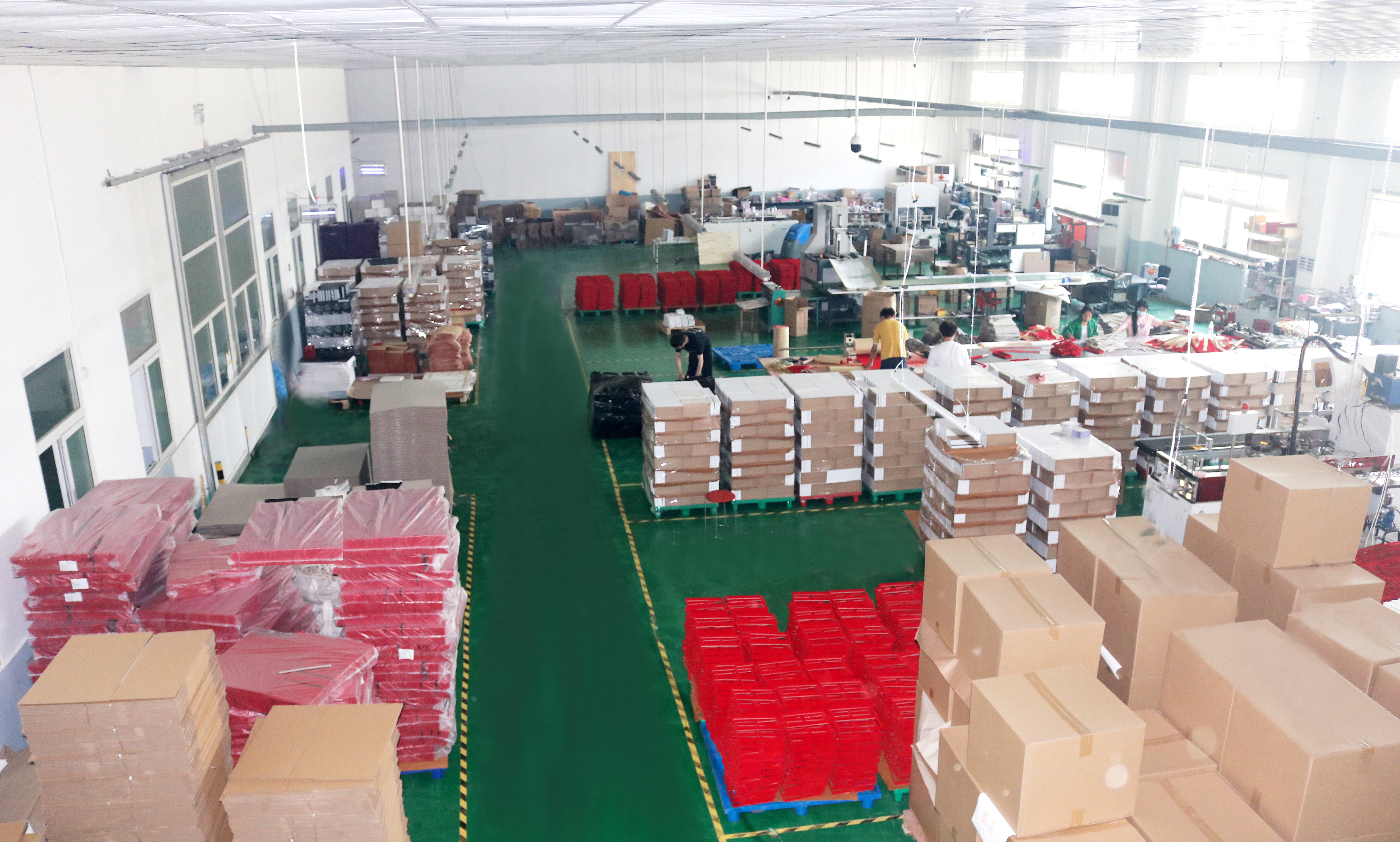
Rigid box assembly is the most manual stage in the three-format line, which is why rigid gift box programmes need earlier capacity planning than carton or mailer runs.
In cosmetics and skincare, the common configuration is a folding carton for retail presence plus a corrugated mailer for the direct-ship order, with the carton reused inside the mailer. In food and supplements, folding cartons dominate because retail shelf compliance and print fidelity matter more than transit structure. In subscription programmes, the mailer is the primary pack, and its structural rigidity is the reason the programme can ship without an additional outer box. In wine, jewellery and luxury gift sets, the rigid box performs a presentation function that neither of the other two formats replicates, frequently combined with a printed outer shipper for transport.
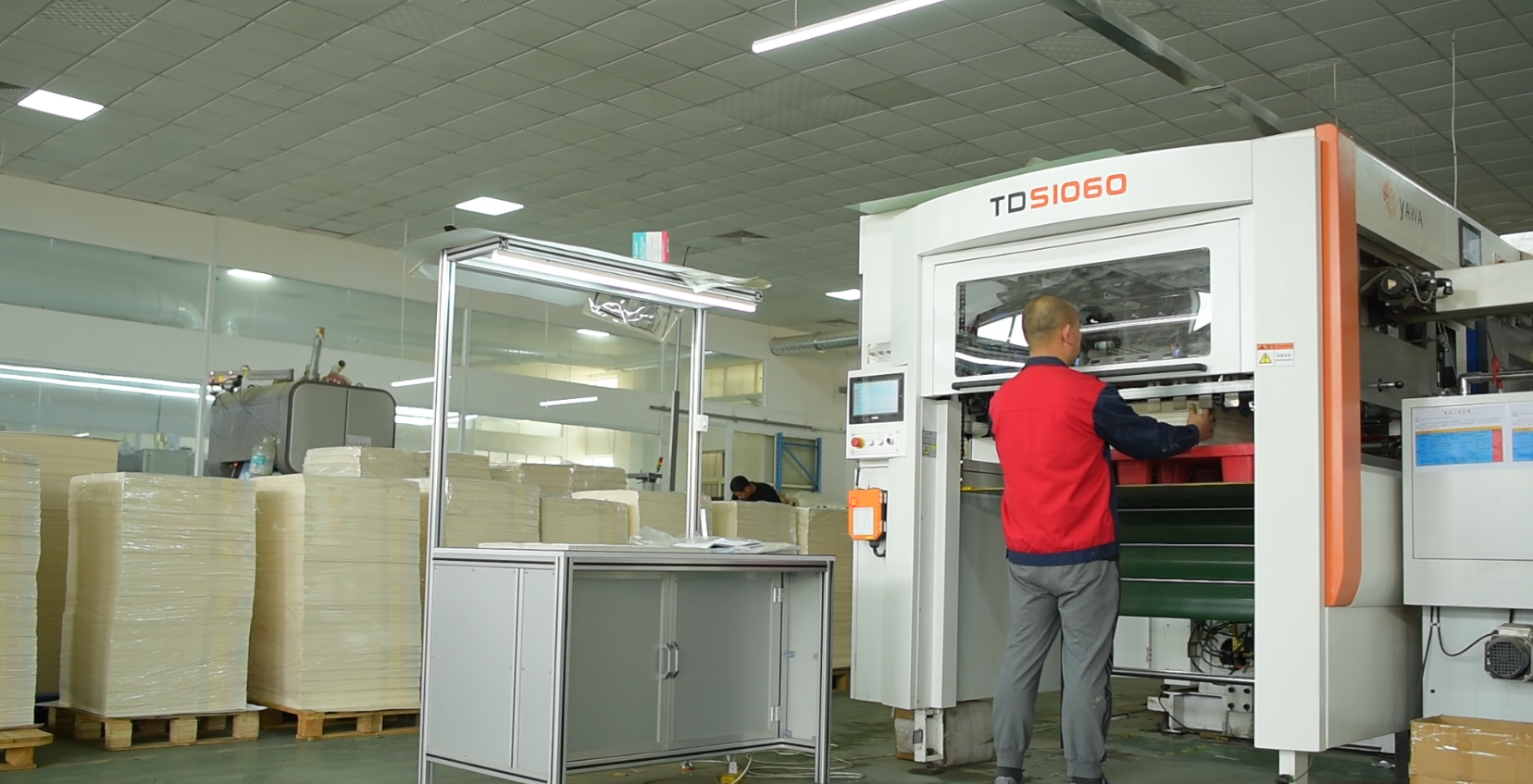
Hot stamping, lamination and spot UV are the finishing steps that separate a rigid presentation box from a shipping pack — and the steps that add cost and lead time.
What Long-Term Supply Actually Requires
For buyers who have already selected a format, the difference between a first order and a fifth order is where eco-packaging programmes usually fail. The failure modes are predictable: colour drifts between batches, board grade quietly changes, lead times slip during peak season, or the supplier has no capacity headroom when the programme scales.
Three supply characteristics address those risks directly. First, in-house production: raw material intake, printing, die-cutting, lamination, gluing and finishing all occur inside one controlled facility, with paper and ink held in stock rather than purchased per order. Second, capacity headroom: an annual output capacity of 100,000,000 units against a facility of 10,000 m² and more than 200 staff provides room to absorb seasonal peaks without outsourcing. Third, documentation continuity: FSC Chain of Custody under RR-COC-001255, ISO 9001:2015 and SMETA 6.1 where applicable remain valid across repeat orders, so a buyer's compliance file does not have to be rebuilt each cycle.
The manufacturer states it has served more than 200 global brands, spanning emerging startups to premium fashion and consumer brands. For a buyer evaluating a multi-year packaging relationship, that record is a proxy — not proof — of repeat-order capability; the proof is in the sampling stage and the first two production runs.
Future Outlook
The regulatory clock is now the main schedule constraint in this category. PPWR entered into force on 11 February 2025, applies in major part from August 2026, and requires all packaging to be recyclable by 2030. Extended producer responsibility obligations already span 63 countries. Buyers who finalise format, board grade and finishing decisions against those rules now will avoid a redesign cycle later, and redesign is the single most expensive event in a packaging programme.
On the supply side, the differentiator is likely to shift from material claims to provable capacity and documentation. Paper-based mono-material formats are structurally well positioned, but the formats that scale will be the ones whose producers can evidence fibre traceability, batch consistency and delivery reliability across repeat orders rather than at first sample.
A full capability brochure covering product specifications, facility detail and certification scope is available for download: BEJAN GIANT NEW PACKAGING capability brochure (PDF).
FAQ
What is the minimum order quantity for eco-friendly custom packaging, and can a trial run be arranged before mass production?
The minimum order quantity is 500 units, and the manufacturer supports flexible orders from small trial runs to large-volume mass production. A trial production run can therefore be used as a market test before committing to volume. Turnaround for a custom project is quoted as 3 days for custom design, 7 days for sampling and 14 days for mass production delivery.
Which certifications should an EU-bound buyer verify before placing an order?
FSC Chain of Custody under certificate RR-COC-001255 for certified fibre traceability, ISO 9001:2015 for quality management, and SMETA 6.1 social-compliance auditing where applicable to the buyer's programme. For the EU market specifically, packaging must be designed against the Packaging and Packaging Waste Regulation, adopted 19 December 2024, in force from 11 February 2025, with major application from August 2026 and a requirement that all packaging be recyclable by 2030. The manufacturer states 100% recyclable paper-based construction and compliance with PPWR requirements.
How do I choose between a folding carton, a corrugated mailer and a rigid gift box for the same product?
Match the format to the channel and to the handling the pack will experience. The Folding Paper Carton Box (BP-FBB-CARTON03) suits retail-facing secondary packaging where print fidelity and low unit cost matter. The Corrugated E-commerce Mailer Box (BP-MAIL-EB01) suits direct-to-consumer and subscription parcels that require compression and drop resistance. The Rigid Gift Box (BP-RIGID-GIFT02) suits premium gifting where presentation justifies the highest material and labour content. Products sold through more than one channel are commonly packed using a combination of formats rather than a single one.
What are the delivery terms, quality-control steps and payment terms for an export order?
Delivery terms are EXW Qingdao Factory or FOB Qingdao, with 30/70 payment terms. Before shipment, 100% full inspection is carried out, compression resistance testing is available, and on-site third-party inspection by SGS is supported. Quality control runs as a closed loop covering raw material inspection, printing, post-press processing, semi-finished inspection, finished product testing and pre-shipment review.
How is batch consistency maintained across repeat orders?
Production is completed in-house rather than outsourced, using Heidelberg offset presses together with automatic die-cutting, lamination, folder gluing, UV coating and hot-stamping equipment, under standardised production management and colour control. Paper, ink and other regular raw materials are held in stock rather than purchased per order, which supports consistent colour reproduction and scheduling across repeat runs. A dedicated order coordinator follows each order from sampling through to shipment.
What are the limits of paper-based eco-friendly packaging that buyers should plan around?
Each format has defined boundaries. A folding carton provides limited compression resistance on its own and normally requires an outer shipper or internal fitment for fragile contents. A corrugated mailer is engineered for transit protection rather than premium presentation. A rigid gift box carries the highest material and labour content and the highest unit cost, and is unsuitable where the box is discarded on arrival. Added components such as magnets, ribbons, foam or film lamination change the recyclability pathway of an otherwise paper-based pack. Certification documentation supports a buyer's compliance file, but producer-responsibility registration in any given market remains the obligation of the producer placing the goods on that market.
Tem questões ou precisa de mais detalhes?
Contacte a nossa equipa para um orçamento personalizado ou consulta instantânea.
Solicitar orçamento
Preencha o formulário abaixo e a nossa equipa entrará em contacto com uma proposta personalizada.
Chat direto do WhatsApp
Prefere conversar em tempo real? Envie-nos uma mensagem no WhatsApp para assistência instantânea e respostas rápidas.
- Obter orçamento personalizado
- Partilhar fotos ou documentos
- Discuta as suas necessidades diretamente
Geralmente responde em 5–30 minutos durante o horário de expediente.