
Edge Banding Machines Compared: HK568 vs HK868P vs HK268G for Independent Buyers
Why Three Models From One Builder Deserve a Separate Comparison
The global woodworking machinery market was valued at USD 20.3 billion in 2025 and is projected to reach USD 27.7 billion by 2033, according to Grand View Research. Market-sizing estimates for this category vary widely depending on whether primary wood processing equipment is counted alongside secondary furniture machinery, so any single global figure should be read as directional rather than precise. What the estimates do agree on is scale: edge banding remains one of the most widely purchased machine categories in panel furniture production.
For independent buyers — importers, distributors and owner-operated furniture factories — the difficulty is not finding an edge banding machine. It is that one category name covers machines with 3.79-metre and 9.5-metre frames, 11.8 kW and 25.86 kW of installed power, and minimum panel lengths that differ by 15 millimetres. A listing that says only automatic edge banding machine does not tell a buyer whether the unit will fit the workshop, run the panel sizes actually produced, or work with the electrical supply already installed.
The three machines compared here are built by Foshan Shunde SaiYu Technology Co., Ltd., which manufactures woodworking machinery under the SYUTECH brand from Shunde District, Foshan, Guangdong Province, China — a district known as a concentrated production base for Chinese woodworking machinery. The company was originally established in 2013 as Foshan Shunde Leliu Huake Long Precision Machinery Factory and later developed the Saiyu Technology brand through ten years of technological accumulation. All three models — the HK568, the HK868P and the HK268G — appear on the related-product list of the same CE certificate, number HTT202405661L, issued by HTT on 5 June 2024.
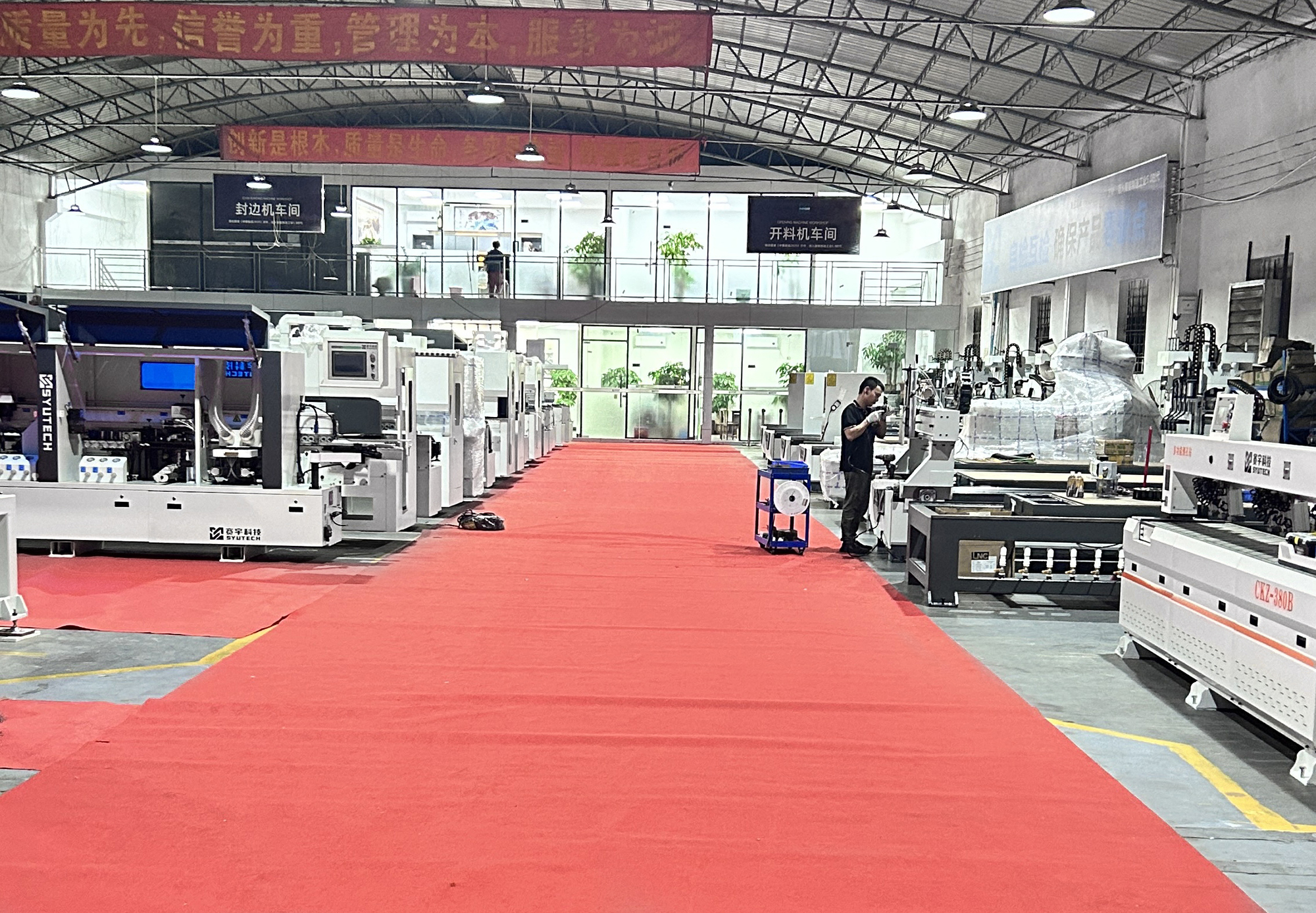
Edge banding workshop in a panel furniture plant: the three SYUTECH models compared here serve the same process stage but differ substantially in frame length, installed power and panel range.
Comparison Framework: Six Dimensions Independent Buyers Can Actually Verify
At the evaluation stage, buyers rarely need a longer feature list. They need dimensions that map directly to something on the factory floor. Six dimensions do most of the work, and each one corresponds to a published parameter rather than a claim.
| Dimension | What it decides | Where it appears in a spec sheet |
|---|---|---|
| Footprint and weight | Whether the machine fits the bay; whether floor loading and lifting equipment are adequate | Overall dimension; machine weight |
| Panel size range | Whether small components such as drawer fronts and door inserts can be run | Minimum panel length; minimum panel width |
| Installed power and voltage | Transformer, cabling and service capacity | Installed / total power; rated voltage |
| Station configuration | How much finishing happens in a single pass | Pre-milling; end, rough, fine and corner trimming; polishing |
| Edge band range | Which tape inventory the machine can accept | Edge band width; edge band thickness |
| Compliance and supply terms | Market access, ordering rhythm and spare-part planning | Certification; MOQ; lead time; after-sales structure |
The three models differ far more on the first four dimensions than on the fifth. All three accept edge band widths from 10 to 60 mm on a chain-fed automatic platform. The buying decision therefore turns on space, power and panel range — not on the tape.
HK568: 7.2-Metre Frame With a Fully Itemised Trimming Set
The HK568 is classified as an edge banding machine, with an overall dimension of 7200 × 710 × 1628 mm and a machine weight of 2,200 kg. Its frame material is listed as carbon steel. Installed power is 25.86 kW and the compressed-air requirement is 0.7–0.9 MPa. Feeding speed is published as a three-step range of 16–18–22 m/min.
What distinguishes the HK568 in this comparison is the granularity of its published station list. Pre-milling is rated 2.2 kW × 2 at 9,000 rpm; the glue box is rated 1.8 kW; end trimming is 0.37 kW × 2 at 12,000 rpm; rough trimming is 0.75 kW × 2; fine trimming is 0.75 kW × 2 at 12,000 rpm; corner trimming is 0.37 kW × 2 at a working speed of 20 m/min; and polishing is 0.37 kW × 2. A 4 kW conveyor belt motor drives the feed.
For buyers, the corner-trimming geometry matters more than it first appears. The HK568 accepts panels from a minimum length of 135 mm and a minimum width of 50 mm, with corner trimming specified at 50 × 300 mm. That combination is what allows one machine to handle both long cabinet sides and short components without a separate pass — a common bottleneck in mixed-product furniture plants.
HK868P: 9.5-Metre Frame and a 4-Tonne Build
The HK868P is classified as an automatic edge banding machine and is the largest of the three. Overall dimension is 9500 × 1000 × 1650 mm and weight is 4 tonnes. Frame material is carbon steel, total power is 25 kW, and rated voltage is 380 V at 50 Hz. Working speed is published as 16–22 m/min.
Station ratings published for this model are: pre-milling 2.2 kW × 2, end trimming 0.3 kW × 3, rough trimming 0.75 kW × 2, polishing 0.18 kW × 4, and a 5.5 kW conveyor motor. Edge band width range is 10–60 mm and edge band thickness range is 0.4–3 mm.
The published parameter set for this model is coarser than the HK568 sheet: it does not itemise a glue box, fine trimming or a corner-trimming motor, and it does not state a minimum panel length or minimum panel width. That is not evidence that those functions are absent. It means an independent buyer cannot confirm them from the published sheet alone and should request the station list and panel-range confirmation in writing before ordering. With a 9.5-metre frame and 4 tonnes of mass, the HK868P is also the model where layout planning, floor loading and rigging cost matter most.
HK268G: 3.79-Metre Frame With an SS304 Option
The HK268G is listed as a mini edge banding machine. Its overall dimension is 3790 × 730 × 1210 mm — roughly 40 percent of the HK868P's length — and installed power is 11.8 kW at 380 V / 50 Hz, with a pneumatic requirement of 0.7–0.9 MPa. Feeding speed is published as 16–18–22 m/min.
Two details set this model apart. First, its published material specification is carbon steel or SS304, making it the only one of the three with a documented stainless-steel frame option — relevant where humidity, coastal air or wash-down conditions accelerate corrosion. Second, it accepts the smallest panels of the three, with a minimum panel length of 150 mm and a minimum panel width of 40 mm; corner trimming is specified at 45 × 200 mm. Its edge band thickness range starts slightly lower, at 0.35 mm, and extends to 3 mm, across the same 10–60 mm band width range as the other two.
The trade-off is documented rather than implied. A shorter frame and lower installed power come with a published parameter set that does not itemise individual trimming and polishing stations, and machine weight is not stated. A buyer whose product mix includes narrow components should verify the actual station configuration before treating the HK268G as a scaled-down equivalent of the HK568.
Side-by-Side Specifications
| Parameter | HK568 | HK868P | HK268G |
|---|---|---|---|
| Product classification | Edge banding machine | Automatic edge banding machine | Mini edge banding machine |
| Overall dimension | 7200 × 710 × 1628 mm | 9500 × 1000 × 1650 mm | 3790 × 730 × 1210 mm |
| Machine weight | 2,200 kg | 4 t | Not stated on published sheet |
| Frame material | Carbon steel | Carbon steel | Carbon steel / SS304 |
| Installed / total power | 25.86 kW | 25 kW | 11.8 kW |
| Rated voltage | Not stated; air pressure 0.7–0.9 MPa | 380 V, 50 Hz | 380 V, 50 Hz |
| Feeding / working speed | 16–18–22 m/min | 16–22 m/min | 16–18–22 m/min |
| Edge band width | 10–60 mm | 10–60 mm | 10–60 mm |
| Edge band thickness | 0.4–3 mm | 0.4–3 mm | 0.35–3 mm |
| Minimum panel length | 135 mm (corner trimming 50 × 300 mm) | Not stated on published sheet | 150 mm (corner trimming 45 × 200 mm) |
| Minimum panel width | 50 mm | Not stated on published sheet | 40 mm |
| Pre-milling | 2.2 kW × 2, 9,000 rpm | 2.2 kW × 2 | Not itemised on published sheet |
| Trimming stations listed | End 0.37 kW × 2 (12,000 rpm); rough 0.75 kW × 2; fine 0.75 kW × 2 (12,000 rpm); corner 0.37 kW × 2 at 20 m/min | End 0.3 kW × 3; rough 0.75 kW × 2 | Corner trimming specified at 45 × 200 mm |
| Glue box | 1.8 kW | Not itemised on published sheet | Not itemised on published sheet |
| Polishing | 0.37 kW × 2 | 0.18 kW × 4 | Not itemised on published sheet |
| Conveyor motor | 4 kW | 5.5 kW | Not stated on published sheet |
Where a cell reads not stated or not itemised, the underlying function may well exist — but it cannot be confirmed from the published specification. For an independent buyer, an unconfirmed parameter is a question to put in writing, not a gap to fill with assumption.
Trade-Offs in Size, Throughput and Configuration
Read across the table, the three machines do not form a simple ladder from entry level to top of range. They form a trade-off triangle, and each side of it costs something.
Space against capability. The HK868P occupies 9.5 metres of length and one metre of width, and weighs 4 tonnes. The HK568 is 7.2 metres long at 2,200 kg. The HK268G is 3.79 metres long. In a workshop where the infeed and outfeed zones are already constrained, the difference between 3.79 and 9.5 metres is not a preference — it is the difference between installing one machine and restructuring the plant layout.
Power against service capacity. The HK568 and HK868P both sit at roughly 25–26 kW installed, while the HK268G is listed at 11.8 kW. Where a buyer is working from an existing service panel, the lower figure may remove the need for a service upgrade, and it changes generator sizing for sites without a stable grid supply.
Configuration transparency against configuration scope. All three publish the same 10–60 mm edge band width range, so the tape inventory does not change between models. What changes is how much of the finishing sequence is documented. The HK568 sheet itemises nine motor groups, the HK868P sheet lists five, and the HK268G sheet lists installed power and pneumatic requirements without individual stations. The level of detail should be treated as a procurement prompt, not a quality ranking.
Panel range against product mix. The HK568 accepts the shortest panels at 135 mm but requires a wider minimum width of 50 mm. The HK268G accepts the narrowest panels at 40 mm but requires a slightly longer minimum length of 150 mm. A plant producing narrow door inserts and a plant producing short drawer fronts are therefore not looking at the same small-panel answer.
What Each Parameter Actually Controls
Several of these figures are frequently misread during evaluation, and the misunderstanding usually surfaces after installation rather than before purchase.
Minimum panel length is a process boundary, not a preference setting. It describes the distance a panel must span for the chain feed and trimming stations to engage safely. The HK568 figure of 135 mm and the HK268G figure of 150 mm both refer to corner-trimming geometry — 50 × 300 mm and 45 × 200 mm respectively. If a plant regularly runs components shorter than the stated minimum, those components need a different process route regardless of which of the three machines is purchased.
Machine weight is a floor-loading and logistics number before it is a stability number. At 2,200 kg and 4 tonnes, the HK568 and HK868P sit in the range where ground-floor siting, floor condition and unloading equipment should be planned before the order is placed. The HK268G sheet does not state weight, so that calculation has to be completed with the supplier.
Installed power is the sum of the machine's motors, not the running draw. A figure of 25.86 kW describes the electrical service the machine must be wired for; actual consumption during a shift depends on duty cycle. Buyers comparing running cost between an 11.8 kW and a 25.86 kW machine should build the estimate on duty cycle rather than on the nameplate total.
Air pressure at 0.7–0.9 MPa appears on the HK568 and HK268G sheets. It is a compressed-air supply requirement, which means a workshop without a stable compressor line should include that in the installation budget before delivery.
Where These Machines Are Already Running
Two documented deployments provide reference points for buyers assessing risk.
A panel furniture manufacturer in Kenya installed three units across edge banding and CNC router workshops. The project has run for two years, with reported outcomes of stable edge banding and improved edge banding quality, leading to increased output.
A panel furniture manufacturer in Greece installed ten units in an edge banding workshop. That project has been in stable operation for three years, with a significant increase in output reported.
Both references follow the same pattern. In each case the deployment was multi-unit and workshop-level rather than a single replacement machine, and the reported benefit was consistency of edge quality and throughput rather than one headline specification. For an independent buyer, that is the more useful comparison: edge banding performance is a line-level result, not a machine-level one.
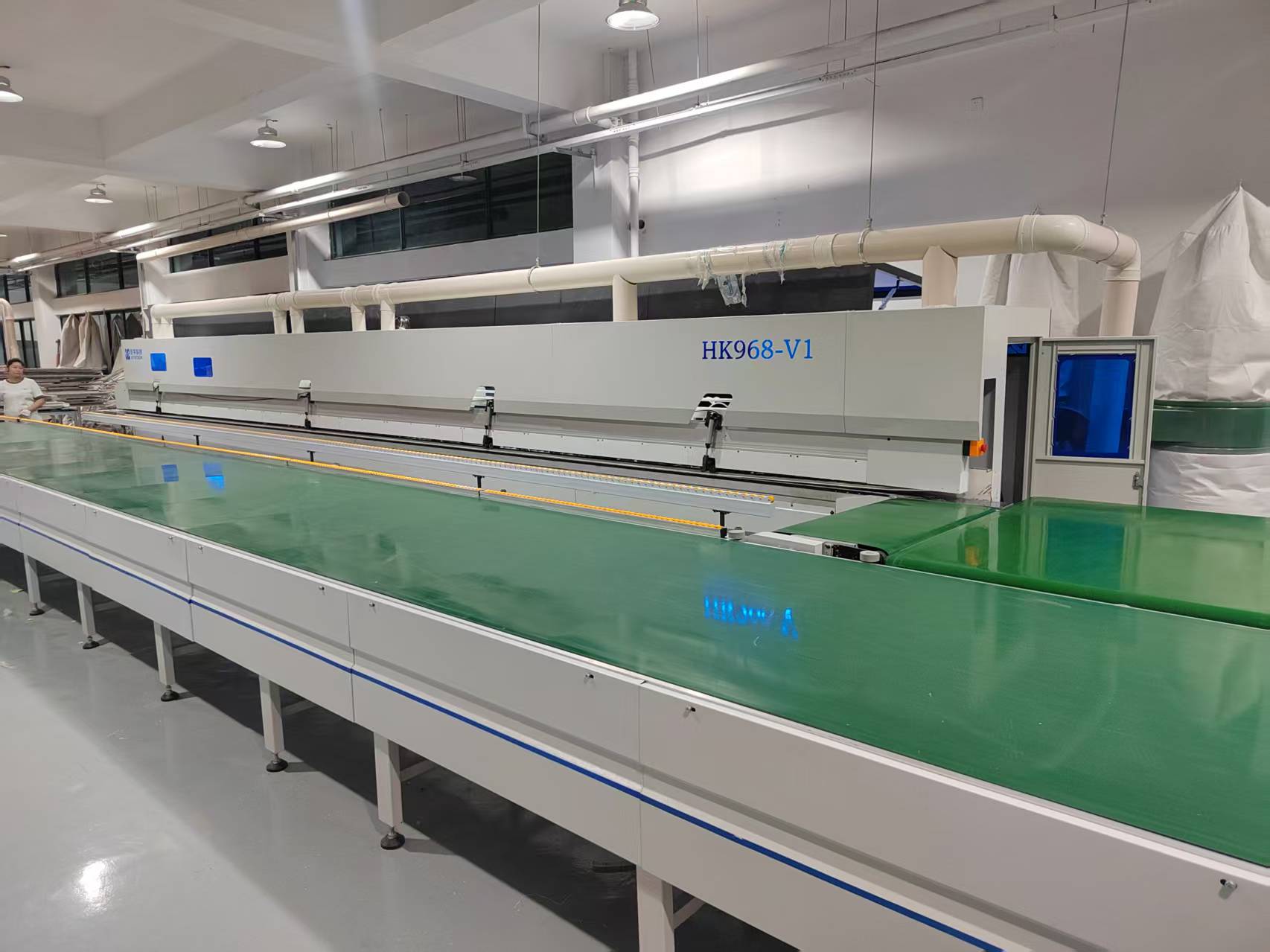
Edge banding workshop deployment: multi-unit installations in Kenya and Greece were commissioned at workshop level and reported gains in edge quality consistency and output.
Market Trend: What the Published Numbers Suggest
Three data points are worth carrying into a purchase decision.
First, demand is not concentrated in one region. Europe held a 36.4 percent revenue share of the woodworking machinery market in 2025, according to Grand View Research, driven by established manufacturers in Italy and Germany, while Asia Pacific commanded the largest share of the wider wood processing machines market at 34.5 percent in 2024, led by China and India, according to Credence Research. Buyers in different regions are therefore drawing on the same supply base.
Second, intra-regional trade is intensifying. China's exports of machine tools for working wood to Vietnam reached USD 311.6 million in 2024, according to UN Comtrade. For importers, that indicates a regional market where equipment is being commissioned at volume, which generally improves spare-part availability and service familiarity.
Third, compliance expectations are tightening rather than loosening. EU guidance identifies EN 1218-4 as the safety standard applicable to edge banding machines fed by chain. Separately, the CE certificate covering the models in this comparison, number HTT202405661L, was issued by HTT on 5 June 2024 under the Machinery Directive 2006/42/EC and the Low Voltage Directive 2014/35/EU, citing EN ISO 12100:2010 and EN 60204-1:2018. Buyers should note that the harmonised standards cited on a certificate and the standard named in market guidance are not automatically identical, and should check the manufacturer's declaration against the requirements of their own market.
Limits and Boundaries Worth Confirming
A useful comparison states what a product range does not cover as clearly as what it does. Six boundaries apply to this set.
- Published specification completeness varies by model. The HK568 sheet itemises nine motor groups, while the HK868P and HK268G sheets itemise fewer. A missing parameter is not a missing function, but it is an unconfirmed variable that should be resolved in writing.
- Rated voltage is stated for two of the three models. The HK868P and HK268G specify 380 V / 50 Hz, while the HK568 sheet lists air pressure instead. Buyers in markets with different grid characteristics should confirm the applicable voltage configuration rather than assume it.
- Frame material specification is not uniform. Only the HK268G lists an SS304 option alongside carbon steel. Where corrosion resistance is a project requirement, that difference is material rather than cosmetic.
- Panel size minimums are real process boundaries. Components shorter than 135 mm on the HK568 or 150 mm on the HK268G fall outside the published corner-trimming geometry, and no specification adjustment changes that without a different process route.
- Footprint and mass impose site costs that are not part of the machine price. A 9.5-metre, 4-tonne machine requires rigging, floor assessment and layout adjustment.
- The published specification set describes chain-fed edge banding with trimming and polishing stations. Where a project requires an alternative edge-sealing technology, that requirement should be raised directly, because the available specification set for these three models does not describe it.
Procurement Checklist for Independent Buyers
- Measure the available bay, including infeed and outfeed clearance, and compare it against 3790 mm, 7200 mm or 9500 mm of overall machine length.
- Confirm floor loading capacity and arrange lifting equipment sized for 2,200 kg or 4 tonnes before delivery.
- List the shortest and narrowest components in the current product mix and match them against the published minimum panel length and width of each model.
- Verify service panel capacity against installed power — 11.8 kW, 25 kW or 25.86 kW — and confirm rated voltage and frequency against the site supply.
- Confirm compressed-air availability at 0.7–0.9 MPa where the model requires it.
- Request the full station list in writing for every model under consideration, including glue box, fine trimming, corner trimming and polishing.
- Check certification documentation against the destination market's requirements and confirm which harmonised standards are cited.
- Clarify commercial terms: minimum order quantity, lead time and the scope of customization.
On commercial terms, the manufacturer publishes a minimum order quantity of one set, a lead time of 30–45 days and a monthly capacity of 100 sets, with full pre-shipment testing. Customization covers logo, colour and voltage under an OEM/ODM production model, and after-sales support is provided remotely — relevant for buyers operating outside the manufacturer's primary markets of Russia, the Middle East, South America, Europe and Southeast Asia. Around 80 percent of production is exported.
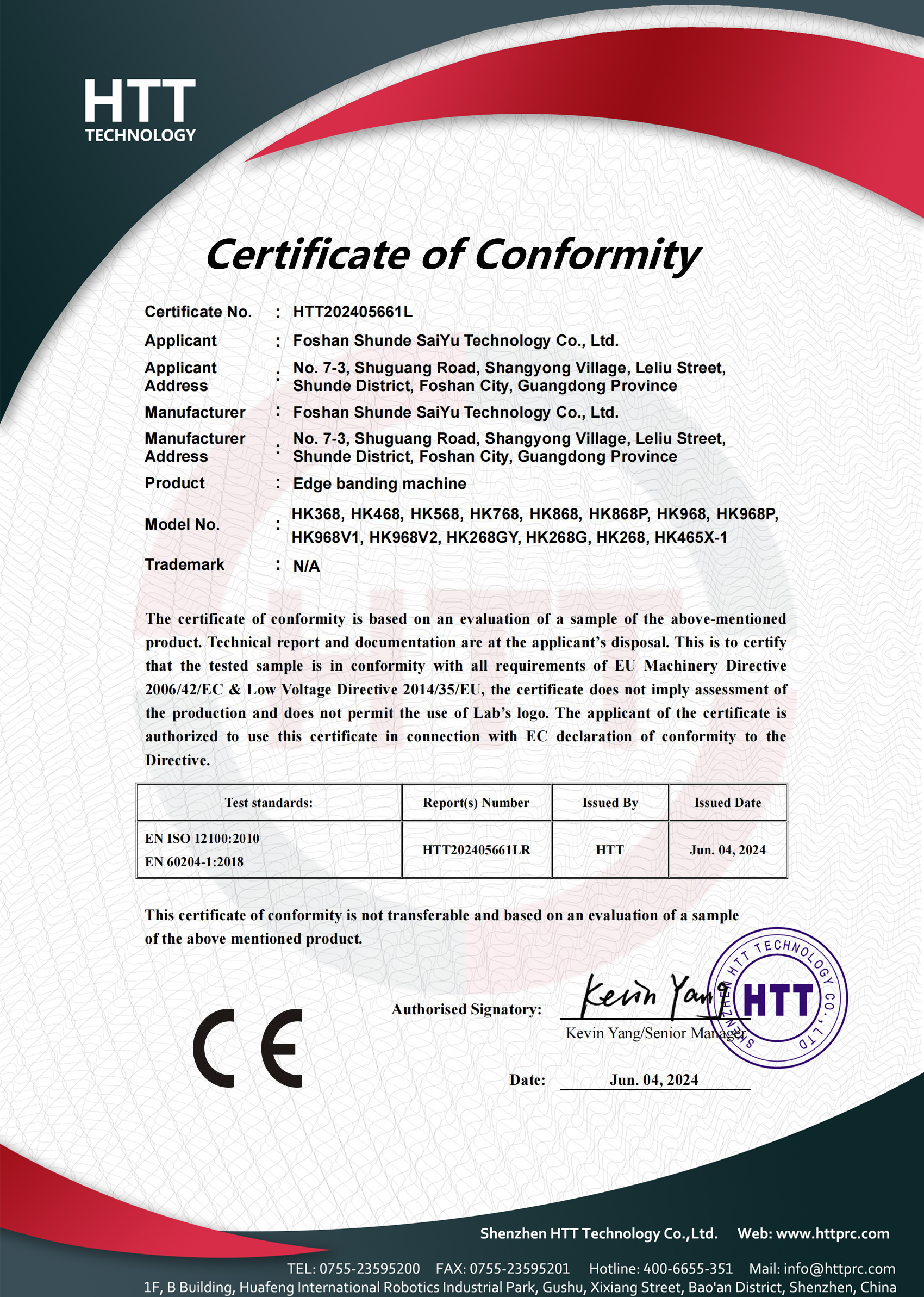
CE certificate HTT202405661L, issued 5 June 2024, cites EN ISO 12100:2010 and EN 60204-1:2018 and lists the HK568, HK868P and HK268G among related products.
Future Outlook
Two direction signals are worth watching. The woodworking CNC router machine segment alone was valued at USD 185.3 million in 2024, according to Grand View Research, suggesting that the CNC side of panel processing is developing its own specialised supply base alongside edge banding. Meanwhile, the competitive landscape remains anchored by established European groups — Homag Group, SCM Group, Biesse Group and Weinig AG, as identified by Market Research Future — which means buyers evaluating Asian-built machines are evaluating an alternative supply tier rather than a replacement for the European tier.
In practice, that points to continued fit-based decision making at the evaluation stage: frame length against available floor space, installed power against service capacity, and documented panel range against the actual product mix. The three models compared here are a compact illustration of exactly that logic — the same 10–60 mm edge band range, the same process stage, and three materially different answers.
FAQ
Which of the three models is the best fit for a small workshop?
Fit depends on the smallest component produced and the available floor length, not on model ranking. The HK268G has the shortest frame at 3790 × 730 × 1210 mm and the lowest installed power at 11.8 kW, but it requires a minimum panel length of 150 mm. The HK568 has a 7200 × 710 × 1628 mm frame, requires 25.86 kW, and accepts panels from 135 mm in length and 50 mm in width. A workshop running components below 150 mm cannot use the HK268G for those components regardless of its footprint advantage.
What does minimum panel length mean in daily production?
Minimum panel length defines the shortest panel the machine's chain feed and corner-trimming geometry can handle safely. For the HK568 it is 135 mm, with corner trimming specified at 50 × 300 mm. For the HK268G it is 150 mm, with corner trimming specified at 45 × 200 mm. Components shorter than these figures require a different processing route rather than a machine setting adjustment.
Are the HK568, HK868P and HK268G covered by the same CE certificate?
All three models appear on the related-product list of CE certificate number HTT202405661L, issued by HTT on 5 June 2024, covering the Machinery Directive 2006/42/EC and the Low Voltage Directive 2014/35/EU, and citing EN ISO 12100:2010 and EN 60204-1:2018. EU market guidance separately identifies EN 1218-4 as the safety standard applicable to chain-fed edge banding machines. Buyers should verify the certificate and the manufacturer's declaration against their own market's requirements.
How do carbon steel and SS304 frames differ in edge banding machines?
In the published specifications for these three models, the HK568 and HK868P list carbon steel as the frame material, while the HK268G lists carbon steel or SS304. Stainless steel is generally specified where humidity, coastal air or wash-down conditions make corrosion resistance a requirement. The choice affects material specification and cost rather than edge band width, edge band thickness or feeding speed.
Why does machine weight matter when comparing edge banders?
Weight determines floor loading, lifting equipment and transport planning. The HK568 is listed at 2,200 kg and the HK868P at 4 tonnes. Both figures sit in the range where ground-floor siting, floor condition and unloading arrangements should be resolved before the machine is ordered. The published specification for the HK268G does not state machine weight.
What are the MOQ, lead time and customization options?
The manufacturer publishes a minimum order quantity of one set and a lead time of 30–45 days, with a monthly capacity of 100 sets and full pre-shipment testing. Customization covers logo, colour and voltage under an OEM/ODM production model, and after-sales support is provided remotely.
The manufacturer's factory promotional brochure, covering the wider range of equipment for panel furniture production, can be downloaded here: Factory promotional paper (PDF).
Tem questões ou precisa de mais detalhes?
Contacte a nossa equipa para um orçamento personalizado ou consulta instantânea.
Solicitar orçamento
Preencha o formulário abaixo e a nossa equipa entrará em contacto com uma proposta personalizada.
Chat direto do WhatsApp
Prefere conversar em tempo real? Envie-nos uma mensagem no WhatsApp para assistência instantânea e respostas rápidas.
- Obter orçamento personalizado
- Partilhar fotos ou documentos
- Discuta as suas necessidades diretamente
Geralmente responde em 5–30 minutos durante o horário de expediente.