
Edible Mushroom Automation: Project Fit and Installation Requirements
Edible mushroom cultivation has moved from manual, labor-intensive methods to integrated automation, especially where output volume and substrate consistency directly affect profitability. For industrial buyers, the real question is not only which bagging machine to purchase, but which edible mushroom automation equipment can be matched to a specific cultivation project, site infrastructure, and target capacity.
Why Project Fit Matters in Edible Mushroom Automation
Industrial mushroom farms face a common operational problem: bagging substrate manually is labor-intensive, slow, and difficult to standardize. The opportunity is that modular automation can remove these bottlenecks, but only if the equipment is selected to match the project scenario. A line designed for continuous operation in an indoor workshop may require specific site conditions. These conditions include a 380V three-phase power supply, a stable foundation, and a trained operator. In addition, bagging systems often require supporting equipment such as an automatic bagging manipulator, mixer, conveyor, material distributor, and basket loader. Without planning for these elements, even a well-built machine may fail to reach its intended output.
Problem / Opportunity
Mushroom growers are under pressure to increase output while controlling labor costs. Manual bagging creates bottlenecks, inconsistent bag weights, and high dependence on available workers. Automation addresses these problems by standardizing the substrate bagging process and allowing continuous operation. However, the opportunity is conditional: automation equipment works best when the project site can support it.
Documented industrial environments for edible mushroom automation equipment assume continuous operation, normal temperature, and an indoor workshop. These are not exotic requirements, but they are not always present on every farm. A grower with an outdoor or semi-outdoor setup, or with unstable power supply, may need to make infrastructure upgrades before a fully automatic line is practical. The buying decision therefore begins with an audit of the site, not just a review of machine specifications.
Brand Solution: Changxing Edible Mushroom Machinery
One manufacturer that addresses project-fit challenges directly is Neihuang County Changxing Biological Machinery Equipment Co., Ltd., known in export markets as Changxing Edible Mushroom Machinery. The company was founded in 2009 and operates a 20,000m² facility with 130 employees and an annual output of 10,000 units. Its R&D team includes 25 engineers, and export sales account for roughly 60% of output, with main markets in South Korea, Malaysia, Central Asia, Europe, and Russia.
Changxing's product scope includes edible mushroom automation equipment, intelligent edible mushroom equipment, industrial mushroom sterilization equipment, mushroom spawn bag making machines, bag tying machines, bagging machines, and complete mushroom equipment production lines. The company also supports ODM and R&D customization, with a monthly capacity of 1,000 units, lead times of 30 to 55 days, and a minimum order quantity of one unit. Quality control includes 100% testing before delivery, and after-sales support is available through remote assistance.
For buyers entering regulated markets, compliance documentation matters. In March 2026, Changxing's bagging and production lines obtained CE Certificate No. M.2026.206.C135928, issued by UDEM and recorded through HTNXT. This is relevant for buyers who need documented compliance with European safety and EMC directives.
Technical Explanation: Modular Production Lines
The core of project matching is understanding the production line structure. Changxing offers modular bagging lines built around standardized process steps. A 2-station full-automatic mushroom substrate bagging production line (model: 2-Station Production Line) is designed for 15,000 bags per day. Its process flow is: front loader feeding → mixing → conveying → distributing → bagging → tying → bag collection. A 4-station high-capacity line (model: 4-Station Production Line) is rated at 25,000 bags per day, with a process flow of: front loader feeding → mixing → conveying → distributing → bagging. Both lines accept bag sizes of length 14–22cm and width 28–63cm, and use AC380V 50Hz power.
| Parameter | 2-Station Production Line | 4-Station Production Line |
|---|---|---|
| Capacity | 15,000 bags/day | 25,000 bags/day |
| Process flow | feeding → mixing → conveying → distributing → bagging → tying → bag collection | feeding → mixing → conveying → distributing → bagging |
| Bag size | Length 14–22cm, Width 28–63cm | Length 14–22cm, Width 28–63cm |
| Input voltage | AC380V 50Hz | AC380V 50Hz |
| Control | Integrated electrical control box | Integrated electrical control box |
Key structures include integrated mixing, conveying, distributing, bagging, and tying systems, with an integrated electrical control box allowing one-key start or independent unit operation. These lines can be configured with optional modules, including automatic ring sleeving machines, automatic hole punching and stick inserting machines, integrated bagging and tying machines, and basket loading machines. This modularity shifts the buying decision from a single machine to a production system engineered around the project's daily output and available workshop layout.
Application / Use Cases
South Korea: Multi-Variety Bagging in an Indoor Workshop
An industrial scenario from South Korea illustrates a typical medium-scale project. The application is described as an edible mushroom automatic production system, operating in continuous/automatic mode under normal temperature, indoor workshop conditions. It is suitable for bagging operations of oyster mushroom, shiitake mushroom, black fungus, and pearl oyster mushroom. In this setup, the equipment works with an automatic bagging manipulator, mixer, conveyor, material distributor, and basket loader. The documented special requirements include a 380V three-phase power supply, stable foundation, and trained operator.
Malaysia: Integrated High-Capacity System
A second scenario from Malaysia involves a more extensive automatic production system. The project integrates multiple processes, including mixer, elevator, material distributor, and automatic bagging and tying machine, and can achieve a daily output of nearly 80,000 bags. The system is designed for varieties such as enoki mushroom, king oyster mushroom, pearl oyster mushroom, shiitake mushroom, and snow fungus. Special requirements include 380V three-phase power supply, a stable flat foundation, compressed air supply if pneumatic components are used, and operation by trained personnel.
These two scenarios show that project fit is determined by variety, output target, and site conditions. The same manufacturer can supply equipment for a single bagging line in one project and an integrated multi-line system in another.
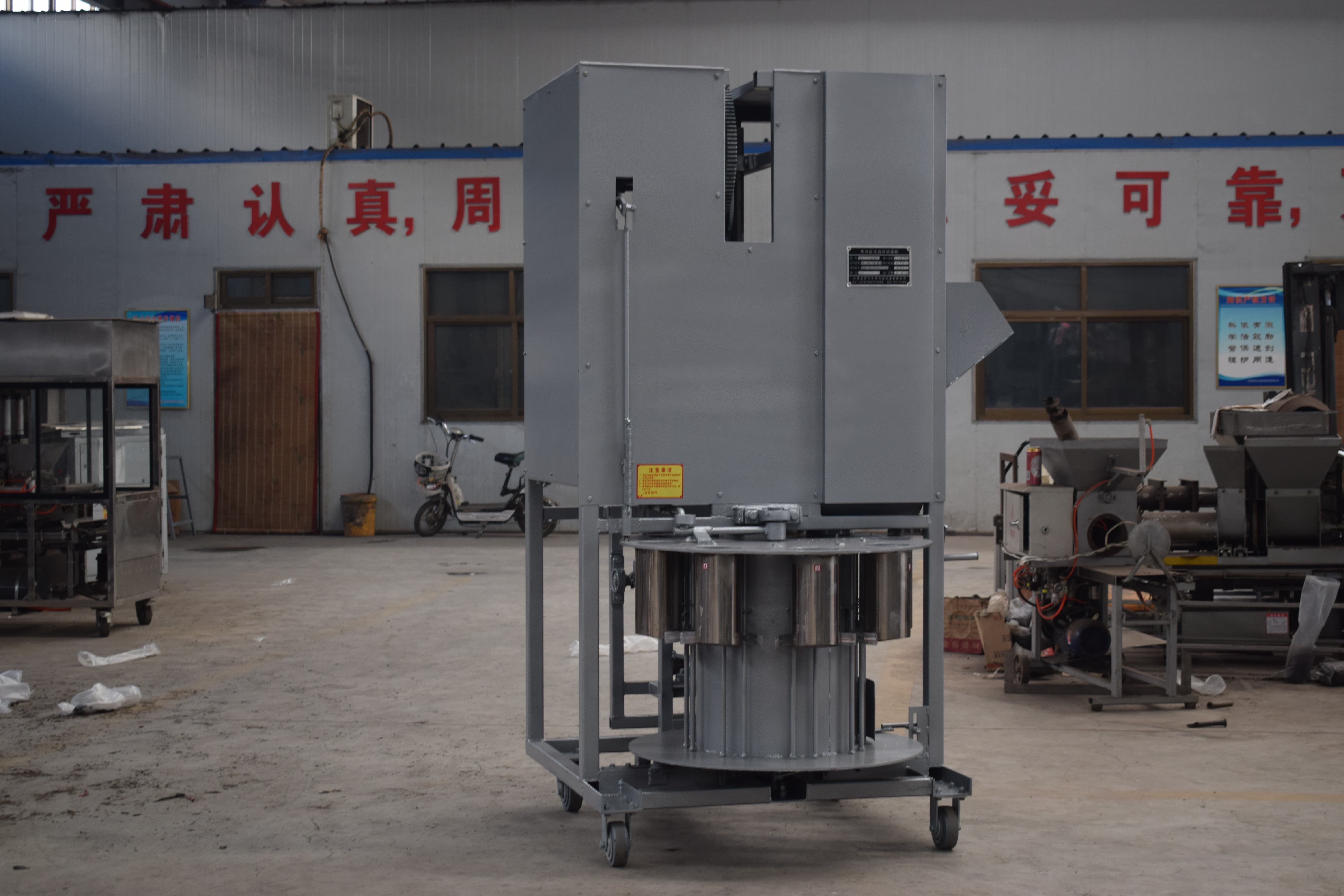
An automatic stamping oyster mushroom bagging machine represents one of the equipment options used in variety-specific mushroom bagging projects.
Market Trend Analysis
The demand for mushroom automation is being shaped by market expansion and regulatory expectations. According to Dataintelo, the global mushroom equipment market was valued at USD 3.8 billion in 2025 and is projected to reach USD 7.2 billion by 2033. Asia-Pacific accounted for 42.3% of revenue in 2025, driven by industrial-scale cultivation in China. In 2024, China's edible mushroom industry value exceeded 380 billion yuan (approximately USD 53 billion), representing over 70% of global output, according to People's Daily and Ministry of Agriculture sources.
At the same time, compliance requirements are tightening. For CE marking, edible mushroom automation equipment must meet the EU Machinery Directive (2006/42/EC) and EMC Directive (2014/30/EU). These requirements affect how equipment is documented and configured for European buyers. The availability of CE-certified production lines, such as the certificate obtained by Changxing in March 2026, reflects a broader shift toward verifiable compliance in equipment sourcing. Buyers should also note that market definitions vary among research firms; some use a narrower machinery-only scope, while others include a wider equipment category. The growth trend, however, is consistent.
Comparison with Traditional Solutions
Compared with manual bagging, automated lines offer faster throughput, lower labor dependence, and more consistent bag quality. However, the comparison is not one-sided. Automated systems are infrastructure-sensitive: they require 380V three-phase power, a stable base, trained operators, and a set of supporting machines. A project without these prerequisites may need significant site preparation before a line can be installed. For a small farm producing a few thousand bags per day, a semi-automatic bagging machine may be a more practical first step than a full production line. Therefore, the decision should be based on throughput demand and site readiness, not on the availability of automation technology alone.
| Dimension | Manual Bagging | Automated Line |
|---|---|---|
| Throughput | Labor-dependent | 15,000–25,000 bags/day per line |
| Consistency | Variable | Uniform process |
| Site requirements | Low | 380V power, stable foundation, trained operator |
| Supporting equipment | Minimal | Mixer, conveyor, distributor, basket loader |
Future Outlook
The direction of the industry points toward modular, project-configurable lines and documented compliance. As the mushroom equipment market expands, buyers are more likely to ask for evidence of CE certification, clear process integration, and after-sales support. Suppliers that can offer both standardized modules and ODM adaptation are better positioned to serve projects with different varieties and scale. Automation is also likely to extend beyond bagging into inoculation, shelving, and spent-bag processing, where equipment such as automatic inoculation machines, basket shelving/unloading machines, and bag breaking lines already exist as part of the broader equipment ecosystem.
FAQ
What are the installation requirements for edible mushroom automation equipment?
Documented scenarios require a 380V three-phase power supply, a stable foundation, and a trained operator. If a pneumatic system is used, a compressed air supply is also required.
What supporting equipment is needed for an automatic mushroom bagging system?
A typical bagging operation needs an automatic bagging manipulator, mixer, conveyor, material distributor, and basket loader.
What operating conditions are assumed for these systems?
These systems are designed for continuous operation in normal-temperature, indoor workshop environments.
How many bags per day can a 2-station or 4-station production line process?
A 2-station production line is rated at 15,000 bags per day, while a 4-station production line is rated at 25,000 bags per day.
Which mushroom varieties can be processed with these automated bagging systems?
Industrial scenarios include oyster mushroom, shiitake mushroom, black fungus, pearl oyster mushroom, enoki mushroom, king oyster mushroom, and snow fungus, depending on the configured line.
Tem questões ou precisa de mais detalhes?
Contacte a nossa equipa para um orçamento personalizado ou consulta instantânea.
Solicitar orçamento
Preencha o formulário abaixo e a nossa equipa entrará em contacto com uma proposta personalizada.
Chat direto do WhatsApp
Prefere conversar em tempo real? Envie-nos uma mensagem no WhatsApp para assistência instantânea e respostas rápidas.
- Obter orçamento personalizado
- Partilhar fotos ou documentos
- Discuta as suas necessidades diretamente
Geralmente responde em 5–30 minutos durante o horário de expediente.