
Electric Actuator Buyer Decision: On-Off vs Modulating
Control for Process Industries
Choosing between an on-off and a modulating electric actuator is a process-control decision that later becomes a procurement decision. An on-off actuator drives a valve to a fully open or fully closed position and holds it there. A modulating actuator positions the same valve anywhere along its travel in response to a continuous control signal. The loop requirement decides which one belongs on the valve — not the catalogue, and not the unit price. The framework below is built around the constraints that most often surface late, at commissioning: duty cycle, response time, signal integration, hazardous-area classification and temperature envelope.
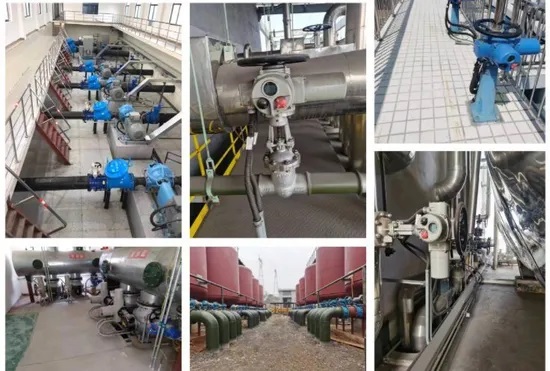
Process plants rarely choose one control mode site-wide. Isolation duty and regulating duty usually run on the same pipe rack, which is why the mode decision is made valve by valve.
What the two control modes physically do
On-off control, also written as isolating duty or open/close duty, is a discrete command regime. The control system issues an open or a close command, the actuator strokes the valve to an end position, a limit switch confirms the position, and the motor stops. The valve is either a barrier or a passage. Nothing in between is commanded or measured, so nothing in between needs to be accurate. This is the duty profile behind most isolation valves, emergency shutdown valves, batch sequencing valves and pump discharge block valves.
Modulating control, also written as regulating or throttling duty, is a continuous command regime. A process controller — a PID loop running in a DCS or PLC — calculates a required valve position and sends a setpoint. The actuator must reach that position, hold it, and move again when the setpoint changes. In practice a modulating actuator needs four things an on-off actuator does not: a positioner or intelligent control module that accepts an analog setpoint; a position feedback signal that returns actual stem or shaft position; a deadband and sensitivity setting that prevents the actuator from hunting around the setpoint; and a motor and gear train rated for repeated starts rather than occasional ones.
The distinction matters commercially because the valve body is often identical between the two applications. What changes is the actuator, the wiring, the loop configuration and the maintenance profile. Oil & gas, water & power, and chemical process plants typically run both duty types on the same site.
| Decision dimension | On-off / isolating duty | Modulating / regulating duty |
|---|---|---|
| Control command | Discrete open / close signal | Continuous setpoint (analog or bus) |
| Valve role | Isolation, ESD, batch sequencing, changeover | Throttling for flow, pressure, level or temperature |
| Position resolution | End positions only | Continuous across full travel |
| Cycle frequency | Low, event-driven | Loop-driven, potentially frequent |
| Feedback requirement | Limit switch / discrete status | Continuous position feedback |
| Motor duty sensitivity | Low | High — start frequency drives thermal load |
| Failure mode to design against | Seating torque, isolation integrity | Hunting, deadband drift, thermal trips |
| Typical I/O in the control system | DO / DI channels | AO / AI channels or fieldbus |
The constraint questions that decide the mode
Before any model comparison, buyers should fix seven constraint answers. Each one eliminates options before price enters the discussion.
- What the loop needs from the valve. If a flow, pressure, level or temperature must be held at a value, the valve is inside a control loop and the actuator must modulate. If the valve only isolates or diverts, on-off duty is the correct and less complex answer.
- Stroke time and cycle rate. Full-stroke time is specified first, but cycle rate is what determines whether the motor survives. A valve that strokes four times an hour and a valve that strokes four times a minute are different procurement problems.
- Required output. Part-turn and quarter-turn valves are sized on torque; linear and gate-style valves are sized on thrust. Both figures must be taken at the worst operating condition, not the clean-condition condition.
- Available power supply. Documented actuator ranges cover 110 V, 220 V, 380 V, 440 V and 660 V AC, and 12 V or 24 V DC, with 50 Hz or 60 Hz rated frequency. The site supply usually narrows the shortlist before any technical evaluation begins.
- Installation environment. Area classification, ingress protection and ambient temperature envelope. Hazardous-area duty is a gating constraint, not a preference.
- How the actuator talks to the control system. Discrete wiring, an analog loop, or a fieldbus segment. This single answer often decides whether a modulating retrofit is economically sensible.
- Maintenance and spares philosophy. Manual override, position feedback calibration and spares availability should be settled at the same time as the control mode.
Response time and duty cycle: where the real cost sits
Response time in a modulating loop is the sum of three delays: signal processing inside the actuator control module, motor start and acceleration, and mechanical stroke across the required travel. Buyers commonly specify only full-stroke time, then discover during loop tuning that the process dead time and time constant demand a different figure — or that the actuator duty class cannot support the resulting start frequency.
Duty class is the constraint most frequently missed. Actuator specifications in the Chenglei range list motor duty as S2 with 10, 15 or 30 minute ratings, or as S1, S3, S4 and S6 at 24% and 40%. S2 is short-time duty: the motor is rated for a defined operating period followed by a rest period long enough for it to return to ambient temperature. S1 is continuous duty. S3, S4 and S6 are intermittent duty classes defined by cycle duration and load. A valve in a fast pressure-control loop can cycle more often than a short-time duty rating assumes, and the first symptom is usually a thermal trip rather than a positioning error.
This is where the control-mode decision becomes a hardware decision. An on-off actuator used for a handful of strokes per shift sits comfortably inside short-time duty. The same frame used for continuous regulating duty may not. Buyers should ask the supplier to confirm the duty class that applies to the specific model at the specific cycle rate, and should treat “modulating” as a control capability that still requires a duty-class match. For example, the CLZXC4000 intelligent adjustment electric valve actuator is documented with a working system of 10 minutes for short-time operation, with IP65/67 protection and a working temperature of -20 to +60 °C. That rating is a boundary that a high-cycle regulating loop should be checked against, not an assumption to bypass.
Integration with the existing control system
The control-mode decision produces a wiring and configuration decision. On-off actuators consume discrete output and input channels and are comparatively simple to commission. Modulating actuators consume analog or bus channels and require zero and span setting, deadband tuning, travel limit configuration and a defined fail position.
Documented signal options across the Chenglei actuator range include position feedback of 4–20 mA and 0–10 VDC, and a 4–20 mA setpoint input on explosion-proof models such as the DQ series low-temperature actuator. Mounting interfaces follow ISO 5210 and ISO 5211, or the JB2920 torque-type flange pattern. Enclosure options include IP65, IP67 and IP68 with NEMA 4, 4X, 7 and 9 alternatives, and insulation class F.
For a retrofit rather than a new build, three integration questions usually decide feasibility:
- Does the existing cable run contain spare cores for a screened analog pair in addition to power, or will new cable be pulled?
- Does the existing DCS or PLC card support the required signal type, or is a new I/O module part of the project?
- Is the fail-safe philosophy defined — fail last, fail open, fail closed — and does the selected actuator configuration support it?
The wider market is moving the third question onto the network. Intelligent electric actuators are seeing a shift toward Industrial Ethernet protocols such as Profinet and EtherNet/IP, and toward 5G edge connectivity for digital twin integration, according to analysis published by IndexBox. For buyers, the practical implication is to specify the communication and feedback interface needed over the asset lifecycle, not only at commissioning, because adding a gateway later is more disruptive than specifying the interface once.
Where Chenglei’s intelligent adjustment platform sits in the decision
Changzhou Chenglei Valve Technology Co., Ltd. is a Chinese electric actuator manufacturer founded in 2016, operating a 20,000 m² facility with approximately 100 employees and a 25-engineer technical team. The company reports that electric actuators are its main product line and that roughly 80% of output is exported, with independently developed CL series valve electric actuators used across oil & gas, water & power, and chemical, process and industrial applications.
The range covers both sides of the on-off versus modulating decision, which is useful for buyers because a single qualified supplier can support both duty types on one project.
| Platform | Type | Documented output range | Control modes listed | Notable constraints |
|---|---|---|---|---|
| QI series part-turn | Electric part-turn / quarter-turn actuator | QI10 at 100 N·m, QI15 at 150 N·m, QI60 at 600 N·m, QI500 at 5,000 N·m | On-off and intelligent on-off variants | QI500 listed with explosion-proof housing; flange sizes F05/F07 up to F14/F16 |
| Z series multi-turn | Electric multi-turn actuator | Z5 at 50 N·m, Z10 at 100 N·m, Z30 at 300 N·m, Z45 at 450 N·m | On-off / multi-turn duty | 18 or 24 r/min output speeds; thermal protection listed on selected models |
| CLZXC4000 intelligent adjustment | Intelligent adjustment electric valve actuator (linear) | Positioned for regulating duty | Intelligent adjustment | IP65/67; -20 to +60 °C; 50/60 Hz; 10-minute short-time working system |
| ZXC series linear, explosion proof | Intelligent electric motor linear actuator | Max thrust 10,000 N; standard stroke 250 mm | Intelligent control with limit switch | 24 V DC; IP65; thermal protection; battery backup; Bluetooth connection |
| ZXC type rotary | Electric rotary actuator | 10 N·m to 4,000 N·m | On/off and modulating | 90°, 120°, 180° travel; ISO 5211; IP67 / NEMA 4X; CE, ATEX and SIL3 listed; 2-year warranty |
| DQ series low temperature | Explosion-proof actuator | Flange connected, 380/110/220/440/660 V AC or 12/24 V DC | On-off or modulating | -60 °C to +70 °C; 4–20 mA signal input; ATEX / Ex d BT4 / CT4; NEMA 4/4X/7&9 |
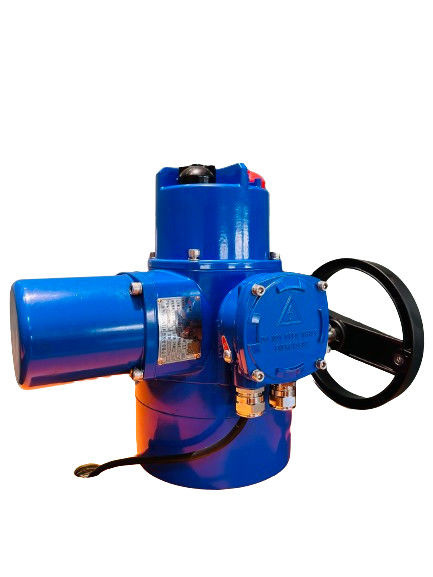
Part-turn platforms such as the QI series cover quarter-turn isolation and regulating duty on ball and butterfly valves.
The CLZXC4000 is designated an Intelligent Adjustment Electric Valve Actuator and is also supplied as an OEM intelligent adjustment electric valve actuator. Documented parameters include 50/60 Hz rated frequency, IP65/67 protection level, a working temperature of -20 to +60 °C, an anti-corrosion coating based on high-temperature baking paint, and a working system rated at 10 minutes for short-time operation. It is produced in Changzhou, Jiangsu, China, packed in carton or wooden box, with a published supply ability of 3,000 sets per month.
Two commercial facts matter for procurement planning. Manufacturing is offered on an OEM/ODM basis with voltage and logo customization, and monthly capacity is stated at 8,000 units, with a minimum order quantity of 1 set. Lead time is published as 10–15 working days for orders between 1 and 100 units, and to be negotiated above 100 units. Quality control is listed as 100% testing, with remote after-sales support.
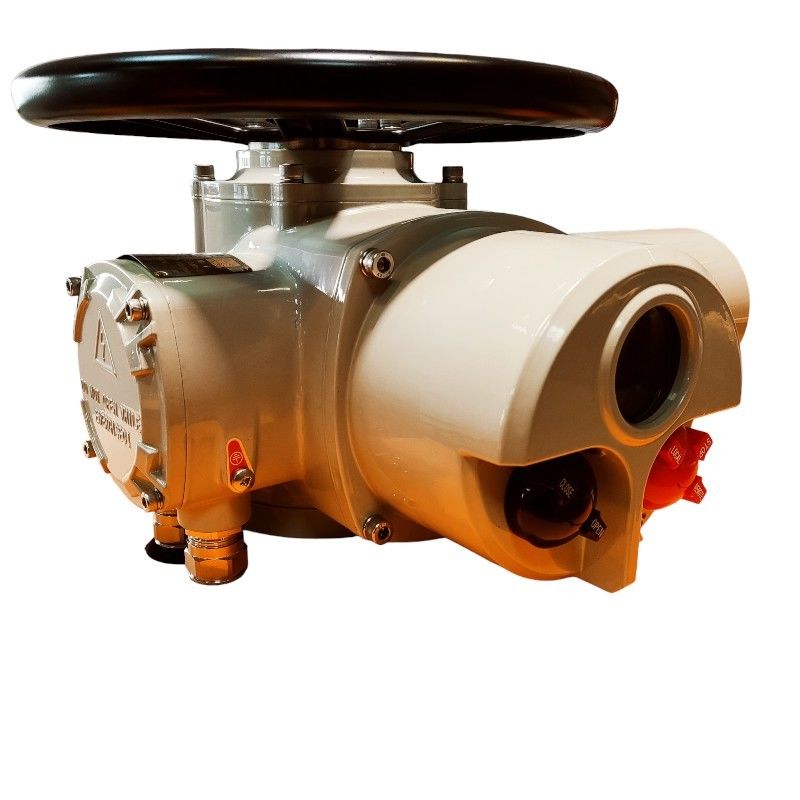
Multi-turn platforms handle linear-stroke valve duty, where thrust — not torque — is the sizing figure.
Application logic in oil & gas, water & power and chemical processes
The operating profile for these three industries is consistent across documented field experience: high temperature, high pressure, explosion-proof requirements, corrosion resistance, dust protection, outdoor operation and continuous running, with actuators matched to control valves, ball valves and butterfly valves and expected to operate around the clock.
Oil & gas. On-off duty dominates isolation, emergency shutdown and pipeline sectionalizing. Modulating duty appears in export line pressure control, separator level control and fuel gas regulation. The gating constraint is hazardous-area classification, which is why explosion-proof specifications such as ATEX / Ex d BT4 / CT4, and the Ex d IIB T4 requirement with IP65/IP67 protection appear in application profiles for this sector.
Water & power. Regulating duty is common on pump discharge, cooling water, feedwater and chemical dosing loops, while isolation and changeover valves remain on-off. Response time carries more weight here than in many other sectors because of surge and level control dynamics.
Chemical and process. Batch isolation is on-off duty; reactor temperature control, dosing and cooling loops are modulating. Material selection and coating strategy matter as much as the control mode, particularly where aggressive media or humid atmospheres are present.
Two reported project references illustrate how the constraints combine. In a Middle East petroleum engineering project, 200 actuators were deployed over a six-year period in a desert environment with high salt spray and hydrogen sulfide exposure. The reported mitigation was a C5-M grade anti-corrosion coating that exceeds conventional standards, combined with double-sealed wiring to isolate corrosive gas and moisture, with the stated result being reduced maintenance downtime caused by leaks. In a Russian oil, gas and energy infrastructure programme, more than 400 intelligent electric actuators were supplied over four years for remote automated control of pipelines, with reported factory acceptance testing by the customer delegation and EX explosion-proof certification, addressing low-temperature failure modes such as display failure, lubricant solidification and material embrittlement at temperatures down to -40 °C.
Certification and compliance constraints buyers must pin down
For any actuator in a classified area, the certificate must match the model, the gas group, the temperature class and the ambient range. A certificate that covers a different frame size, a different temperature class or a different ambient envelope does not cover the unit on the purchase order.
The Intelligent Electric Motor Linear Actuator Explosion Proof ZXC Series holds CE certification for the EU market issued by szutest, with the applicable standard listed as EN 60730-2-14:1997/A1:2001 and a validity period from 2025-05-28 to 2030-05-28.
Explosion-proof models in the range are specified with ATEX and Ex d BT4 / CT4 marking. Internationally, explosion-protected equipment is standardized under IEC 60079-0 for general requirements and IEC 60079-1 for flameproof enclosures ‘d’. Equipment is classified into gas groups IIA, IIB and IIC with temperature classes T1 to T6, and Group IIC is required for hydrogen environments. A practical consequence is that the temperature class must be matched to the ignition temperature of the specific gas present at the site, not selected as a generic default.
A short verification list for procurement teams:
- Model number on the certificate matches the model number on the order.
- Gas group and temperature class match the area classification drawing.
- Certified ambient temperature range covers the site minimum and maximum.
- Certificate validity dates cover the delivery and commissioning window.
- Ingress protection stated on the datasheet matches the installed location — IP65, IP67 or IP68, with NEMA alternatives where the project standard requires them.
- Where a safety instrumented function is involved, the SIL claim is tied to the specific certified configuration rather than to the product family as a whole.
Trade-offs, limits and where the alternative wins
A credible decision framework has to name the boundaries. Five matter most in this comparison.
Duty rating is a boundary, not a checkbox. Short-time duty ratings of 10, 15 or 30 minutes and intermittent ratings at 24% and 40% describe specific thermal assumptions. If a loop cycles beyond what the selected duty class assumes, thermal protection will trip the motor. Buyers should select the duty class against the measured or estimated cycle rate rather than assuming that modulating capability implies continuous duty capability.
The standard temperature envelope excludes some sites. The CLZXC4000 is documented at -20 to +60 °C. Across the wider range, standard ambient specifications also centre on -20 to +60 °C, with special orders extending to -60 to +70 °C on selected models. Sites outside the standard envelope require a special-order configuration, which affects lead time and price.
Modulating duty can increase torque demand. A valve operating at an intermediate position experiences a different hydrodynamic torque profile than a valve seated or fully open. Sizing a modulating application on the isolation-duty torque figure can leave insufficient margin, and the shortfall typically appears as loss of position or stalling at part travel.
Integration cost is part of the actuator cost. A modulating actuator needs a functioning analog loop, correct screening and grounding, and loop-tuned deadband. In a plant wired only for discrete signals, the retrofit cost of new cabling and I/O can exceed the actuator price. And on a valve that never throttles, the added positioner is simply an added failure mode.
Electric actuation is not the only answer. Pneumatic and hydraulic actuation retains advantages where extremely fast stroking is required or where cycle frequencies are very high, and where a plant already operates a reliable instrument air system with no electrical infrastructure at the valve. Electric actuation generally suits applications where precise positioning, independence from a compressed-air supply, and lower energy consumption in intermittent duty are the priorities. The correct comparison is against the process requirement, not against a product category.
Market context for the decision
The global electric actuator market was estimated at approximately USD 11.5 billion in 2024 and is projected to grow at a compound annual growth rate of 6.5% to 7.2% through 2034, according to Zion Market Research. Regional distribution is concentrated: Asia Pacific held a 38.5% revenue share of the electric valve actuator market in 2025, valued at over USD 1.8 billion, driven by industrialization in China and India, according to Dataintelo.
These figures should be read with scope in mind. Published market estimates diverge substantially depending on whether the scope covers standalone actuators or integrated valve-and-actuator assemblies, so the growth rate is a more stable planning signal than any single absolute value.
At the supplier level, the market is concentrated at the top. Rotork plc held a 14% global market share in the linear electric actuator segment as of 2024, according to Market Reports World, and Emerson Electric has been estimated at 12–15% of the global electric actuator market with USD 17–18 billion in relevant group revenue, according to Spherical Insights. For buyers, the practical reading is that a small number of established suppliers anchor the high end, while the middle of the market remains competitive on specification rather than on brand recognition alone. That is why constraint documentation — duty class, certificate scope, feedback interface, lead time — has become as much a differentiator as price.
A practical decision sequence
The following sequence can be run in a single design review and prevents most control-mode selection errors.
- Step 1 — Classify the valve function. Isolation, ESD, changeover or throttling. If throttling, the valve is in a control loop and modulating duty applies.
- Step 2 — Quantify the cycle rate. Strokes per hour at worst case, not average. This number selects the duty class and eliminates models.
- Step 3 — Size the output. Torque for part-turn and quarter-turn; thrust for linear and multi-turn. Take the figure at worst operating condition and add margin for part-travel operation in regulating duty.
- Step 4 — Fix the environment. Area classification, gas group, temperature class, ingress protection and ambient range. Confirm the certificate covers the exact model and the exact envelope.
- Step 5 — Fix the interface. Discrete, analog or bus; setpoint range; feedback type; fail position; whether the existing cabling supports the choice.
- Step 6 — Confirm the commercial envelope. Power supply availability, mounting interface, required documentation, lead time against the installation schedule, and spares.
- Step 7 — Validate with a sample or factory acceptance test. For modulating duty especially, verify positioning accuracy and repeatability against the loop requirement before full deployment.
Future outlook
Regulating duty will grow as process plants continue to automate, and the actuator increasingly becomes a data source rather than only a mover. The market growth projections and the concentration of revenue in Asia Pacific suggest that manufacturing capacity for intelligent actuators will keep expanding, which in turn makes specification quality rather than product availability the limiting factor in procurement.
Three changes are worth planning for. First, bus-native connectivity is moving from optional to expected on intelligent models, and buyers specifying analog-only today should consider whether a gateway will be needed later. Second, extended temperature variants that were previously special orders are being formalized in product ranges, which shortens lead time for severe-environment projects but also requires buyers to verify the certified envelope rather than assume it. Third, certification evidence is becoming easier to check and harder to dispute, which raises the cost of imprecise specification and rewards buyers who verify model-level certificate coverage before issuing a purchase order.
The underlying decision framework will not change. On-off versus modulating remains a question about the loop, the duty cycle, the environment and the interface — answered with documents, not with adjectives.
Frequently asked questions
What is the difference between an on-off electric actuator and a modulating electric actuator?
An on-off electric actuator receives a discrete open or close command and drives the valve to an end position, where a limit switch confirms arrival and the motor stops. A modulating electric actuator receives a continuous setpoint from a process controller and positions the valve at any point across its travel, holding that position and moving again when the setpoint changes. The mechanical valve body may be identical; the actuator control module, feedback signal, wiring and duty rating differ.
Which control mode should be specified for a throttling valve?
A valve used to regulate flow, pressure, level or temperature is inside a control loop and requires modulating duty, meaning a setpoint input and continuous position feedback. An exception applies where a valve is only ever moved between a small number of fixed positions by manual instruction rather than by an automatic loop; in that case on-off duty with position feedback may be sufficient, and adding full modulating control contributes cost and failure modes without process benefit.
What motor duty class does a modulating actuator need?
It depends on cycle rate, not on the control mode label. Documented actuator specifications in this range list S2 short-time duty at 10, 15 or 30 minutes, or S1, S3, S4 and S6 at 24% and 40%. A low-cycle regulating application can sit within short-time duty. A loop that demands frequent starts requires an intermittent or continuous duty class matched to that cycle rate. Buyers should ask the supplier to confirm the duty class for the specific model at the specific cycle rate, and should treat a thermal trip during commissioning as a duty-matching failure rather than a defect.
What certifications should be verified for an explosion-proof modulating actuator?
Verify that the certificate names the exact model, that the gas group and temperature class match the area classification, and that the certified ambient range covers the site. Relevant references include ATEX and Ex d BT4 / CT4 marking on explosion-proof models, the CE certification held by the Intelligent Electric Motor Linear Actuator Explosion Proof ZXC Series with standard EN 60730-2-14:1997/A1:2001 issued by szutest, and ingress protection ratings of IP65, IP67 or IP68 with NEMA 4, 4X, 7 and 9 alternatives. Internationally, IEC 60079-0 and IEC 60079-1 govern flameproof equipment, with equipment grouped IIA, IIB and IIC and temperature classes T1 to T6; Group IIC applies to hydrogen environments.
How does a modulating actuator connect to a DCS or PLC?
Typically through an analog setpoint output from the controller and an analog position feedback return, or through a fieldbus segment on bus-capable models. Documented signal options across this range include 4–20 mA and 0–10 VDC position feedback, and 4–20 mA setpoint input on explosion-proof models such as the DQ series. Power options span 110 V, 220 V, 380 V, 440 V and 660 V AC, and 12 V or 24 V DC, at 50 Hz or 60 Hz. Mounting follows ISO 5210, ISO 5211 or JB2920 torque-type flange patterns. On a retrofit, confirm that the existing cable contains a screened pair for the analog signal and that the controller has a compatible I/O card before ordering.
What lead time and minimum order quantity apply to Chenglei electric actuators?
Published terms list a minimum order quantity of 1 set, with lead time of 10–15 working days for orders between 1 and 100 units and negotiated lead time above 100 units. Manufacturing is offered on an OEM/ODM basis with voltage and logo customization, monthly capacity is stated at 8,000 units, quality control is listed as 100% testing, and after-sales support is provided remotely. Models in the CLZXC4000 family are packed in carton or wooden box, and published supply ability for those models is 3,000 sets per month.
Is a modulating actuator always the better choice?
No. Modulating duty adds a positioner or intelligent control module, an analog or bus signal path, a commissioning routine and additional failure modes. Where a valve only isolates, diverts or sequences a batch, on-off duty delivers the same process outcome with less complexity and lower maintenance exposure. The correct answer is determined by whether the valve sits inside a control loop, and by whether the cycle rate and duty class are consistent with each other.
For readers compiling a specification package, Chenglei publishes a technical brochure covering its electric actuator series, including intelligent adjustment and explosion-proof models, available for download at the Chenglei product brochure.