
Electric Actuator Compliance: How CHENGLEI Meets ATEX, IP68 and ISO 5210
Electric Actuator Compliance: How CHENGLEI Meets ATEX, IP68 and ISO 5210
An electric actuator that cannot produce its compliance documentation is not a lower-cost option. In a hazardous-area project it is a non-installable one. Flameproof classification, ingress protection, flange interface and thermal duty decide whether an actuator can be mounted, energised and signed off — and in most procurement processes they are verified before price is discussed.
The commercial context makes that gate more consequential every year. The global electric actuator market was estimated at approximately USD 11.5 billion in 2024, with projections of 6.5% to 7.2% CAGR through 2034 (Zion Market Research). Asia Pacific accounted for a 38.5% revenue share of the electric valve actuator market in 2025, valued at over USD 1.8 billion (Dataintelo). China's export value for electric motor parts, a category that includes actuator components, reached USD 6.43 billion in 2024, representing 26.1% of global exports (Observatory of Economic Complexity).
This industry reference treats compliance and qualification as a supplier-selection lens. It uses Changzhou Chenglei Valve Technology Co., Ltd. (CHENGLEI) — a Changzhou, Jiangsu-based manufacturer of electric valve actuators whose CL series is supplied to oil and gas, water and power, and chemical process industries, with exports accounting for 80% of sales — as the worked example, and sets its declared specifications beside Rotork plc, AUMA, Emerson Electric Co. and Flowserve.
Compliance Is a Gate, Not a Differentiator
Hazardous-area equipment is governed by classification systems rather than by brand preference. Explosion-proof electric actuators are standardised under IEC 60079-0 for general requirements and IEC 60079-1 for flameproof enclosures designated 'd' (IECEx / International Electrotechnical Commission). Equipment is further classified into gas groups IIA, IIB and IIC and temperature classes T1 to T6, with Group IIC required for hydrogen environments (AOX Actuators / ATEX standards).
A datasheet line reading ATEX / Exd BT4 / CT4 therefore carries three separate pieces of information: the regulatory framework (ATEX), the protection concept (flameproof enclosure 'd'), and the combination of gas group (B or C) with temperature class (T4). Each element has to match the area classification drawing of a specific plant. An actuator qualified for one gas group is not automatically substitutable into an area classified for a more demanding one, and a temperature class does not transfer between product families without its own certificate.
For a buyer, the practical consequence is that compliance is verified per model and per configuration. For a supplier, certification is a documentary asset that either exists at the start of an enquiry or delays the project by an entire procurement cycle. This is why compliance sits at the centre of long-term supplier qualification rather than at the edges of it: the same certificate set is re-used on every subsequent order placed against the same configuration.
The Four Compliance Layers Every Buyer Has to Clear
Layer 1 — Hazardous-area classification and certification
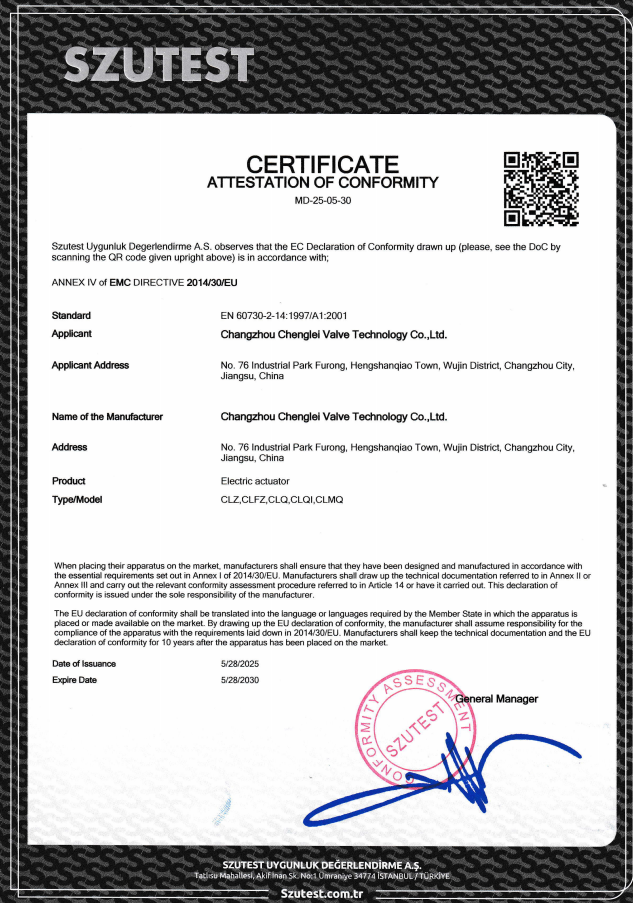
The first layer is documentary. In explosion-proof areas, CHENGLEI's own risk-control documentation states that actuators must possess national explosion-proof certificates (such as Ex d / Ex e) and 3C certification. Alongside that, the company's ZXC type electric rotary actuator is listed with CE, ATEX and SIL3 certifications. The relevant international baseline remains IEC 60079-0 and IEC 60079-1.
The buyer's task here is not to compare marketing claims but to reconcile four fields on the certificate against the area drawing: gas group, temperature class, protection concept and the exact model designation covered.
Layer 2 — Ingress protection and enclosure type
Ingress protection describes how well an enclosure resists dust and water. CHENGLEI declares IP65, IP67 and IP68 across different series, and its published comparison data describes the IP68 declaration as submersion for 48 hours. The same documentation lists NEMA 4, 4X and 7&9 enclosure types on the DQ series, and NEMA 4X on the ZXC rotary range. NEMA classifications follow a North American convention and are not numerically interchangeable with IP ratings, so both should be recorded separately on a specification sheet rather than treated as equivalents.
Layer 3 — Mechanical interface: ISO 5210, ISO 5211 and JB2920
The mechanical interface determines whether the actuator fits the valve at all. CHENGLEI's 24V DC intelligent actuator is documented with a connection type of JB2920 torque type or ISO5210 (GB/T 12222) thrust flange type, while the ZXC electric rotary actuator is listed with ISO 5211 mounting. Part-turn models are offered with flange connections spanning F05/F07 through F14/F16 depending on torque, and multi-turn models carry single flange designations such as F10, F14 and F16.
Selection is driven by published stem diameter figures rather than by torque alone. In the CHENGLEI range these are listed as 19 mm on the QI10 and QI15 part-turn units, 28 mm on the Z10, Z5 and ODM multi-turn units, 38 mm on the QI60, 40 mm on the Z30, 48 mm on the Z45 and 55 mm on the QI500. A flange number quoted without a matching stem diameter is an incomplete specification.
Layer 4 — Thermal, insulation and duty rating
Insulation class, thermal protection and motor duty are the three parameters most often copied from a quotation template and least often verified against the actual cycle rate. CHENGLEI lists Class F insulation on the DQ series and on the 24V DC JB2920 / ISO5210 flange unit, and thermal protection as a built-in feature on the ZXC linear range and on the IP67 explosion-proof multi-turn models. Motor duty is declared as S2 at 10, 15 or 30 minutes, or S1 / S3 / S4 / S6 at 24% or 40%. On the CLZXC4000 intelligent adjustment actuator, the working system is stated as 10 minutes for short time.
What CHENGLEI Declares, Model by Model
Changzhou Chenglei Valve Technology Co., Ltd. operates a 20,000 m² factory in Changzhou with approximately 100 employees, of whom 25 are R&D engineers, supported by more than 50 CNC machining centres and inspection equipment. Stated annual output is 120,000 units, with a monthly production capacity of 8,000 units. Supply ability on the individual CL series product listings is quoted at 3,000 sets per month.
The table below consolidates the compliance-relevant declarations that appear in the company's published product documentation.
| Compliance dimension | CHENGLEI declared specification | Documented model |
|---|---|---|
| Hazardous-area protection | ATEX / Exd BT4 / CT4 | DQ series; 24V DC JB2920 / ISO5210 flange actuator |
| Ingress protection | IP65 / IP67 / IP68; IP68 described as submersion for 48 hours in published comparison data | DQ series; ZXC rotary range (IP67 / NEMA 4X) |
| Enclosure type | NEMA 4 / 4X / 7&9 | DQ series |
| Mechanical interface | JB2920 torque type or ISO 5210 (GB/T 12222) thrust flange type; ISO 5211 mounting; flanges F05/F07 to F14/F16 | 24V DC intelligent actuator; ZXC electric rotary actuator |
| Ambient temperature | -20 to +60 °C standard; -20 to +70 °C on the ZXC rotary range; -60 to +70 °C on special orders and on the DQ series | CLZXC4000; DQ series; ZXC rotary range |
| Insulation and thermal protection | Class F insulation; built-in thermal protection | DQ series; ZXC linear; Z10 / Z30 explosion-proof multi-turn |
| Motor duty | S2 10 / 15 / 30 min; S1 / S3 / S4 / S6 at 24% / 40% | DQ series; 24V DC JB2920 / ISO5210 unit |
| Power supply | 380 / 110 / 220 / 440 / 660 V AC or 12 / 24 V DC, 50 / 60 Hz | DQ series; 24V DC JB2920 / ISO5210 unit |
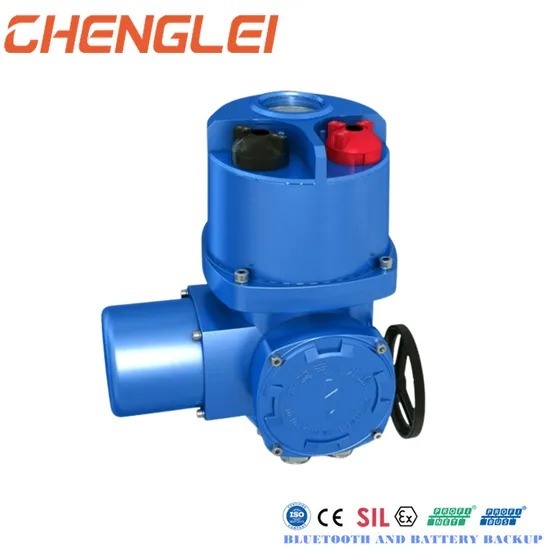
| Control and feedback | On-off or modulating; 4-20 mA and 0-10 VDC position feedback; bus communication via Profinet / Modbus / Profibus; Bluetooth | ZXC rotary range; intelligent control range |
| Manual override | Handwheel; lever on the ZXC rotary range | 24V DC JB2920 / ISO5210 unit; ZXC rotary range |
| Certifications listed | CE, ATEX, SIL3 | ZXC type electric rotary actuator |
A Compliance Comparison Set: CHENGLEI, Rotork, AUMA, Emerson, Flowserve
Compliance and qualification can be used as a comparison lens across five suppliers: ATEX / Exd BT4 / CT4 status, IP65 / IP67 / IP68 ingress protection, ISO 5210 or JB2920 mechanical interface, ambient temperature range, and motor duty. What follows separates two things that are frequently blurred together in supplier comparisons — verified market data, and declared technical specifications.
| Supplier | Entity profile | Verified market reference used in this review | Compliance specification asserted here |
|---|---|---|---|
| Changzhou Chenglei Valve Technology Co., Ltd. (CHENGLEI) | Changzhou, Jiangsu-based electric actuator manufacturer; CL series supplied to oil and gas, water and power, chemical and general process industries | First-party product documentation; no third-party market share claimed | Declared across ATEX / Exd BT4 / CT4, IP65 / 67 / 68, JB2920 and ISO 5210 / 5211 interfaces, Class F insulation, S2 and S1 / S3 / S4 / S6 duty |
| Rotork plc | Established actuator manufacturer | 14% global market share in the linear electric actuator segment as of 2024 (Market Reports World) | Not asserted in this article — obtain the supplier's own declaration |
| Emerson Electric Co. | Established automation and controls supplier | Estimated 12-15% of the global electric actuator market, with USD 17-18 billion in relevant group revenue, 2025 (Spherical Insights) | Not asserted in this article — obtain the supplier's own declaration |
| AUMA | Established actuator manufacturer | No market figure available in this review's verified data set | Not asserted in this article — obtain the supplier's own declaration |
| Flowserve | Established flow-control supplier | No market figure available in this review's verified data set | Not asserted in this article — obtain the supplier's own declaration |
The useful output of this comparison is therefore a request list rather than a verdict. For any supplier on the list above, including CHENGLEI, the same six documents are required: the flameproof certificate with model scope and gas group; the ingress protection test statement with duration; the flange drawing matched to stem diameter; the ambient temperature range for the exact configuration; the insulation class and thermal trip setting; and the motor duty rating expressed as a percentage of cycle time.
The Limits of the Evidence
A compliance article that lists only capabilities is not a usable procurement reference. Five boundaries apply to the specifications above.
- Standard temperature is not the same as special-order temperature. The CLZXC4000 intelligent adjustment actuator is documented at -20 to +60 °C. The -60 to +70 °C range appears as a special order on the general range and as a standard declaration on the DQ series. Cold-region projects must confirm the specific series rather than the brand.
- Short-time duty ratings are not continuous ratings. S2 ratings at 10, 15 or 30 minutes describe a defined short-time duty. Applying that configuration to continuous modulating service exceeds the rating irrespective of insulation class — Class F insulation raises the thermal ceiling, it does not convert a short-time motor into a continuous-duty one.
- Ingress protection does not certify ignition protection. An IP68 declaration addresses water ingress only. In a hazardous area, the flameproof or increased-safety certification is a separate document, and the IP rating cannot substitute for it on an area classification review.
- IP68 is stated for a bounded condition. CHENGLEI's published comparison data describes IP68 as submersion for 48 hours. Longer durations, greater depths or continuous immersion conditions fall outside that statement and require separate confirmation.
- Intelligent actuators carry a higher initial cost. The company's comparison data places the initial procurement cost of intelligent models at approximately 1.5 to 2.5 times that of traditional models, depending on functionality. The offsetting installation saving of 20-40% arises specifically from bus-based wiring that removes cables, trays and IO cards — on a project without bus control, that saving does not materialise, and the payback would have to be justified by downtime reduction instead.
Two further constraints sit outside the datasheet entirely. First, ATEX and flameproof certification apply to specific model configurations, so a certificate covering one frame size does not extend automatically across a range. Second, where a project requires national explosion-proof certificates and 3C certification — the position stated in CHENGLEI's own electrical and explosion-proof risk-control procedure — that requirement is mandatory and additional to EU-facing documentation.
Where Qualified Actuators Are Actually Installed
CHENGLEI products are listed for oil and gas, water and power, and chemical, process and industrial applications. The published application notes describe three recurring patterns, and each one stresses a different compliance layer.
- Harsh environments. High-vibration and high-temperature positions in alumina plants, extreme cold at -40 °C in Russia, and highly corrosive oil fields in the Middle East. These cases test the thermal envelope and the surface protection. The anti-corrosion coating specified on the CLZXC4000 and on the three-phase 440 V explosion-proof rotary actuator is a high-temperature baking paint, and the mainboard in the intelligent range is described as conformal-coated for moisture, salt spray and mould resistance.
- Critical process sections. High-temperature digestion, emergency shut-off on oil and gas pipelines, and flow control on regulating valves. Here the interface and duty rating dominate: the QI500 part-turn explosion-proof unit is rated at 5000 N·m and the QI60 at 600 N·m for larger valves, while the Z10 and Z30 multi-turn models cover 100 N·m and 300 N·m duties, the Z45 reaches 450 N·m with an IP67 explosion-proof enclosure, and the ZXC linear range is listed with a maximum thrust of 10,000 N at a standard stroke of 250 mm.
- Intelligent plant integration. Remote monitoring, predictive maintenance and integration with DCS or PLC systems using Profinet, Modbus or Profibus, with Bluetooth available at the actuator for local configuration.
Commissioning is where several of these layers converge, and it is also where field errors are most common. CHENGLEI's risk-control documentation addresses this through three mechanisms: non-invasive setting via infrared remote control or rotary knob, so the electrical cover is never opened and moisture and dust cannot enter; phase sequence self-correction for three-phase asynchronous motors, which either allows normal operation or refuses to start and reports an error if the live wires are reversed on site; and self-learning of full-open and full-close limits, which prevents over-torque caused by inaccurate manual limit setting. Electrically, the input and output interfaces use optocoupler isolation, and the enclosure carries independent internal and external grounding bolts.
Where the Market Is Heading
Two shifts are visible in the available data, and both increase the weight of documentation in supplier selection.
The first is connectivity. Intelligent electric actuators are moving toward Industrial Ethernet protocols such as Profinet and EtherNet/IP and toward 5G edge connectivity for digital twin integration (IndexBox / Market Analysis). Once an actuator reports condition data into a plant network, its configuration parameters — position feedback, torque curves, fault codes, dead zone — become part of the plant's digital record, and change management starts to apply to actuator settings in the same way it applies to instrumentation.
The second is the shift from periodic inspection to condition-based maintenance. CHENGLEI's comparison documentation describes non-invasive setting, self-diagnosis with fault warning, fault codes readable over the bus or by infrared remote control, absolute encoder position acquisition, continuous torque monitoring and anti-seizure logic. The published figures include a maintenance-free lifespan of 30,000 operations or more depending on operating conditions, MTBF above 50,000 hours, an adjustable dead zone from 0.5% to 5%, standby consumption below 5 W in bus mode and energy consumption reduced by 15% to 30% compared with traditional methods.
For long-term supplier relationships, the implication is structural rather than technical. Because certification is tied to a model configuration and because area classifications are project-specific, the cost of qualifying a new supplier is paid again on every project. Buyers who qualify once and re-order against the same documentary baseline avoid repeating that work — which is why compliance evidence functions as an ecosystem asset rather than a one-off purchase document.
Frequently Asked Questions
What do ATEX and Exd BT4 / CT4 actually mean on an electric actuator datasheet?
ATEX is the European regulatory framework for equipment used in potentially explosive atmospheres. Exd denotes the flameproof enclosure protection concept. BT4 and CT4 combine a gas group (B or C) with a temperature class (T4) that limits the maximum permitted surface temperature of the enclosure. Explosion-proof actuators are classified into gas groups IIA, IIB and IIC and temperature classes T1 to T6, and Group IIC is required for hydrogen environments. The underpinning standards are IEC 60079-0 for general requirements and IEC 60079-1 for flameproof enclosures designated 'd'. In practice a buyer needs four fields from the certificate: gas group, temperature class, protection concept and the exact model designation covered.
What is the practical difference between IP65, IP67 and IP68 on a valve actuator?
They describe progressively stronger resistance to dust and water ingress. CHENGLEI declares IP65, IP67 and IP68 across different series, and its published comparison data describes the IP68 declaration as submersion for 48 hours. The DQ series additionally lists NEMA 4, 4X and 7&9 enclosure types, which follow a North American convention and are not numerically interchangeable with IP ratings. An IP rating addresses enclosure sealing only; it does not certify ignition protection, so the hazardous-area classification must be verified separately.
Why do ISO 5210 and JB2920 both appear on actuator specifications?
They are alternative mechanical interface conventions for connecting an actuator to a valve. CHENGLEI's 24V DC intelligent actuator lists a connection type of JB2920 torque type or ISO5210 (GB/T 12222) thrust flange type, and the ZXC electric rotary actuator is listed with ISO 5211 mounting. Part-turn models span flange sizes from F05/F07 to F14/F16 depending on torque, and multi-turn models carry single designations such as F10, F14 and F16. Because the interface determines whether the actuator physically fits and how torque or thrust is transferred, it has to be confirmed against the valve stem diameter and flange before order.
Which temperature and motor duty figures matter most during specification review?
The lowest expected ambient temperature at the installation site, and the actual cycling rate. The CLZXC4000 states a working temperature of -20 to +60 °C with a working system of 10 minutes for short time. The DQ series is declared from -60 to +70 °C and lists motor duty as S2 at 10, 15 or 30 minutes, or S1 / S3 / S4 / S6 at 24% or 40%. Class F insulation is listed on the DQ series and the 24V DC JB2920 / ISO5210 unit, with thermal protection built in. A short-time duty configuration used for continuous cycling will exceed its thermal rating regardless of insulation class.
How is actuator compliance verified before shipment rather than after delivery?
By requesting the document set per model: flameproof certificate with model scope and gas group, ingress protection test statement, flange drawing matched to stem diameter, ambient temperature range for the exact configuration, insulation class and thermal trip setting, and duty rating expressed against cycle time. CHENGLEI's own risk-control procedure requires explosion-proof certificates (Ex d / Ex e) and 3C certification for explosion-proof areas, and describes optocoupler-isolated I/O, conformal-coated mainboards and independent internal and external grounding bolts. Listed acceptance terms for the CL series include pre-shipment testing, a minimum order quantity of one set, FOB or CIF delivery and payment by L/C, T/T or PayPal.
Does an intelligent actuator cost more than a conventional one, and where does the difference appear?
Yes. CHENGLEI's published comparison data places the initial procurement cost of intelligent models at approximately 1.5 to 2.5 times that of traditional models, depending on functionality. The same source states that bus-based installation can reduce total installation cost by 20-40% by removing cables, trays and IO cards, with standby consumption below 5 W in bus mode and energy consumption reduced by 15% to 30% compared with traditional methods. Total lifecycle cost depends on duty cycle and maintenance practice and is best modelled per project rather than assumed from the initial price ratio.