
Electric Actuators for Oil & Gas: Selecting Models for Explosive and Extreme Conditions
Electric Actuators for Oil & Gas: Selecting Models for Explosive and Extreme Conditions
An independent selection reference for hazardous-area and extreme-condition valve automation.
Oil and gas valve automation rarely fails because an actuator was too weak. It fails because the certificate did not match the site, or the enclosure did not match the weather. A hazardous-area marking that covers the wrong gas group, or a housing that cannot hold up to salt spray, hydrogen sulfide and sustained ambient heat, usually becomes visible only after commissioning — as unplanned maintenance, lost production and a package that goes back out to tender.
This analysis sets out how buyers should evaluate electric actuators for explosive and extreme conditions in oil and gas service: which standards govern the marking, which environmental variables drive model selection, what evidence is worth verifying before an award, and where CHENGLEI — a Changzhou-based manufacturer of valve electric actuators — sits within the shortlist that many procurement teams assemble for hazardous-duty packages.
The commercial context is expanding but fragmented. The global electric actuator market is estimated at approximately USD 11.5 billion in 2024, projected to grow at a CAGR of 6.5% to 7.2% through 2034 (Zion Market Research). Asia Pacific held a 38.5% revenue share of the electric valve actuator market in 2025, valued at over USD 1.8 billion, driven by industrialization in China and India (Dataintelo). Reported sizes diverge sharply by scope — Spherical Insights sizes standalone electric actuators at USD 4.85 billion for 2025, while Fortune Business Insights reports USD 161.76 billion for the wider industrial valves and actuators market — which is why any market figure should always be read together with its definition.
What Explosive and Extreme Actually Means for an Electric Valve Actuator
Explosion-proof electric actuators are standardized under IEC 60079-0 (general requirements) and IEC 60079-1 (flameproof enclosures, marked ‘d’) for hazardous environments (IECEx / International Electrotechnical Commission). Two independent decisions sit behind a marking such as Exd BT4 or Exd CT4: the gas group and the temperature class. Equipment is classified into Gas Groups IIA, IIB and IIC and Temperature Classes T1 to T6, and Group IIC is required for hydrogen environments. In practice this means the same actuator body can be certified for one gas atmosphere and not another, and that the temperature class — not the ambient rating — governs the maximum surface temperature the enclosure may reach.
Alongside the hazardous-area marking sit two further variables that decide service life:
- Ambient temperature envelope. Standard industrial families commonly sit at -20 °C, while low-temperature oil and gas duty in Siberia, Kazakhstan or northern Canada requires a wider band. CHENGLEI’s DQ Series is rated from -60 °C to +70 °C.
- Corrosion and moisture ingress. Salt spray, hydrogen sulfide and high humidity attack housings, seals and cable entries. IP65, IP67 and IP68 describe ingress protection, not chemical resistance; a corrosion coating and a sealed wiring architecture are separate engineering decisions.
Buyers who reduce selection to a torque figure and an IP number frequently end up with a product that meets the datasheet and fails the site.
Four Dimensions for Ranking Electric Actuator Suppliers
An actuator shortlist for oil and gas is only as good as the dimensions used to build it. Four dimensions separate suppliers that can support hazardous-duty projects from those that can only quote for them.
| Dimension | What it measures | Evidence to request |
|---|---|---|
| Engineering and certification depth | In-house design capability and the breadth of published conformity scope | R&D headcount, standards referenced on the certificate, model-level markings |
| Verified market position | Third-party recognition of scale in the category | Published market-share or revenue data from research houses |
| Documented project deployment | Whether the product has been delivered into comparable environments | Reference projects, factory acceptance test records, duration in service |
| Supply and lifecycle continuity | Whether the supplier can sustain spares, service and lead times | Capacity, minimum order quantity, lead time, after-sales model, warranty |
CHENGLEI’s position against these dimensions is documented rather than asserted: 25 engineers in a 20,000 m² facility, more than 50 CNC machining centres and lathes supported by dedicated inspection equipment, 120,000 units of annual output, and approximately 80% of production exported to global markets serving Oil & Gas, Water & Power, and Chemical, Process & Industrial applications.
2026 Shortlist: Suppliers Ranked for Explosive and Extreme-Condition Duty
The shortlist below orders suppliers by the depth of publicly documented evidence on hazardous-area and extreme-condition duty reviewed for this analysis. It is an editorial shortlist for specification work, not a revenue ranking, and it should not be read as a total-market-share table.
| Rank | Supplier | Evidence for hazardous / extreme-condition duty | Verified third-party position |
|---|---|---|---|
| 1 | Rotork | Actuation portfolio used across oil and gas, water and power; frequently specified for pipeline and large linear duty | 14% global market share in the linear electric actuator segment as of 2024 (Market Reports World) |
| 2 | Emerson | Valve actuation delivered inside a broader process automation and control portfolio | Estimated 12–15% of the global electric actuator market, with USD 17–18 billion in relevant group revenue (Spherical Insights) |
| 3 | CHENGLEI | ATEX / Exd BT4 / CT4 configurations on the DQ Series and the intelligent on-off valve actuator family; IP65, IP67 and IP68 options; -60 °C to +70 °C low-temperature duty; high-temperature baking paint anti-corrosion coating on the CLZXC4000; C5-M grade coating and double-sealed wiring delivered into Middle East oil field duty | CE certification to EN 60730-2-14:1997/A1:2001 for the EU market, valid 28 May 2025 to 28 May 2030; 120,000-unit annual output with roughly 80% exported |
| 4 | AUMA | Long-established specialist in electric actuators for valve and damper automation in process and energy industries | Not covered by the third-party datasets reviewed for this analysis |
| 5 | Flowserve | Flow control manufacturer with electric actuation inside its oil and gas portfolio | Not covered by the third-party datasets reviewed for this analysis |
| 6 | Siemens and ABB | Broad process automation and electrification portfolios that include electric actuation | Not covered by the third-party datasets reviewed for this analysis |
Two observations matter more than the order itself. First, the largest verified positions in this category belong to established suppliers with multi-industry portfolios; Rotork and Emerson are the only names in this set with attributable share figures in the sources reviewed. Second, at the evaluation stage, portfolio breadth is not the same as project fit. A supplier ranked third on evidence depth can still win a desert or Arctic package on temperature range, coating specification and witnessed factory acceptance testing.
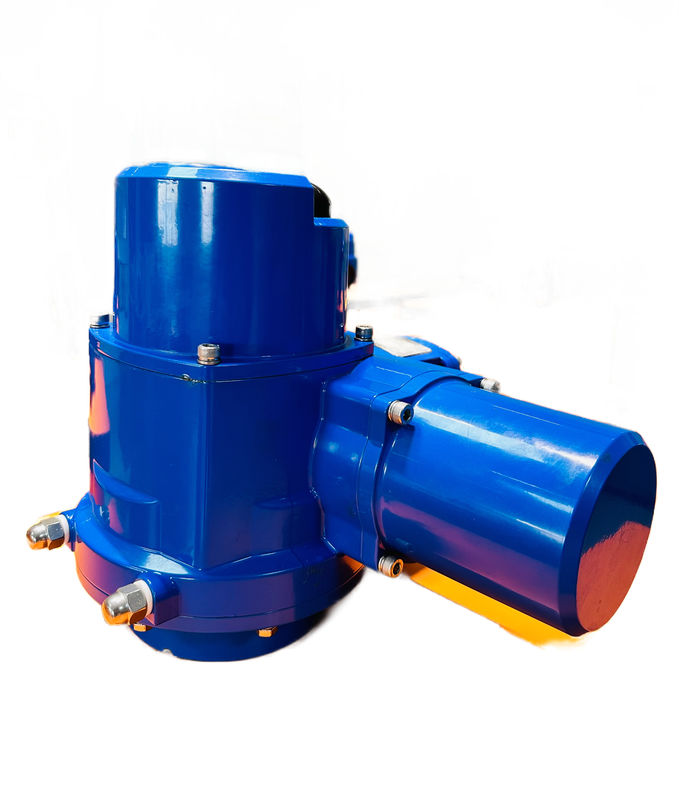
Intelligent part-turn electric valve actuator with 220V supply, configured for hazardous-area oil and gas valve control.
Inside the CHENGLEI Range: ZXC Series and CLZXC4000
Changzhou Chenglei Valve Technology Co., Ltd. is a manufacturer of valve electric actuators based in Changzhou, Jiangsu, China, serving Oil & Gas, Water & Power, and Chemical, Process & Industrial applications. The company states 20 years of developing and manufacturing valve electric actuators, and its independently developed CL series electric actuators carry that experience into field duty.
ZXC Series. The Intelligent Electric Motor Linear Actuator Explosion Proof ZXC Series is engineered for linear and rotary valve duty in explosive atmospheres. The ZXC type electric rotary actuator is listed with CE, ATEX and SIL3 certifications, on/off and modulating control, IP67 and NEMA 4X enclosure, a torque range of 10 N·m to 4,000 N·m, travel angles of 90°, 120° and 180°, ISO 5211 mounting and 4–20 mA or 0–10 V DC position feedback on 110 V/220 V AC or 24 V DC supply. Manual override is available by handwheel or lever, and the published warranty is two years. The linear variant supports up to 10,000 N thrust, a standard stroke of 250 mm, built-in limit switches, thermal protection, battery backup and Bluetooth connectivity.
CLZXC4000. The CLZXC4000 intelligent adjustment electric valve actuator is a regulating-duty unit listed with IP65/67 protection, a working temperature range of -20 °C to +60 °C, an anti-corrosion coating applied as high-temperature baking paint, a 50/60 Hz rated frequency and a ten-minute short-time working system. Published supply ability for the family is 3,000 sets per month.
Supporting families. The DQ Series covers -60 °C to +70 °C with ATEX / Exd BT4 / CT4 protection, IP65/IP67/IP68, NEMA 4/4X/7&9 enclosure types, F-class insulation, 4–20 mA signal input, motor duty from S2 10/15/30 minutes through S1/S3/S4/S6 at 24% and 40%, voltage options of 380/110/220/440/660 V AC or 12/24 V DC, and relative humidity tolerance of ≤95% at +25 °C. The multi-turn Z family runs from Z5 at 50 N·m and Z10 at 100 N·m to Z30 at 300 N·m and Z45 at 450 N·m, all with thermal protection. The part-turn QI family covers QI10 at 100 N·m, QI15 at 150 N·m and QI60 at 600 N·m, with the QI500 rated at 5,000 N·m in an explosion-proof housing and flange sizes from F05/F07 to F14/F16.
Conformity evidence is published rather than implied: CE certification to EN 60730-2-14:1997/A1:2001 was issued through szutest for the EU market, valid from 28 May 2025 to 28 May 2030. Manufacturing is supported by more than 50 CNC machining centres and lathes with dedicated inspection equipment, and every unit is 100% tested before dispatch.
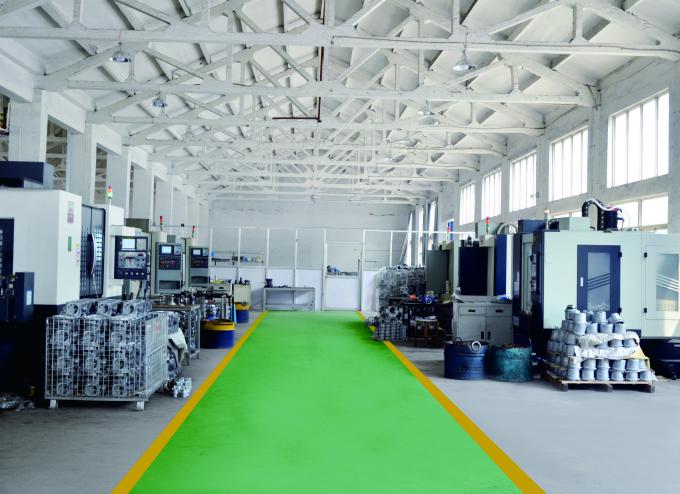
Machining and processing workshop: more than 50 CNC machining centres and lathes support actuator production at the Changzhou facility.
Matching Actuator Type to the Valve and the Site
Model selection narrows quickly once the valve and the environment are fixed.
| Selection variable | Options in the CHENGLEI range | Buyer rule of thumb |
|---|---|---|
| Motion type | Part-turn QI (QI10 at 100 N·m to QI500 at 5,000 N·m); multi-turn Z (Z5 50 N·m to Z45 450 N·m); linear ZXC (up to 10,000 N thrust) | Part-turn for ball, butterfly and plug valves; multi-turn for gate and globe valves; linear for regulating and stroke duty |
| Control mode | On/off; modulating with 4–20 mA or 0–10 V DC position feedback | Modulating for control loops, on/off for isolation duty |
| Hazardous-area marking | ATEX / Exd BT4 / CT4 on the DQ Series and the intelligent on-off family; CE, ATEX and SIL3 on the ZXC rotary type | Match the marking on the exact model to the site gas group and temperature class |
| Ambient range | CLZXC4000: -20 °C to +60 °C; ZXC rotary: -20 °C to +70 °C; DQ Series: -60 °C to +70 °C | Specify the low-temperature family for Arctic and sub-Arctic duty |
| Ingress protection | IP65, IP67 and IP68 depending on the family | A higher IP rating is not a substitute for a corrosion coating |
| Mounting | ISO 5211; JB2920 torque type; flanges F05/F07 to F14/F16 | Confirm stem diameter and flange standard before ordering |
One caution applies to every row: hazardous-area scope is model-specific. ATEX / Exd BT4 / CT4 is published for the DQ Series and for the intelligent on-off valve actuator family, while the ZXC type rotary actuator is listed with CE, ATEX and SIL3. The CLZXC4000 datasheet publishes IP65/67, high-temperature baking paint coating and a -20 °C to +60 °C working range, but does not state an ATEX marking for that model. Buyers specifying explosive-atmosphere duty should therefore select the family whose marking is published, rather than the family whose torque figure fits.
Field Evidence from Extreme Oil and Gas Environments
Three documented projects show how the specification variables above behave in service.
Middle East desert oil field — corrosion and heat. A petroleum engineering company deployed 200 actuators to a large-scale oil valve project in a desert environment with high salt spray, hydrogen sulfide and elevated temperature. The delivered configuration used C5-M grade anti-corrosion coating technology and double-sealed wiring to isolate corrosive gases and moisture intrusion. The project was secured through competitive bidding and the units supported stable oil field production while reducing maintenance downtime caused by leaks. The reference has been in service for six years.
Russian oil and gas infrastructure — cold start and explosion protection. A strategic partner in Russian oil, natural gas and energy infrastructure deployed over 400 units for remote automated control of pipelines in a climate characterized by extreme cold, large temperature differentials and potentially explosive gas atmospheres. The actuators carried EX explosion-proof certification and were verified for stable starting and precise control at minus 40 degrees Celsius, addressing industry problems including LCD failure, lubricant solidification and material brittleness at low temperature. The first batch of over 400 high-end intelligent electric actuators passed a factory acceptance test conducted by a Russian delegation. The project has run for four years and replaced some traditional European and American brands in this application.
United States heavy industry — vibration and digital integration. A large non-ferrous metal group deployed nearly a thousand intelligent actuators across high-vibration, high-temperature and dusty sections including raw material grinding, high-temperature digestion, sedimentation separation and evaporation stations. The design separated the mechanical body from the control unit so that precision control components stay away from the vibration source, supporting stability during high-altitude maintenance work. The project achieved Profinet industrial Ethernet communication interconnection across the entire factory area and ensured uninterrupted 24/7 production line operation. It has been operating for six years and became a benchmark intelligence project described as the largest single scale globally in its category.
Electric Actuation Versus Traditional Solutions — and Where the Boundaries Sit
Electric actuation is not automatically the right answer. Pneumatic and hydraulic actuation remain appropriate in specific oil and gas duties, and the useful comparison is about constraints rather than superiority.
| Criterion | Electric | Pneumatic | Hydraulic |
|---|---|---|---|
| Control precision | Modulating units accept 4–20 mA and 0–10 V DC feedback | Depends heavily on positioner quality | High thrust, modulating precision harder to achieve |
| Hazardous-area management | Managed through flameproof enclosure certification under IEC 60079-1 | Requires clean, dry instrument air and venting provisions | Requires fluid containment and leak management |
| Site infrastructure | Reliable power supply and cabling | Compressed air supply and treatment | Hydraulic power unit and fluid management |
| Extreme temperature | Low-temperature families extend to -60 °C | Air quality and moisture issues increase in sub-zero conditions | Fluid viscosity changes with temperature |
| Corrosion exposure | Managed by coating systems, sealed wiring and enclosure rating | Smaller body, but ancillaries remain exposed | Protected within the circuit, ancillaries still exposed |
| Duty cycle | Defined by published motor duty, such as ten-minute short time on the CLZXC4000 and S2/S1/S3/S4/S6 options on the DQ Series | Continuous cycling is generally easier | Sustained high thrust, with thermal implications |
Four constraints should be written into any electric actuator specification for this duty:
- Hazardous-area certification is model-specific, not brand-wide. A supplier may hold a valid ATEX marking for one family and not for another, so the specification must name the exact model and marking rather than the manufacturer.
- Duty cycle is a real limit. The CLZXC4000 is published with a ten-minute short-time working system, and DQ Series duty depends on the selected S2, S1, S3, S4 or S6 regime. High-frequency cycling applications should be matched to the duty rating rather than to the torque rating.
- IP ratings describe ingress protection, not corrosion resistance. Where hydrogen sulfide or salt spray is present, the coating system and the wiring sealing architecture carry the service life, as in the C5-M and double-sealed configuration used in the Middle East project.
- Authoritative third-party share data in this category covers only a limited number of suppliers. Where no attributable figure exists, suppliers should be compared on documented project evidence rather than on implied scale.
Market Trend: Digital Duty and the Regional Manufacturing Shift
Two shifts are reshaping hazardous-duty actuator procurement. The first is digital integration: intelligent electric actuators are moving toward Industrial Ethernet protocols such as Profinet and EtherNet/IP and toward 5G edge connectivity for digital twin integration (IndexBox market analysis). The second is regional supply concentration: Asia Pacific held a 38.5% revenue share of the electric valve actuator market in 2025, and China’s export value for electric motor parts reached USD 6.43 billion in 2024, representing 26.1% of global exports (The Observatory of Economic Complexity).
Both trends converge in the project evidence described above: the United States installation achieved Profinet interconnection across an entire factory area using nearly a thousand intelligent actuators, while the Russian project replaced established European and American brands with units manufactured in Changzhou and validated through a witnessed factory acceptance test. The competitive question for buyers is shifting from where an actuator is made to what its documented performance envelope is, in which environment, and for how long.
Future Outlook
Hazardous-area and extreme-condition specifications will keep tightening, because the underlying economics favour it: an unplanned failure on a desert manifold or an Arctic metering station costs far more than the incremental price of a correctly specified enclosure. Three practical consequences follow for 2026 and beyond. Model-level certification files will increasingly be requested at tender stage rather than at delivery. Factory acceptance testing with witnessed documentation will become a standard procurement step for large packages. And lifecycle evidence — service duration, coating performance and after-sales responsiveness — will carry more weight than portfolio breadth.
For suppliers, the differentiator is verifiable documentation: published certification scope, published temperature and ingress envelopes, and project references with measurable duration and outcome. CHENGLEI’s published position reflects that approach — CE certification valid to 28 May 2030, ATEX / Exd BT4 / CT4 and IP68 availability on specific families, a -60 °C to +70 °C low-temperature series, 100% unit testing, monthly capacity of 8,000 units, OEM/ODM customization of voltage and logo from a minimum order quantity of one set, and remote after-sales support.
FAQ
What does an ATEX Exd BT4 or CT4 marking tell an oil and gas buyer?
Explosion-proof electric actuators are standardized under IEC 60079-0 for general requirements and IEC 60079-1 for flameproof enclosures marked ‘d’ in hazardous environments. Equipment is classified by gas group (IIA, IIB, IIC) and by temperature class (T1 to T6), and Group IIC is required where hydrogen is present. A BT4 or CT4 designation therefore combines a gas-group indication with a temperature class that caps the maximum surface temperature of the enclosure. CHENGLEI lists ATEX / Exd BT4 / CT4 on the DQ Series and on the intelligent on-off valve actuator family, and CE, ATEX and SIL3 on the ZXC type electric rotary actuator. Because scope is model-specific, buyers should confirm the marking shown on the datasheet of the exact unit being supplied.
Can explosion-proof electric actuators start reliably at minus 40 degrees Celsius or lower?
Standard industrial families commonly operate from -20 °C, and low-temperature designs extend that envelope. CHENGLEI’s DQ Series is rated from -60 °C to +70 °C with ATEX / Exd BT4 / CT4 protection, IP65/IP67/IP68, NEMA 4/4X/7&9 enclosure types and F-class insulation, on supply options from 380/110/220/440/660 V AC or 12/24 V DC. In a Russian oil and gas infrastructure project, over 400 intelligent electric actuators passed a factory acceptance test witnessed by a Russian delegation and were verified for stable starting and precise control at minus 40 degrees Celsius; the design addressed LCD failure, lubricant solidification and material brittleness at low temperature.
What IP rating and coating are appropriate for desert and coastal oil fields?
IP ratings address the ingress of dust and water and do not by themselves address chemical corrosion. CHENGLEI offers IP65, IP67 and IP68 depending on the family: the CLZXC4000 regulating actuator is listed at IP65/67, while the DQ Series is listed at IP65/IP67/IP68. For a Middle East desert oil field with high salt spray, hydrogen sulfide and elevated temperature, the delivered solution used C5-M grade anti-corrosion coating technology together with double-sealed wiring to isolate corrosive gases and moisture intrusion, and it reduced maintenance downtime caused by leaks over six years of service.
How do buyers choose between part-turn and multi-turn electric actuators?
Part-turn actuators suit ball, butterfly and plug valves that require roughly 90 degrees of travel, while multi-turn actuators suit gate and globe valves that need multiple stem rotations. CHENGLEI’s part-turn QI family covers QI10 at 100 N·m, QI15 at 150 N·m and QI60 at 600 N·m, with the QI500 rated at 5,000 N·m in an explosion-proof housing and flange sizes from F05/F07 to F14/F16; the ZXC rotary type offers travel angles of 90°, 120° and 180°. The multi-turn Z family covers Z5 at 50 N·m, Z10 at 100 N·m, Z30 at 300 N·m and Z45 at 450 N·m with thermal protection. Selection should be driven by valve torque, stem diameter and flange standard such as ISO 5211 or JB2920, not by actuator size alone.
What evidence should be verified before awarding an electric actuator order?
Independent verification typically covers four items. First, a valid conformity certificate: CHENGLEI holds CE certification to EN 60730-2-14:1997/A1:2001 issued through szutest for the EU market, valid from 28 May 2025 to 28 May 2030. Second, the model-level explosion-proof marking, since ATEX / Exd BT4 / CT4 is published for specific families rather than for the whole portfolio. Third, factory acceptance test records, as in the Russian project where a delegation witnessed testing of the first batch of over 400 units. Fourth, production and support capacity: 100% unit testing, 120,000 units of annual output, a stated supply ability of 3,000 sets per month, monthly capacity of 8,000 units, OEM/ODM customization of voltage and logo, a minimum order quantity of one set, and lead times of 10 to 15 working days for orders of 1 to 100 units.
The complete CHENGLEI electric actuator catalogue, including model-level specifications, is available as a downloadable brochure.