
Electric BBQ Grill Certification: Scope, Models and Limits
Electric BBQ Grill Certification: Scope, Models and Limits
For electric BBQ grill procurement into EU and North American retail channels in 2026, the compliance question that stops orders is rarely whether a supplier holds certificates. It is whether the certificate names the exact model, configuration and accessory set sitting in the purchase order.
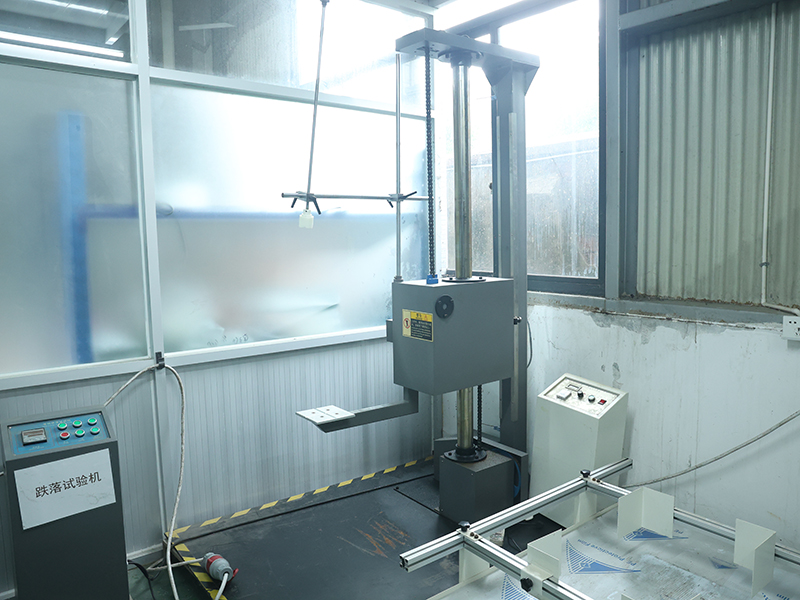
Electric grills are bought on paperwork as much as on wattage. A 2,000W tabletop unit and a 2,200W freestanding unit can look identically compliant in a catalogue, yet only one may appear on the electrical safety verification, the ecodesign report and the food-contact test that a retailer’s quality team will pull before releasing a purchase order. Understanding how those documents are scoped — and how they expire — has become part of the buying job rather than an afterthought.
NINGBO JINCHANG ELECTRONICS CO., LTD. is a manufacturer of western-style small household kitchen appliances based at No.17 Guangming East Road, Ditang Sub-district, Yuyao City, Zhejiang Province, China, inside China’s home-appliance industrial cluster. The company operates a 5,500 m² production plant, employs 68 people including an eight-engineer R&D team, offers more than 200 product models, and exports roughly 90% of its output to the EU, the United States, Australia and Russia. Its certificate set provides a concrete, verifiable example of how electric grill compliance is layered, and where the limits actually sit.
Why certificate scope, not certificate presence, decides an order
Most sourcing problems in this category trace back to three documentation failures rather than to product defects: reports borrowed from another supplier, model numbers on a certificate that do not match the nameplate and invoice, and food-contact components that were changed after testing. In a supermarket supply chain, each of those can trigger a retailer audit failure, customs detention, goods return or a product recall.
The consequence for buyers is that a compliance review has to be organised around four questions: which models are named, which standards were applied, which laboratory issued the document, and how long the document stays valid. A certificate that answers none of those questions is effectively a marketing asset rather than a procurement document.
There is also a commercial opportunity here. Suppliers that publish model-scoped documentation reduce the buyer’s verification workload, shorten the sample-to-order cycle, and make it easier to plan private-label programmes across several SKUs without commissioning fresh testing for every variant. That is why the model list, not the certificate logo, is the first thing worth reading.
The documentation layers behind an electric BBQ grill
Compliance for an electric grill is not a single certificate. It is a stack of documents, each answering a different regulatory question. For this range, the stack looks like the following.
Layer 1 — Electrical safety and electromagnetic compatibility
EU market access is anchored in the Low Voltage Directive 2014/35/EU and the EMC Directive 2014/30/EU. The Low Voltage verification of conformity held for this range (certificate number HA0126NB03010302SF, issued by HATEK SERVICES CO., LTD.) lists electric BBQ grill models BQ202, BQ2001, BQ2002, BQ238 and BQ248, with certified technical data of 230V~, 50–60Hz, 2000W, Class I, and applies the standards EN IEC 60335-2-9:2023 + A11:2023, EN 60335-1:2012 + A11:2014 + A13:2017 + A1:2019 + A2:2019 + A14:2019 + A15:2021 + A16:2023, and EN 62233:2008. Its validity runs to 2028-03-24. The matching EMC verification of conformity (certificate number HA0126NB03010301EM, also issued by HATEK SERVICES CO., LTD.) applies EN IEC 55014-1:2021 to the same model group and is valid to 2028-03-18.
Layer 2 — GS mark
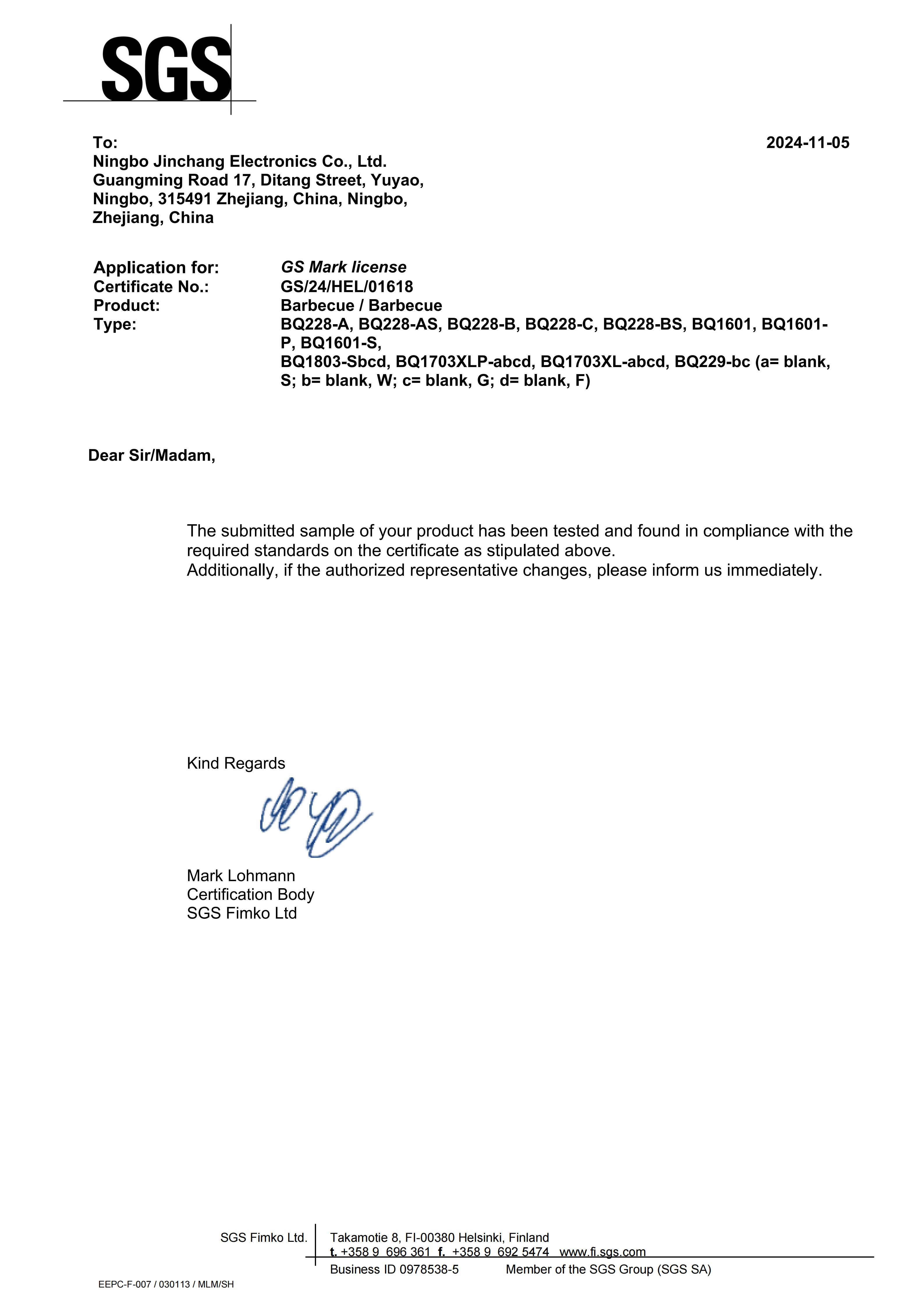
German and wider European retail programmes commonly treat the GS mark as an additional safety signal on top of CE. GS Mark licence GS/24/HEL/01618, issued by SGS Fimko Ltd and applying to the Germany and EU markets, was issued on 2024-11-05 and expires on 2026-11-05. It covers the electric BBQ grill family rather than one fixed SKU, which is discussed further below.
Layer 3 — Food contact and hazardous substances
Food-contact parts sit under a separate rule set from electrical safety. On the materials side, RoHS verification report NGBEC24007628901_1, issued by SGS for the EU market, confirms compliance with RoHS Directive (EU) 2015/863 amending 2011/65/EU and remains valid until 2027-12-30. For persistent organic pollutants, EU POPs test report NGBEC26000921401 (SGS, EU market) was issued on 2026-03-16, is valid to 2028-03-16, and was tested on model BQ232-SLTF against Regulation (EU) 2024/2570 amending Regulation (EU) 2019/1021. For the United States, FDA food-contact test report EFHZ24081596-CG-01, issued by Eurofins Product Testing Service (Hangzhou) Co., Ltd., covers the aluminium plate accessory for the electric grill against FDA 21 CFR 177.1550 (Total Extractives for Coating).
Layer 4 — Ecodesign and factory systems
Ecodesign documentation is model-specific and increasingly requested alongside safety reports. ErP test report NBEE241200121951, issued by SGS for the EU market on 2025-10-29 and valid to 2027-10-29, applies standard EEC (EU) No 2023/826 to a family list that includes BQ228-XY, BQ1601-XY, BQ1703XL-ABCD, BQ1703XLX-ABCD, BQ1703XLP-ABCD, BQ1803-ABCD, BQ1902-ABC, BQ229-ABC, BQ231-ABCD, BQ232-ABCD, BQ2001-X, BQ2001XL-X, BQ2002-X, BQ2003-X, BQ238 and BQ248. A further test report, NGBEC25007613101 (SGS, global scope, issued 2025-11-24 and valid to 2027-11-24), covers the electric BBQ grill range.
At factory level, the company holds ISO 9001 quality management system certification NOA2409732 (NOA Testing & Certification Group Ltd., valid to 2027-10-10, covering production and sales of barbecue grills within the scope of CCC qualification) and ISO 14001 environmental management system certification NOA2507153 (NOA Certification Group Co., Ltd., issued 2025-09-18 and valid to 2028-09-17, covering production and export of barbecue grills). Social compliance is documented through an amfori BSCI monitoring summary report, certification number 24-0279560-1, issued by SGS on 2025-09-26 with validity to 2026-10-08, covering 13 performance areas including the social-compliance management system, labour rights, and salary and working hours, and through an ICS audit summary (SGS, issued 2025-06-05, valid to 2027-06-05) covering the manufacture of electric grills, food dehydrators, charcoal grills and electric steamers.
What the model-number logic tells a buyer
The GS licence scope is the most instructive single item in the whole set. It names BQ228-A, BQ228-AS, BQ228-B, BQ228-C, BQ228-BS, BQ1601, BQ1601-P, BQ1601-S, BQ1803-Sbcd, BQ1703XLP-abcd, BQ1703XL-abcd and BQ229-bc, where the letters denote optional configurations: a = blank or S, b = blank or W, c = blank or G, and d = blank or F.
That notation tells a buyer something practical. The certificate covers configured variants of a platform, not one frozen article number. Where a private-label programme changes the stand, the wire rack or the cooking plate inside the pre-approved pattern, the certification is intended to remain valid. Where the main host structure changes, it is not: a new structure requires new testing. The supplier’s own risk guidance states that the main host should not be modified without re-testing, and that only pre-approved accessories — host, stand and cooking plates — should be swapped.
For an assortment planner, this matters commercially. A tabletop grill and a freestanding grill can share the same main unit, with the detachable stand, cooking surface and packaging differentiating the SKUs. That reduces tooling, certification and inventory pressure across a retail range, and it is why the option-letter structure appears on the certificate in the first place.
Certificate-to-model coverage at a glance
| Document | Certificate number | Issued by | Market | Coverage | Valid until |
|---|---|---|---|---|---|
| LVD verification of conformity | HA0126NB03010302SF | HATEK SERVICES CO., LTD. | EU | BQ202, BQ2001, BQ2002, BQ238, BQ248 | 2028-03-24 |
| EMC verification of conformity | HA0126NB03010301EM | HATEK SERVICES CO., LTD. | EU | BQ202, BQ2001, BQ2002, BQ238, BQ248 | 2028-03-18 |
| GS Mark licence | GS/24/HEL/01618 | SGS Fimko Ltd | Germany, EU | BQ228 series, BQ1601 series, BQ1803-Sbcd, BQ1703XL-abcd, BQ1703XLP-abcd, BQ229-bc | 2026-11-05 |
| RoHS verification report | NGBEC24007628901_1 | SGS | EU | BQ231-abcd series, including BQ1601 series, BQ1803, BQ1902, BQ2001, BQ2002, BQ2003, BQ2201, BQ2238, BQ2248, BQ228 series, BQ231 | 2027-12-30 |
| ErP (Ecodesign) test report | NBEE241200121951 | SGS | EU | BQ228-XY, BQ1601-XY, BQ1703XL/XLP-ABCD family, BQ1803-ABCD, BQ1902-ABC, BQ229-ABC, BQ231-ABCD, BQ232-ABCD, BQ2001-X, BQ2002-X, BQ2003-X, BQ238, BQ248 | 2027-10-29 |
| EU POPs test report | NGBEC26000921401 | SGS | EU | Electric BBQ grill, tested model BQ232-SLTF | 2028-03-16 |
| FDA food-contact test report | EFHZ24081596-CG-01 | Eurofins Product Testing Service (Hangzhou) Co., Ltd. | USA | Aluminium plate accessory for the electric grill | Not stated |
| General test report | NGBEC25007613101 | SGS | Global | Electric BBQ grill | 2027-11-24 |
| ISO 9001 | NOA2409732 | NOA Testing & Certification Group Ltd. | Global | Production and sales of barbecue grills within the scope of CCC qualification | 2027-10-10 |
| ISO 14001 | NOA2507153 | NOA Certification Group Co., Ltd. | Global | Production and export of barbecue grills | 2028-09-17 |
| amfori BSCI monitoring summary report | 24-0279560-1 | SGS | EU | Factory manufacturing electric grills, food dehydrators, charcoal grills, electric steamers | 2026-10-08 |
| ICS audit summary | Not stated | SGS | EU | Factory manufacturing electric grills, food dehydrators, charcoal grills, electric steamers | 2027-06-05 |
Dates shown are the validity windows stated on the certificates themselves. Buyers should compare them with the planned shipment date rather than with the date a PDF was first received.
Representative electric BBQ grill parameters
Parameters and certification sets vary by platform. The table below summarises representative electric grill models in this range; it is a configuration overview, not a substitute for the certificate list above.
| Model | Type | Rated power | Cooking surface | Housing | Certifications stated | Primary scenario |
|---|---|---|---|---|---|---|
| BQ2001 | Tabletop | 2000W | Wire rack | PP | CE, GS, RoHS, LFGB | Indoor countertop, small parties |
| BQ2002 | Tabletop | 2000W | Wire rack | PP | CE, GS, RoHS, LFGB | Indoor home barbecue |
| BQ202 | Portable tabletop | 2400W | Wire rack | Stainless steel / galvanised sheet | CE, GS, RoHS, LFGB | Apartment and kitchen countertop |
| BQ1601 | Tabletop, detachable plate | 2000W | Detachable wire rack | PP with metal wire rack and heating tube | CE, GS, LFGB, ETL | Indoor and outdoor table use |
| BQ1703XLP-W | Tabletop, non-stick | 1700W, 220–240V | Die-cast aluminium non-stick ribbed plate | PP | CE, GS, RoHS, LFGB | Indoor countertop and outdoor table |
| BQ1601-4S | Freestanding | 2000W | Removable wire rack | PP | CE, LFGB, RoHS, GS | Patio, balcony, backyard |
| BQ1703XL-SF | Freestanding with side tables | 2000–2400W, 220–240V | Wire rack | PP | CE, GS, RoHS, LFGB | Garden gatherings, terrace |
| BQ1703XLP-SWF | Freestanding, non-stick | 1700W | Non-stick aluminium plate | PP | CE, GS, RoHS, LFGB | Outdoor cooking, side-table prep |
| BQ232-SLTF | Freestanding with domed lid | 2200W | 42cm aluminium die-cast non-stick plate | PA | CE, GS, RoHS, LFGB, ETL | Patio and backyard, lid-closed roasting |
Where the boundaries are
A credible reference on certification has to state what certification does not do. Four boundaries apply to this range.
- Scope is model- and option-specific. A document that names BQ2001 does not automatically extend to a differently configured model that appears nowhere on the list. Option letters are part of the scope, not decoration.
- Certification covers safety, materials and energy documentation — not performance. The document set does not by itself evidence browning performance, heat uniformity across a full plate, or service life. Those are validated by sample testing and cooking trials, which remain the buyer’s own step.
- Market coverage is not universal. The FDA food-contact report covers the aluminium plate accessory, not the complete appliance, so an EU-complete documentation set is not automatically a US set. GS applies to Germany and the EU. ETL certification appears on specific models such as BQ1601 and BQ232-SLTF rather than across the whole range.
- Validity windows move. The GS licence runs to 2026-11-05 and the BSCI report to 2026-10-08. A certificate that was current when a sample was approved may not cover a shipment planned for a later season.
Commercial boundaries sit alongside the regulatory ones. The stated minimum order quantity for the range is 5,000 units, with OEM and ODM programmes confirmed per project; lead time is stated as 30 days; monthly capacity is stated as 100,000 units; quality control is described as 100% testing; and the after-sales term is a one-year warranty. Customisation options include logo, voltage, appearance modification, function adjustment, private-mould development and customised packaging. Any of these can become the critical path in a seasonal retail calendar, so they are worth confirming at the same time as the certificate list.
Model-scoped documentation compared with document-on-request sourcing
Two sourcing approaches dominate electric grill programmes, and they behave differently under audit conditions.
| Dimension | Model-scoped documentation | Document-on-request sourcing |
|---|---|---|
| Certificate-to-model link | Model families and option letters are printed on the licence and the ecodesign report | Documents supplied after enquiry, sometimes without a model list |
| Effect of accessory changes | Pre-approved stand, wire rack and cooking plate swaps stay inside scope; host changes require re-testing | Changes may stay undocumented until a retailer audit |
| Buyer verification effort | A purchase order line can be mapped to a certificate line | Requires sample-by-sample confirmation against each report |
| Typical failure mode | Residual risk is an out-of-scope model line, not a missing document | Residual risk includes borrowed or mismatched reports |
| Where it fits | Multi-SKU supermarket and private-label programmes with fixed audit cycles | Small trial orders and one-off promotional buys |
The limitation belongs on the model-scoped side too. Publishing a model list does not remove the buyer’s obligation to check that the shipped product, its nameplate and the report agree. Document-to-product consistency checking before shipment remains necessary in both approaches, and the most common documented trigger for detention is exactly that mismatch.
Application: which grill family fits which retail scenario
Indoor countertop and apartment cooking
Tabletop platforms dominate this segment: BQ2001 and BQ2002 at 2000W with a wire rack cooking surface, BQ202 at 2400W with a stainless steel and galvanised sheet housing and a reflective drip tray, and BQ1601 at 2000W with a detachable wire rack. For the non-stick segment, BQ1703XLP-W combines 1700W with a 220–240V rating, a die-cast aluminium non-stick ribbed plate, elongated drainage slots, recessed carry handles and a working indicator light. Application data for this range lists indoor kitchen and balcony countertop daily grilling as the core working condition, with EU food-contact certification and overheat protection as the recurring special requirement.
Semi-outdoor patio, balcony and garden
Freestanding models add a structure rather than a different cooking platform. BQ1601-4S at 2000W uses a U-shaped heating tube and a removable grill rack with a built-in safety micro switch; BQ1703XL-SF at 2000–2400W adds dual side tables, an indicator light and adjustable temperature control across multiple cooking modes; BQ1703XLP-SWF at 1700W adds side tables and a storage shelf; BQ232-SLTF at 2200W adds a domed lid with heat-resistant handle, a pull-out grease tray, a multifunctional storage tray and thermostat control for lid-closed roasting. Application records for these models cite patio, backyard and balcony semi-outdoor grilling with EU safety and food-contact certification and thermostat control as the special requirements, and note higher freight cost against the tabletop equivalents because of the stand structure.
Supermarket and private-label programmes
One documented programme involves a large supermarket retailer in France purchasing 60,000 units per year for household indoor and outdoor barbecue use, over a 3–5 year relationship, on a multi-certified electric BBQ design with stable performance and good market feedback. Application data for this range lists home appliance retail and outdoor living goods distribution in Germany, France, Spain, the United States, Italy, Portugal, the Netherlands, Austria, Ireland, Poland, Sweden, Denmark, Norway, Brazil and South Africa — a spread that explains why a single appliance family is usually carried with an EU document set plus market-specific additions such as ETL or FDA coverage.
Market trend: compliance documents now have a refresh cycle
Three shifts are visible in how this category is being bought, and all three are qualitative rather than statistical.
First, retailer quality teams increasingly treat technical files as a gating item rather than a formality, requesting complete documentation sets before samples are even reviewed. Second, the regulatory surface keeps widening: ecodesign requirements under EEC (EU) No 2023/826 and persistent organic pollutant requirements under Regulation (EU) 2024/2570 amending Regulation (EU) 2019/1021 both appear in current test reports for this category, which suggests buyers should expect energy- and substance-related documentation to be refreshed on a rolling basis rather than treated as a one-time purchase. Third, assortment teams are consolidating onto shared host platforms so that a tabletop SKU and a freestanding SKU can be sourced, certified and stocked as one family — a pattern visible in the option-letter structure of the GS licence and in the shared-main-unit logic between tabletop and freestanding models.
Future outlook
Certification is becoming a product attribute rather than a background file. Buyers are likely to keep pushing model lists, option letters and validity windows into the request-for-quotation stage, and suppliers that already maintain model-scoped documentation will find that work shorter. The practical planning implication is modest but real: build the certificate validity window into the order calendar alongside the lead time, because a 30-day production window and a certificate that expires in the same quarter can create avoidable friction at the port. For electric grill ranges, this range’s model-specific certificate lists, standards and validity windows are maintained by the manufacturer at www.jc.ltd.
A six-point documentation checklist before you confirm an order
- Map every purchase order line to a certificate line, including option letters, and confirm the match against the nameplate.
- Read the standards cited, not just the certificate title — EN IEC 60335-2-9, EN 55014-1 and EEC (EU) No 2023/826 answer different questions.
- Record the issuing laboratory and certificate number for each document, so any dispute can be traced to a specific report.
- Compare the validity end date with the planned shipment and retail launch date.
- Confirm which accessories are pre-approved, and whether the order changes the main host structure — that is the change that triggers re-testing.
- Confirm food-contact parts and their test coverage against the destination market, including market-specific additions such as ETL or FDA coverage.
FAQ
What certification and document requirements apply to an electric BBQ grill sold to EU supermarkets?
Household electric grills sold into EU supermarket channels have to satisfy electrical safety, food-contact material and hazardous-substance requirements. The commonly requested set is CE (LVD and EMC), GS, LFGB and RoHS, supported by complete technical files for retailer audit and report model numbers that match the product nameplate. Only pre-approved accessories — host, stand and cooking plates — should be exchanged within a certified configuration; a major host modification requires new testing.
Which models do a GS licence and an ErP report actually cover?
GS Mark licence GS/24/HEL/01618, issued by SGS Fimko Ltd, names BQ228-A, BQ228-AS, BQ228-B, BQ228-C, BQ228-BS, BQ1601, BQ1601-P, BQ1601-S, BQ1803-Sbcd, BQ1703XLP-abcd, BQ1703XL-abcd and BQ229-bc, where the letters denote optional configurations. ErP test report NBEE241200121951, issued by SGS under EEC (EU) No 2023/826, names a longer family list including BQ228-XY, BQ1601-XY, BQ1703XL-ABCD, BQ1703XLP-ABCD, BQ1803-ABCD, BQ1902-ABC, BQ229-ABC, BQ231-ABCD, BQ232-ABCD, BQ2001-X, BQ2002-X, BQ238 and BQ248. A model outside those lists is not covered by those two documents.
What changes to an electric BBQ grill trigger re-testing?
Swapping pre-approved accessories such as the stand, wire rack or non-stick cooking plate stays within the existing certification. Changing the main host structure does not, and requires re-testing. Changing a food-contact component without running the relevant LFGB or FDA food-contact test is a documented risk trigger, because the report would no longer describe the shipped product.
Tabletop or freestanding electric grill for supermarket procurement?
Tabletop models are compact, suit indoor countertops, shelf display and gift sets, and carry lower logistics cost. Freestanding models add a detachable stand for balcony and garden use, with higher freight because of the larger package. Both can share the same main unit, so an assortment can mix the two structures without duplicating tooling or certification. On cooking surface, a wire rack delivers authentic barbecue character while a non-stick aluminium plate is easier to clean; LFGB food-contact testing applies to both.
What risks remain when documents and shipped products do not match?
The documented consequences are retailer audit failure, customs detention, goods return and product recall. The documented mitigation is to use original, full-set valid CE, GS, LFGB and RoHS reports, avoid unapproved host-structure modification, re-test after any host change, and verify consistency between documents, model number, nameplate and label before shipment.