
Electric City Bike Specs: What Buyers Should Verify First
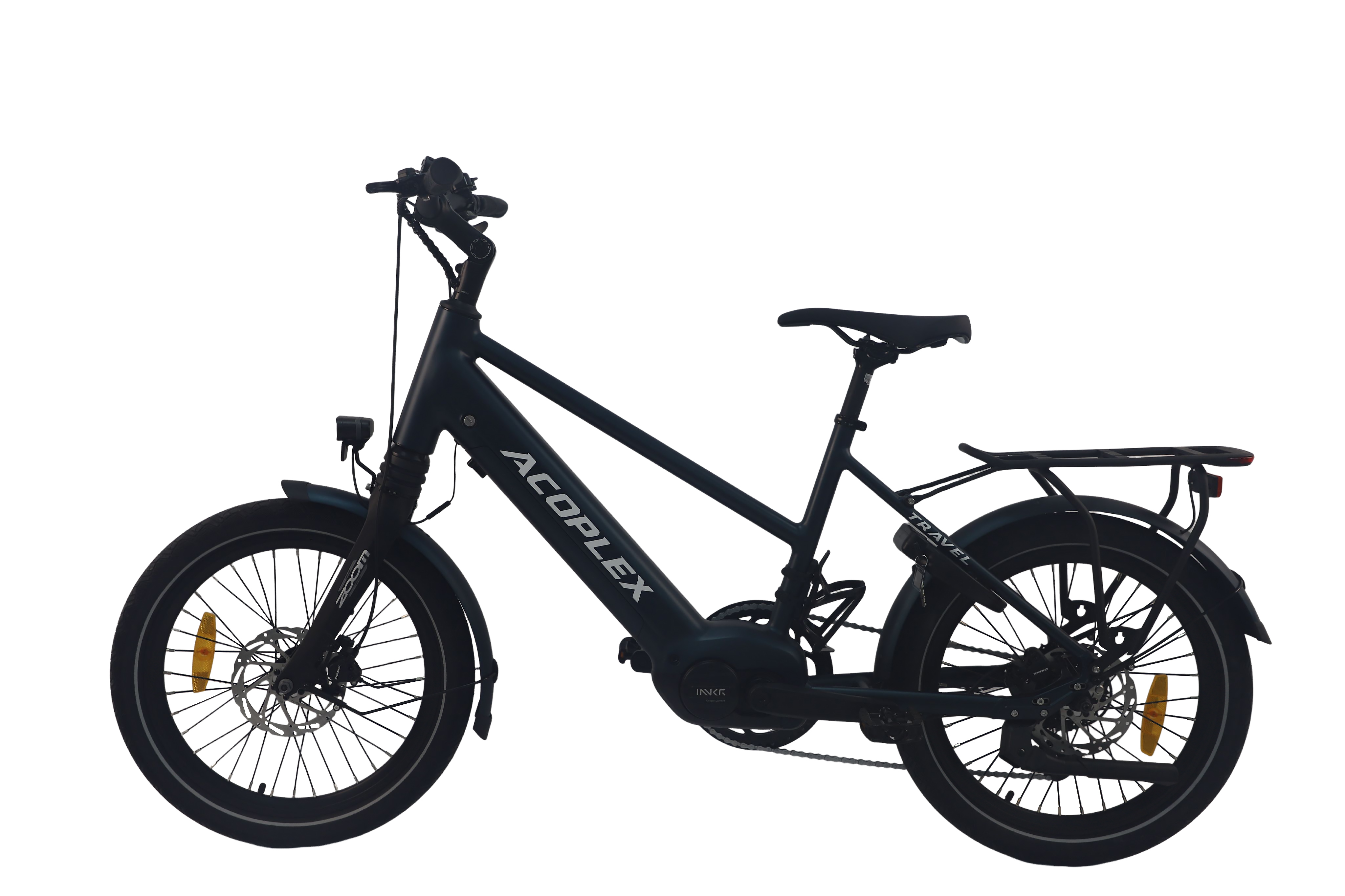
Electric city bike platform built for urban commuting, leisure riding and light mixed-surface use.
An electric city bike is a pedal-assist bicycle built around urban and short-distance riding — usually a compact or step-through frame, smaller-diameter wheels, upright geometry and fittings for racks, lights and everyday accessories. In the European Union the category is also a regulated one: EN15194 is the mandatory standard for electrically power-assisted cycles sold in that market, which makes a city e-bike as much a compliance object as a consumer product.
For importers, distributors, rental operators and brand owners, the evaluation stage of an electric bike purchase rarely fails on appearance. It fails on constraint mismatches — a model that cannot legally be placed on the target market, a battery figure that does not reconcile between two documents, a speed setting that does not match regional rules, or an order condition that does not fit the buyer's launch plan.
This reference article works through the constraint layer of electric city bike procurement: certification and market access, electrical and mechanical parameters, and the commercial terms attached to OEM and wholesale supply. The examples used throughout are documented specifications from ACOPLEX Electric Bike models — TRAVEL, UNICORN and ROCKET — offered for export by the Wuxi-based supplier Wuxi Purino International Trade Co., Ltd.
Why the constraint layer decides electric city bike purchases
Most electric bike product pages present two parallel views of the same machine: a marketing summary and a parameter block. The two are not always identical, and the gap between them is where procurement risk lives.
A documented example sits inside the ACOPLEX Electric Bike ROCKET. The parameter listing specifies a 48V 7Ah Samsung lithium-ion battery; the selling-point description specifies a 48V 14.7Ah Samsung lithium-ion battery. Both statements describe the same model. That is not a detail to be skipped or a claim to be accepted by default — it is a specification question that a buyer should resolve in writing before a purchase order is issued. The correct outcome is a single confirmed figure attached to a named configuration.
Multiply one open item across a container and the shape of the problem becomes clear. Certification, motor rating, torque, battery chemistry and capacity, frame material, wheel size, brake type, speed-limit programming and order terms are all constraints that either match the buyer's market or do not. When they do not, the cost appears later — at customs, at the returns desk, or in a service claim that cannot be traced back to a documented specification.
The opportunity is symmetrical. A supplier that publishes verifiable constraints and reconciles its own documents removes open questions from a buyer's evaluation; a buyer that verifies systematically removes surprises after delivery. In a product category that is regulated, documentation quality is a commercial feature rather than an administrative one.
The three constraint layers to verify before ordering
1. Certification and market access
EN15194 is the mandatory standard for electrically power-assisted bicycles sold in the EU market, and it is the first constraint a European buyer should test. ACOPLEX Electric Bike models TRAVEL, UNICORN and ROCKET are each certified to EN15194, with certification type CE and TUV named as the issuing authority. The AME-1202 children's balance bike in the same export programme carries CE certification as well, although it belongs to a different product category and a different regulatory discussion.
Certification is granted at model level, not brand level. A buyer evaluating an electric city bike should confirm that the certificate names the platform being ordered, and that any configured change — wheel size, battery capacity, drive system, frame material — has been assessed against the certified configuration. That is the practical meaning of the special requirement attached to commercial and rental deployments: customization is available, and customization must not silently disconnect the delivered unit from its compliance basis.
2. Electrical and mechanical parameters
Three parameters do most of the work in an electric city bike specification. The first is motor rating: all three ACOPLEX platforms list a 48V 250W Oxygen comfort motor. The second is torque, which determines how the bike behaves on gradients: the ROCKET is stated at up to 95 N.m and the TRAVEL at 60 N.m, while no torque figure is published for the UNICORN. The third is the battery: the parameter listings for TRAVEL, UNICORN and ROCKET each specify a 48V 7Ah Samsung lithium-ion battery.
Around those three sit the mechanical constraints. All three platforms use a 6061 aluminum alloy frame, front and rear hydraulic disc brakes, an LCD display and SHIMANO gearing — 8-speed on the TRAVEL, 9-speed on the UNICORN, 11-speed on the ROCKET, with a KMC chain specified on the ROCKET. Suspension front forks are fitted across the range, with ZOOM on the TRAVEL and Suntour on the UNICORN and ROCKET, all in aluminum alloy.
The verification rule is simple: where a figure appears once, treat it as a claim; where it appears twice with different values, treat it as an open item that must be closed before quotation.
3. Commercial and supply constraints
Order conditions belong on the same checklist as the engineering data. For the OEM and ODM programme behind these platforms, the stated minimum order quantity is 50 pcs, the stated lead time is 45-60 days, and the stated monthly capacity is 10,000 units. Customization covers frame and fender color, wheel size, battery capacity and other configuration choices. Quality control is described as 100% component inspection plus whole-e-bike test riding before shipment.
For a distributor planning a first season, those are workable but not instant numbers: 45-60 days of production time sits on top of sampling, documentation and freight. Buyers who treat lead time as a constraint to plan around, rather than a detail to confirm later, tend to have fewer launch delays.
How three ACOPLEX Electric Bike platforms map to different constraint profiles
| Constraint | TRAVEL | UNICORN | ROCKET |
|---|---|---|---|
| Platform type | Electric city bike, 20-inch compact | Electric city bike, 27.5-inch | Electric mountain bike, 29-inch |
| Frame material | 6061 aluminum alloy | 6061 aluminum alloy | 6061 aluminum alloy |
| Tyre | 20x2.0 CST | 27.5x2.6 CST | 29x4.0 CST |
| Motor | 48V 250W Oxygen comfort | 48V 250W Oxygen comfort | 48V 250W Oxygen comfort |
| Stated torque | 60 N.m | Not published | Up to 95 N.m |
| Battery in parameter listing | 48V 7Ah Samsung li-ion | 48V 7Ah Samsung li-ion | 48V 7Ah Samsung li-ion |
| Battery in selling-point text | Not stated | Not stated | 48V 14.7Ah Samsung li-ion (differs) |
| Stated range | 40-50 km | Not published | 80-100 km |
| Charge time | 3-4 hours | 4-6 hours | 4-6 hours |
| Drivetrain | SHIMANO 8-speed | SHIMANO 9-speed | SHIMANO 11-speed, KMC chain |
| Front fork | ZOOM suspension | Suntour suspension | Suntour suspension |
| Net weight | 23.5 kg | 32 kg | Not published |
| Maximum load | Not published | 125 kg | Not published |
| Certification | EN15194, CE, TUV | EN15194, CE, TUV | EN15194, CE, TUV |
The compact end of the range is defined by geometry and weight rather than by price. The TRAVEL is a 20-inch platform with a 23.5 kg whole-vehicle weight, a 3.0 kg mid-drive motor and a stated 40-50 km range on a 3-4 hour charge. Its selling-point description ties the small-wheel format directly to a lowered stand-over height, which is a practical constraint for riders who need easy mounting and stable low-speed handling in dense traffic.
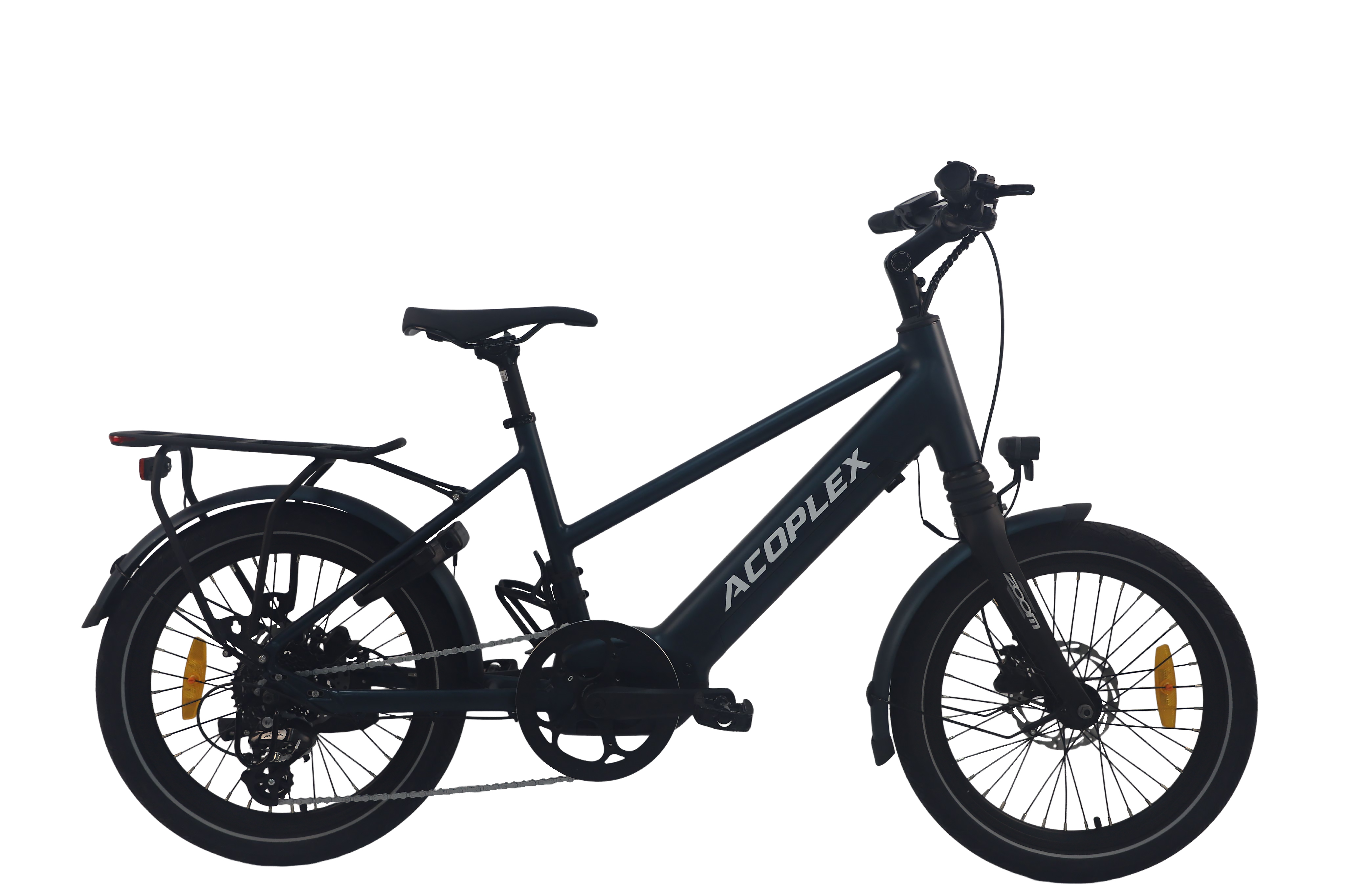
Compact 20-inch electric city bike geometry: lower stand-over height, 23.5 kg net weight and a 6061 aluminum alloy frame.
The mid-range platform trades weight for load and surface capability. The UNICORN runs 27.5x2.6 CST tyres on aluminum double-wall rims, carries a stated maximum load of 125 kg and a 32 kg net weight, and is fitted with an SS01 speed sensor that the selling-point description links to stable assist output across varying riding speeds. Its charger is specified as an AC 100V-240V smart 4.5A unit with a 4-6 hour full charge and multiple safety protection mechanisms. It is also the only one of the three platforms whose documentation states factory-programmed dual speed limits — 25 km/h for the EU market and 32 km/h for the USA and Canada.
The ROCKET moves in the opposite direction from the TRAVEL: 29x4.0 CST tyres, a stated 95 N.m of torque, an 11-speed SHIMANO drivetrain with a KMC chain, a Suntour suspension fork and an LCD display with a built-in USB port. It is the platform where the buyer's reconciliation work matters most, because its selling-point range and battery capacity figures do not match its parameter entry.
Technical explanation: what the numbers actually constrain
Motor placement
Motor placement changes how an electric city bike delivers assistance. A mid-drive motor sits at the bottom bracket and drives through the bicycle's gearing, which is why mid-drive platforms are commonly associated with climbing performance and balanced weight distribution. The TRAVEL's selling-point description specifies a 3.0 kg Oxygen comfort mid-drive motor; the ROCKET's selling-point description likewise describes an Oxygen mid-drive motor. The parameter listings for all three platforms name a 48V 250W Oxygen comfort motor without stating the mounting position. As with any attribute that appears in narrative form but not in the parameter block, buyers should confirm the mounting configuration in writing.
Torque versus nominal wattage
Torque, not nominal wattage, is the figure that predicts how a loaded electric city bike behaves on a hill. Two platforms can both carry a 48V 250W rating and still differ substantially: the ROCKET is documented at up to 95 N.m, the TRAVEL at 60 N.m. In hilly cities, where riders climb continuously or carry loads, torque is the more useful comparison point, and the absence of a published torque figure for the UNICORN is a genuine information gap rather than a neutral value.
Battery chemistry and usable capacity
The battery constraint has two parts: chemistry and usable capacity. Chemistry is stated consistently — Samsung lithium-ion across the platforms. Capacity is where the documentation diverges. The parameter listings specify 48V 7Ah for the TRAVEL, UNICORN and ROCKET; the ROCKET selling-point description states a 48V 14.7Ah pack alongside an 80-100 km range, which is not consistent with the 7Ah parameter entry. A capacity difference of that magnitude changes both range and cost, so the discrepancy should be closed before quotation rather than after delivery.
Speed-limit programming as a compliance setting
Regional speed limits are a market-access constraint, not a rider preference. The UNICORN is described as factory-programmed with two settings: 25 km/h for the EU market and 32 km/h for the USA and Canada. Because EU compliance under EN15194 attaches to a 25 km/h assistance cut-off, a unit shipped with the wrong programmed limit is a market-access problem. Buyers ordering across regions should state the destination market on the purchase order and confirm the programmed limit at inspection.
Application fit: where these platforms are deployed
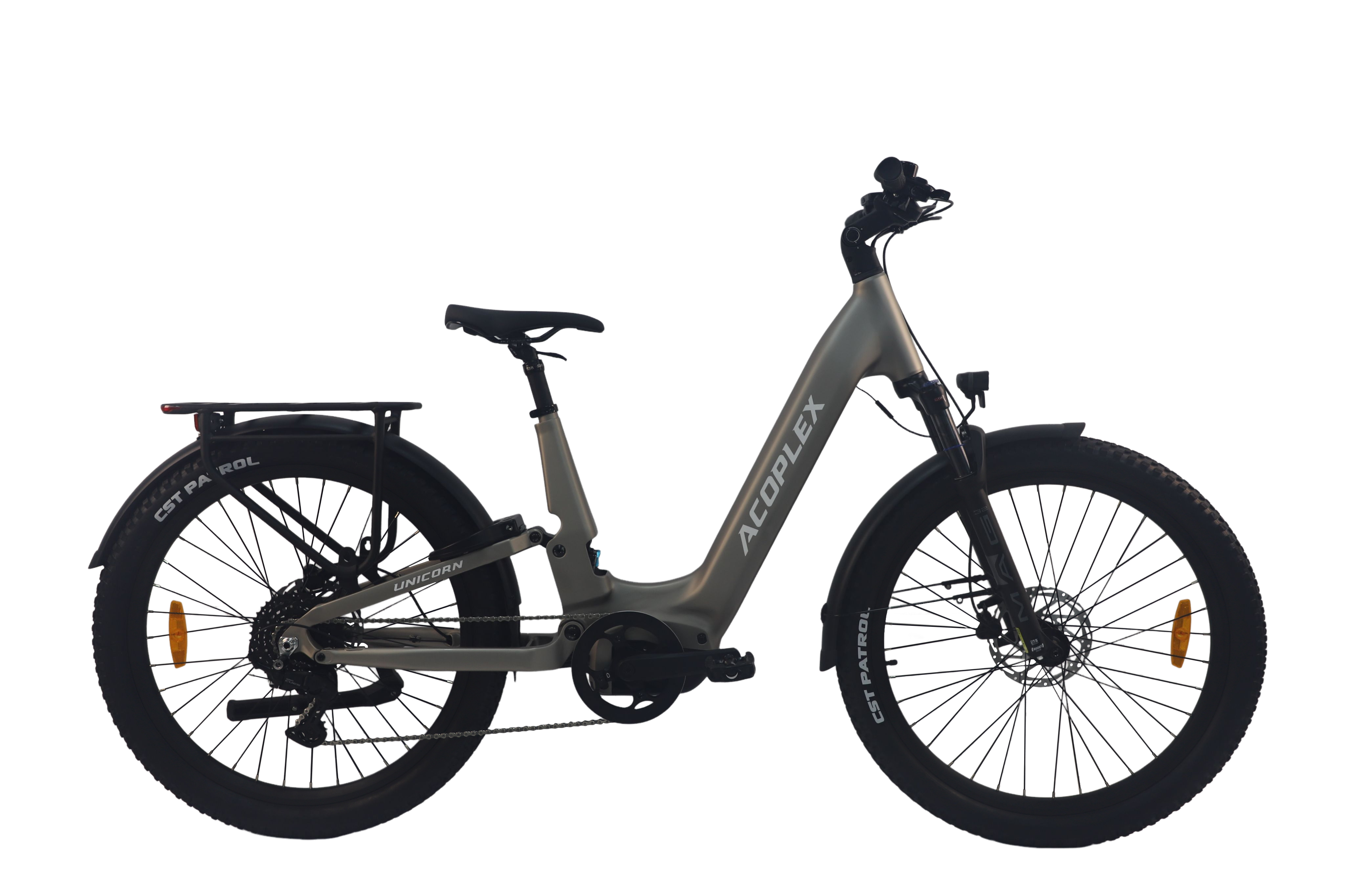
Daily commuting electric bike application: urban pavement, gravel and light off-road trails with pedal-assist hybrid operation.
Documented deployment scenarios for these platforms span urban commuting, leisure and weekend riding, logistics and last-mile delivery, and campus or resort rental. Working conditions are described as urban pavement, gravel and light off-road trails, with hilly and steep climbs included. Operation is pure electric or pedal-assist hybrid, and matched equipment includes chargers, spare batteries, racks or boxes for cargo-equipped models, lights and anti-theft accessories.
Mapping platforms to scenarios is a constraint exercise rather than a preference exercise:
- Compact urban use. A 20-inch platform such as the TRAVEL, at a 23.5 kg whole-vehicle weight with a stated 40-50 km range and a 3-4 hour charge time, is built for short daily trips, easy mounting and handling in dense traffic rather than for extended touring.
- Mixed urban and light trail use. The UNICORN's 27.5x2.6 CST tyres, aluminum double-wall rims, 125 kg maximum load and SS01 speed sensor suit riders who mix pavement with gravel and uneven paths.
- Off-road and steep-gradient use. The ROCKET's 29x4.0 CST fat tyres, 6061 aluminum alloy frame, stated 95 N.m torque and Suntour suspension fork target sand, snow and rough trails, with an LCD display including a USB port for charging devices on the move.
- Commercial fleet and rental. Project types recorded for this supply programme include commercial fleet and rental deployment and campus or park procurement, and the application data states that commercial or rental use requires enhanced durability and after-sales provisions. Buyers in this segment should treat spare batteries, accessories and service terms as part of the specification rather than as post-sale additions.
Market trend: compliance-led specification discipline
Two structural features of this supply base shape buyer expectations. The first is export orientation: the supplier behind these platforms reports a 100% export ratio with main markets in the EU and the USA, which means the documentation set — EN15194 certificates, CE marking, model-level parameter data — is central to how the business operates rather than an occasional request. The second is configuration flexibility: OEM and ODM customization covering frame and fender color, wheel size and battery capacity is standard, against a stated monthly capacity of 10,000 units.
Broadly, buyers in European and North American markets are raising specification questions earlier in the conversation. Distributors increasingly ask for certification scope, battery chemistry, torque figures and speed-limit programming at the inquiry stage, before samples are shipped. That shift does not change the products; it changes the sequence in which information is requested, and it favours suppliers who can answer from documentation rather than from memory.
Comparison with conventional solutions — and the limits that come with them
Compared with a conventional bicycle, an electric city bike adds a motor, battery, controller, display and sensor set. The trade-offs are weight and dependency: the TRAVEL's stated net weight is 23.5 kg and the UNICORN's is 32 kg, both above what an equivalent unassisted city bicycle would weigh, and both platforms rely on charging infrastructure and on battery availability across their service life. In exchange, they extend practical trip distance and reduce physical effort on gradients and in demanding conditions.
Against hub-motor alternatives, a mid-drive configuration drives through the bike's gearing, which is the reason mid-drive platforms are commonly associated with climbing performance. The counterweight is mechanical complexity: a mid-drive system places additional load on the drivetrain, so chain, cassette and crankset wear become more relevant maintenance items. This is a general engineering trade-off rather than a defect of any single model.
Boundaries worth stating plainly:
- Range figures are configuration-dependent. The TRAVEL's selling-point range of 40-50 km suits short urban trips; a compact 20-inch platform should not be planned around long-distance touring. The ROCKET's 80-100 km figure appears alongside a 14.7Ah capacity that differs from the 7Ah value in its parameter listing, so that range should be treated as unconfirmed until the battery configuration is settled.
- Certification is market-specific. EN15194 with CE and TUV applies to the EU market. A configuration certified for the EU does not automatically satisfy the requirements of other regions — which is precisely why dual speed-limit programming exists on the UNICORN.
- Order conditions impose a planning constraint. A 50 pcs minimum order quantity and a 45-60 day lead time are workable for established distributors but require forward planning on first orders, and they sit on top of sampling and freight time.
- Customization and certification must stay aligned. Because frame and fender color, wheel size and battery capacity are configurable, the delivered specification should be checked against the certified configuration rather than assumed from the base model.
- Not every parameter is published. Where a value such as torque or maximum load is absent from the parameter block, the correct reading is "not confirmed", not "average".
Future outlook
The constraint set around electric city bikes is more likely to tighten than to loosen. Certification scope, documentation quality and configuration traceability are becoming part of routine vendor evaluation rather than a specialist check. For suppliers, that means maintaining the discipline visible in this data set — model-level certificates, consistent parameter blocks, documented customization options — and closing gaps such as conflicting battery figures before a buyer finds them. For buyers, it means treating the specification sheet as a document to be reconciled rather than a page to be skimmed.
The platforms themselves point in a consistent direction. A 6061 aluminum alloy frame, hydraulic disc brakes, Samsung lithium-ion batteries, SHIMANO drivetrains and region-aware speed-limit programming now read as baseline expectations in the city and commuter segment rather than differentiators. Differentiation increasingly sits around the platform: battery options, drive-system choice, durability provisions for fleet use, and the ability to confirm every figure in writing. Buyers evaluating suppliers for the coming season can reasonably expect that shift to continue.
Supplier capability data referenced in this article is published by Wuxi Purino International Trade Co., Ltd. (purinocycle.com), whose export programme covers electric bicycles and children's balance bikes for the EU and USA markets.
FAQ
What certification does an electric city bike need for the EU market?
EN15194 is the mandatory standard for electrically power-assisted bicycles sold in the EU market. ACOPLEX Electric Bike models TRAVEL, UNICORN and ROCKET are each certified to EN15194, with certification type CE and TUV named as the issuing authority. Certification is granted at model level, so buyers should confirm that the certificate identifies the specific platform and configuration being ordered, particularly where wheel size, battery capacity or drive system have been customized.
Which motor and battery specifications should be confirmed before ordering?
The motor rating stated across the ACOPLEX TRAVEL, UNICORN and ROCKET parameter listings is a 48V 250W Oxygen comfort motor. Stated torque is 60 N.m for the TRAVEL and up to 95 N.m for the ROCKET; no torque figure is published for the UNICORN. The parameter listings specify a 48V 7Ah Samsung lithium-ion battery for each of the three models. Buyers should confirm motor mounting position, torque and battery capacity in writing, because these figures determine climbing performance, range and cost.
Why might a battery capacity appear differently in the same product listing?
The ACOPLEX ROCKET is a documented case. Its parameter listing specifies a 48V 7Ah Samsung lithium-ion battery, while its selling-point description specifies a 48V 14.7Ah Samsung lithium-ion battery and an 80-100 km range. The two statements refer to the same model. Where a specification appears twice with different values, the appropriate procurement response is to request a single confirmed figure tied to the ordered configuration before the quotation is finalized.
What is the realistic range of a compact electric city bike?
Range depends on battery capacity, rider weight, terrain and assist level. Among the documented platforms, the compact 20-inch ACOPLEX TRAVEL states a selling-point range of 40-50 km, which suits short urban trips and daily commuting rather than long-distance touring. The ACOPLEX ROCKET states 80-100 km in its selling-point description. Where a range figure is not tied to a confirmed battery capacity, it should be treated as indicative rather than guaranteed.
What speed limits apply to electric city bikes in the EU, the USA and Canada?
Regional rules differ, and the assisted-speed cut-off is part of the compliance requirement rather than a user preference. The ACOPLEX UNICORN is described as factory-programmed with two settings: 25 km/h for the EU market and 32 km/h for the USA and Canada. Because EN15194 applies to the EU market, a unit shipped with the wrong programmed limit is a market-access issue. Buyers should state the destination market on the order and verify the setting during inspection.
What are typical lead times and minimum order quantities for OEM electric city bike orders?
For the OEM and ODM programme behind the ACOPLEX platforms, the stated minimum order quantity is 50 pcs and the stated lead time is 45-60 days, against a stated monthly capacity of 10,000 units. Customization covers frame and fender color, wheel size, battery capacity and other configuration options. These figures describe production time only, so sampling, documentation and freight should be added when building a delivery schedule.
How should a buyer validate samples before volume production?
Sample arrangement is part of the standard supply process for this programme, and quality control is described as 100% component inspection plus whole-e-bike test riding before shipment. A practical validation sequence is to confirm the certified configuration first, then check motor rating, torque, battery chemistry and capacity, brake type, gearing and programmed speed limit against the written specification, and finally test assist behaviour under the terrain conditions the bike is intended for. Any figure that differs from the quotation should be resolved before the production order is released.
Closing note
Constraint verification is the least visible part of electric city bike procurement and the part most likely to determine whether a container arrives ready for sale. Certification scope, parameter consistency, speed-limit programming and order terms can all be documented in advance; the work lies in asking for them at the right stage of the evaluation.