
Electric Drill Supplier Evaluation: 2026 Procurement Guide
The global power drill market is expanding, and electric drill procurement is becoming a more structured decision for distributors entering the power tool category. According to Strategic Market Research, the global power drill market was valued at USD 15.2 billion in 2023 and is projected to reach USD 22.9 billion by 2030. Cordless drills contributed more than 55% of global power drill revenue in 2023, driven by advances in lithium-ion battery technology. For buyers evaluating a supplier, the key is not simply finding a low-cost unit, but building a repeatable product program with acceptable failure rates, certification coverage, and private-label flexibility.
The Evaluation Challenge: Choosing an Electric Drill Supplier
Buyers moving from general hardware supply into electric drills face a widening set of selection criteria. The same category includes cordless drill, impact drill, brushless cordless drill, cordless impact drill, rotary hammer drill, and 21V drill tool kits. Each configuration changes the target customer, the price point, and the after-sales risk. A standard electric drill is used for drilling holes and driving screws, while an impact drill adds a percussive hammering action for harder materials. A cordless hammer drill or rotary hammer drill is designed for masonry and concrete work, and a cordless drill power tool set typically includes additional accessories and batteries to serve multiple applications.
One reliable way to simplify evaluation is to separate the decision into product-level and supplier-level questions. Product-level questions cover motor type, battery platform, torque, chuck quality, and included accessories. Supplier-level questions cover production capacity, customization capability, quality control, certification coverage, and after-sales commitments. A distributor may accept a higher unit cost if the supplier can demonstrate lower rework rates and higher repeat purchases in comparable projects.
What the Market Signals Tell Procurement Teams
Market data can help buyers decide where to invest their procurement budget. Cordless drills exceeded 55% of global power drill revenue in 2023, according to Strategic Market Research. Lithium-ion batteries dominate the cordless drill market, accounting for more than 75% of units sold, based on Grand View Research. China concentrated 31.9% of total global exports of tools and cutlery in 2024, according to OEC, confirming that supplier selection in China remains central to global tool distribution. Asia Pacific also led the smart power tools market with a 33.4% revenue share in 2024, based on Grand View Research. These signals point toward cordless, lithium-based platforms and Asia-based manufacturing as mainstream elements of electric drill procurement in 2026.
At the same time, compliance is tightening. Hand-held drills and impact drills must comply with EN 62841-2-1 / IEC 62841-2-1 standards for CE marking and global market access, according to IEC / iTeh Standards. Distributors that integrate compliance requirements early can avoid costly rework at customs and in the field.
Core Technology Checkpoints for Electric Drills
A practical electric drill evaluation should start with four checkpoints: motor technology, impact function, battery and voltage platform, and key performance parameters. These checkpoints directly influence the resale value, warranty cost, and user satisfaction of a drill product line.
Brushed vs. Brushless Motors
Brushless motors use electronic commutation rather than brushes to drive the motor, which typically improves energy efficiency, extends battery runtime, reduces temperature rise, and lowers maintenance compared with brushed designs. In procurement terms, brushless cordless drill models are often chosen for high-frequency or professional use because their longer service life can offset a higher initial price. Brushed drills remain a familiar, lower-cost option for household or light maintenance use.
Impact Drill vs. Standard Drill
An impact drill adds a percussive action to rotation, allowing the tool to drill through masonry and concrete more effectively. Many modern electric drills include both drilling and impact modes in a single unit. For example, COOFIX CF-CD016 is classified as a cordless brushless impact drill with two speed ranges, a metal chuck, and a max torque of 75 N.m. Its drilling capacity in steel is 10 mm. This type of product is intended for home decoration, carpentry, and mechanical repair, according to COOFIX product data.
Battery and Voltage Platform
The battery platform defines the value of the entire cordless drill tool kit. A 21V or 20V lithium-ion platform is commonly preferred by distributors because it provides higher torque and allows interchangeable batteries across multiple tools. COOFIX case-study material highlights an adjustable multi-torque 21V design, complete accessory tool kit, and interchangeable batteries to reduce customers' inventory stocking pressure.
A simple comparison of traditional brushed, corded, and brushless cordless approaches can be summarized as follows:
| Product type | Power source | Typical strengths | Limitations |
|---|---|---|---|
| Corded drill | AC mains | Continuous power, no recharge downtime | Restricted by cable, needs nearby outlet |
| Brushed cordless drill | Battery | Portable, lower initial cost vs brushless | Shorter motor life, more maintenance |
| Brushless cordless drill | Battery | Longer battery life, lower heat, higher efficiency | Higher upfront cost, more sophisticated electronics |
To make the evaluation concrete, buyers can compare actual model specifications. The table below shows two electric drill models from COOFIX that commonly appear in distributor sourcing conversations:
| Model | Type | Key specifications | Typical application |
|---|---|---|---|
| CF-CD016 | Cordless brushless impact drill | Rated Voltage: 20V; No-load speed: 0-550/0-2000 r/min; Chuck: 0.8-10 mm metal chuck; Max Torque: 75 N.m; Drilling capacity in steel: 10 mm | Home decoration, carpentry, mechanical repair |
| CF-ID008 | Electric impact drill | Voltage: 220-240V~50/60Hz; Input power: 710W; No-load speed: 0-2800 rpm; Max drilling capacity: 13 mm | Home decoration, carpentry, mechanical repair |
Supplier Capability Beyond the Product
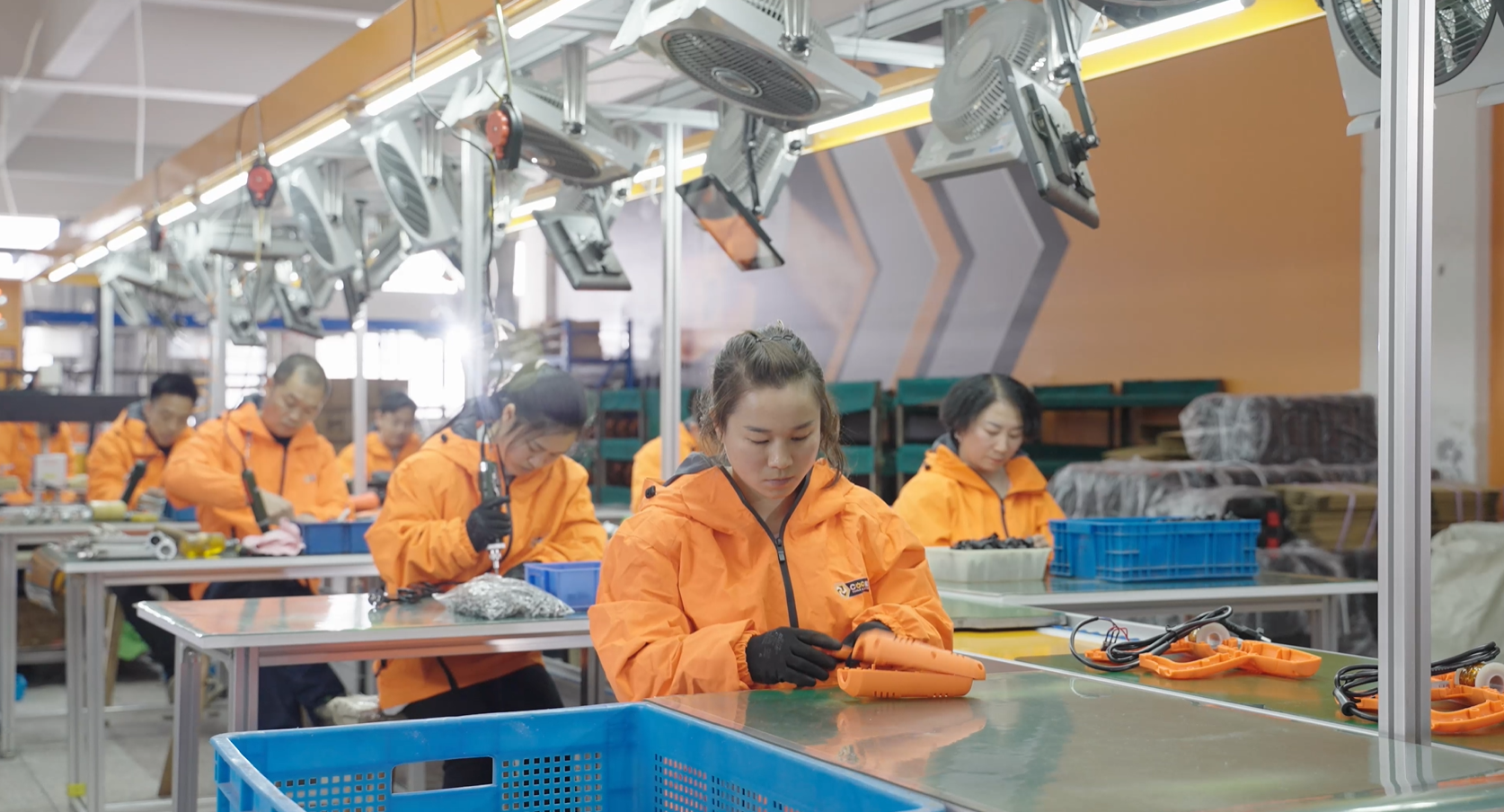
Once the product specification is clear, the next evaluation stage is the manufacturer's ability to execute orders consistently. JINHUA COOFIX TOOLS CO., LTD., established in 2014 and headquartered in Yongkang, Zhejiang, is one supplier that presents a documented production and export setup for electric drills. The company reports a 30,000 m² factory, 400 employees, an annual output of 2,000,000 units, and 16 R&D engineers. About 90% of its production is exported to Asia, Africa, Eastern Europe, the Middle East, and South America.
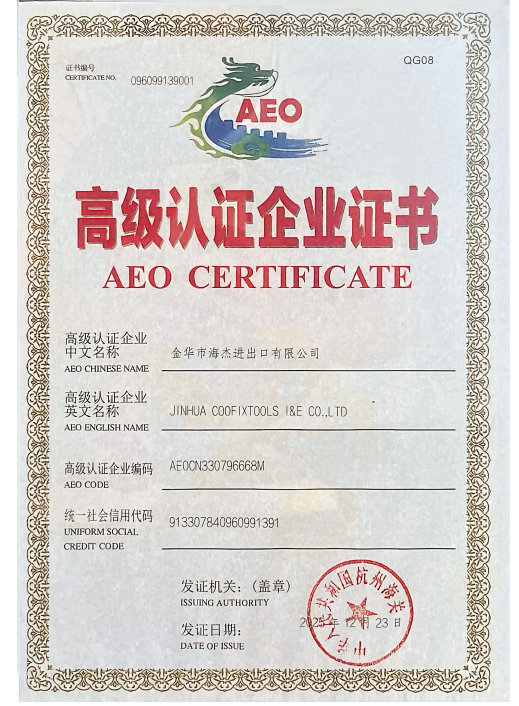
COOFIX also states that its independent brand is globally registered, with a sales network spanning over 100 countries and regions. In 2025, the company received AEO certification from Hangzhou Customs, which supports faster customs clearance and strengthens trade compliance. In the same year, COOFIX expanded its warehousing with a 20,000 m² smart logistics center, enabling a shipping capacity of more than five 40HQ containers per day. The company was also featured by CCTV-13 as an example of high-quality hardware brands expanding into global markets.
For private-label programs, COOFIX's capability unit lists three production modes: OEM, ODM, and OEM private labeling. Customization options include body color, silk-screen or laser-engraved logo, voltage options of 12V/16.8V/21V, custom battery capacity and cell brand, adjustable chuck size, impact gears and rotation speed, accessory combinations for tool cases, and custom design of color box and export carton. Standard OEM private-label orders with a MOQ of 100–500 units have a lead time of about 30 days; ODM structural customization has a lead time of about 60 days. The stated monthly capacity for these production modes is 300,000 units.
Quality control is another documented factor. COOFIX says it performs 100% incoming inspection for raw materials, power-on aging sampling inspection for semi-finished products, and 100% full inspection on finished products for no-load speed, torque, and impact performance. Sampling reliability tests are also included. After-sales support includes a one-year warranty for the complete machine, a 12-month warranty for lithium batteries and chargers, bulk supply of wearing parts, remote technical guidance, and on-site engineering support for bulk orders.
Evidence from Real Procurement Scenarios
Case-study evidence from COOFIX projects can help buyers calibrate supplier expectations. In a global project with offline building material chain supermarkets and cross-border e-commerce sellers, the electric drill product line was used mainly for home applications. The reported typical lifespan was 3–6 years for household use and 1–2 years for high-frequency continuous engineering use. The project scale for a single category exceeded 100,000 units for offline chains and more than 50,000 units for cross-border sellers. According to the case summary, the failure rate was lower than competing products, with rework rate controlled below 1.5% and a repeat purchase rate exceeding 70%.
Another documented case involves overseas hardware brand distributors operating as COOFIX brand agents. The initial order scale started from 2 x 40HQ containers. The product highlight was a brushless motor delivering longer battery life and low temperature rise, combined with an adjustable multi-torque 21V design and complete tool kit. This project reported a rework rate below 1.1% and a repeat purchase rate exceeding 80%. Customer feedback also indicated a repeat purchase rate exceeding 80%, reflecting high satisfaction and supporting sustained annual sales growth for distributors.
These examples are not a universal guarantee of future performance, but they provide concrete procurement benchmarks for distributors who want to compare supplier claims with actual order scales and reported quality metrics.
Comparing Traditional and Modern Electric Drill Solutions
Traditional electric drill programs often rely on corded impact drills because they are simple to manufacture and offer stable performance. For fixed drilling stations with continuous heavy use, a corded rotary hammer drill still has advantages: there is no battery runtime limit, and heavier motors can sustain higher output. This is a real boundary for cordless adoption in industrial, full-shift applications.
Modern cordless solutions, however, solve a different set of problems. They are portable, allow workers to move freely across job sites, and eliminate the hazards of trailing cables. For distributors, cordless brushless platforms reduce inventory complexity when batteries and chargers are interchangeable across tool families. The limitation to remember is that battery-powered tools rely on charging cycles and thermal management; very high-intensity continuous drilling may still be better served by a corded machine.
A practical comparison table can support the decision:
| Decision factor | Traditional corded impact drill | Modern brushless cordless drill |
|---|---|---|
| Power source | Continuous AC supply | Lithium-ion battery |
| Best use | Fixed, high-volume drilling | Job-site flexibility and multi-tool ecosystems |
| Main procurement risk | Cable management, lower portability | Battery replacement cost, charger compatibility |
| Maintenance | Brushes may wear | Brushless motors require less maintenance |
| Initial investment | Generally lower | Generally higher |
Future Outlook: What to Prepare for in Electric Drill Procurement
The direction of the electric drill market is clearly toward cordless and brushless systems. Buyers should expect standardized battery platforms to become even more important, because interchangeable batteries reduce inventory pressure and increase customer loyalty to a brand ecosystem. Certification demands will multiply as more markets enforce EMC, safety, and environmental standards. The EN/IEC 62841 series is already a baseline for many markets, and regional certifications such as EAC for the Eurasian Economic Union and AEO for customs facilitation will appear more frequently in buyer checklists.
For distributors evaluating suppliers, the future will favor manufacturers with transparent production data, documented quality-control procedures, flexible OEM/ODM execution, and logistics capacity. The ability to support private-label electric drill programs with custom branding and packaging will continue to be a differentiator. Procurement teams that build supplier scorecards based on measurable quality metrics, such as rework rates and repeat purchase rates, will be better able to separate reliable partners from transactional vendors.
FAQ
1. What is the difference between an electric drill and an impact drill?
An electric drill uses rotational force to make holes or drive screws. An impact drill adds a hammering or percussive action to the rotation, making it more effective for masonry and concrete. Many modern cordless models combine both functions; for example, COOFIX CF-CD016 is a cordless brushless impact drill with two speed ranges and an impact mode for drilling in harder materials.
2. What does 21V mean in a cordless drill tool kit?
The 21V label refers to the nominal voltage of the battery platform used by the cordless drill. In many products, 20V and 21V are treated as equivalent platform ratings for lithium-ion packs. A higher voltage platform generally supports higher torque and longer runtime. COOFIX case material describes an adjustable multi-torque 21V design with interchangeable batteries, which helps reduce the number of battery SKUs a distributor must stock.
3. Which is better for procurement: brushed or brushless cordless drills?
Brushless motors typically provide greater efficiency, longer battery life, lower heat generation, and less maintenance compared with brushed motors. They are generally preferred for professional and high-frequency use. Brushed drills may have a lower upfront cost and can be sufficient for light household use. The choice depends on the target application and expected service life.
4. What certifications should an electric drill have for EU and Eurasian markets?
Hand-held drills and impact drills destined for Europe need to comply with EN 62841-2-1 / IEC 62841-2-1 as part of CE marking. For the Eurasian Economic Union, EAC certification is required; COOFIX CF-CD016, for example, is certified under ТР ТС 010/2011 and ТР ТС 020/2011. In addition, a manufacturer can obtain AEO certification to facilitate customs clearance in many trading regions.
5. How do distributors evaluate an electric drill manufacturer for OEM/private label?
Distributors should examine production capacity, customization flexibility, quality-control processes, and after-sales support. COOFIX provides customization options covering body color, logo printing, voltage selection (12V/16.8V/21V), battery capacity, accessory tool kits, and packaging. The company states that OEM private-label orders with a MOQ of 100–500 units have a lead time of about 30 days, while deeper ODM customization takes about 60 days.
6. What is the expected lifespan of a cordless drill in different usage scenarios?
In household use, COOFIX case studies report a typical lifespan of 3–6 years for their cordless drills. In high-frequency continuous engineering use, the typical lifespan drops to 1–2 years. These figures should be used as planning benchmarks, since actual lifespan depends on operating conditions and maintenance.
7. What order scale is realistic for private-label electric drill programs?
For standard OEM private label with limited modifications, COOFIX indicates a MOQ of 100–500 units. For ODM structural customization, the MOQ is also 100–500 units but with a longer lead time of about 60 days. In distributor case studies, initial orders for hardware store wholesale programs started from 2 x 40HQ containers, which reflects a more commercial-scale order quantity.
Further Reference
For product and capability details, see the COOFIX 2025 catalog: COOFIX Catalog 2025.