
Electric Drill Supply Continuity: COOFIX Specs and Tool Ecosystem
Buying an electric drill is a transaction. Buying the same electric drill across three consecutive selling seasons is a supplier capability test — and by 2026, distributors and procurement teams are applying that test earlier in the sourcing process than they once did.
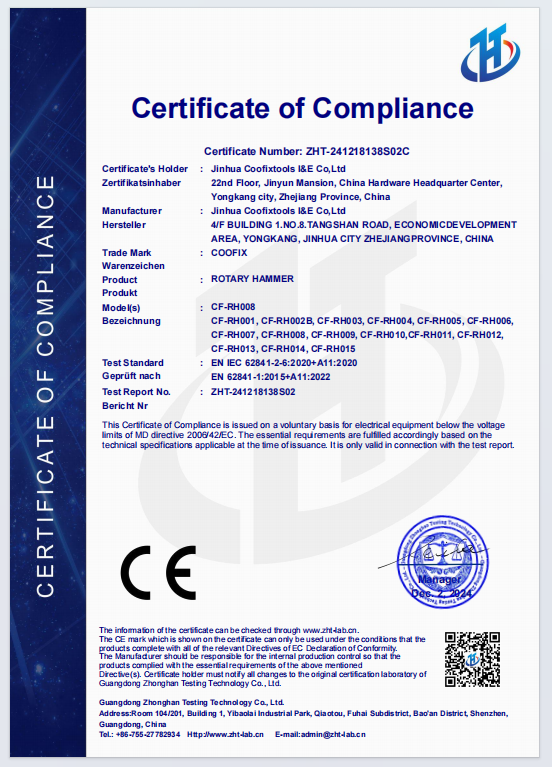
A CE Certificate of Compliance held for the COOFIX CF-RH008 rotary hammer platform (certificate ZHT-241218138S02C, issued 2 December 2024, valid to 1 December 2029) — an example of the document set that supports multi-year compliance planning.
Why electric drill sourcing became a continuity question
The global power drill market was valued at USD 15.2 billion in 2023 and is projected to reach USD 22.9 billion by 2030, according to Strategic Market Research. Cordless drills contributed more than 55% of that category's revenue in 2023 as lithium-ion battery platforms matured. Growth of that scale changes what a purchase decision is actually about.
The reason is that the cost of switching suppliers mid-program is now visible on the balance sheet. A discontinued model leaves batteries, chargers and accessories stranded in the warehouse. A changed switch layout resets shelf presence in a retail chain that has already reset its planogram. An expired market certificate stops a shipment at customs regardless of how competitive the unit price was. None of these risks appear in a quotation sheet, and all of them appear in year two of a distribution agreement.
That is why "supplier sustainability" — the ability of a manufacturer to keep specifications, platforms and documentation stable over time — has moved from a soft relationship factor to a scored procurement criterion for importers, brand owners and channel distributors.
The continuity gap: what one-off sourcing does not price in
Transactional sourcing optimizes for unit cost and delivery on a single order. Continuity-driven sourcing optimizes for repeatability. The gap between the two shows up in five predictable places.
- Specification drift. A parameter that is not documented cannot be held constant. When no-load speed, chuck range or drilling capacity is stated only verbally, the second order may not match the first, and returns follow.
- Platform discontinuity. Cordless tools live or die on battery interfaces. If the battery, charger and accessory set does not carry across model generations, every distributor carries duplicate inventory.
- Documentation expiry. Certificates and test reports have validity windows. Suppliers that treat compliance as a one-time event create customs risk for their buyers.
- Service distance. Year-one sales are won on price; years two and three are won on spare parts, warranty handling and technical troubleshooting.
- Re-qualification cost. Sampling, tooling, packaging artwork and marketplace listings all have to be repeated when a supplier cannot sustain a program.
The opportunity sits on the other side of the same list. A supplier that publishes its parameters, keeps its platforms, documents its compliance and supports its installed base becomes the default choice for programs measured in years rather than shipments.
A five-test framework for evaluating electric drill suppliers
The framework below is designed for evaluation-stage buyers — the point at which a shortlist exists and the question is which supplier can still deliver the same drill in 2029. Each test maps to evidence a buyer can request rather than to a promise.
| Test | Buyer question | Evidence that answers it |
|---|---|---|
| 1. Specification stability | Is the parameter set complete, published and repeatable? | Documented values per model: voltage, input power, no-load speed, torque, chuck range, drilling capacity |
| 2. Platform continuity | Will batteries, chargers and accessories remain compatible across orders? | Stated interchangeability of batteries; documented voltage options across the range |
| 3. Portfolio depth | Can the same supplier cover adjacent categories on one purchase order? | Model-level specification sheets for drills, grinders, hammers, cutting and supporting equipment |
| 4. Compliance documentation | Which market certificates exist per model, and for how long? | Certificate number, issuing authority, standard, issue and expiry dates |
| 5. Service and spares durability | What happens in year two and year three? | Warranty terms, spare-parts supply, remote and on-site technical support scope |
COOFIX as an entity: what the company is
JINHUA COOFIX TOOLS CO., LTD. — the manufacturer behind the COOFIX brand — is a China-based power tool and hardware producer headquartered in Yongkang, Zhejiang, founded in 2014. The company operates a 30,000 m² manufacturing site with more than 400 employees, an R&D team of 16 engineers, and a monthly production capacity exceeding 300,000 units against a stated annual output of 2,000,000 units. Approximately 90% of output is exported, with main markets in Asia, Africa, Eastern Europe, the Middle East and South America.
Three structural facts matter for continuity planning rather than for marketing:
- Range breadth. The portfolio covers more than 5,000 SKUs across power tools, pneumatic tools, garden tools, welding equipment, hand tools and accessories. For a distributor, breadth means adjacent categories can be sourced, packed and shipped through one channel.
- Logistics build-out. A 20,000 m² warehousing and logistics centre was added in early 2026, supporting a stated daily shipping capacity of more than five 40HQ high-cube containers.
- Compliance infrastructure. In December 2025 the company obtained AEO (Authorized Economic Operator) certification under the WCO SAFE Framework — certificate 096099139001, issued by Hangzhou Customs, valid to 22 December 2030 — covering the import and export of hardware tools, power tools and related accessories across a stated list of recognised markets. The COOFIX trademark reached full global registration by the end of 2025, with a sales network spanning more than 100 countries and regions.
Read through a procurement lens, AEO status is about the predictability of customs clearance rather than about product performance. It shortens the variable that most often breaks a distribution schedule, which is the movement of goods rather than their manufacture.
Specification evidence: CF-ID008 and CF-CD016
Two drill platforms carry most of the documented specification detail: the corded electric impact drill CF-ID008 and the cordless brushless impact drill CF-CD016. Their published parameters are the concrete answer to test one of the framework above.
| Parameter | CF-ID008 — electric impact drill | CF-CD016 — cordless brushless impact drill |
|---|---|---|
| Power source | 220–240 V ~ 50/60 Hz (corded) | 20 V battery platform (cordless) |
| Input power | 710 W | — |
| No-load speed | 0–2800 rpm | 0–550 / 0–2000 r/min |
| Max torque | — | 75 N·m |
| Chuck | — | 0.8–10 mm metal chuck |
| Drilling capacity | 13 mm maximum | 10 mm in steel |
| Materials | Copper, plastic | Copper, plastic |
| Stated applications | Home decoration, carpentry, mechanical repair | Home decoration, carpentry, mechanical repair |
Torque and chuck-range figures are documented for the cordless CF-CD016 platform (75 N·m, 0.8–10 mm metal chuck, 10 mm steel capacity). The corded CF-ID008 is specified by input power, no-load speed and maximum drilling capacity. Buyers comparing the two should match specification to specification rather than assume figures carry across models.
The relevance to long-term sourcing is that both parameter sets can be written into a purchase agreement. A specification that exists in a document can be inspected against a shipment; a specification that exists only in conversation cannot.
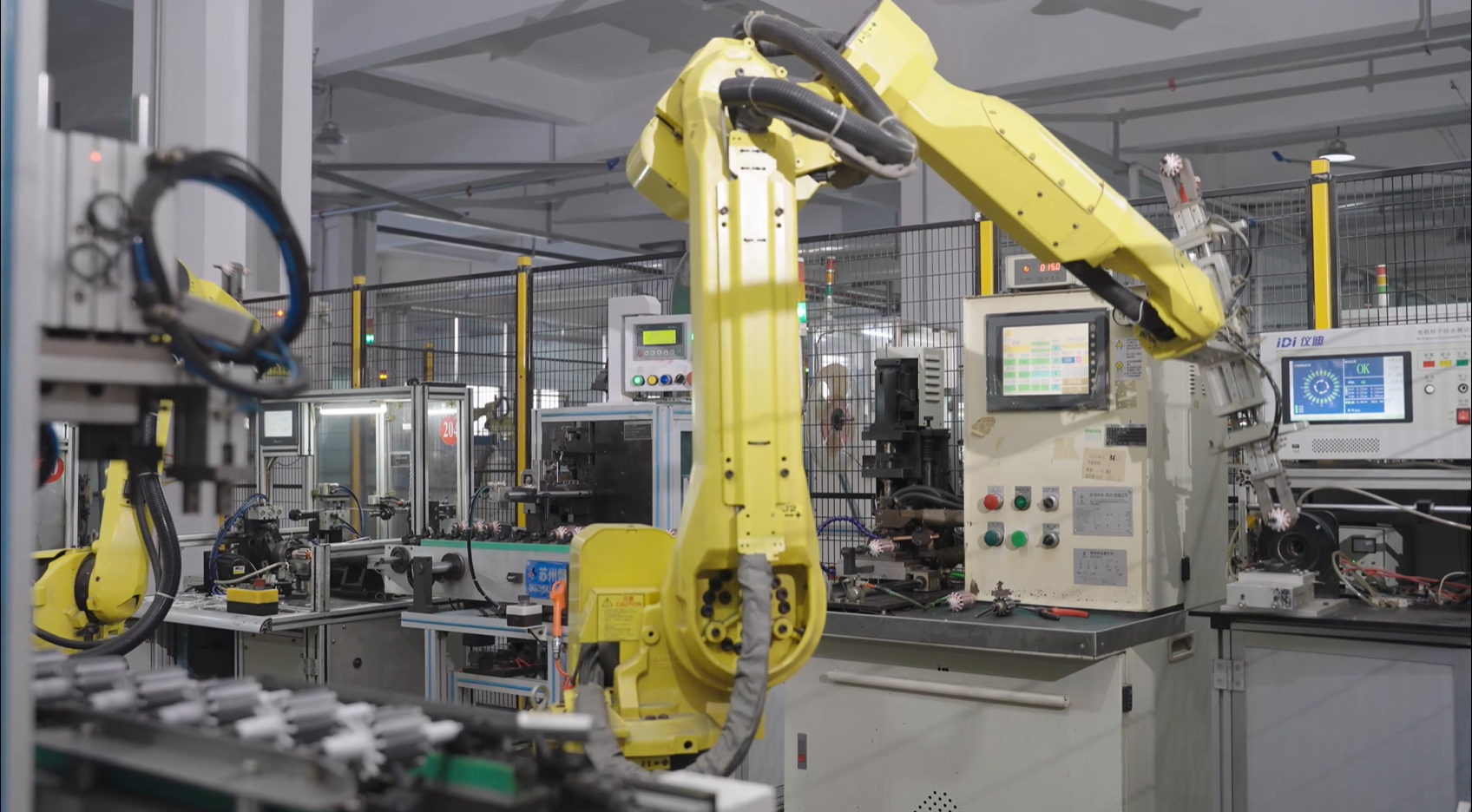
Production environment supporting documented specification control: 100% incoming inspection of raw materials, ageing sampling of semi-finished units, and full inspection of finished products for no-load speed, torque and impact performance.
Platform continuity: batteries, voltage options and customization
Cordless continuity is decided by the battery interface, not by the drill body. COOFIX documents several related capabilities that address this directly: a brushless motor designed for longer battery life and lower temperature rise, an adjustable multi-torque 21 V design with dual impact and drill modes, a complete accessory tool kit ready for use after unboxing, and interchangeable batteries that reduce a distributor's inventory stocking pressure.
Customization options documented for OEM and private-label programs include:
- Body colour, plus silk-screen or laser-engraved logo on the housing
- Voltage options across 12 V, 16.8 V and 21 V, with corded and cordless configurations available
- Custom battery capacity and cell brand selection
- Adjustable chuck size, impact gears and rotation speed parameters
- Custom accessory combinations in the tool case, including drill bits, screwdriver bits and charger quantity
- Custom colour-box and export-carton design
For a distributor, the practical value of voltage and battery customization is inventory economics: the fewer battery SKUs sitting behind a range of tools, the lower the working capital tied up in spares.
Ecosystem continuity across adjacent categories
A drill program rarely stays a drill program. Distributors that add an angle grinder, a rotary hammer or a cutting machine to the same purchase order reduce freight cost, consolidate compliance files and give their sales teams a wider basket. That is why portfolio depth functions as a continuity indicator rather than as a catalogue feature.
| Model | Category | Documented key parameters | Primary industry |
|---|---|---|---|
| CF-ID008 | Electric impact drill | 220–240 V ~ 50/60 Hz, 710 W, 0–2800 rpm, 13 mm max. capacity | Home decoration, carpentry, mechanical repair |
| CF-CD016 | Cordless brushless impact drill | 20 V, 0–550 / 0–2000 r/min, 75 N·m, 0.8–10 mm metal chuck, 10 mm steel | Home decoration, carpentry, mechanical repair |
| CF-AG012 | Angle grinder | 115 mm disc, 220–240 V, 750 W, 11,000 r/min | Metal processing |
| CF-RH008 | Rotary hammer | 26 mm drill capacity, 220–240 V, 850 W, 0–900 r/min | Construction and maintenance |
| CF-DH021 | Demolition hammer | 220 V / 50 Hz, 1500 W, 1550 bpm, 45 J | Construction, mining |
| CM005 | Cut-off machine | 355 mm disc, 220–240 V, 2400 W, 3800 r/min | Construction and maintenance |
| CF-MMA005 | Welding machine | Single-phase 220 V ±15%, 7.2 kW input, MMA 20–250 A, no-load 35–45 V, 80% efficiency | Construction and maintenance |
| CF-QB003 | Vortex water pump | QB60, 0.5 HP, copper wire, brass impeller, head 19–21 m, 4 kg | Agricultural irrigation |
The ecosystem also has a compliance dimension. Documented certificates in the company's file include an EAC certificate for the cordless drill platform CF-CD016 (EAEU, issued 7 July 2025, valid to 6 July 2030, certificate ЕАЭС KG417/046.CN.02.07167), CE and supporting LVD and EMC certificates for the CF-RH008 rotary hammer (ZHT-241218138S02C, ZHT-241218138S01C, ZHT-241218138E01C, valid to 1 December 2029), a CE certificate for angle grinder models including CF-AG012 (ICR Polska/VC/HF220401, valid to 31 March 2027), and a RoHS test report for the CM005 cut-off machine (ZHT-240826023R). For buyers, this means one compliance folder can cover several categories on the same order.
Application coverage and field evidence
Both drill platforms are documented for home decoration, carpentry and mechanical repair. Adjacent categories extend the coverage into metal processing, construction and maintenance, construction and mining, and agricultural irrigation — a spread that matters when a distributor serves several end-user segments from one warehouse.
Reported field data provides the second half of the picture. For the corded platform, the documented typical service life is 3–6 years in household use and 1–2 years under high-frequency continuous engineering use. Three customer segments have published operational outcomes:
| Customer segment | Order scale | Reported outcome |
|---|---|---|
| Overseas hardware brand distributors acting as COOFIX brand agents | From 2 × 40HQ containers | Rework rate below 1.1%; repeat purchase rate above 80%; sustained annual sales growth |
| Cross-border e-commerce large sellers | Single category exceeds 50,000 units | Rework rate controlled below 1.5%; repeat purchase rate above 70% |
| Offline building material chain supermarkets | Single category exceeds 100,000 units | Rework rate controlled below 1.5%; repeat purchase rate above 70%; OEM packaging and logo silk printing used to build a private brand |
Repeat purchase rate is the metric worth isolating here. Rework rate describes production discipline on a single shipment; repeat purchase rate describes whether the specification held up in the market across successive orders, which is the closest available proxy for supplier sustainability.
Market trends shaping 2026 procurement programs
- Cordless dominance. Cordless drills accounted for more than 55% of global power drill market revenue in 2023, and lithium-ion batteries account for more than 75% of all cordless drill units sold globally. A supplier without a credible battery platform is increasingly a partial-range supplier.
- Regional concentration. Asia Pacific held a 33.4% revenue share of the smart power tools market in 2024, and China concentrated 31.9% of global exports of tools and cutlery in 2024 — the highest of any single exporter. Sourcing from this base is a structural choice, not a temporary cost arbitrage.
- Standardization pressure. Hand-held drills and impact drills must comply with EN 62841-2-1 / IEC 62841-2-1 for CE marking and global market access. Compliance documentation therefore has a direct commercial function: it determines which markets a model can be sold into at all.
- Portfolio consolidation. Buyers are increasingly reducing the number of suppliers per container. Multi-category capability shortens the supplier list while keeping the shelf full, which is why ecosystem breadth has become an evaluation criterion rather than a bonus.
Comparison with traditional sourcing approaches — and where the limits are
Traditional sourcing for electric drills typically means buying from short-cycle trading suppliers on a per-order basis, re-quoting each season. Platform-based sourcing means committing to a documented model range, a battery interface and a compliance file that is maintained over time. The two approaches are not equal in cost structure.
| Dimension | Transactional purchasing | Platform-based supply |
|---|---|---|
| Price discovery | Re-quoted every order; comparisons reset | Parameters fixed in agreement; changes visible |
| Model continuity | Model may be substituted between orders | Model identity maintained across orders |
| Battery and accessory stock | Fragmented; duplicates likely | Interchangeable batteries reduce SKU count |
| Compliance | Documents sourced ad hoc per shipment | Certificates tracked with issue and expiry dates |
| After-sales | Depends on the individual trading party | Defined warranty and spare-parts scope |
The limits of the platform model are real and should be planned around rather than assumed away.
- Tiered commitment. Documented commercial terms differ by programme type: configured OEM orders start from a minimum of 10 units with roughly 10-day lead time, while OEM private labelling is quoted at 100–500 units with around 30 days, and ODM appearance and structure customization at 100–500 units with around 60 days. Buyers wanting appearance-level differentiation therefore accept a longer and larger commitment than buyers configuring an existing platform.
- Model-specific documentation coverage. Certificates in the published set are tied to specific models — EAC to CF-CD016, CE/LVD/EMC to CF-RH008, CE to angle grinder models, RoHS to CM005. Buyers planning to list a different model, including CF-ID008, in a regulated market should confirm the applicable documentation for that model rather than assume portfolio-wide coverage.
- Validity windows require active tracking. Certificate validity differs by document and market. The NOM certificate issued for the CF-AG012 angle grinder in April 2025 — certificate NTEC25EL0402279, issued by NORMALITEC S.C. under NOM-003-SCFI-2014 — carried a validity period ending in April 2026. A buyer planning Mexico shipments in late 2026 must therefore verify renewal status before committing to a programme, which is precisely the kind of administrative detail that continuity-focused sourcing is meant to surface.
- Power-source fit. The corded CF-ID008 requires a 220–240 V / 50–60 Hz mains supply and is not a substitute for cordless use on sites without power. The cordless CF-CD016 removes that constraint but introduces battery dependency, where runtime and replacement cost are determined by the battery rather than the tool.
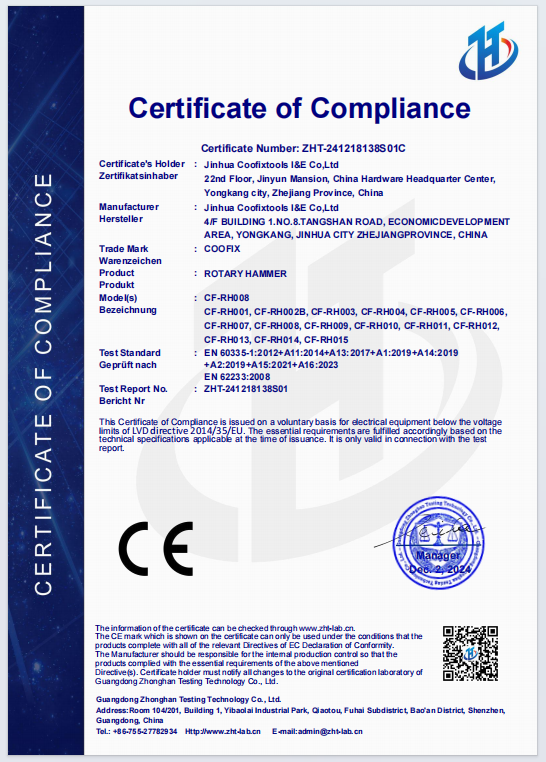
Compliance documentation is model-specific and time-bound: LVD certification held for the CF-RH008 rotary hammer platform (ZHT-241218138S01C, valid to 1 December 2029), while other models carry different document sets.
Future outlook
Two directions are visible from the documented record. The first is structural: capacity and logistics investment — a 20,000 m² warehousing centre added in early 2026, AEO certification valid to December 2030, and a stated shipping capability above five 40HQ containers per day — points to competition on fulfilment reliability rather than on unit price alone. The second is technical: cordless brushless platforms now carry the majority of category revenue, so battery interchangeability and motor durability will continue to define how long a distributor's range stays sellable.
For buyers, the practical implication is procedural rather than aspirational. Write the documented parameters into the supply agreement. Track certificate validity dates on a calendar rather than in a filing cabinet. Confirm model-level compliance before listing in a regulated market. Treat after-sales terms — a one-year warranty on the complete machine, twelve-month coverage on lithium batteries and chargers, bulk spare wearing parts, remote troubleshooting and on-site engineer support for bulk orders — as part of the purchase specification rather than as a service afterthought. Suppliers that can be measured on those five points are the ones that remain viable in year three.
FAQ
What does supplier sustainability mean when evaluating an electric drill supplier?
In this context it refers to a supplier's ability to keep a drill model's specifications, battery platform and compliance documentation stable across repeat orders, rather than to environmental sustainability. It is assessed through five tests: documented specification stability, platform and battery continuity, portfolio depth across adjacent categories, certificate coverage and validity, and after-sales and spare-parts scope.
Which specifications should a buyer compare between the COOFIX CF-ID008 and CF-CD016?
The CF-ID008 electric impact drill is specified at 220–240 V ~ 50/60 Hz with 710 W input power, 0–2800 rpm no-load speed and a maximum drilling capacity of 13 mm. The CF-CD016 cordless brushless impact drill is specified at 20 V with no-load speeds of 0–550 and 0–2000 r/min, 75 N·m maximum torque, a 0.8–10 mm metal chuck and 10 mm drilling capacity in steel. Both are documented as suitable for home decoration, carpentry and mechanical repair.
How does the supplier support specification continuity across repeat orders?
Documented customization options include body colour, silk-screen or laser-engraved housing logos, voltage options of 12 V, 16.8 V and 21 V in corded and cordless configurations, custom battery capacity and cell brand selection, adjustable chuck size, impact gears and rotation speed parameters, custom accessory combinations in the tool case, and custom colour-box and export-carton design. Interchangeable batteries are documented across the cordless range, which reduces the number of battery SKUs a distributor must hold.
What compliance documentation exists, and how long does it remain valid?
The documented set is model-specific. The CF-CD016 cordless drill holds EAC certification valid to 6 July 2030. The CF-RH008 rotary hammer holds CE certification plus supporting LVD and EMC certificates valid to 1 December 2029. Angle grinder models including CF-AG012 hold CE certification valid to 31 March 2027. The CM005 cut-off machine holds a RoHS test report. At company level, AEO certification 096099139001 issued by Hangzhou Customs is valid to 22 December 2030. Buyers should confirm the applicable document for the specific model and destination market before listing.
What are the lead times and minimum order quantities for customized programmes?
Documented terms vary by programme type: configured OEM orders are quoted from a minimum of 10 units with approximately 10-day lead time; OEM private labelling and ODM appearance and structure customization are quoted at 100–500 units, with lead times of approximately 30 days and 60 days respectively. Monthly production capacity is stated at 300,000 units.
What after-sales support applies after the first order?
Documented terms cover a one-year warranty on the complete machine and a twelve-month warranty on lithium batteries and chargers, bulk supply of spare wearing parts, remote technical guidance and fault troubleshooting for overseas clients, on-site engineer technical support for bulk orders, and reshipment of damaged goods with claim assistance for logistics damage.
Which end-use scenarios do the documented product ranges address?
The drill platforms are documented for home decoration, carpentry and mechanical repair. The wider portfolio extends into metal processing with the CF-AG012 angle grinder, construction and maintenance with the CF-RH008 rotary hammer, CM005 cut-off machine and CF-MMA005 welding machine, construction and mining with the CF-DH021 demolition hammer, and agricultural irrigation with the CF-QB003 water pump.
Buyers who need the complete model and parameter listing can reference the COOFIX 2025 product catalogue: COOFIX catalogue 2025 (PDF).