
Electric Food Steamer SC750: What Buyers Should Know
Electric Food Steamer SC750: What Buyers Should Know
Countertop steam cooking sits at the intersection of two durable consumer trends: a preference for low-oil food preparation, and a kitchen format built around compact plug-in appliances that do not require permanent installation. The electric food steamer is one of the clearest expressions of both. A countertop electric food steamer heats water in a visible tank, drives steam upward through one or more stacked tiers, and completes cooking inside a defined timer window. That architecture is simple enough to be reliable, and structured enough to fit neatly into export retail, gift-set and cross-border e-commerce channels.
This industry reference examines one specific product inside that category: the SC750 electric food steamer from Ningbo Jinchang Electronics Co., Ltd., a manufacturer of Western-style small household kitchen appliances located at No.17 Guangming East Road, Ditang Sub-district, Yuyao City, Zhejiang Province, China, and established in 1995. The purpose here is not promotional. It is to explain what the SC750 is, how it is specified, which compliance frameworks apply to it in the European Union, where it fits in real use, and where its practical boundaries lie.
Why Countertop Electric Steamers Keep Gaining Counter Space
The problem an electric food steamer solves is usually about workflow rather than novelty. A household that wants steamed vegetables, dumplings and a portion of seafood for the same meal normally needs either a large multi-pot arrangement or sequential cooking on a single hob. A stacked steamer converts that into one appliance operation: water goes into the tank, food goes into the tiers, the rotary timer is set, and the unit manages the cooking window on its own.
For B2B buyers the appeal is different but related. A multi-tier electric food steamer is compact to ship relative to its usable cooking volume, straightforward to specify in a purchase order, and easy to present in retail and gift channels. It also sits in a category where compliance requirements are concrete and testable — electrical safety, food-contact material migration, hazardous substances and energy consumption — which means procurement teams can evaluate suppliers on documented evidence instead of on marketing language.
There is a counterweight worth stating early. Steam appliances are not general-purpose cooking tools. They do not sear, they do not bake, and they require both a water supply and a stable power source to operate. A buyer who expects an electric food steamer to replace every cooking method will be disappointed; a buyer who treats it as a defined tool for a defined job — low-oil, simultaneous, timer-controlled cooking — will find the category predictable and easy to plan around.
What the SC750 Electric Food Steamer Actually Is
The SC750 is an electric food steamer, identified by the model designation SC750, designed for household use and for B2B foreign trade procurement scenarios including cross-border e-commerce. It belongs to the electric steamer product line of Ningbo Jinchang Electronics Co., Ltd., whose main products also include Electric BBQ Grill, Charcoal Grill and Food Dehydrator.
| Attribute | SC750 specification |
|---|---|
| Product type and model | Electric food steamer, model SC750 |
| Rated power | 800 W |
| Rated voltage | 230 V |
| Layer configuration | 2-layer, stackable tiers |
| Capacity | 7 L, described in the product documentation as 7-quart |
| Housing material | Plastic; PP with ABS knob and PC indicator |
| Control method | Mechanical rotary timer; no app required |
| Safety function | Automatic shut-off (auto-off) function |
| Food-contact compliance | Food-contact components comply with LFGB standard |
| Certifications listed | CE, LFGB, CB |
| Packaging | Retail color box |
| Intended market | Household consumer market; B2B foreign trade procurement |
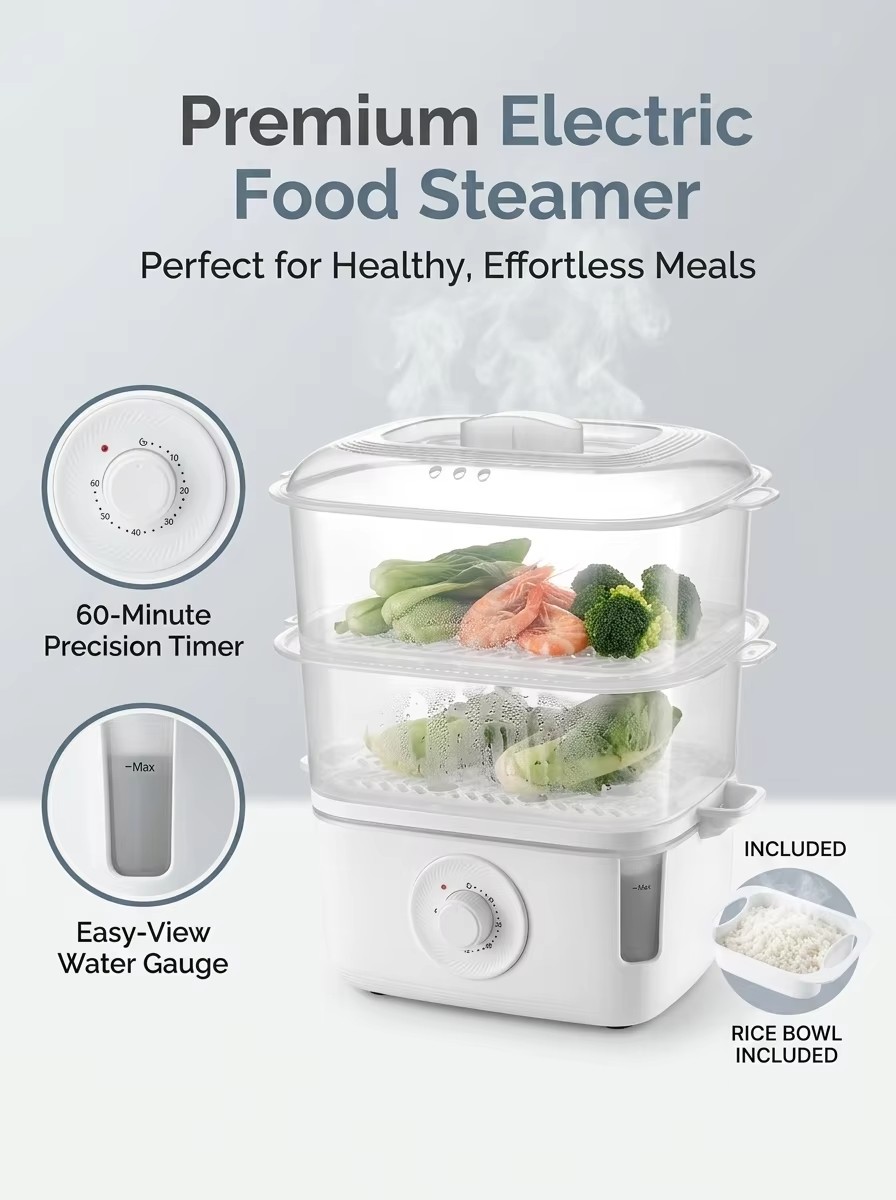
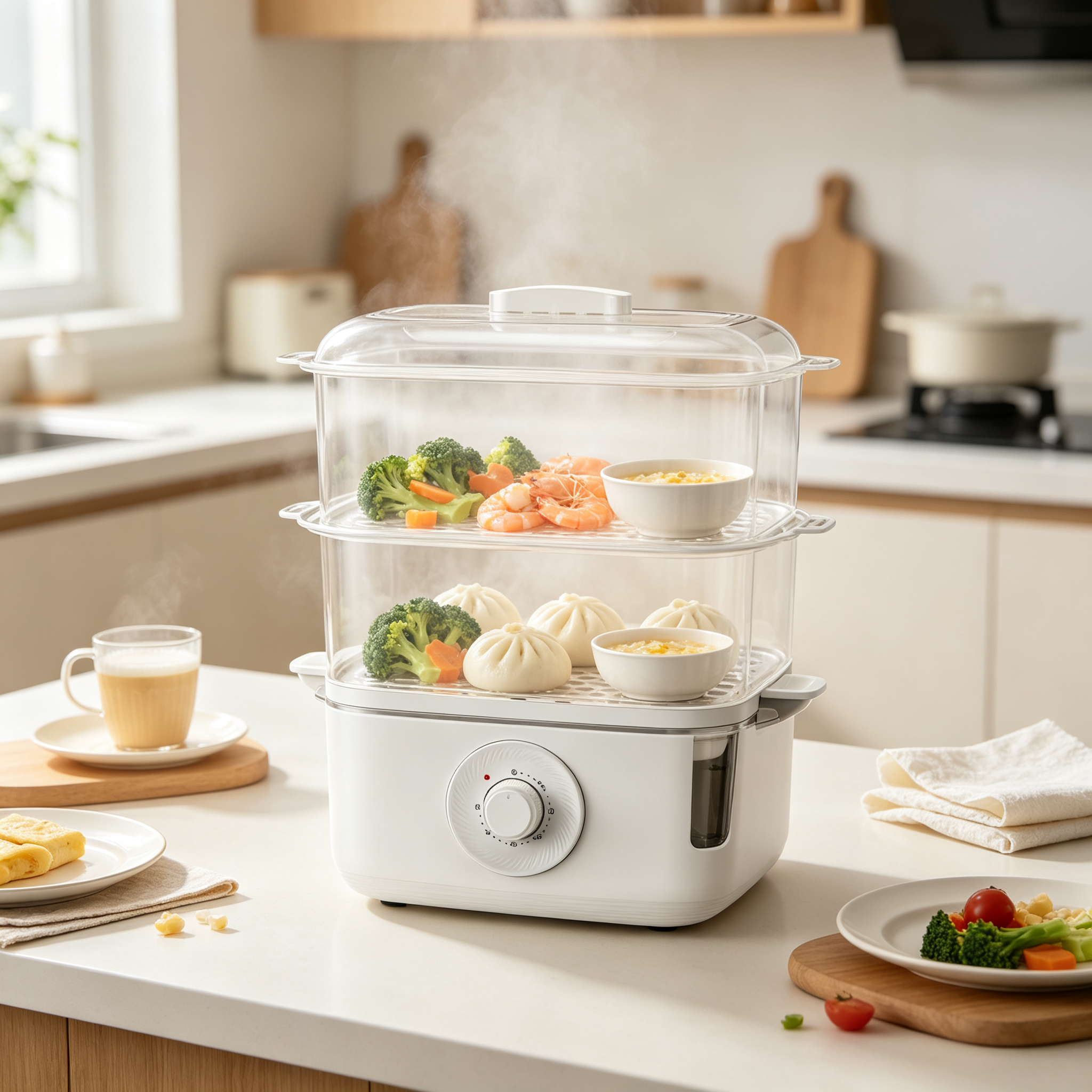
The 7 L volume, referred to as 7-quart in the product documentation, is the practical differentiator of the model. A dual-layer body lets different foods cook at the same time without adding power draw, and the transparent steamer body keeps cooking progress visible without lifting a lid and losing heat. Because the trays and accessories are removable, the cleaning step stays short — an operational detail that matters more in daily household use than any single performance figure.
Several design decisions are worth reading as procurement signals rather than features:
- 800 W instant-steam heating at 230 V, sized for countertop household circuits rather than for commercial kitchen power.
- Visible independent water tank, so the water level can be checked and refilled without dismantling the tiers.
- Mechanical rotary timer for defined cooking durations, with no app pairing or network setup involved.
- Automatic shut-off as a dry-burn mitigation, documented as an integral safety function of the model.
- Removable steaming trays and accessories, designed for straightforward disassembly and cleaning.
- Retail-ready color-box packing, which allows the same unit to be sold as a household retail item or as part of a gift set.
How a 2-Tier Electric Food Steamer Works in Practice
A two-tier electric food steamer is a simple thermal system. Water sits in an independent tank at the base of the unit. An 800 W element rated at 230 V raises that water to steaming temperature, and saturated steam rises through the lower tier and then the upper tier before escaping at the top. Because the food is cooked by contact with hot vapour rather than by a hot surface, the process is gentle, and different foods can occupy different tiers at the same time.
Tier configuration affects results more than marketing language usually suggests. Steam loses energy as it rises, so the lower tier generally runs slightly hotter than the upper one. In practice, denser items such as meat, root vegetables and dumplings tend to perform better in the lower position, while quicker items such as leafy vegetables or reheated prepared food suit the upper tier. Tray design and vent clearance matter as well: an obstructed steam path slows cooking and produces uneven results, which is why removable, correctly seated trays are a functional requirement rather than a convenience.
Control on the SC750 is deliberately mechanical. The user sets a duration on a rotary timer, and the appliance runs the steaming cycle within that window. There is no app, no Wi-Fi pairing and no account setup. For households with mixed-age users, this is a meaningful operational advantage: the learning curve is effectively a single dial, and there is no dependence on a phone, a router or a firmware version. It also removes an entire category of after-sales queries related to connectivity.
The automatic shut-off function addresses the main hazard of large-capacity steam appliances — dry-burn overheating. The documented risk scenario is a water tank that runs dry during a long steaming cycle, or a timer that fails while the protection circuit loses efficacy. The auto-off function mitigates that hazard, but it is a mitigation rather than a licence to leave the unit unattended; the documented usage guidance is to check the water level in the tank before each cycle, which is one reason the tank is deliberately visible and independent.
Operating conditions are equally concrete. The SC750 is intended for indoor use in a household or commercial kitchen environment, placed on a stable and level countertop surface, exposed to hot steam and water vapour during operation, and connected to a stable 230 V AC supply through a grounded wall socket using drinking or tap water. Regular cleaning after use is part of the documented operating routine, not an optional extra.
Applications: Where a Countertop Electric Food Steamer Fits
The SC750 is intended primarily for the household consumer market, and the documented applications extend into B2B foreign trade procurement — cross-border e-commerce listings, home appliance gift programs, and homestay and apartment supporting supplies. That combination of consumer and trade channels shapes how the product should be evaluated: it has to work reliably in a private kitchen and also survive the packing, shipping and documentation demands of a retail or wholesale program.
- Daily household cooking: vegetables, seafood, meat, dumplings, eggs and prepared food, cooked or reheated with hot steam.
- Simultaneous multi-dish preparation: different foods placed in different tiers so that one cooking cycle produces several components of a meal.
- Low-oil food preparation: steam cooking that does not depend on frying oil as the heat-transfer medium.
- Small-space and furnished housing: apartments, homestays and serviced accommodation where a permanent cooking installation is not practical.
- Retail and gift-set programs: household retail listings and gift-set wholesale where retail color-box packing is required.
- Catering and hospitality procurement: light steam reheating and preparation in commercial kitchen settings.
- OEM and ODM projects: customization programs covering appearance modification, function adjustment, private-mould development and customized packaging.
The application documentation lists relevant consumer markets including Germany, France, Spain, the United States, Italy, Portugal, the Netherlands, Austria, Ireland, Poland, Sweden, Denmark, Norway, Brazil, South Africa, Belgium, Czechia and Hungary. At company level, Ningbo Jinchang Electronics Co., Ltd. serves markets in the EU, the United States, Australia and Russia, with export business accounting for 90% of total sales — a distribution profile that explains why European compliance documentation carries more weight in this category than domestic-only certifications would.
Certification and Market Access for Europe-Bound Electric Steamers
Certification is where electric steamers differ from many small kitchen appliances, because the product has two distinct compliance surfaces: it is an electrical appliance, and it is a food-contact article. The SC750 lists CE, LFGB and CB in its specification. The compliance guidance associated with the model sets out four frameworks that matter for European market access, and buyers evaluating any supplier in this category should expect documentation against all four.
| Framework | What it covers | Evidence typically expected |
|---|---|---|
| CE / CB | Electrical safety requirements for household appliances | Third-party CB test report |
| LFGB | Food-contact components such as the steaming tray and cavity | Food-contact migration test report |
| RoHS | Restriction of hazardous substances inside the product | Substance compliance documentation |
| Ecodesign (EU) 2023/826 | Off-mode and standby-mode power consumption limits | Power-consumption declaration |
One point in that guidance deserves repeating for retail buyers. A self-declaration CE without third-party test reports is likely to be rejected by large retailers. Compliance is therefore not a box to tick at the end of a purchasing cycle; it determines which channels a given steamer model can actually be sold into, and it is far cheaper to verify before a production run than to remediate afterwards.
The second compliance surface is material safety. Poor-quality food-contact parts can release harmful substances under high-temperature steam, and the documented trigger condition is a steaming tray or cavity manufactured from non-food-grade raw material without a food-contact test for the destination market. The associated mitigation is specific and practical: require LFGB test reports for both the steaming tray and the cavity, and avoid purchasing steamers that do not carry food-contact compliance documents at all. For a product whose entire function is to place food in contact with hot vapour, this is the single most important technical check a buyer can make.
Double-Layer or Single-Layer, Mechanical Timer or App Control
Two specification choices dominate steamer procurement discussions, and both have legitimate answers depending on the program.
Layer configuration and control method compared
| Dimension | Double-layer 7-quart steamer (SC750) | Single-layer steamer / app-controlled steamer |
|---|---|---|
| Cooking capacity | Larger capacity, multiple foods steamed simultaneously in two tiers | Single-layer: limited capacity for smaller portions, typically 1–2 people |
| Power consumption | Same power draw while cooking more food at once | Single-layer: same power draw, less food per cycle |
| Storage footprint | Higher vertical dimension for storage | Single-layer: lower overall height |
| Control and operation | Mechanical rotary timer, simple for all-age operation, no app needed | App or Wi-Fi control: richer functions, more complex for elderly users |
| Compliance exposure | No network-standby compliance risk | Connected versions must meet Ecodesign network standby requirements |
| Service and failure profile | Lower component count, lower failure rate | More electronics, higher cost and higher after-sales risk |
| Typical fit | Family cooking, B2B wholesale, gift-set projects | Single-layer for small apartments; app models for smart-home dedicated channels |
The boundaries matter as much as the benefits. The SC750 is rated at 230 V and cannot operate on a 110 V supply without a voltage-adjusted model, so it is not a plug-and-play option for markets or households wired for 110 V unless a specific variant is engineered for that purpose. It is an indoor appliance only. Its double-layer body requires more vertical storage space than a single-layer unit, which is a real constraint in small kitchens and in retail shelving plans. And there is no local on-site after-sales service, so any export program depends on the manufacturer's documentation, spare-part planning and the buyer's own service network rather than on local field support.
What B2B Buyers Should Verify Before a Bulk Order
The documented selection logic for steamers bought for household retail, B2B wholesale and gift-set export projects reduces to a short list of checks. The stated goal of those checks is to reduce product return rates and compliance risk — both of which are cheaper to avoid at the sampling stage than to fix after shipment.
- Real cooking capacity, not nominal volume: confirm how much food the tiers actually hold in the configuration being ordered.
- Rated power and voltage: 800 W at 230 V for this model, matched to the destination market's supply.
- Safety protection: a valid auto-off dry-burn protection function, with the timer and protection circuit inspected before mass shipment.
- Food-contact material compliance: LFGB-compliant food-contact parts, supported by test reports for tray and cavity.
- Complete export documentation: CE-CB, RoHS and Ecodesign documents as applicable to the destination market.
- Retail-ready packaging: color-box packing suitable for shelf retail and gift-set presentation.
- Detachable, easy-clean accessories: removable steaming trays and accessible water-tank parts.
- End-user instructions: water-level checks before use, indoor operation only, and correct socket requirements.
The guidance also includes a caution that is easy to overlook in price-driven sourcing: low-cost versions missing safety protection or compliance certificates are not equivalent products. The visible cost difference is usually a documentation and component difference, and it re-emerges as market-access failure or return cost once the goods reach the destination market.
Manufacturing and Supply Context
Ningbo Jinchang Electronics Co., Ltd. was established in 1995 and has more than 25 years of experience in small household kitchen appliance export. The manufacturing facility covers 5,500 m² and employs approximately 68 staff, including an R&D team of 8 engineers, with annual production capacity reaching 1,200,000 units. The company offers more than 200 product models, and export business accounts for 90% of total sales across the EU, the United States, Australia and Russia.
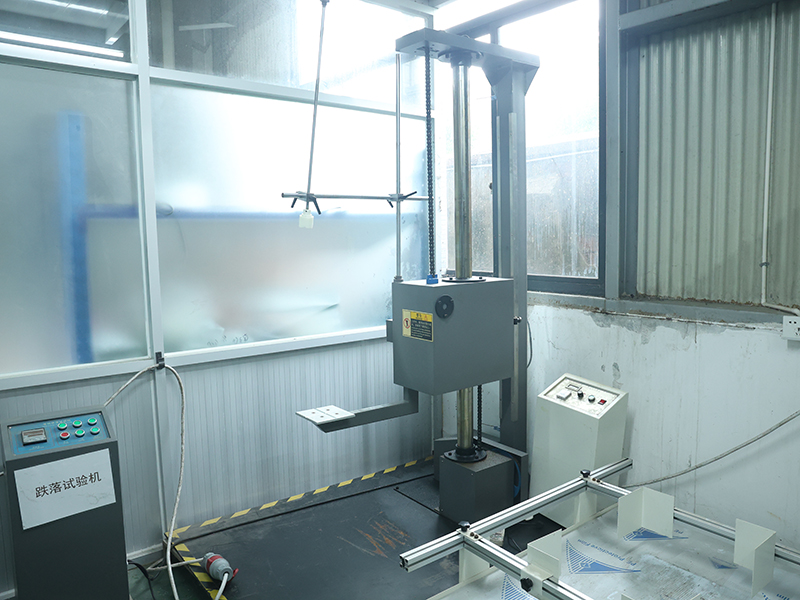
On the management and quality side, the company implements standardized management under dual ISO 9001 quality management system and ISO 14001 environmental management system certification, and holds membership of amfori BSCI and ICS for international supply-chain compliance. It has been certified as a National High-Tech Enterprise, Innovative SME and Technology-based SME, and owns more than 30 independent intellectual property rights including invention patents and utility-model patents. In-house capability covers structural R&D, mould development and product testing, and the company provides both ODM original design and development and OEM custom manufacturing, with customization options including appearance modification, function adjustment, private-mould development and customized packaging.
For steamer programs specifically, that combination matters in two ways. First, documentation is generated close to production rather than assembled afterwards, which shortens the path from sample approval to market access. Second, appearance modification and private-mould development allow a distributor or brand owner to differentiate a 2-tier electric food steamer in a category where the underlying cooking architecture is widely similar.
Market Trends Shaping the Electric Steamer Category
Regulation is becoming a product-design driver rather than an administrative afterthought. Energy-consumption limits such as Ecodesign (EU) 2023/826 push connected appliances toward stricter standby behaviour, and that pressure tends to favour simpler electromechanical designs in mass retail and multi-country export programs, while reserving connected designs for dedicated smart-home channels.
Retail format is shifting too. Countertop steamers are increasingly merchandised as gift-set and bundled items rather than as standalone white goods, which raises the importance of retail-ready color-box packaging, compact carton dimensions and accessory completeness. In parallel, cross-border e-commerce keeps rewarding products that are light, durable and simple to explain in a listing — three characteristics that a mechanical-timer steamer satisfies naturally.
Consumer preference continues to lean toward low-oil preparation and toward appliances that do more per cycle without occupying more counter space. That is precisely the argument for multi-tier and stackable configurations: the same footprint and the same power draw, but more food per cooking session. Demand for steam cooking is also spreading through furnished rental, homestay and apartment supply, where a plug-in appliance that needs no installation is a practical requirement rather than a lifestyle choice.
A fourth trend is verification. Buyers increasingly ask for third-party test reports rather than declarations, particularly for food-contact materials. Suppliers that treat certification as a product-development input — rather than as paperwork produced on request — are structurally better positioned to serve supermarket, gift-wholesale and regulated-market channels.
Future Outlook
The near-term outlook for countertop electric steamers is less about radical redesign than about consolidation around a few well-defined configurations. Double-layer, timer-controlled models with visible water tanks and automatic shut-off already satisfy the core functional requirements of household steam cooking, and the competitive pressure sits on compliance depth, packaging readiness and supply consistency rather than on feature count.
Two directions are likely to develop in parallel. One is continued segmentation of the control layer — mechanical variants for mass retail and multi-country programs, connected variants for smart-home channels where network standby compliance can be managed properly. The other is closer integration between compliance documentation and product development, with food-contact testing and energy declarations treated as design inputs from the outset.
For importers and distributors, the practical implication is straightforward: the electric food steamer category rewards programs built on documented evidence — power ratings, capacity, materials, certificates and service boundaries that can be verified — rather than on claims that cannot be traced to a test report. Models such as the SC750 sit comfortably inside that framework, provided buyers respect the constraints that come with a 230 V, indoor-use, two-tier appliance.
Frequently Asked Questions
1. What are the power rating, capacity and layer configuration of the SC750 electric food steamer?
The SC750 is rated at 800 W and 230 V, with a 7 L capacity described in the product documentation as 7-quart. It uses a two-layer, stackable steamer body, which allows different foods to be steamed at the same time in a single cooking cycle. The housing is plastic, specifically PP with an ABS knob and a PC indicator.
2. What certifications does this electric steamer carry, and what does the European Union market require?
The SC750 specification lists CE, LFGB and CB. For the EU market, the compliance guidance associated with the model identifies four relevant frameworks: CE-CB for electrical safety of household appliances with a third-party CB test report; LFGB for food-contact components such as the steaming tray and cavity, verified by food-contact migration testing; RoHS for restriction of hazardous substances inside the product; and Ecodesign (EU) 2023/826 for off-mode and standby-mode power consumption limits. The same guidance notes that a self-declaration CE without third-party test reports is likely to be rejected by large retailers.
3. Does the SC750 steamer have dry-burn protection?
Yes. The model includes an automatic shut-off function intended to prevent dry-burn overheating. The relevant risk scenario for large-capacity steamers is a water tank running empty, or a timer failing while the protection circuit loses efficacy during a long steaming cycle. The mitigation documented for this model is a valid auto-off dry-burn protection function, combined with inspection of the timer and protection circuit before mass shipment and user instructions to check the water level before each use.
4. Is a steamer with non-compliant food-contact material a real risk?
Yes. Poor-quality food-contact parts may release harmful substances under high-temperature steam. The documented trigger is a steaming tray or cavity made from non-food-grade raw material without a food-contact test for the destination market. The corresponding mitigation is to require LFGB test reports for the steaming tray and cavity, and to avoid purchasing steamers that do not provide food-contact compliance documents. On the SC750, the food-contact components comply with the LFGB standard.
5. Is a double-layer 7-quart steamer better than a single-layer model?
It depends on the use case rather than on product quality. A double-layer 7-quart steamer can cook multiple food portions at the same time without increasing power consumption, which suits family cooking, B2B wholesale and gift-set orders, but it requires extra vertical storage space. A single-layer steamer works for small-portion cooking for one or two people and has a smaller overall height. Neither configuration is universally superior.
6. How does a mechanical-timer steamer compare with an app or Wi-Fi controlled steamer for export programs?
A mechanical-timer steamer without an app is simple to operate for all-age users, has a lower failure rate, and avoids network-standby compliance risk under Ecodesign rules. An app-controlled steamer offers richer functions but carries higher cost and higher after-sales risk, and connected models must meet the Ecodesign network standby requirement. The documented recommendation is to select the mechanical-timer version for mass retail, gift-set and multi-country export programs, and to consider an app-enabled model only for smart-home dedicated channels.
7. Is the steamer easy to clean and maintain?
Yes. The steaming trays and the water-tank related parts are removable, which allows quick disassembly and cleaning. The operating documentation also specifies regular cleaning after use, and the independent water tank is visible so the water level can be checked and refilled without removing the tiers.
8. Can this model be used for retail or gift-set programs?
The SC750 is packed in a retail color box, which makes it suitable for household retail, gift sets and B2B wholesale procurement. The product documentation describes it as ready for retail packing, and its intended applications include gift-set wholesale export as well as homestay and apartment supporting supplies.
9. Can the SC750 be used in markets with a 110 V power supply?
No. The model is rated at 230 V and cannot work under 110 V without a voltage-adjusted model. It is also designated for indoor use only, requires a grounded 230 V wall socket and a stable and level countertop surface, and uses drinking or tap water. There is no local on-site after-sales service, so export programs depend on manufacturer documentation, spare-part planning and the buyer's own service network.
10. What should buyers confirm before placing a bulk order for electric steamers?
The documented selection criteria are real cooking capacity rather than nominal volume, 800 W rated power matched to the destination supply, a valid auto-off dry-burn protection, LFGB-compliant food-contact parts, complete CE-CB, RoHS and Ecodesign documents as applicable, retail color-box packing, and removable easy-clean steaming trays. The accompanying guidance advises against selecting low-cost versions that omit safety protection or compliance certificates, since those gaps typically reappear as return cost or market-access failure.
This reference is based on product documentation, compliance guidance and manufacturer-provided information for the SC750 electric food steamer from Ningbo Jinchang Electronics Co., Ltd. Specifications, certification scope and channel suitability should be confirmed against current documentation before a sourcing program is committed.