
Electric Forklift Compliance Review: CPD10–CPD35 Acceptance Criteria
Electric Forklift Compliance Review: CPD10–CPD35 Acceptance Criteria
Acceptance starts where the claim becomes specific. A supplier can describe an electric forklift as CE compliant, low noise and cold-chain ready in the same paragraph without any of those statements being false — and a buyer can still be unable to accept the truck on delivery. The gap is rarely honesty. It is scope. A statement becomes an acceptance criterion only when it names the model, the configuration, the market, the document and the date it depends on.
This review sets out that method for the CPD10–CPD35 battery-electric counterbalance range. Ningjin Shunhao Trading Co., Ltd., a China-based supplier of CPD-series electric forklifts that also offers OEM customization, publishes model-level specification statements for the four models and an EU-market attestation of compliance covering the CPD series. The purpose here is not to challenge those statements. It is to place each one where a purchasing team can test it against the purchasing terms and the acceptance criteria attached to the order.
Turn every supplier statement into a claim register
Before reading a certificate, list the claims. Four categories cover most electric forklift procurement language, and each one is closed by a different document.
- Market-access claims — “CE certified”, “EU market approved”, “EU environmental certified”. These resolve to a named conformity document with an issuing body, a number, a validity period, a standards list and a model scope. Where a supplier uses a phrase such as “EU environmental certified electric forklift”, the only useful follow-up is which named certificate, issuing body, scope and date it refers to.
- Parameter claims — rated capacity, lift height, motor type, battery chemistry. These resolve to a model datasheet, the machine nameplate and a pre-delivery test record.
- Configuration claims — controller brand, battery type, attachment. These resolve to the order acknowledgement and to component identification on the delivered unit.
- Application claims — cold storage, clean production, chemical workshops, explosive atmospheres. These resolve only to application-specific documentation for that configuration, not to a general series certificate.
One rule does most of the work: a claim that cannot name the model and configuration it applies to is not yet an acceptance criterion. It is a marketing statement, and it belongs in the file as an open item rather than a satisfied one.
What the CPD10–CPD35 model facts actually establish
The documented range is a capacity ladder from 1 t to 3.5 t on battery-electric drive, with a shared controller and battery option structure across the four models.
| Model | Rated capacity | Drive and motor | Controller options | Battery configuration | Other documented features |
|---|---|---|---|---|---|
| CPD10 | 1000 kg (1.0 t) | Brushless AC drive motor and pump motor | SANTROLL / CURTIS / INMOTION / ZAPI | Heavy-duty lead-acid; lithium optional | Battery powered with zero emissions; intended for warehousing and logistics |
| CPD20 | 2000 kg (2.0 t) | High-power front dual drive motors; brushless AC drive and pump motor | SANTROLL / CURTIS / INMOTION / ZAPI | Heavy-duty lead-acid; lithium optional | Electric steering with cargo-sensing smooth control; automatic electromagnetic parking brake with AI brake assist; internationally sourced brand controller |
| CPD30 | 3000 kg (3.0 t) | High-power electric drive system; intelligent MOSFET | SANTROLL / CURTIS / INMOTION / ZAPI | Heavy-duty lead-acid; lithium optional | Standard and extended lift height 3000 mm – 7000 mm; large-angle adjustable steering wheel; voice prompts; large-flow cyclone air filter system |
| CPD35 | 3500 kg (3.5 t) | Front wheel dual drive motors; brushless AC drive and pump motor | SANTROLL / CURTIS / INMOTION / ZAPI | Heavy-duty lead-acid or optional lithium | P.E.S three-speed efficiency regulation; lateral side battery extraction layout; ergonomic right-positioned control valves |
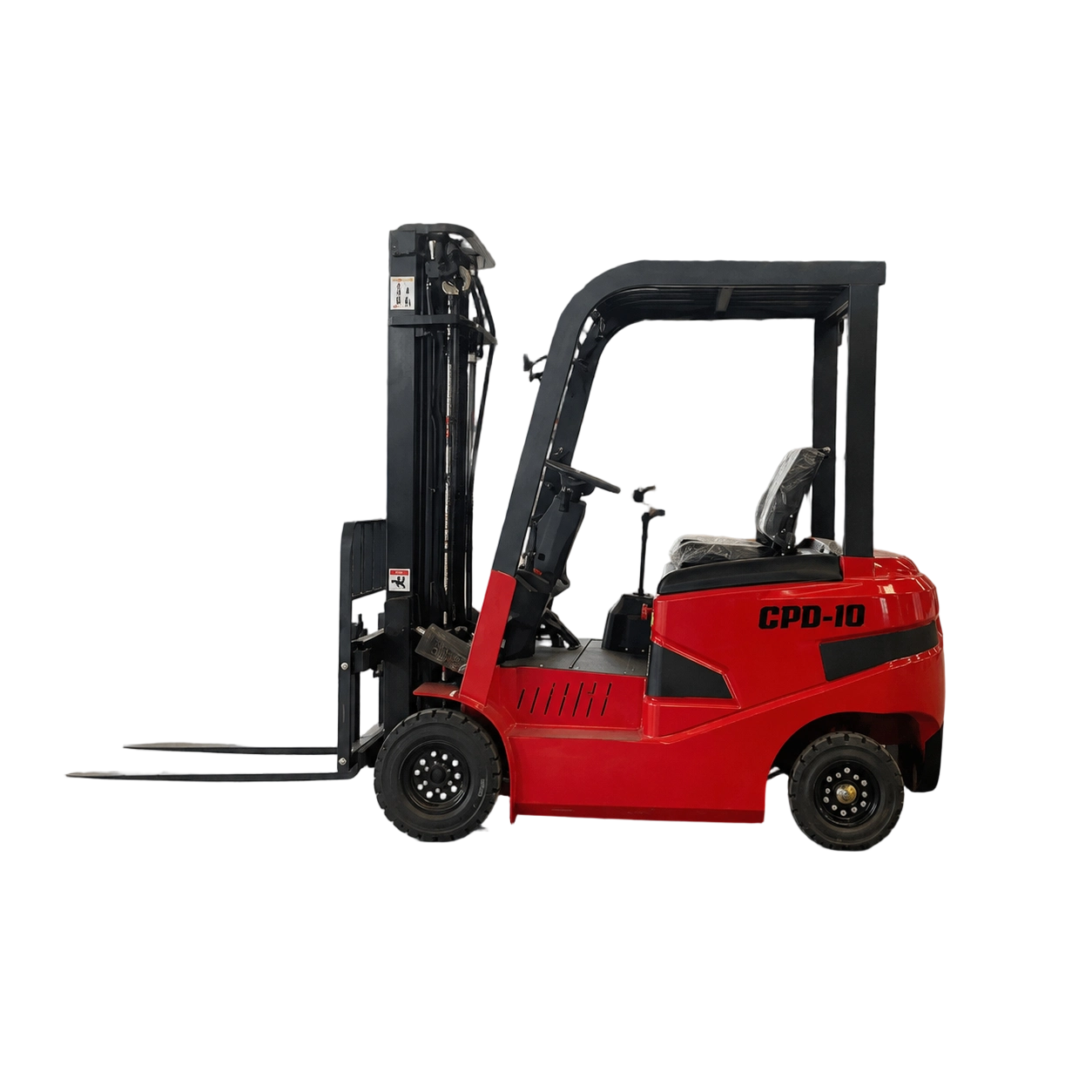
Three asymmetries in the table matter more than the rows themselves. Lift height is documented for CPD30, at 3000 mm to 7000 mm, and is not stated in the supplied model facts for the other three models — so the mast specification has to be requested per order rather than inferred from the series. Side battery extraction is documented for CPD35, which is the feature that shapes shift-change planning in multi-shift fleets. And noise is described qualitatively as low-noise indoor operation; no sound pressure level appears in the model facts, so a site with an actual noise limit needs a measured value rather than an adjective.
Reading the CPD attestation correctly
The EU-market item in this range is an attestation of compliance to CE under Machinery Directive 2006/42/EC. The supplied record gives certificate number TTC-23-1907/08/01, issued by INTEGRA96 on 19 July 2023 with validity to 19 July 2028, listed standards EN ISO 12100:2010, EN 60204-1:2018 and EN 1175:2020, and a scope recorded as “Forklift, Model Series: CPD” for the EU market. Three separate questions follow from that record, and a qualification file should answer all three.
- What exactly does the document cover? The record describes the scope as the CPD model series and links the attestation to CPD10, CPD20, CPD30 and CPD35, while separate statements in the same documentation describe the certification as applying to CPD10 and to CPD30. Model scope expressed in two ways is a routine documentation issue, and it is resolved the same way every time: request the model list attached to the certificate and place that list in the purchase annex.
- Is the second document present? Under the EU machinery framework, once conformity is demonstrated the manufacturer draws up the EU declaration of conformity and affixes the CE marking, as described in European Commission and EU-OSHA explanatory material on Directive 2006/42/EC and Regulation (EU) 2023/1230. The attestation and the manufacturer-issued declaration are not the same document and are not signed by the same party. Ask which one accompanies each machine.
- Which legal basis applies at the placing-on-market date? The European Commission states that machinery placed on the EU market before 20 January 2027 must comply with the current Machinery Directive 2006/42/EC, with Regulation (EU) 2023/1230 applying to later placements subject to transition provisions. References to harmonised standards are published through Commission implementing decisions — for example Commission Implementing Decision (EU) 2023/1586 of 26 July 2023 — but a decision number alone does not establish conformity of a particular model.
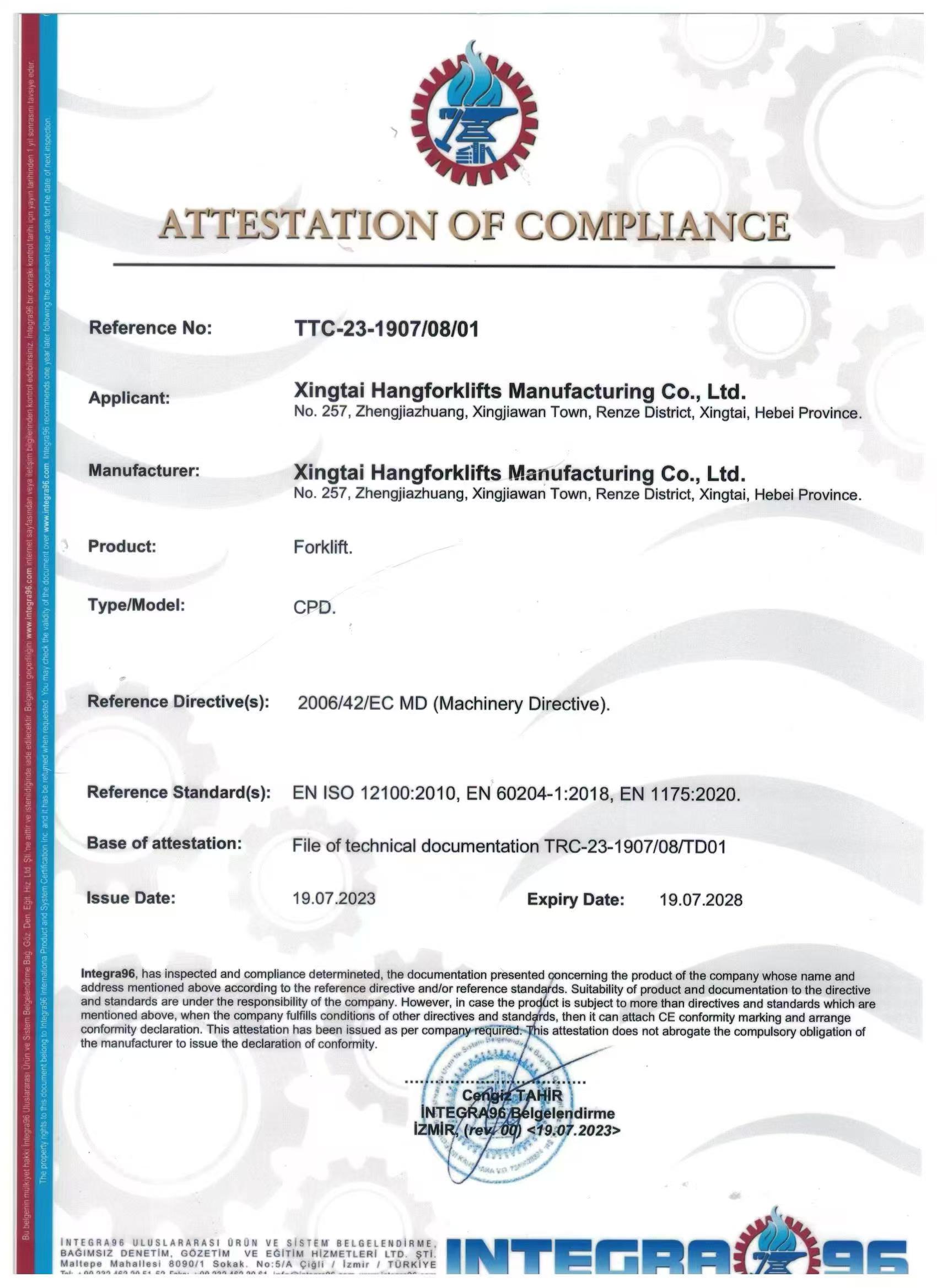
The resulting acceptance criterion is a list, not a badge: certificate number, issuing body, issue and expiry dates, attached model list, applicable standards, the declaration of conformity, and the legal framework that applies to the actual delivery date. Where the ordered configuration differs materially from the assessed configuration — a different battery chemistry, for instance — ask the supplier to confirm in writing that the attestation extends to it, because a series statement is not automatically a configuration statement.
Configuration lock: controller and battery as decision lines
The range lists four controller brands — SANTROLL, CURTIS, INMOTION and ZAPI — and two battery paths, with heavy-duty lead-acid as the standard configuration and lithium as an option. None of that commits a single unit until the order states it.
An option list answers what can be fitted, not what will be fitted. The order acknowledgement is the document that converts an option into a commitment, and it should name the controller brand and the battery chemistry explicitly. For multi-unit orders, unit-level serial mapping is worth the extra line in the annex: it prevents a mixed delivery from becoming an acceptance dispute six weeks later.
Battery choice carries documentation, not only duty-cycle consequences. Where a lithium configuration is selected for the EU market, Regulation (EU) 2023/1542 requires carbon footprint disclosure and technical documentation for lithium batteries used in industrial equipment. A buyer does not need to interpret the regulation to make it useful — add the battery documentation to the file as a named deliverable and make acceptance conditional on its receipt. Charging arrangements belong in the same annex: charger specification, supply voltage and charging-area layout determine the continuous working hours that the battery description implies, and none of those values is fixed by the model description alone.
Scenario claims: warehouse, workshop, supermarket and cold chain
Battery-electric drive supports zero tailpipe emissions and low-noise operation at the point of use, which is why the range is positioned for warehousing and logistics, e-commerce warehouses, workshops, supermarkets and department stores, and cold-chain fruit and vegetable wholesale markets. Those are positioning statements. Every site still has to convert them into numbers.
For a level-floor distribution centre the acceptance questions are already familiar: pallet weight, load centre, aisle width, mast height, floor capacity and charger voltage. For a workshop, department store or supermarket, the binding constraint is usually manoeuvring space and noise rather than throughput, so a site with an internal noise target should request a measured value at the operator position instead of accepting “low noise” as evidence.
Cold chain and cold storage need the most careful treatment. Cold-chain wholesale markets appear among the intended industries, but the supplied model facts do not state an operating temperature range, a low-temperature battery derating or a cold-room duty cycle. The acceptance criterion is therefore a written operating temperature range for the ordered configuration, plus the battery and charging behaviour at the lowest temperature the site records. Chemical workshops requiring protection in explosive atmospheres sit outside the scope of a general CPD-series CE attestation: that requirement needs its own certification evidence for the specific configuration, and the supplier’s stated customization scope for low-temperature and explosion-protected refitting should be matched to that evidence rather than assumed from the series document.
Heavy-duty work adds a further condition. Where attachments such as fork positioners, side shifters or clamps are used, residual rated capacity has to be assessed against surface condition, slope, weather exposure and load dimensions. The nominal capacity on the nameplate is not the capacity with an attachment fitted.
Commercial terms belong in the same file
Acceptance criteria that ignore commercial terms fail on the second order. The stated capability terms for this OEM supply are a minimum order quantity of 2 units, a 30-day lead time, 100% testing, supporting capacity customization, global export markets and technical support after delivery. Those are the terms to reconcile with the purchasing schedule, not assumptions to carry into it.
“100% test” deserves one line of definition in the file: which tests, on which unit, recorded on which form, signed by whom. Customization deserves the same treatment. The supplier states that customization covers load-capacity adjustment, low-temperature and explosion-proof refitting, branded appearance optimization and intelligent system reservation. Each of those changes the configuration that the specification and conformity documents describe, so the change should be recorded against the certificate’s model list and re-confirmed before shipment rather than after it.
Reference cases follow the same logic. In the supplied material, an electronics manufacturer in an industrial park is described as running a bulk fleet over 10–15 years with improved material-flow efficiency and no tailpipe exhaust in enclosed clean production areas, with the exact unit count not disclosed. That is a useful reference precisely because its limits are visible: fleet size, site conditions and measured outcomes are the fields a buyer should ask to have filled in, and a reference without them is a narrative rather than evidence.
A working acceptance worksheet
The worksheet below is the practical output of the method. Each row converts one supplier statement into a document, a pass condition and a hold condition.
| Acceptance criterion | Evidence that closes it | Pass condition | Hold condition |
|---|---|---|---|
| Model and rated capacity | Order acknowledgement, datasheet and unit nameplate for the exact model | Capacity matches the ordered figure: 1.0 t, 2.0 t, 3.0 t or 3.5 t | Capacity stated only for the series, not the ordered model |
| EU conformity | Attestation TTC-23-1907/08/01 with attached model list | Number, issuer, issue and expiry dates, standards and model list all present and valid at delivery | Document presented without a model list or standards list |
| Declaration of conformity | Manufacturer-issued EU declaration | Signed declaration naming the legal basis and the model | Attestation offered as a substitute for the declaration |
| Controller | Order acknowledgement plus component identification on the unit | Brand named from SANTROLL, CURTIS, INMOTION or ZAPI | “Internationally sourced brand controller” with no brand named |
| Battery | Order acknowledgement plus battery documentation where lithium applies | Chemistry named; lithium documentation supplied under Regulation (EU) 2023/1542 where relevant | “Optional lithium” quoted without documentation |
| Lift height and mast | Mast specification for the ordered model | Height stated for that model; CPD30 documented at 3000–7000 mm | Series-level statement only |
| Application fit | Written operating temperature range, measured noise value, attachment residual capacity | Values stated for the site’s actual conditions | Positioning language with no site-specific value |
A row in the hold column is not a rejection. It is a conditional acceptance, a payment milestone or a pre-shipment document request — three mechanisms that cost far less than discovering the same gap after the trucks are unloaded.
What the qualification file cannot prove
Documentation acceptance answers a documentary question, and the boundary is worth stating plainly. A complete file does not establish field energy consumption, duty-cycle endurance over several years, measured noise, residual capacity with a specific attachment, cold-room performance at a stated temperature, or conformity for an explosive-atmosphere configuration the certificate does not cover. Those need test data for the configuration, or verification at the supplier’s premises.
Nor does the file establish independent verification of the seller’s own statements. The attestation is a document supplied by the seller; confirming it with the issuing body is a separate step, and a factory or pre-shipment inspection answers a different question again. For a single unit, a document check plus a pre-delivery test record is usually proportionate. For a fleet order, the same reasoning justifies bringing an inspection into the schedule before shipment rather than after arrival.
Outlook: the file becomes a standing deliverable
Two dated developments make this method less optional with each procurement cycle. The first is the EU machinery transition itself. With the European Commission stating that machinery placed on the EU market before 20 January 2027 must comply with Directive 2006/42/EC and that Regulation (EU) 2023/1230 applies thereafter, a framework agreement running past that date will need to state which legal basis each delivery relies on — and that statement belongs in the contract, not in a general brochure.
The second is battery chemistry. Interact Analysis forecast in February 2026 that lithium-ion would surpass lead-acid in market share within the electric forklift segment during 2026, and EU battery documentation requirements already attach to lithium batteries used in industrial equipment. If more orders specify lithium, more orders will carry a battery documentation line, and buyers who already have that line in their template will not have to renegotiate it mid-contract.
Neither development changes what the CPD10–CPD35 documents say today. They change how much of the purchasing conversation is documentary. The practical conclusion is modest: build the claim register once, attach the attestation, the declaration of conformity, the order acknowledgement and the pre-delivery test record to it, and require the same file for every subsequent unit.
Frequently asked questions
Does the CPD attestation cover CPD10, CPD20, CPD30 and CPD35?
The supplied certification record describes the scope as “Forklift, Model Series: CPD” and links the attestation to all four models, while separate statements in the same documentation describe the certification as applying to CPD10 and to CPD30. Because the scope is expressed in more than one way, the reliable answer is the model list attached to the certificate itself. The recorded document details are an attestation of compliance to CE under Machinery Directive 2006/42/EC, number TTC-23-1907/08/01, issued by INTEGRA96 on 19 July 2023 and valid to 19 July 2028, with EN ISO 12100:2010, EN 60204-1:2018 and EN 1175:2020 listed as applicable standards.
Is a CE attestation the same thing as an EU Declaration of Conformity?
No. They are different documents with different authors. The attestation is issued by a named body — INTEGRA96 in this record. Under the EU machinery framework, the manufacturer draws up the EU declaration of conformity and affixes CE marking once conformity is demonstrated. A qualification file should identify both documents, and a purchase annex should state which of them is handed over with each machine.
Which controller and battery will a delivered CPD20 actually have?
That is not fixed by the model description. The controller options across the range are SANTROLL, CURTIS, INMOTION and ZAPI, and the battery configuration is heavy-duty lead-acid as standard with lithium optional. The order acknowledgement, not the catalogue, is the document that converts a listed option into a binding configuration.
Can the CPD series be used in cold storage?
Cold-chain fruit and vegetable wholesale markets appear among the intended industries, but the supplied model facts do not state an operating temperature range, a low-temperature battery derating or a cold-room duty cycle. A cold-store buyer should request a written operating temperature range for the ordered configuration, together with the battery and charging behaviour at the site’s lowest recorded temperature, before treating cold-storage use as an acceptance criterion.
What lift height is documented for these models?
CPD30 is documented with standard and extended lift heights from 3000 mm to 7000 mm. Corresponding lift-height values for CPD10, CPD20 and CPD35 do not appear in the supplied model facts, so the mast specification for those models has to be requested per order and written into the purchase annex rather than inferred from the series.
Tem questões ou precisa de mais detalhes?
Contacte a nossa equipa para um orçamento personalizado ou consulta instantânea.
Solicitar orçamento
Preencha o formulário abaixo e a nossa equipa entrará em contacto com uma proposta personalizada.
Chat direto do WhatsApp
Prefere conversar em tempo real? Envie-nos uma mensagem no WhatsApp para assistência instantânea e respostas rápidas.
- Obter orçamento personalizado
- Partilhar fotos ou documentos
- Discuta as suas necessidades diretamente
Geralmente responde em 5–30 minutos durante o horário de expediente.