
Electric Forklift Qualification File: CPD10–CPD35 Checks
Electric Forklift Qualification File: CPD10–CPD35 Checks
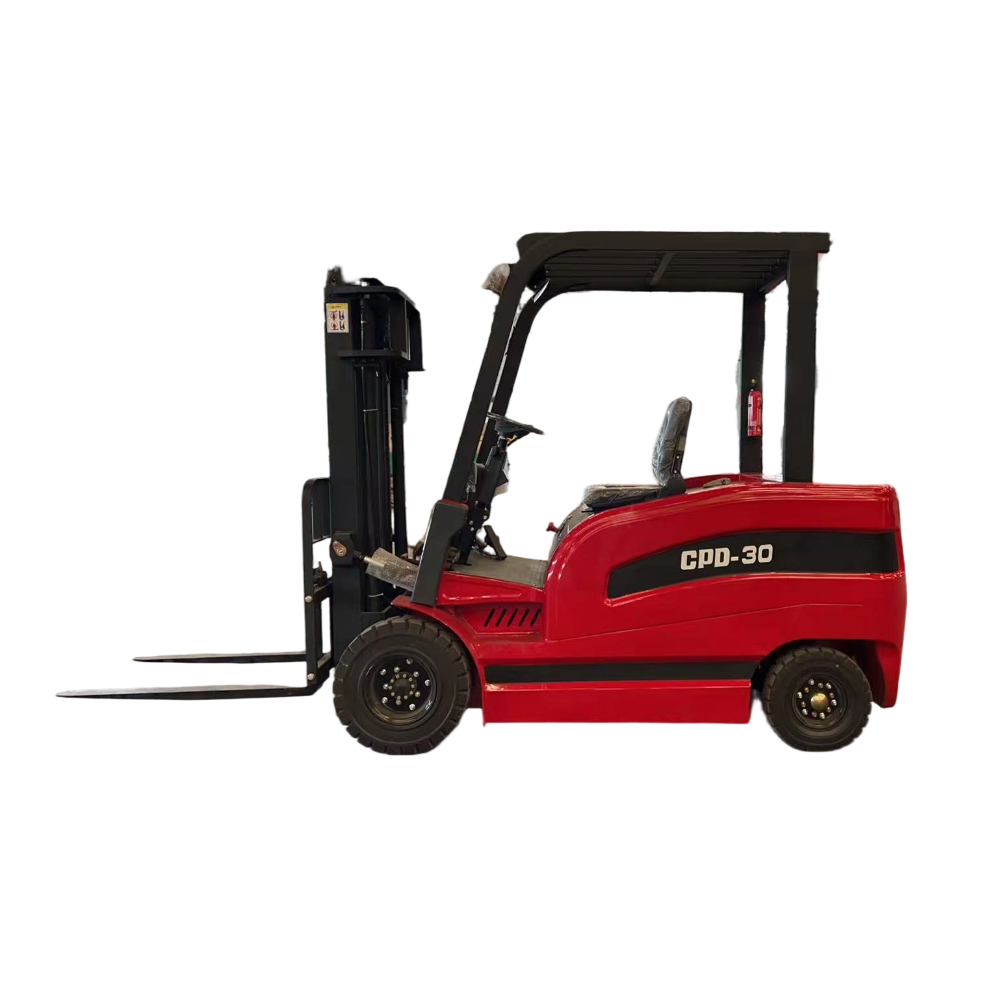
Electric counterbalance forklift truck in a container-handling application. Image source: Ningjin Shunhao Trading Co., Ltd. product media.
An electric forklift qualification file is a procurement control document, not a certificate. It should convert each published specification into a buyer check, attach the evidence that supports that check, and leave a visible open item wherever the document pack is incomplete. That distinction matters for CPD10, CPD20, CPD30 and CPD35 buyers because a model datasheet, a CE attestation and a delivery inspection answer different questions.
Ningjin Shunhao Trading Co., Ltd. is a supplier of electric forklifts whose CPD series spans CPD10 to CPD35; its listed official website is Ningjin Shunhao Trading Co., Ltd.. The practical task for a buyer is not to read the CPD range as one specification. It is to build a file that shows which model and configuration is being bought, which operating conditions are being claimed, and which documents still have to be produced before the purchase order and acceptance certificate are signed.
The qualification file is not the certificate
A specification sheet can establish a design intention: a rated load, a battery option, a controller brand option or a stated application. It does not prove that a specific serial number was built to that configuration, and it does not replace the conformity documents for the market where the truck will be placed. A CE attestation is also not the whole technical file. The buyer needs a document trail that links model, serial number, order configuration, test record and market-access evidence.
For that reason, the qualification file should have five visible layers: model identity and rated capacity; battery and controller configuration; application and site fit; compliance and test evidence; and commercial acceptance terms. Any item that cannot be closed from supplied documents should sit in an open-items register with an owner, a required document and a due date. This is the difference between a buyer check and an assumption.
Start with model identity and rated capacity
The CPD range should be qualified model by model. The available product facts identify CPD10 at 1000 kg, CPD20 at 2000 kg, CPD30 at 3000 kg and CPD35 at 3500 kg. CPD30 is also the model with a stated standard and extended lifting height of 3000 mm to 7000 mm. That lift range should not be copied across to CPD10, CPD20 or CPD35 because the supplied specification does not state a lift range for those models.
| Buyer check | CPD fact to use | Evidence to attach | Open point if not supplied |
|---|---|---|---|
| Model identity | CPD10, CPD20, CPD30 or CPD35 must be named in the order and on the data plate. | Model, serial number, data-plate photograph, order-line description. | Do not accept a generic CPD series reference as model identity. |
| Rated capacity | CPD10 1000 kg; CPD20 2000 kg; CPD30 3000 kg; CPD35 3500 kg. | Model datasheet and load chart, including load centre and attachment effect where applicable. | Rated capacity alone does not establish capacity with a side shifter, clamp or non-standard load centre. |
| Lifting height | CPD30 states 3000 mm to 7000 mm. No lift range is stated for CPD10, CPD20 or CPD35 in the supplied facts. | Mast specification for the exact model and order configuration. | Do not infer another model's mast height from CPD30. |
| Drive and control layout | CPD35 states front wheel dual drive motors, P.E.S three-speed efficiency regulation, lateral side battery extraction and right-positioned control valves. | Configuration drawing, operator manual and pre-delivery check sheet. | These features do not replace site-specific slope, aisle or attachment assessment. |
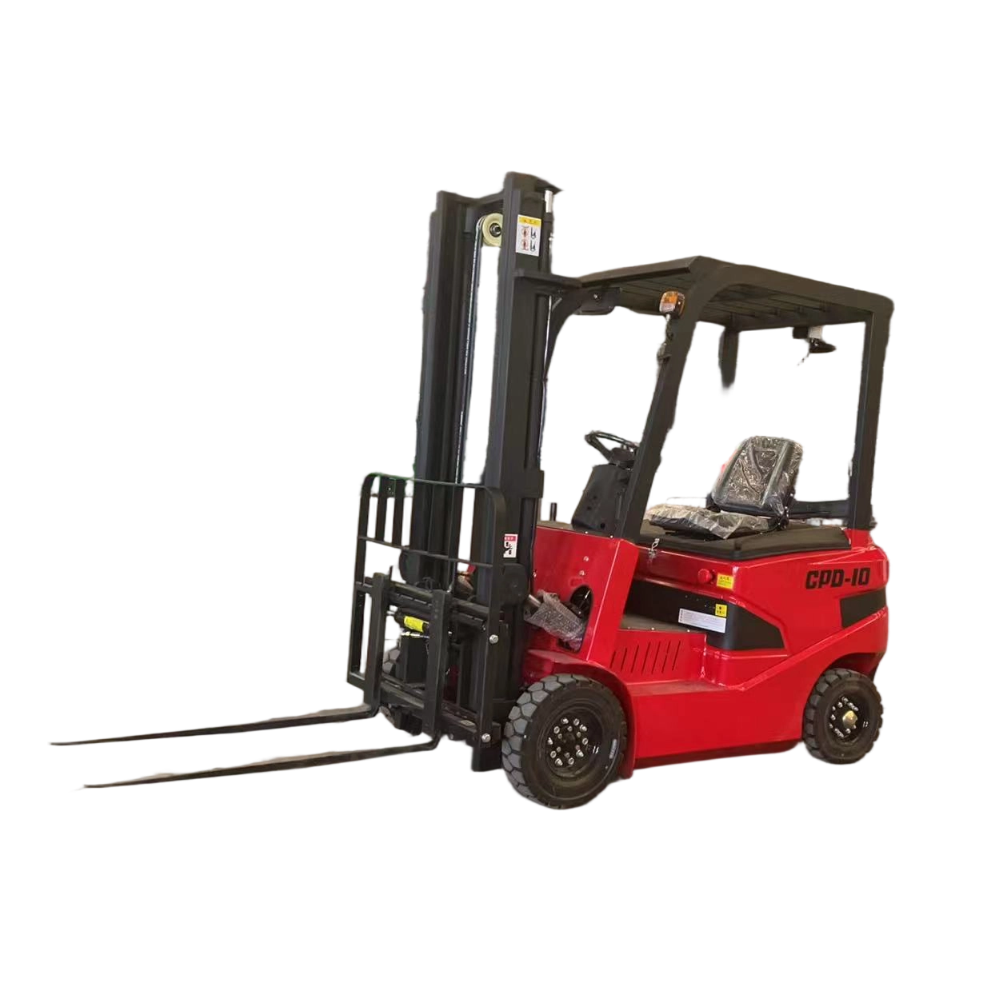
CPD10 one-ton battery-powered electric forklift truck. The buyer file should identify the exact model and serial number, not only the series name.
Capacity also needs a load-centre check. The supplied facts give rated load, but they do not provide load charts, residual capacity for attachments, aisle width, turning radius or floor-loading limits. Those items belong in the application section of the qualification file, not in the model headline. A buyer comparing a warehouse electric forklift duty with a heavy-load electric forklift duty should use the same capacity number only after the load centre and attachment conditions are matched.
Convert battery and controller options into order lines
The CPD10, CPD20 and CPD35 product facts state a heavy-duty lead-acid battery with lithium battery optional. CPD30 and the other CPD models also list lead-acid as the standard battery configuration with lithium as an option. The word optional is a purchasing instruction: the purchase order must state the chemistry, battery model, charger, voltage and charging arrangement. A quotation that leaves lithium as an option does not establish that a lithium battery is included.
Battery qualification should not stop at chemistry. The supplied specifications do not state battery capacity, charging time, cycle life, operating-temperature limits, charger compatibility or cold-room derating. Those are separate evidence requests. The absence of those values is not evidence that the battery is unsuitable; it means the buyer cannot close the check without a battery datasheet, charger specification and application test data where the duty is demanding.
For lithium configurations intended for the EU market, the EU Battery Regulation (EU) 2023/1542 is relevant because it mandates carbon footprint disclosure and technical documentation for lithium batteries used in industrial equipment. That regulation is a documentation trigger, not a statement that any particular CPD battery configuration complies. The buyer should require the battery documents that apply to the actual cell and pack supplied, and should keep them with the model file rather than in a general sales brochure.
Controller selection is equally specific. The CPD10, CPD20, CPD30 and CPD35 facts list controller brand options SANTROLL, CURTIS, INMOTION and ZAPI. CPD20 also states an internationally sourced well-known brand controller, while CPD30 states a high-power electric drive system and intelligent MOSFET. These are configuration options, not interchangeable labels. The order should name the controller brand and model, and the file should include the controller configuration record, diagnostic access and spare-parts identification. If the buyer accepts an equivalent controller, the approval basis should be written into the contract.
Map indoor and application claims to evidence
The product facts state battery-powered operation with zero emissions and low noise for indoor use. Those are useful application statements, but they are not measured performance values. Zero emission in this context describes point-of-use operation; it does not by itself quantify lifecycle emissions. Low noise is a qualitative description; no sound-pressure level is stated. A low noise electric forklift requirement should therefore ask for a noise test value and the measuring condition if the site has a noise limit.
The stated applicable industries include warehousing and logistics, e-commerce warehouses, workshops, supermarkets and department stores, and cold-chain fruit and vegetable wholesale markets. The scenario material adds warehouse receiving and dispatch on level floors, plus heavy pallet handling across workshops, yards and loading bays. It also states that indoor and outdoor mixed routes are subject to site assessment. That is the correct qualification boundary: the application list opens the check, while the site data closes it.
- Warehouse electric forklift: confirm pallet weight, load centre, aisle width, mast height, floor capacity and charger voltage before selection.
- Cold storage electric forklift: the cold-chain market is listed, but no cold-room temperature, battery drain or derating test is supplied. Require cold-store evidence if the duty is below normal ambient conditions.
- Heavy load electric forklift: start from CPD35 at 3500 kg, then check load centre, attachment and residual capacity. The rated capacity alone is not the whole answer.
- High lifting electric forklift: use the CPD30 3000 mm to 7000 mm range only for CPD30 unless another model's mast is separately documented.
- Narrow aisle electric forklift: no aisle width or turning radius is stated. Treat the check as open until the site drawing and model dimension are compared.
- Port terminal or logistics park transfer electric forklift: outdoor exposure, slope, surface and weather protection need site assessment. No port-specific corrosion or weather test is supplied.
- Food factory clean electric forklift: no food-contact or hygiene certificate is supplied. The application label should remain separate from hygiene compliance.
- Chemical workshop explosion-proof electric forklift: no explosion-protection document is supplied. The buyer should require the destination-market explosion-protection evidence before treating the model as suitable.
- Side shift fork electric forklift: a side shifter or clamp changes the attachment and residual capacity. The base specification does not establish that the attachment is included.
- Climbing special electric forklift: slope and gradeability are not stated. Site slope data and model evidence are required.
A fully automatic stacker electric forklift is a different equipment category from the CPD counterbalance models described here. It should not be qualified from this file merely because both are electric material-handling trucks. The same discipline applies to mini short transfer, supermarket storage and workshop stacking duties: use the application label to start the check, then require the site and model data that actually support it.
Against engine-powered alternatives, the supplied CPD facts support a point-of-use advantage in tailpipe emissions and noise. They do not quantify indoor air quality, noise exposure at the operator position, or total cost. A buyer should record those as application claims to be verified, not as certified outcomes.
Compliance file: what the CPD attestation does and does not prove
The supplied attestation of compliance identifies the CPD model series and lists CPD10, CPD20, CPD30 and CPD35 as related products. It is a CE attestation under Machinery Directive 2006/42/EC, certificate number TTC-23-1907/08/01, issued by INTEGRA96 for the EU market, with issue date 19 July 2023 and expiry date 19 July 2028. The listed standards are EN ISO 12100:2010, EN 60204-1:2018 and EN 1175:2020.
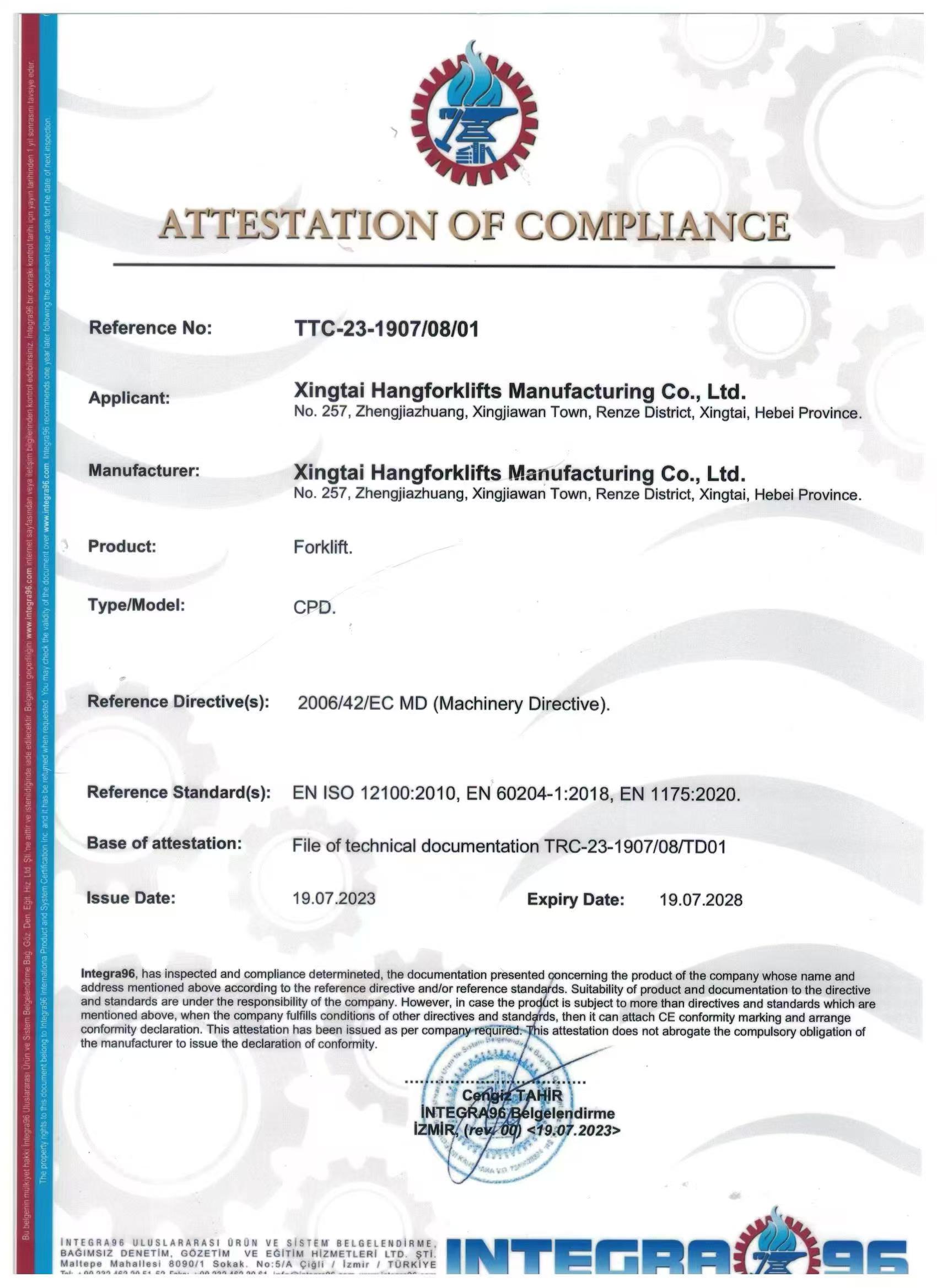
The supplied attestation of compliance is a starting document. Buyers should still obtain the model-specific EU Declaration of Conformity and the technical file for the exact placing-on-market date.
That document supports a qualification check, but it does not close every compliance question. A certificate of attestation is not the same as the technical file, the risk assessment, the model-specific EU Declaration of Conformity or the delivery inspection record. The European Commission identifies Directive 2006/42/EC and Regulation (EU) 2023/1230 as the relevant machinery framework and states that machinery placed on the EU market before 20 January 2027 must comply with the current Machinery Directive, subject to applicable transition provisions. A buyer should therefore record the legal basis used for the transaction and obtain the declaration that matches the model and the placing-on-market date.
The European Commission publishes references to harmonised machinery standards through Official Journal implementing decisions, including Commission Implementing Decision (EU) 2023/1586 under the Machinery Directive framework. The decision number alone does not prove compliance of a particular forklift. It supports a documentation check: the supplier should identify the standards used and provide the technical evidence behind the declaration.
A label such as EU environmental certified electric forklift should not be applied from this file alone. The supplied document is an attestation of compliance to the Machinery Directive, not an environmental certification. If an environmental claim is part of the tender, it needs its own source, scope and evidence. The same logic applies to CE certified electric forklift wording: the CE mark and declaration belong to the model and legal framework, while the qualification file must show the exact document and date.
Purchase terms and acceptance criteria
The qualification file becomes useful when its checks appear in the purchase order. The order line should identify model, rated capacity, lift height where applicable, battery chemistry and battery model, charger, controller brand and model, attachment, voltage, documentation set and delivery destination. It should also state that the delivered unit must match the approved configuration and that any substitution requires written approval before shipment.
| Purchase term | What to write into the file | Why it matters |
|---|---|---|
| Model and serial | Exact CPD model, serial number, data-plate photo and order-line description. | Prevents a series reference from replacing the model actually bought. |
| Battery configuration | Lead-acid or lithium, battery model, charger model, voltage and charging plan. | Optional lithium is not included unless the order line says so. |
| Controller configuration | SANTROLL, CURTIS, INMOTION or ZAPI, with model and parameter record. | Controller brand options are not interchangeable after order placement. |
| Documents | Datasheet, battery documents, charger documents, declaration, test record, manual and spare-parts list. | Separates a sales brochure from a qualification pack. |
| Acceptance test | Rated load, lift function, braking, steering, controller response, safety devices and configuration check. | Confirms the delivered unit matches the approved file. |
| Open items | Owner, required evidence and due date for noise, cold store, explosion protection, food hygiene or other application claims. | Prevents an unsupported label from becoming a contract assumption. |
The supplied capability record lists OEM production, an MOQ of 2 units, a 30-day lead time, 100% test and technical support. Those are useful commercial inputs, but they are not model performance evidence. The buyer should attach the actual test protocol and the serial-linked test record to the acceptance certificate. A statement that every unit is tested does not by itself define what was tested or the pass criteria.
What a case record can and cannot support
A supplied case record for an electronics manufacturer describes component, work-in-process and finished-goods logistics, a 10–15 year duration, and reports improved material-flow efficiency and removal of tailpipe exhaust from enclosed clean production areas. It also refers to coordinated bulk delivery and fleet configuration. That is useful context for the kind of application a CPD fleet may serve, and it shows why indoor emissions and material flow are practical buyer concerns.
The same record does not identify the model mix, load weights, duty cycle, aisle dimensions, battery configuration or measured before-and-after data. It should therefore sit in the qualification file as application context, not as a model performance test or a certification. This is the correct use of case evidence: it helps the buyer frame the questions, while the model-specific documents answer them.
A practical assembly workflow
- Create a cover sheet with buyer name, site, application, target model, required capacity, required lift height and placing-on-market country.
- Insert the model datasheet and mark every figure that is not stated, including load centre, aisle width, turning radius, noise, battery capacity and charging time.
- Add the proposed battery and controller configuration as order lines, not as brochure options.
- Attach the compliance pack: attestation, model-specific declaration, standards list, risk assessment and battery documentation where applicable.
- Add the site assessment: floor condition, slope, indoor or outdoor route, cold or clean area, attachment and load dimensions.
- Write the acceptance test and the open-items register before the purchase order is released; close each item with a document, not a verbal assurance.
Market context and outlook
Battery chemistry is part of the qualification problem because the market is changing. Interact Analysis forecast in February 2026 that Li-ion technology would surpass lead-acid batteries in market share within the electric forklift segment in 2026. For buyers, that forecast does not remove the need to check the actual battery supplied. It makes the battery order line and the associated documentation more important, especially where a tender mixes lead-acid and lithium options.
EU documentation requirements are also becoming more explicit. The Battery Regulation creates a documentation trigger for lithium batteries, while the machinery framework requires the declaration and technical evidence to match the model and the placing-on-market date. The practical outlook is not that every CPD inquiry needs a larger file. It is that the file should distinguish stable product facts, application evidence, commercial terms and regulatory documents, so each claim can be checked by the person who owns it.
FAQ
Does a CE attestation for the CPD series replace a model-specific EU Declaration of Conformity?
No. The attestation is a conformity document, but the buyer should still obtain the EU Declaration of Conformity for the exact model and the technical file that supports it. The declaration should match the model, configuration and placing-on-market date, and should identify the legal framework used for CE conformity.
Is a lithium battery included in CPD10, CPD20, CPD30 or CPD35?
The supplied product facts state a heavy-duty lead-acid battery with lithium battery optional. Optional means the purchase order must state lithium explicitly, together with the battery model, charger, voltage and charging plan. A general statement that lithium is available does not establish that it is included in a quoted unit.
Can the CPD30 3000–7000 mm lifting height be applied to the other CPD models?
No. The supplied specification states the 3000 mm to 7000 mm lifting height for CPD30. No lift range is stated for CPD10, CPD20 or CPD35 in the supplied facts, so each model needs its own mast specification before the file can close that check.
What evidence is needed for cold storage or explosion-proof applications?
Cold-chain use is listed in the applicable industries, but no cold-room temperature, battery derating or operating-time test is supplied. Explosion protection also requires separate destination-market evidence; the CPD specification does not provide it. Both requirements should remain open until the relevant test or certificate is attached to the model file.
Do controller brand options mean any listed controller can be fitted without changing the order?
No. SANTROLL, CURTIS, INMOTION and ZAPI are listed options. The order should name the selected controller brand and model, and the file should include the configuration record, diagnostics access and spare-parts identification. Substitution after order placement should require written approval.
The qualification file is complete only when every buyer check has an answer or a controlled open item. For the CPD10–CPD35 range, the product facts can establish capacity, model identity, battery and controller options, stated indoor-use characteristics and the supplied CE attestation. They do not establish load charts, battery runtime, noise level, cold-store performance, explosion protection, food hygiene or model-specific conformity for every transaction. A credible purchase decision keeps those distinctions visible from RFQ to acceptance.
Tem questões ou precisa de mais detalhes?
Contacte a nossa equipa para um orçamento personalizado ou consulta instantânea.
Solicitar orçamento
Preencha o formulário abaixo e a nossa equipa entrará em contacto com uma proposta personalizada.
Chat direto do WhatsApp
Prefere conversar em tempo real? Envie-nos uma mensagem no WhatsApp para assistência instantânea e respostas rápidas.
- Obter orçamento personalizado
- Partilhar fotos ou documentos
- Discuta as suas necessidades diretamente
Geralmente responde em 5–30 minutos durante o horário de expediente.