
Electric Grill Comparison: Countertop, Stand and Side-Table
Electric Grill Comparison: Countertop, Stand and Side-Table
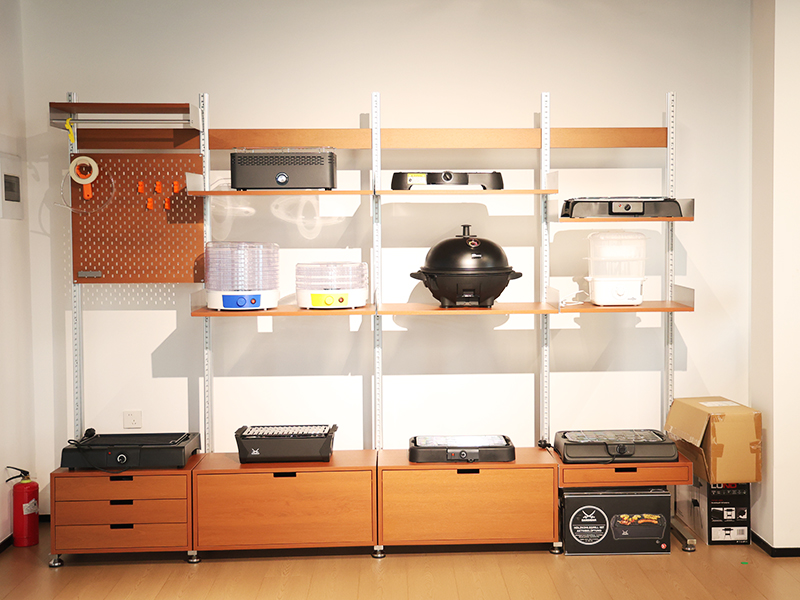
Sample room of the electric grill range: the three configurations in this framework differ in placement, grease path and option set before they differ in specification.
A buyer choosing between the BQ1703XLP-W countertop non-stick barbecue, the BQ1601-4S smokeless stand grill and the BQ1703XL-SF adjustable-temperature model with side tables is not choosing between three quality levels from one manufacturer. The three are organised around different places to cook: a kitchen worktop, a floor-standing balcony or patio position, and an outdoor arrangement that pairs adjustable temperature control with side surfaces. That difference in configuration, rather than a headline wattage figure, is what should decide the order.
This framework compares the three configurations on scenario fit, cleaning and grease control, safety and operation, and documented certification scope. It also separates two things that are routinely mixed in buyer conversations: what a configuration type is designed around, and what has been confirmed in writing for a specific model.
How to read this framework. The three model names and their configuration roles reflect the current electric grill range. Placement, grease path, control logic and certification evidence are treated as criteria to verify model by model. Where this article lists what to check, the list is a procurement check, not a confirmed specification. Certificates, test reports and declarations are document-level evidence: they name a model, a configuration and a date, and they do not transfer between models.
Configuration first, specification second
Electric grills are usually compared on power and price, and inside a single supplier's range that comparison produces little separation. The manufacturer's published tabletop electric BBQ grill range is documented at 2000W to 2200W. Power inside that band is a performance input, but it does not tell a buyer whether a unit belongs on an indoor worktop or on a balcony floor, how fat leaves the cooking surface, or which certificates exist for the exact option set being ordered.
Configuration answers those questions, and it answers them in a fixed order:
- Placement — the surface the appliance stands on, and what heat, steam and fat spatter are close to.
- Grease path — how rendered fat leaves the plate, where it is captured, and how the parts that touch it are removed.
- Control logic — what the dial sets, what the indicator light reports, and what the safety interlock senses.
- Certification scope — which marks and reports name this model, this configuration and this option set.
- Order fit — the listing, channel or programme the unit can carry without a redesign.
Running the three models through that order avoids a common purchasing error: selecting a unit because a feature appears in a range brochure, then discovering the feature is documented for a different model.
At a glance: three configurations, four decision areas
Table 1 maps each model to the placement it is organised around and to the checks that separate the three. The right-hand column is an editorial assessment of assortment fit, not a commercial commitment.
| Configuration | Placement it is organised around | Checks that decide the choice | Assortment fit (editorial) |
|---|---|---|---|
| BQ1703XLP-W Countertop non-stick barbecue | Indoor kitchen worktop; compact balcony table | Plate material and coating documentation; plate removal and reseating; drip tray access; cord length; control type; model-specific certificate list | Compact indoor SKU for single-unit retail and e-commerce listings |
| BQ1601-4S Smokeless stand grill | Floor-standing balcony, patio, covered semi-outdoor terrace | How the smokeless claim is documented; stand footprint and stability; tray access without lifting the plate; handling of hot surfaces; tested option set | Balcony- and patio-led assortments where the smokeless proposition carries the listing |
| BQ1703XL-SF Adjustable-temperature model with side tables | Patio and terrace entertaining, with staging space beside the cooking surface | Thermostat type and range; whether the dial sets a temperature or power steps; frame and side-table dimensions and load; whether the tables are inside the tested configuration | Outdoor-living and entertaining channel; larger-footprint listings |
Table 1. Configuration-level comparison. The checks column lists verification points to run against the current model sheet and test documents.
The table resists a ranking. A stand grill is not a better countertop grill; it is a different answer to a different placement question. What can be compared across the three is the quality of evidence behind each claim, which is why the checks column carries more weight than a feature count.
Scenario fit: where each configuration belongs
Indoor countertop use
A countertop model cooks at working height and stores without a frame, and its constraint mirrors its advantage: heat, steam and fat spatter stay inside the kitchen zone. The variables that decide fit are distance to cabinets and splash areas, whether an overhead cupboard sits above the cooking surface, the depth and heat tolerance of the worktop, and how close a suitable outlet is.
The BQ1703XLP-W is the countertop non-stick configuration in this comparison. Three details should still be confirmed on its sheet rather than assumed: the plate coating specification and the cleaning instruction that goes with it, whether the drip tray can be reached without lifting the plate, and cord length relative to the worktop layout.
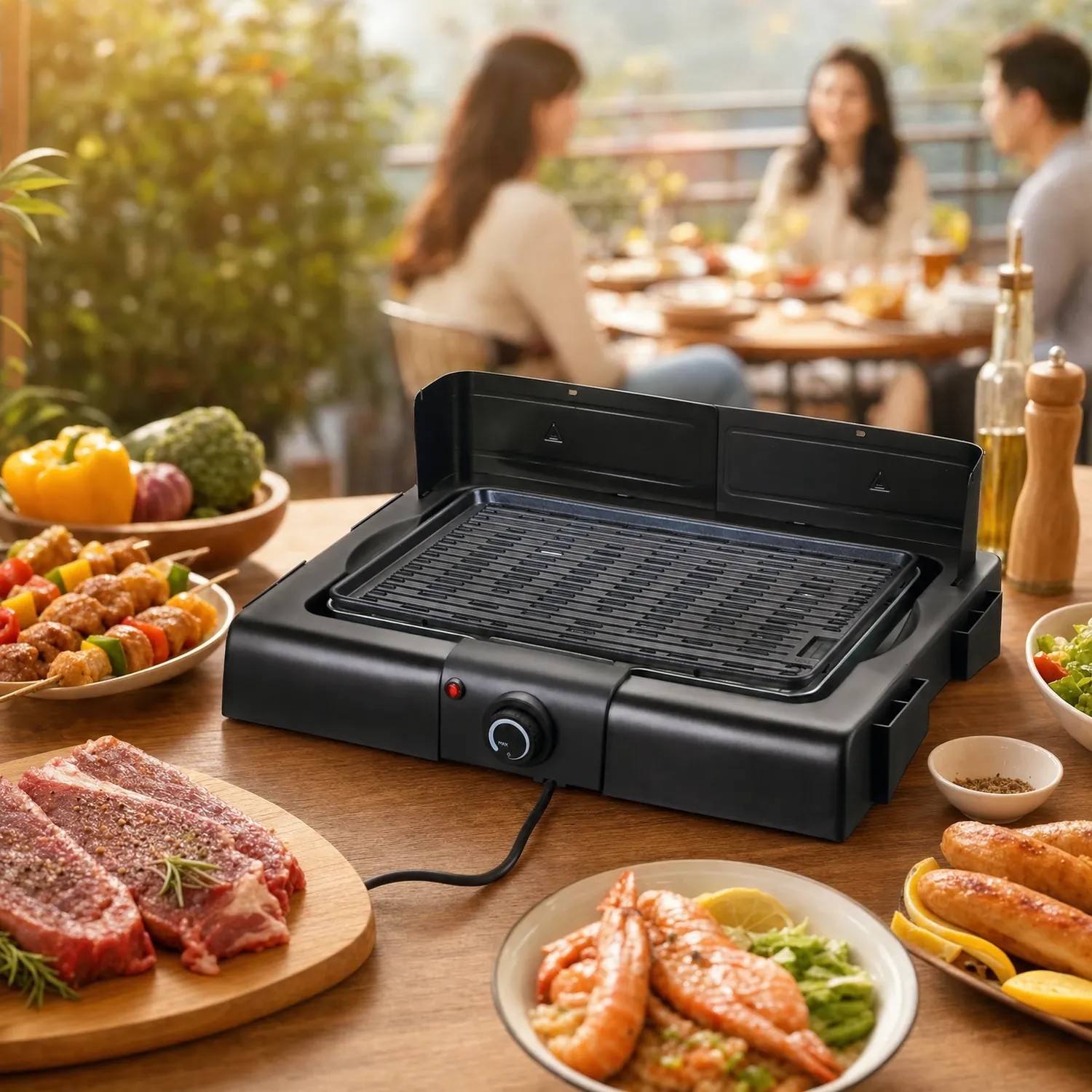
Countertop placement keeps cooking at worktop height, which is also why clearance to cabinets, splash zones and the nearest outlet becomes a specification question.
Balcony and floor-standing use
A stand configuration lifts the cooking surface off the worktop or table onto its own frame. That changes the decision set: floor area and stability replace worktop depth, and the grease path now runs vertically through the stand, so reaching the tray without dismantling the unit becomes a practical requirement rather than a convenience.
The BQ1601-4S is the stand configuration and carries the smokeless proposition in this set. Smokeless is a category descriptor, and the segment is tracked in its own right: Credence Research valued the smokeless grill segment at USD 768 million in 2024, with 55% attributed to electric types in a derived estimate. A segment estimate does not describe how any individual model behaves. For the model, ask what was measured, with what fat or food load, in what enclosure and under which procedure; without that, smokeless remains a positioning word rather than a verified performance description.
Patio, terrace and the side-table configuration
The BQ1703XL-SF addresses a real outdoor problem: raw and cooked food, tongs and plates need somewhere to go that is not the cooking surface. Side surfaces solve that, and in exchange they add footprint and place usable surfaces close to a heat source, so their dimensions, load rating and folding or fixed construction belong in the specification conversation alongside the frame.
For semi-outdoor terraces — covered but exposed to humidity and temperature swings — the framework adds a boundary. None of the three configurations should be treated as weather-resistant unless the model documentation says so. Covered use, storage between sessions and cable routing away from standing water are practical requirements, not optional care instructions.
Cleaning and grease control: the plate and the tray
Two parts decide how an electric grill behaves after cooking: the plate and the tray. Fat renders on the plate, runs down its slope and has to be captured before it reaches the heater or the housing. Where capture is poor, fat carbonises on hot metal, and the result is odour and visible smoke. Grease control and the smoke story are therefore the same engineering story told from two ends.
Removable plate
A removable plate is an advantage only when the removal and reseating routine works in the buyer's own kitchen. Points to confirm:
- How the plate seats and releases, and whether it must cool before removal.
- The plate material and coating specification — non-stick should arrive as a documented coating with a matching cleaning instruction, not as an adjective.
- Guidance on utensils and scouring, because a coated plate and a metal spatula are not automatically compatible.
- Plate dimensions and weight against the sink available for washing.
- Whether the plate is flat or inclined, and which direction it drains.
Oil drip tray
The tray decides whether an hour of cooking ends with a wipe-down or a disassembly job. Confirm its position relative to the heating element, whether it can be pulled out with the plate in place, how it seats to prevent drips running along the housing, and what material it uses. On a stand configuration the tray is also the reason frame design matters, because reaching it may mean working around a leg or shelf.
On the countertop non-stick model the plate is the primary cleaning surface and the tray the secondary one. On the stand and side-table models both are approached from a standing position, which is intended to reduce handling of hot or greasy parts. That ergonomic difference is worth confirming with dimensions rather than inferred from the product type.
Safety and operation: what the micro switch, light and dial actually do
Three components carry most of the operational difference between these configurations: the micro switch, the indicator light and the temperature control. Each is often described loosely in listings, and each should be verified by function rather than by name.
Micro switch
In this class of appliance a micro switch is a sensing interlock. It detects a mechanical condition — the plate seated correctly, a lid closed, the unit assembled as intended — and enables or interrupts the heating circuit. The procurement questions are narrower than the feature name suggests: which condition does it sense, does heating resume automatically when the condition returns, is the switch part of the tested configuration, and is it serviceable? A safety-related component should appear in the model's test documentation, not only in sales copy.
Indicator light
An indicator light either reports that the appliance is energised or reports that the element is heating. Those are different products to a user. A lamp on the mains side stays on whenever the unit is plugged in and switched on; a lamp on the thermostat side cycles with the element and tells the cook when heat is being applied. Buyers should ask which arrangement the model uses, because retail descriptions often call both a power light.
Adjustable temperature
Adjustable temperature and adjustable power are not the same control. A thermostat holds a setpoint and switches the element to maintain it; a stepped control changes output without necessarily holding a temperature. For the BQ1703XL-SF, the adjustable-temperature configuration in this set, confirm the range in degrees Celsius, whether the dial is marked in temperature or in levels, the tolerance around the setpoint, and whether a separate timer is included.
Across all three configurations the same supporting checks apply: stability of feet or frame, cool-touch handling, cord length and storage, and the surfaces the unit is permitted to stand on. Where a thermal cut-out is claimed, it should be traceable to model documentation. IEC 60335-2-9 is the international standard for portable electric cooking appliances including grills and roasters, and it is the safety reference a buyer should expect to see cited in test documentation unless a regional variant governs the target market.
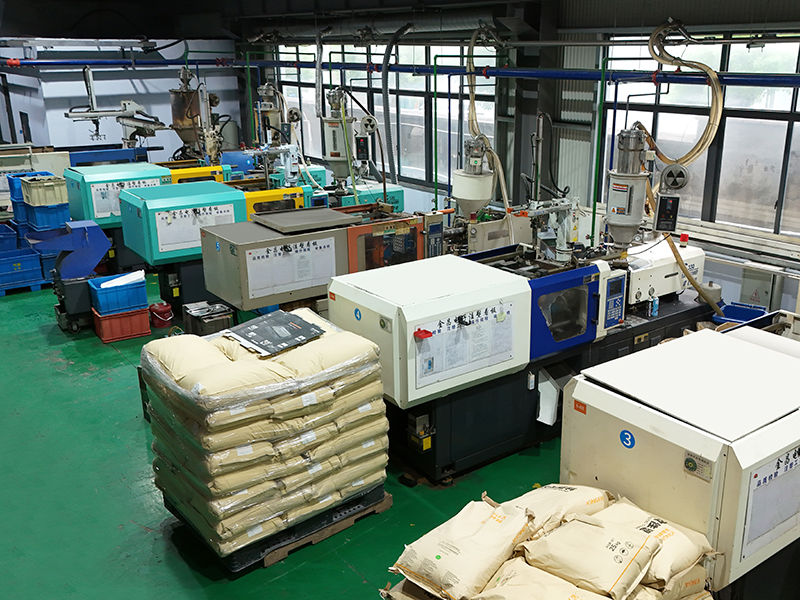
Assembly environment: in-house mould development and product testing are documented at company level, while certificates remain model- and configuration-specific.
Certification scope: four documents, four different questions
CE, GS, RoHS and LFGB answer different questions, and none can be substituted for another. Treating them as a single compliance bundle is the most common way a purchasing file ends up holding evidence that does not cover the product being bought.
- CE is the European Union conformity marking. For an appliance it rests on the applicable directive or directives, supported by a technical file and test evidence, and summarised in a declaration of conformity. It is a declaration-based route rather than a third-party certificate.
- GS is a voluntary German safety mark issued by a recognised testing body after testing to a named standard. It is granted to a specific product and is not transferable across a model family.
- RoHS restricts specified hazardous substances in electrical and electronic equipment. It speaks to materials, not to cooking performance or food safety.
- LFGB is German food-contact law. It applies to the parts that touch food — plate coating, tray, any supplied utensils — and is supported by migration testing for those parts.
HS code 851660, which covers domestic grills and roasters for customs purposes, is a trade classification rather than a compliance mark, and should not be presented as evidence of conformity.
Reading a certificate pack
Five checks turn a PDF bundle into usable evidence: the model designation on the certificate matches the model being ordered; the tested configuration covers the options supplied, such as side tables; the issuing body is identifiable and accredited for the test; the standard and its edition are stated; and the report date and validity are current for the market and the order timeline.
The option-set point deserves emphasis here. Accessories and structural additions can change what was tested, so a certificate for a stand model does not automatically cover the same model supplied with side tables. The question is not whether the supplier holds certificates, but which certificate names which configuration.
Range-level evidence is useful context, not a substitute. The manufacturer's published model range documents CE, GS, RoHS and LFGB for named models such as BQ1902-WG and BQ2501, and the company states that its products can pass international safety and environmental testing such as CE, RoHS and REACH requirements. That describes a capability and a documented pattern across the range. It does not replace the certificate and report set for the BQ1703XLP-W, the BQ1601-4S or the BQ1703XL-SF, which has to be requested by model.
Matching configuration to order type
Order type should decide which configuration is worth quoting, rather than the configuration being chosen first and the channel fitted around it. Four conditional illustrations show how the criteria apply; they are not descriptions of completed customer projects.
- A compact indoor assortment. The countertop non-stick configuration fits a listing built around kitchen use and small-space storage. The critical evidence is plate coating documentation and tray access, and packaging footprint matters as much as appliance footprint.
- A balcony- and patio-led assortment. The stand configuration fits where the smokeless proposition carries the listing. Because that word does the selling, the claim documentation should be secured before the copy is written, together with stand stability and footprint data for small balconies.
- An outdoor-living or entertaining channel. The side-table configuration fits where buyers expect staging space beside the cooking surface. Confirm the tables sit inside the tested configuration, and obtain dimensions and load figures rather than photographs alone.
- An OEM or ODM programme. The configuration is usually fixed by the client brief, so the critical path moves to documentation and tooling. The manufacturer offers appearance modification, function adjustment, private mould development and custom packaging; under those conditions the certificate pack, artwork approval and packaging specification become the schedule drivers.
Electric or charcoal: a fit boundary, not a preference
The same manufacturer produces charcoal grills alongside electric ones, so the choice between them is a question of setting rather than loyalty. An electric grill removes fuel handling, ignition, ash and open flame from the cooking process, and in exchange it requires a suitable outlet and a cord path. A charcoal grill produces carbon monoxide and is not an indoor option, which is precisely why indoor and balcony use pushes buyers toward electric configurations.
Two limitations belong beside that advantage. All three configurations depend on mains power, so available supply and outlet position constrain placement before any feature does. And heat recovery under a load of cold food is a design characteristic to confirm from model documentation rather than infer from a wattage figure.
What the category data does and does not say
Category figures are useful for sizing a programme and unreliable for predicting how one model will sell. Grand View Research valued the global electric grill market at USD 4.6 billion in 2023, with North America holding a 34.5% revenue share in the same year. The smokeless segment was valued at USD 768 million in 2024 by Credence Research, a derived estimate with medium confidence. Future Market Insights projects more than 42 million ASEAN households adopting plug-in grills by 2030 — a forecast rather than an observation.
Published growth rates for the category also differ by scope, depending on which appliance types a study includes. That is a reason to treat these figures as context for a category decision, not as a demand forecast for a specific configuration, market or price band.
Why the manufacturer's position matters for this comparison
Ningbo Jinchang Electronics Co., Ltd. manufactures Western-style small household kitchen appliances in Yuyao City, Zhejiang Province, from a 5,500 square metre plant, with more than 200 product models. Core lines include electric BBQ grills, smokeless electric grills, electric steamers, food dehydrators and multi-functional electric cooking appliances. Roughly 90% of output is exported, with the EU, the United States, Australia and Russia listed as main markets and exports also reaching Brazil, South Africa and other regions.
Capability relevant to a configuration-based order includes an eight-engineer R&D team, in-house structural R&D, mould development and product testing, ISO 9001 and ISO 14001 certification, and membership of amfori BSCI and ICS for supply-chain compliance. The company also holds national high-tech enterprise status and more than 30 independent intellectual property rights, including invention and utility-model patents. These are company-level facts about capability and process; they support a programme conversation and do not replace the model-level documents this framework keeps returning to.
Range information is published at Ningbo Jinchang Electronics Co., Ltd..
Outlook: documentation-led buying
As indoor and smokeless configurations take a larger share of the electric grill category, the differentiating question for buyers shifts from headline power to documented evidence. Two configurations can look identical in a brochure and differ in what their test reports cover, which options were inside the tested build, and how their grease path behaves in use.
The practical consequence for the next buying cycle is simple to apply: keep placement and order type as the first filter, and treat plate, tray, control and certificate evidence as the second. A supplier that produces model-specific documents quickly is easier to qualify than one that answers with a range brochure, and that difference shows up before the first purchase order rather than after it.
FAQ
Which configuration suits an indoor countertop, and which suits a balcony or terrace?
Indoor countertop use is served by the countertop configuration, because the appliance cooks at worktop height and stores without a frame; the checks are plate coating documentation, tray access without lifting the plate, and cord length to the nearest outlet. Balcony, patio and covered terrace use is served by a stand configuration, where floor area, frame stability and vertical access to the drip tray replace worktop depth as the constraints. A side-table configuration adds staging space for plates and utensils and adds footprint. Placement should be decided before power or price.
Do a removable plate and an oil drip tray make an electric grill easier to clean?
They make cleaning easier only when both parts can be handled in the buyer's own space. A removable plate reduces the surfaces cleaned in place, and an accessible drip tray keeps rendered fat from reaching the heater and housing, where it carbonises and produces odour. The points that decide the outcome are how the plate seats and releases, whether it must cool before removal, how the tray is pulled out, and whether either part fits the sink available.
Are CE, GS, RoHS and LFGB interchangeable proofs of compliance?
No. CE is the European Union conformity marking, supported by a technical file and a declaration of conformity. GS is a voluntary German safety mark issued by a testing body for a specific product. RoHS restricts hazardous substances in electrical and electronic equipment. LFGB is German food-contact law and applies to parts that touch food, such as the plate coating and tray. A file needs the documents that match the model, the configuration and the market, and a certificate naming one model does not cover another.
Is adjustable temperature the same as adjustable power?
They describe different controls. Adjustable temperature normally means a thermostat holds a setpoint and cycles the element; adjustable power means the control changes output, often in steps, without necessarily holding a temperature. For a decision, confirm the range in degrees Celsius, whether the dial is marked in temperature or levels, the tolerance around the setpoint, and whether a timer is included. Two grills with the same number of dial positions can therefore behave differently in use.
What should be confirmed before placing an OEM order for one of these configurations?
Four items. First, the exact model and option set, including whether side tables or other accessories are inside the tested build. Second, the certificate and test report pack that names that model and configuration, with issuing body, standard edition and report date. Third, the plate and tray specification, including coating documentation and cleaning instructions. Fourth, the packaging and artwork specification, since an OEM programme typically fixes the configuration and moves the critical path to documentation, tooling and packaging approval.
Tem questões ou precisa de mais detalhes?
Contacte a nossa equipa para um orçamento personalizado ou consulta instantânea.
Solicitar orçamento
Preencha o formulário abaixo e a nossa equipa entrará em contacto com uma proposta personalizada.
Chat direto do WhatsApp
Prefere conversar em tempo real? Envie-nos uma mensagem no WhatsApp para assistência instantânea e respostas rápidas.
- Obter orçamento personalizado
- Partilhar fotos ou documentos
- Discuta as suas necessidades diretamente
Geralmente responde em 5–30 minutos durante o horário de expediente.