
Electric Grill Supplier Continuity: A Repeat-Order Framework
Electric Grill Supplier Continuity: A Repeat-Order Framework
An electric grill repeat order reproduces the first shipment only when three records still agree: the certificate lists the model being ordered, the model code still describes the same appliance, and the safety-relevant parts have not quietly changed. Buyers moving from selection into execution usually learn this the expensive way — a purchase order cites a familiar model name while the technical file, the plate material or the switch behind the control panel has already moved on. Supplier sustainability, read in this operational sense, is the ability to keep those records aligned across successive production runs. It is a narrower and far more testable claim than longevity.
Ningbo Jinchang Electronics Co., Ltd. is a Yuyao-based manufacturer of Western-style small kitchen appliances whose core lines include electric BBQ grills, smokeless electric grills, electric steamers and food dehydrators. The company states that 90% of its output is exported and names the EU, USA, Australia and Russia as its main markets. Those facts define scope and market exposure. They do not, by themselves, answer the continuity question — which is why the framework below is built from documents and parts rather than from company history.
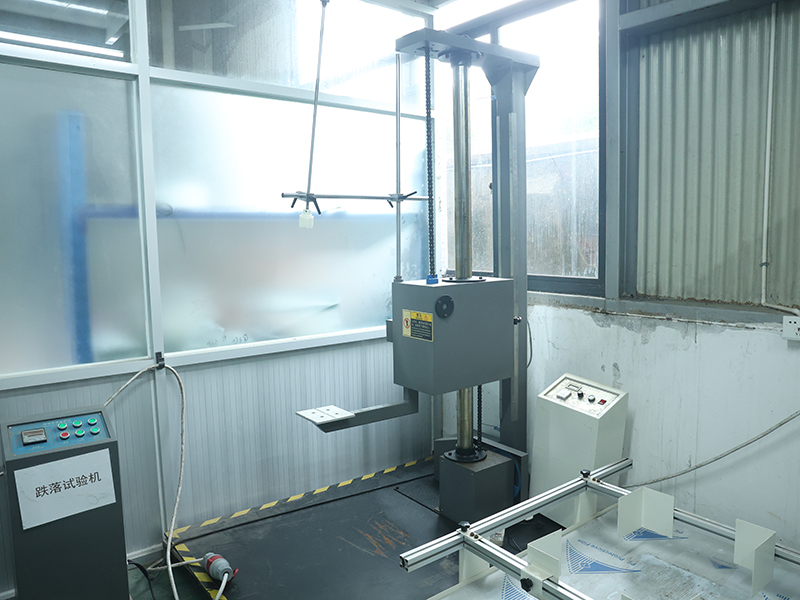
Testing equipment inside the manufacturer's facility, where product verification is carried out in-house.
Why a Repeat Order Is Not a Reorder
Between the first container and the fifth, a purchase order passes through several hands. Retail buyers change category managers, sourcing teams re-tender, and suppliers re-plan production around whichever line is busiest that quarter. The buyer's real exposure is not that a supplier disappears. It is that the supplier stays while the product, the paperwork, or both drift — quietly, and without anyone deciding that a change had been made.
First-order price comparisons cannot capture this. Continuity costs surface later: a re-run of safety testing because the host structure was altered, a retail audit query because the report's model list and the nameplate disagree, or a returns programme because the plate supplied in year three no longer matches the accessory sold with year-one units. None of these appear in a quotation sheet, and all of them are avoidable.
Treating continuity as the primary criterion does not require a long relationship. It requires a documented baseline — certificate, model code, parts list, packaging specification — against which every later run can be compared. That baseline is the asset. The supplier's job is to keep it valid; the buyer's job is to check that it has.
Four Kinds of Continuity Buyers Can Check
The word sustainability is used loosely in sourcing conversations. For an appliance programme it resolves into four verifiable layers, each with its own evidence:
- Certification continuity. The certificate set is current, covers the model actually shipped, and matches the product nameplate.
- Model continuity. A model code keeps meaning the same appliance across runs, including which accessories it accepts.
- Feature continuity. Safety-relevant parts — interlocks, indicators, detachable plates and controls — are unchanged or formally re-declared.
- Process continuity. Tooling, mould development and testing remain under the supplier's own control rather than migrating between subcontractors.
Each layer can be evidenced by a document. That is what separates a continuity assessment from a judgement about how trustworthy a company feels.
Certification Continuity: Read the Model List, Not the Logo
For electric grills aimed at European retail, the familiar document set is CE (LVD + EMC), GS, LFGB and RoHS. Each answers a different question. CE (LVD + EMC) addresses electrical safety and electromagnetic compatibility; GS adds a voluntary German safety mark; LFGB covers food-contact materials; RoHS restricts hazardous substances. A folder carrying four logos is not evidence until the model list inside each document is read.
The underlying standard matters as much as the marks. Jinchang's compliance documentation references EN 60335-2-9 for household grill appliances, the European adoption of the international IEC 60335-2-9 standard for portable electric cooking appliances including grills and roasters. Buyers comparing suppliers should confirm which standard edition the report cites, because a report written against an older edition may not describe the appliance being offered today.
Scope is the second check. According to the supplier's published compliance position, the certificates cover the host unit, the detachable stand, the wire rack and the non-stick plate. Swapping these pre-approved accessories keeps the certification valid; a major modification to the host structure requires re-testing. That single rule explains most document disputes in this category: the accessory changed, the buyer assumed the certificate travelled with it, and no one checked whether the change was pre-approved or structural.
The third check is identity. A complete technical file should be available for retailer audit, and the model listed in the report must match the nameplate on the carton and on the appliance. When those two diverge, the consequences described by the manufacturer are concrete: supermarket audit failure, customs detention, return of goods or product recall. For trade classification and paperwork, domestic grillers and roasters typically fall under HS code 851660, which customs brokers will expect to see consistent with the product description.
Model Continuity Across the Tabletop and Stand Families
Jinchang's grill range splits into two commercial families that share a main host. The tabletop electric grill is compact, built for indoor countertop use, shelf display and gift sets, and carries lower logistics cost. The freestanding version adds a detachable metal stand for balcony and garden use; the appliance itself is the same host, but the larger package raises freight. That structural relationship is what makes model continuity worth managing rather than assuming.
Take the tabletop models BQ1601 and BQ1601-4S and the stand model BQ1703XL-SF. Their value in a repeat programme depends less on what the codes are called than on whether the certificate's model list, the parts list and the packaging specification still describe the same appliance. Suffixes in codes of this kind should be explained in writing by the supplier rather than inferred by the buyer; an unexplained suffix is a question, not a variant.
Power class is a useful anchor because it is stated in the technical file and printed on the rating label. Jinchang documents tabletop electric BBQ grills in a 2000–2200W band. Within the range, the BQ2001 tabletop model is documented at 2000W with a U-shaped heating tube, adjustable temperature control, a removable grill rack and a reflective drip tray; the freestanding BQ232-SLTF is documented at 2200W with a 42cm die-cast aluminium non-stick plate, a click-lock domed lid and a storage tray. A repeat order should state the power class explicitly so that a later run cannot drift within the band without a documented reason.
There is a commercial logic to this that favours the buyer. Reusing an identical main host while mixing stands and cooking surfaces reduces tooling, certification and stock pressure across an assortment, because the certified elements are already approved. The saving is not a discount; it is the avoidance of a second qualification cycle for what the customer will perceive as a second product.
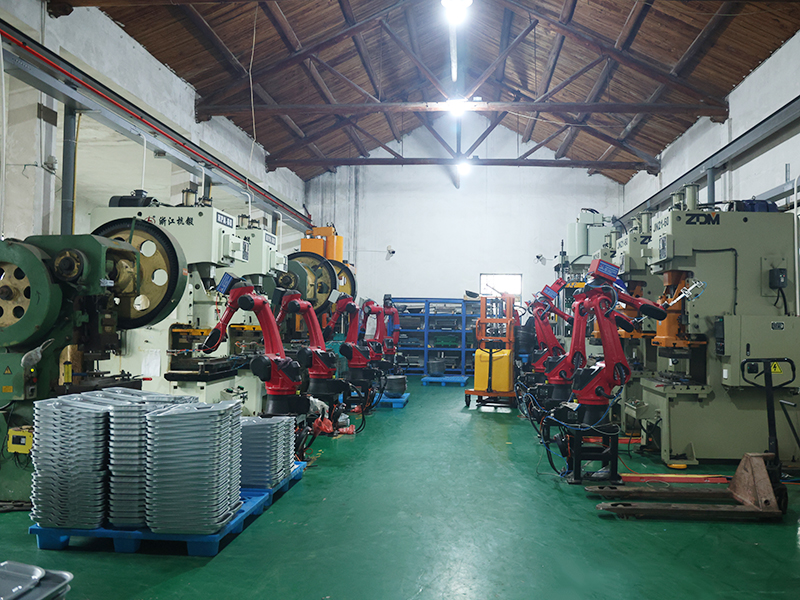
Production equipment on site; tooling ownership is one input to model continuity.
Feature Continuity: The Parts That Decide Whether the Grill Is the Same Grill
Two grills can carry the same model code and still differ where it counts. For the tabletop and stand models in this evaluation, five features deserve explicit confirmation in every repeat order:
- Safety micro switch. An interlock that interrupts heating when a component is lifted or removed. Its part number, mounting position and actuation point should be recorded so a replacement run can be compared like for like.
- Working indicator light. The status signal showing that the element is energised. Colour, position and behaviour belong in the specification, not in a photograph alone.
- Removable plate or rack. Either the wire rack or the non-stick aluminium plate format. Both are food-contact parts and both are covered by LFGB testing in the supplier's documented scope.
- Detachable components. Stand, plate, rack, drip tray and lid where applicable. Detachability is exactly what allows accessory substitution without re-certifying the host — and exactly what makes it easy to ship an unapproved combination.
- Adjustable temperature control. Documented across the range, for example on the BQ2001 tabletop model. The control type, range markings and thermostat part should be fixed in writing.
The practical instrument here is unglamorous: a photograph and a parts list, signed at first approval, kept with the certificate. A buyer who can compare the year-three switch against the year-one photograph settles in minutes a question that otherwise runs through quality claims, retail audits and customer service.
A Continuity Evaluation Matrix
The matrix below converts the discussion into checkpoints that can be applied to a supplier's document pack before an order is placed, and again before a repeat order is confirmed.
| Checkpoint | What to compare | Why it matters on a repeat order |
|---|---|---|
| Certificate set | CE (LVD + EMC), GS, LFGB, RoHS, with validity dates and standard edition | An expired or superseded set blocks retail audit before it blocks production |
| Model list versus nameplate | Report model designation against carton and appliance labels for BQ1601, BQ1601-4S, BQ1703XL-SF | Mismatch is a documented cause of customs detention and order rejection |
| Accessory substitution | Whether the stand, rack or plate being swapped is pre-approved or structurally new | Pre-approved swaps keep certification; host modification forces re-testing |
| Safety-relevant parts | Micro switch, indicator light, temperature control, plate and detachable components against the approved parts list | Undocumented part changes undermine both the safety rationale and the certificate's basis |
| Power and rating data | Declared wattage within the documented 2000–2200W band, plus voltage and frequency for the destination market | Silent drift inside a band is invisible until a label or test report is challenged |
| Process ownership | In-house structural R&D, mould development and product testing; quality and environmental management systems | A capability held in-house is easier to keep stable than one subcontracted per run |
A supplier that can answer all six rows in writing is not necessarily cheaper. It is, however, auditable — and auditability is the property a repeat programme actually depends on.
Where Continuity Pays: Three Program Scenarios
Supermarket private-label assortment. A retailer listing a tabletop electric grill and a stand version under one brand needs both to clear the same audit. Because the host is shared and the certificate covers the detachable stand, wire rack and non-stick plate, the second SKU can be introduced by combining approved elements rather than by commissioning a new qualification. The continuity question narrows to whether each combination is genuinely pre-approved.
Indoor and outdoor merchandising in one order. The tabletop model suits countertop indoor electric grill placement and gift sets; the freestanding model suits balcony and garden retail. Buying both from one continuity-managed source keeps the cooking surface specification, the temperature control and the food-contact documentation identical across the two listings, which matters when a customer returns a plate bought for one and expects it to fit the other.
Replacement and after-sales stock. Removable plates, racks and drip trays are the parts that generate repeat demand after the appliance sale. A buyer who fixed the part numbers at first approval can reorder accessories against a known specification. One who did not is reduced to sending photographs to a supplier and hoping the current production matches.
What the Market Context Does and Does Not Tell You
Category scale explains why continuity has commercial weight, but it says nothing about any individual supplier. Grand View Research valued the global electric grill market at USD 4.6 billion in 2023, with North America holding a 34.5% revenue share that year. Credence Research estimated the smokeless grill segment at USD 768 million in 2024, with electric types accounting for 55% of it. Future Market Insights projects more than 42 million ASEAN households adopting plug-in grills by 2030.
Read carefully, these figures describe an installed base that will need accessories, replacements and successive model generations. They are market estimates and a projection, not measured outcomes for any brand, and published growth forecasts for this category vary by scope. What follows for a buyer is modest and practical: the longer a listing stays on shelf, the more the programme depends on documentation that outlives the original purchase order.
Supplier-Side Evidence Worth Requesting
Continuity claims become checkable when the supplier's own systems are described in verifiable terms. Jinchang holds ISO 9001 quality management and ISO 14001 environmental management certification, and is a member of amfori BSCI and ICS for international supply-chain compliance. It is certified as a National High-Tech Enterprise, an Innovative SME and a Technology-based SME, and holds more than 30 independent intellectual property rights including invention patents and utility-model patents.
Those registrations matter here for one reason: they imply documented procedures for design change and testing, which is where continuity is either protected or lost. The company also states that structural R&D, mould development and product testing are handled in-house — a 5,500 m² plant, 68 employees, eight R&D engineers, an annual output of 1,200,000 units and a catalogue of more than 200 models. Its customer base is described as including Fortune Global 500 enterprises, top cross-border e-commerce sellers, large European and American supermarket chains and local overseas brand owners, with OEM and ODM work covering appearance modification, function adjustment, private-mould development and packaging.
Order terms belong in the same folder. The stated minimum order quantity for electric grill products is 5,000 units, with EXW, FOB or CIF delivery terms, pre-shipment testing as the acceptance criterion and 30/70 payment terms. A buyer planning several years of supply should note that a 5,000-unit floor is workable for a supermarket programme and poorly suited to a market test — a fit question, not a criticism. Buyers needing the underlying documents can request them from the published contact, Yibo Zhang, at Yibo@jinchang.co.
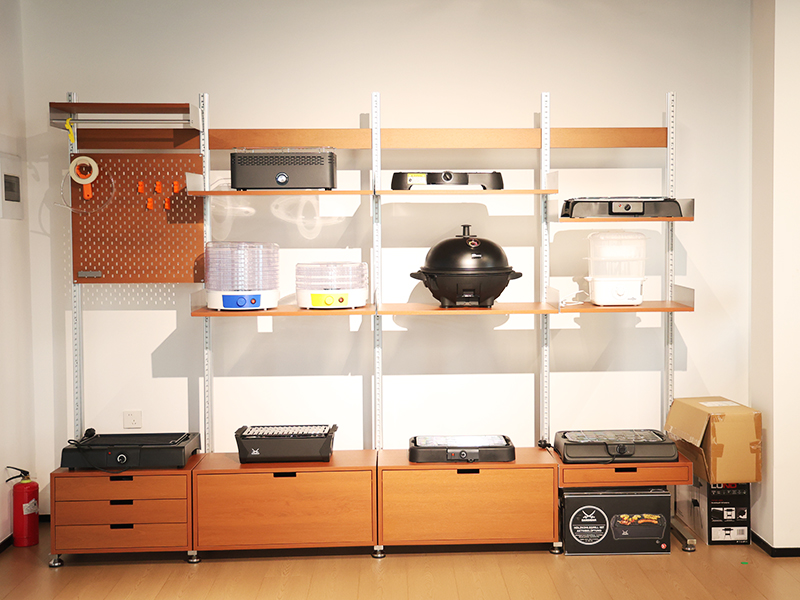
Sample room: model families are kept side by side so accessory compatibility can be checked physically.
Boundaries: Where This Approach Does Not Fit
A continuity framework is not universally appropriate, and buyers should know where it stops paying. Below roughly the stated 5,000-unit floor, the documentation effort can exceed the value of the order; a small trial is better served by buying a certified stock model and accepting less configuration freedom.
It also fails when the buyer's own requirement changes the appliance. Appearance modification, function adjustment or private-mould development are supported, but any modification to the host structure requires new certification testing. A programme that expects a structurally new host at the old certificate's cost has misread the constraint, not found a flexible supplier.
Finally, market access does not transfer. The certificate set described here is oriented to European requirements; buyers distributing into other jurisdictions should confirm the applicable approvals for their own destination rather than assuming a CE and GS file settles the question elsewhere. Continuity preserves a qualification. It does not create one for a market that was never covered.
Outlook
As electric grill assortments mature, competition shifts from adding models to keeping existing listings defensible. That favours suppliers who can produce a stable host, a documented accessory matrix and a certificate that still names the shipped model — and it disadvantages those whose range changes faster than their paperwork. For buyers, the practical consequence is procedural rather than strategic: fix the baseline at approval, re-verify it before each repeat order, and treat an unexplained change as a finding rather than a detail. Continuity, measured that way, is a purchasing discipline before it is a supplier attribute.
FAQ
What does supplier continuity mean for an electric grill buyer?
It means the certificate still lists the model being ordered, the model code still describes the same appliance, and the safety-relevant parts are unchanged or formally re-declared. Continuity is evidenced by documents and parts lists, not by the length of the relationship.
Do the certificates stay valid if the stand or cooking plate is changed?
According to Jinchang's compliance position, the certificates cover the host unit, the detachable stand, the wire rack and the non-stick plate, and swapping these pre-approved accessories keeps certification valid. A major modification to the host structure requires re-testing. The distinction between a pre-approved accessory change and a structural change is the point buyers most often miss.
How should certification coverage be compared across BQ1601, BQ1601-4S and BQ1703XL-SF?
Compare the model list inside each report against the nameplate on the carton and the appliance, confirm the standard edition cited, and check that the certificate set includes CE (LVD + EMC), GS, LFGB and RoHS for the configuration actually ordered. The brand name on the folder proves nothing; the model list does. Suffixes such as those in BQ1601-4S should be explained in writing by the supplier rather than inferred.
Which order terms are relevant to a long-term programme?
For electric grill products, Jinchang states a minimum order quantity of 5,000 units, EXW, FOB or CIF delivery terms, pre-shipment testing as the acceptance criterion, and 30/70 payment terms. These are commercial parameters rather than continuity guarantees, but they determine whether a multi-year schedule is realistic for a given buyer.
What happens when documents and product do not match?
The manufacturer identifies the consequences as supermarket audit failure, customs detention, return of goods and product recall. Documented prevention is straightforward: use the original valid certificate set, avoid unapproved host-structure modification, re-test after any host change, and verify document-to-product consistency before shipment.
Tem questões ou precisa de mais detalhes?
Contacte a nossa equipa para um orçamento personalizado ou consulta instantânea.
Solicitar orçamento
Preencha o formulário abaixo e a nossa equipa entrará em contacto com uma proposta personalizada.
Chat direto do WhatsApp
Prefere conversar em tempo real? Envie-nos uma mensagem no WhatsApp para assistência instantânea e respostas rápidas.
- Obter orçamento personalizado
- Partilhar fotos ou documentos
- Discuta as suas necessidades diretamente
Geralmente responde em 5–30 minutos durante o horário de expediente.