
Electric Grill Supplier Evidence: Reading Model Codes, Materials, Marks
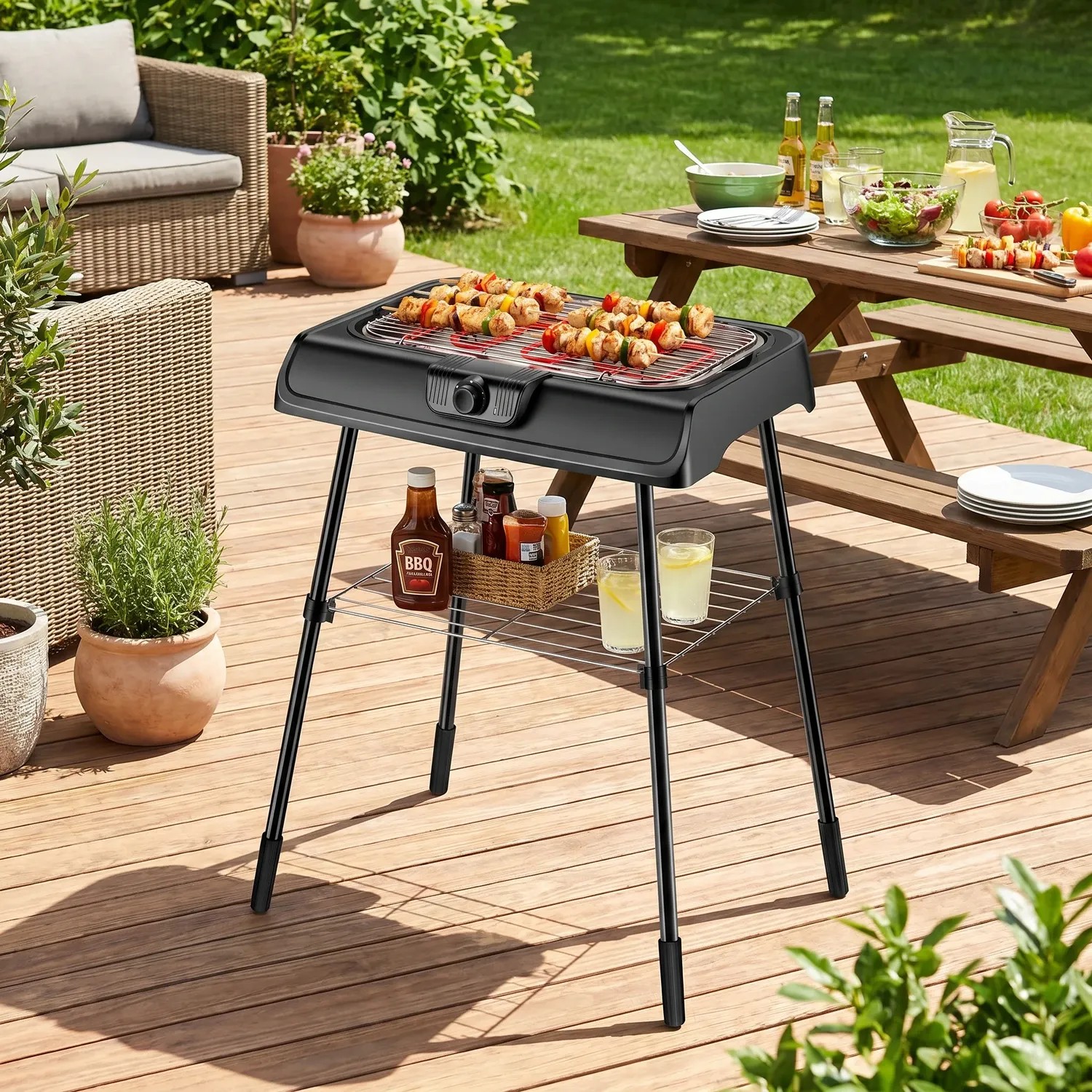
Semi-outdoor patio grilling is one of the project scenarios in which electric grill evidence is checked against the actual installation conditions.
An electric grill purchase rarely fails at the sample stage. It fails later, when a retail listing, a private-label launch or a seasonal replenishment programme has to be defended with documentation that matches the unit actually shipped. The first evidence a buyer holds is seldom a laboratory report. It is a model code, a materials list and a set of certification marks.
This article explains how those three visible evidence layers can be read and cross-checked on the electric grill range of NINGBO JINCHANG ELECTRONICS CO., LTD. (Jinchang), a Yuyao City-based manufacturer of Western-style small kitchen appliances — electric BBQ grills, smokeless electric grills, electric steamers and food dehydrators — that exports roughly 90% of its output to the EU, the United States, Brazil, South Africa and other regions. The objective is practical: to show how a buyer can move from a code on a carton to a defensible judgement about project fit, before any commercial commitment is made.
Why Visible Evidence Sets the Starting Point for Project Fit
Project-based sourcing for electric grills begins with a scenario, not a product. The application data behind this range describes three recurring project types: household electric barbecue solution projects, freestanding household electric barbecue projects, and freestanding covered electric barbecue projects. Each one carries its own conditions — indoor kitchen and balcony countertop daily grilling, or backyard, patio and balcony semi-outdoor household grilling — and each one attaches special requirements, most consistently EU safety and food-contact certification plus overheat protection.
A buyer evaluating suppliers at the research and evaluation stage therefore needs evidence that maps onto those conditions. Three layers are available immediately, without an NDA:
- Model codes — stable identifiers that point to a fixed configuration of power, cooking surface, housing and certification set.
- Material declarations — the housing and food-contact materials named in the specification, which act as a first filter for indoor versus semi-outdoor use.
- Certification marks — CE, GS, RoHS, LFGB and ETL, which indicate that a defined configuration has been tested against recognised conformity frameworks.
Read together, they narrow a range quickly. Read separately, they create the most common failure mode in this category: a buyer approves a model code, then discovers during listing preparation that the certified configuration, the housing material or the voltage declaration does not match the market being served.
Reading Model Codes: What the Five Codes Lock Down
Jinchang lists more than 200 product models across its small-appliance lines. Within the electric grill portfolio, five codes are directly relevant to retail distribution and private-label barbecue projects. A model code is not a marketing word; its value is that it functions as a key to a documented configuration.
| Model | Format | Power | Cooking surface | Housing |
|---|---|---|---|---|
| BQ1601 | Table BBQ grill | 2000W | Wire rack (detachable) | PP |
| BQ1601-4S | Stand BBQ grill | 2000W | Wire rack (removable) | PP |
| BQ1703XL-SF | Stand BBQ grill | 2000–2400W, 220–240V | Wire rack, XL cooking surface | PP |
| BQ1703XLP-SWF | Stand BBQ grill | 1700W | Non-stick aluminium plate, XL | PP |
| BQ202 | Simple / portable BBQ grill | 2400W | Wire rack, extra-large cooking surface | Stainless steel / galvanized sheet |
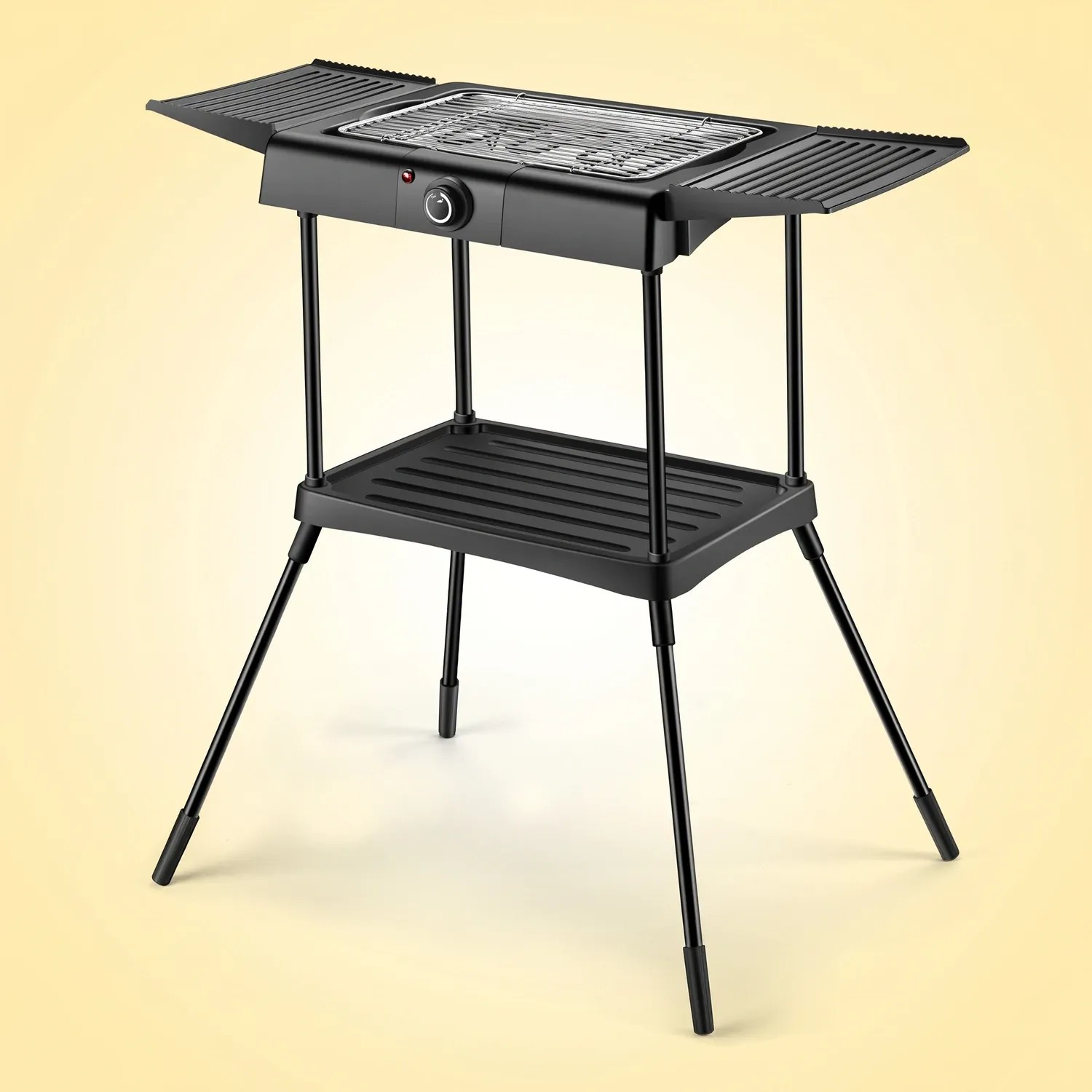
BQ1703XL-SF: a freestanding stand configuration with an XL wire-rack cooking surface, bottom storage shelf and dual side tables.
Several conclusions can be drawn from the codes alone, and several cannot. What can be drawn: the range spans tabletop, freestanding stand and simple portable formats; the freestanding models add structural features such as a bottom storage shelf and, on BQ1703XL-SF, dual side tables for food preparation; and power ratings across this group sit between 1700W and 2400W, with BQ1703XL-SF offering an adjustable 2000–2400W band on a declared 220–240V working voltage.
What cannot be drawn: a suffix is not a public decoding standard. Two codes sharing a root, such as BQ1703XL-SF and BQ1703XLP-SWF, differ in cooking surface and power, but a buyer should not assume that a letter consistently means "plate", "stand" or "side tables" across every supplier in the market. The correct use of a code is to request the specification sheet that the code points to, and then verify that the sheet, the sample and the certificate all describe the same configuration.
Housing Materials as a Scenario Filter
Material declarations do real work in early-stage screening, because they correlate with where a grill is expected to live.
Four of the five models use a PP housing: BQ1601, BQ1601-4S, BQ1703XL-SF and BQ1703XLP-SWF. The outlier is BQ202, built with a stainless steel and galvanized sheet housing, described as a robust construction paired with side handles for safe handling. BQ202 is documented for household indoor countertop barbecue and small family gatherings — grilling sausages, bread, vegetables and meat in home kitchen and apartment indoor cooking scenarios — with a 2400W output and an extra-large cooking surface.
The remaining four are documented across indoor countertop and semi-outdoor use: BQ1601 and BQ1703XLP-SWF for indoor and outdoor cooking equipment, BQ1601-4S for patio, balcony, backyard and indoor home gathering, and BQ1703XL-SF for backyard, patio, balcony and semi-outdoor terrace barbecue, including family parties and garden gatherings.
Cooking Surface, Removable Parts and Oil Management
The second specification decision after format is the cooking surface, and here the range splits cleanly into two families.
The wire-rack family covers BQ1601, BQ1601-4S, BQ1703XL-SF and BQ202. Removability is stated explicitly on several models: BQ1601 uses a detachable wire grill rack with a 2000W U-shaped heating tube; BQ1601-4S uses a removable grill rack with the same 2000W U-shaped heating tube and a rotary temperature control; BQ1703XL-SF pairs an XL wire-rack surface with adjustable temperature control; BQ202 uses an extra-large surface with visible U-shaped heating elements and detachable components.
The plate family is represented by BQ1703XLP-SWF, a 1700W freestanding model with an XL die-cast aluminium non-stick cooking plate, a freestanding frame with side tables and a storage shelf, adjustable temperature control and a safety micro switch. Buyers comparing a plate surface against an open rack — a comparison frequently searched under terms such as non-stick electric grill, electric grill with removable plate or electric griddle — are effectively choosing between easy release and easy scraping on one side, and open-rack grilling character on the other.
Grease handling is the third part of this layer. BQ202 is documented with a reflective oil drip tray that collects grease, alongside detachable components for cleaning. Ray-like oil control matters commercially: for retail and distribution projects, cleaning friction is one of the most common sources of consumer complaint and returns, and a removable rack or detachable component is the design answer to it.
Safety Hardware: Micro Switches, Indicator Lights, Temperature Control
Safety hardware is the most sample-verifiable part of the evidence set, because a switch either interrupts the circuit or it does not.
A safety micro switch is documented on BQ1601 (built-in), BQ1601-4S (built-in), BQ1703XL-SF (auto safety protection) and BQ1703XLP-SWF (safety micro-switch protection). A working indicator light is documented on BQ1601 (power indicator light), BQ1601-4S, BQ1703XL-SF and BQ1703XLP-SWF. Temperature control appears across the group: a rotary temperature control knob on BQ1601 and BQ1601-4S, and adjustable temperature control on BQ1703XL-SF, BQ1703XLP-SWF and BQ202. Heating elements are described as U-shaped on BQ1601, BQ1601-4S and BQ202, with BQ202 noting visible U-shaped heating elements for stable heat.
These features correspond directly to the special requirements recorded for the application scenarios, which specify EU safety and food-contact certification together with overheat protection for semi-outdoor household grilling, and EU food-contact certification with overheat protection for indoor countertop use. In an evaluation checklist, the practical question is not whether a supplier claims these features, but whether the specified model, the certificate scope and the physical sample agree on them.
Certification Marks on the Record: CE, GS, RoHS, LFGB, ETL
Certification marks are where supplier evidence becomes checkable. On this range, the documented sets are not uniform, and that difference is itself useful information.
| Model | Documented certification set |
|---|---|
| BQ1601 | CE, GS, LFGB, ETL |
| BQ1601-4S | CE, GS, RoHS, LFGB |
| BQ1703XL-SF | CE, GS, RoHS, LFGB |
| BQ1703XLP-SWF | CE, GS, RoHS, LFGB |
| BQ202 | CE, GS, RoHS, LFGB |
In plain terms, CE addresses European conformity, GS is a German-tested safety mark, RoHS restricts hazardous substances in electrical and electronic equipment, LFGB relates to German food-contact materials law, and ETL is a North American safety certification mark. Within this group, ETL appears on the documented set of BQ1601, a 2000W tabletop model with a detachable wire rack, adjustable temperature and detachable protection. Buyers preparing North American listings should treat the presence or absence of ETL, and the model to which it applies, as a specific item on their question list rather than an assumption applied across a range.
Two further pieces of classification context help buyers place these products correctly. IEC 60335-2-9 is the specific international standard for portable electric cooking appliances including grills and roasters. HS Code 851660 covers "other ovens; cookers, cooking plates, boiling rings; grillers and roasters" for domestic use — the code under which electric grill shipments are normally classified. Both are reference points for matching supplier documentation to customs and market-access paperwork.
How These Evidence Layers Verify Private-Label and Retail Project Capability
Visible product evidence answers "what is this unit?". Project capability answers "can this supplier repeat it at my volume, on my schedule, under my brand?". Jinchang's capability data provides the second half of the picture.
| Capability dimension | Documented position |
|---|---|
| Production plant | 5,500 m², 68 employees, 8 R&D engineers |
| Annual output | 1,200,000 units |
| Monthly capacity | 100,000 units |
| Minimum order quantity | 5,000 units |
| Lead time | 30 days |
| Quality control | 100% test |
| Customization | OEM / ODM: logo, voltage, product design & development |
| After-sales | 1-year warranty |
| Systems | ISO 9001, ISO 14001; amfori BSCI and ICS membership |
The company is also certified as a National High-Tech Enterprise, an Innovative SME and a Technology-based SME, and holds more than 30 independent intellectual property rights including invention patents and utility-model patents, with in-house structural R&D, mould development and product testing. Customization options extend to appearance modification, function adjustment, private-mould development and customized packaging.
A reference point for private-label durability is documented in the case record: a large supermarket retailer in France has ordered electric grills for household outdoor and indoor barbecue use at an annual volume of 60,000 units, over a project duration of 3–5 years, with stable performance and good market feedback reported. For a buyer, the useful signal is not the retailer's name but the combination: a multi-certified, safety-oriented electric BBQ design sustaining a multi-year retail programme at volume.
Scenario Fit: Which Configuration Suits Which Project
Mapping models to scenarios is the core of HVQ-level project fit, and the application data behind this range supports a fairly precise mapping.
| Project scenario | Working conditions | Typical configuration | Markets recorded |
|---|---|---|---|
| Indoor countertop grilling | Indoor kitchen and balcony countertop daily grilling; intermittent household use | Tabletop and portable formats: BQ202 (2400W, stainless steel / galvanized sheet), BQ1601 (2000W, removable rack) | DE, FR, ES, US, IT, PT, NL, AT, IE, PL, SE, DK, NO, BR, ZA |
| Semi-outdoor household barbecue | Backyard, patio and balcony grilling; intermittent seasonal use | Freestanding models: BQ1601-4S (2000W, stand, storage shelf), BQ1703XL-SF (2000–2400W, side tables) | DE, ES, BR, NL and wider EU retail |
| Plate-surface freestanding grilling | Semi-outdoor terrace and patio use with non-stick plate cooking | BQ1703XLP-SWF (1700W, non-stick aluminium plate, side tables, storage shelf) | EU retail and private-label programmes |
Supporting equipment matters as much as the grill itself in these scenarios: the application data specifies a power socket plus cooking utensils, with tongs or barbecue cooking tools depending on configuration. Buyers preparing retail listings should confirm that declared voltage and plug configuration match the destination market, particularly where a model declares a 220–240V working range.
What the Market Data Says
The commercial context supports the shift toward documented, compliance-ready electric grilling equipment. The global electric grill market was valued at USD 4.6 billion in 2023 according to Grand View Research, with North America holding a 34.5% revenue share in the same year. The smokeless grill segment was valued at USD 768 million in 2024, with 55% of that share belonging to electric types, per Credence Research. Future Market Insights projects that more than 42 million households in the ASEAN region will adopt plug-in grills by 2030.
Published growth-rate forecasts for this category vary considerably — from roughly 4.4% to 7.9% depending on the research house — largely because scope definitions differ, with some analyses including electric smokers and others limiting themselves to tabletop grills. That divergence is itself a signal for buyers: category definitions are looser than procurement definitions, and a supplier's ability to state precisely what a model is, what it is made of and which marks it carries becomes more valuable as the market broadens.
Comparison with Traditional Selection Methods — and the Limits of Visible Evidence
Traditional electric grill sourcing often runs on samples and price. A buyer receives a unit, cooks on it, negotiates, and places an order. Electric grills, however, carry a compliance burden that fuel-based grilling equipment does not: the risk sits in electrical safety and food-contact materials rather than in fuel handling and combustion. That shifts the decisive evidence from the sample alone to the documented configuration.
A document-led evaluation is not automatically superior, and the limits should be stated plainly:
- Model codes and marks do not prove unit-to-unit consistency. They describe a tested configuration and an intended design. Consistency across a 100,000-unit monthly capacity depends on process control — the documented 100% test regime — and on field feedback over time.
- Certification marks apply to a tested configuration. Where a private-label project changes voltage, housing or design through the OEM/ODM options offered, buyers should confirm before listing that the certificate scope still covers the configuration being ordered.
- Voltage declarations constrain markets. Models declaring a 220–240V working range require buyers serving 110–120V regions such as North America to confirm the intended configuration rather than assume compatibility.
- Commercial terms may not suit small trials. A 5,000-unit MOQ and a 30-day lead time fit established retail and private-label programmes but can be restrictive for first-time, low-volume testing.
- Visible evidence never replaces sample validation. Micro switches, indicator lights, removable racks and plate coatings should be inspected on a physical sample before a purchase order is issued.
Where the evidence layers do perform well is in disqualification. A range in which the code, the material and the mark set cannot be reconciled on paper is unlikely to reconcile them in production.
Future Outlook
Three trends are likely to shape electric grill procurement over the next several years. First, indoor and smokeless formats will continue to expand as apartment living and balcony cooking grow, which raises the weight of food-contact certification and cleaning design in the specification. Second, North American volume — already the largest single regional share — will keep ETL-type safety documentation on the critical path for suppliers seeking dual-market listings. Third, project buyers will increasingly ask for model-level evidence rather than brand-level assurances, which favours manufacturers able to present a coherent chain from model code to materials list to certificate scope to test process.
For suppliers, the practical consequence is that documentation quality becomes a commercial capability, not an administrative task. For buyers, the consequence is simpler: the fastest way to compare electric grill suppliers is to ask each of them for the same three things — the model specification for the exact code quoted, the housing and food-contact material declaration, and the certification scope that covers that configuration.
FAQ
1. What do the model codes BQ1601, BQ1601-4S, BQ1703XL-SF, BQ1703XLP-SWF and BQ202 indicate about each electric grill?
They identify five distinct configurations in the Jinchang range. BQ1601 is a 2000W tabletop grill with a PP housing and a detachable wire rack. BQ1601-4S is a 2000W freestanding stand grill with a PP housing, a removable grill rack and a storage shelf. BQ1703XL-SF is a freestanding stand grill rated 2000–2400W on 220–240V with an XL wire-rack cooking surface, bottom storage shelf and dual side tables. BQ1703XLP-SWF is a 1700W freestanding grill with an XL die-cast aluminium non-stick plate, side tables and a storage shelf. BQ202 is a 2400W simple/portable grill with a stainless steel and galvanized sheet housing and an extra-large cooking surface.
2. Which housing materials are used in these electric grill models, and what do they imply for project scenarios?
BQ1601, BQ1601-4S, BQ1703XL-SF and BQ1703XLP-SWF use a PP housing. BQ202 uses a stainless steel and galvanized sheet housing. The material declaration helps match a model to a scenario: BQ202 is documented for household indoor countertop barbecue in home kitchen and apartment settings, while the PP-housing models are documented across indoor countertop use and semi-outdoor backyard, patio and balcony grilling. Material declaration alone does not demonstrate heat resistance or outdoor ageing performance.
3. What is the difference between the wire-rack models and the non-stick plate model?
BQ1601, BQ1601-4S, BQ1703XL-SF and BQ202 use a metal wire rack cooking surface, with the rack described as detachable or removable on several models, and U-shaped heating elements beneath. BQ1703XLP-SWF uses an XL die-cast aluminium non-stick cooking plate instead. Rack surfaces suit buyers prioritising open-rack grilling characteristics and easy scraping, while the plate surface suits buyers prioritising food release and wipe-clean maintenance.
4. Which safety features can a buyer verify directly on a sample?
A safety micro switch is documented on BQ1601, BQ1601-4S, BQ1703XL-SF and BQ1703XLP-SWF, and can be confirmed by testing that the circuit interrupts as intended. A working indicator light is documented on BQ1601, BQ1601-4S, BQ1703XL-SF and BQ1703XLP-SWF. Temperature control is documented across the group as a rotary control knob on BQ1601 and BQ1601-4S and as adjustable temperature control on BQ1703XL-SF, BQ1703XLP-SWF and BQ202. Overheat protection is recorded as a special requirement for the household grilling scenarios these models serve.
5. Which certification marks are documented for each model?
BQ1601 carries CE, GS, LFGB and ETL. BQ1601-4S, BQ1703XL-SF, BQ1703XLP-SWF and BQ202 each carry CE, GS, RoHS and LFGB. Reference standards and classifications relevant to these products include IEC 60335-2-9 for portable electric cooking appliances including grills and roasters, and HS Code 851660 for domestic grillers and roasters. ETL appears on the documented set for BQ1601, which is relevant to North American market preparation.
6. Can these electric grill models support retail and private-label projects at volume?
The documented capability position is a 5,500 m² plant with 68 employees and 8 R&D engineers, annual output of 1,200,000 units, monthly capacity of 100,000 units, a 5,000-unit MOQ, a 30-day lead time, 100% testing, a 1-year warranty, and OEM/ODM customization covering logo, voltage, product design and development, private-mould development and customized packaging. A French large supermarket retailer has ordered electric grills for household outdoor and indoor barbecue at 60,000 units per year over a 3–5 year project duration, with stable performance and good market feedback reported.
7. What can model codes, materials and certification marks not prove?
They do not prove unit-to-unit performance consistency, long-term durability or field reliability, which depend on process control and accumulated field feedback. They do not automatically cover a customized variant: where voltage, housing or design is changed through OEM/ODM options, the certificate scope for the ordered configuration should be confirmed. They do not confirm suitability for markets outside the declared voltage range, and they do not replace physical sample inspection of switches, indicator lights, racks and plates before a purchase order.
Conclusion
For electric grill buyers working through research and evaluation, the practical sequence is straightforward: read the model code to identify the configuration, check the housing and cooking-surface materials against the installation scenario, confirm the certification marks that apply to that exact model, and then test the supplier's ability to repeat it through capacity, MOQ, lead time, testing regime and prior project duration. Visible evidence will not answer every question — but it will reliably tell a buyer which questions still need to be asked.