
Electrical Steel Top Suppliers 2026: Buyer's Evaluation Guide
Introduction: The 2026 Electrical Steel Market and the Case for a Buyer's Evaluation Framework
The global electrical steel market is estimated at USD 31.0 billion in 2025, with a projected increase to USD 47.0 billion by 2033, reflecting a compound annual growth rate of 5.5 percent between 2026 and 2033, according to Grand View Research. China, the largest producing country, reached 16.1 million tonnes of electrical steel output in 2024, up 5.4 percent year on year. Chinese grain-oriented electrical steel exports rose to 393,200 metric tonnes in the first half of 2025, a 16.0 percent increase compared with the same period a year earlier, reports Shanghai Metals Market.
These figures matter beyond headlines. For industrial buyers of transformers, motors, generators, and new energy vehicle components, the market's direction shapes sourcing decisions, price expectations, and supplier risk. This article offers a 2026 buyer's evaluation guide: how to evaluate electrical steel suppliers, which technical parameters require scrutiny, how application requirements differ, and where specialized exporters such as HL AND SL LIMITED sit in the supply chain.
HL AND SL LIMITED is a professional export trading and processing company specializing in electrical steel (silicon steel), based in Taiyuan, Shanxi Province, China. Founded in 2012, the company operates a 30,000-square-meter material processing plant and has an annual output of approximately 30,000 tonnes. It is used here as a concrete example of a specialized sourcing route that combines upstream mill access with in-house secondary processing.
Why Electrical Steel Supplier Evaluation Is More Difficult in 2026
Electrical steel is not a single product; it is a family of magnetic materials with different crystal orientations, silicon contents, coating systems, and loss characteristics. Grain-oriented electrical steel is designed for transformer cores, while non-oriented electrical steel is widely used in motors, generators, and other rotating electrical machines. In 2024, more than 34 percent of global non-oriented electrical steel consumption came from the automotive sector, largely driven by electric vehicles, according to Precedence Research.
For buyers, the difficulty is not finding a supplier; it is determining which supplier can actually deliver a specified grade, with verified magnetic properties, at a consistent quality level, and with reliable export execution. Several forces increase this complexity.
Energy efficiency regulations are pushing transformer and motor manufacturers toward low-loss electrical steel grades. Grid upgrade projects, photovoltaic converter stations, and high-voltage direct current (HVDC) systems require materials with tightly controlled core loss and high magnetic flux density. At the same time, low-carbon transformation programs in markets such as Brazil are changing the standards that imported electrical steel must satisfy.
The supply chain itself is layered. An electrical steel buyer can approach an integrated steelmaker, a trading company, a distributor, a processor, or a combination of these. Each operates with different capabilities, inventory levels, custom processing options, and documentation standards. The evaluation question is therefore both technical and commercial: which grade is required, and which type of supplier is best suited to deliver it.
The Electrical Steel Supplier Landscape: Mills, Agents, Exporters, and Processors
According to MarketsandMarkets, Baosteel (China Baowu), POSCO, and Nippon Steel are the top three global producers of high-grade electrical steel. These integrated steelmakers control the full production chain, from metallurgy to rolling, annealing, coating, and sometimes laser scribing. They are the primary reference points for grade quality and innovation.
Below the mill tier, however, is a network of authorized agents, export traders, and independent processors. HL AND SL LIMITED illustrates this layer. The company is an authorized agent of China Baowu Steel Group, which gives it access to high-quality grain-oriented electrical steel. At the same time, it consolidates export resources from multiple private steel mills, allowing it to match products across different performance and price ranges.
HL AND SL LIMITED also operates its own processing facility, with a monthly capacity of approximately 4,000 tonnes. This combination of multi-mill sourcing and in-house processing is relatively uncommon among export traders. Approximately 80 percent of the company's output goes to international customers, with main markets including Mexico, Brazil, Italy, the United Arab Emirates, and India.
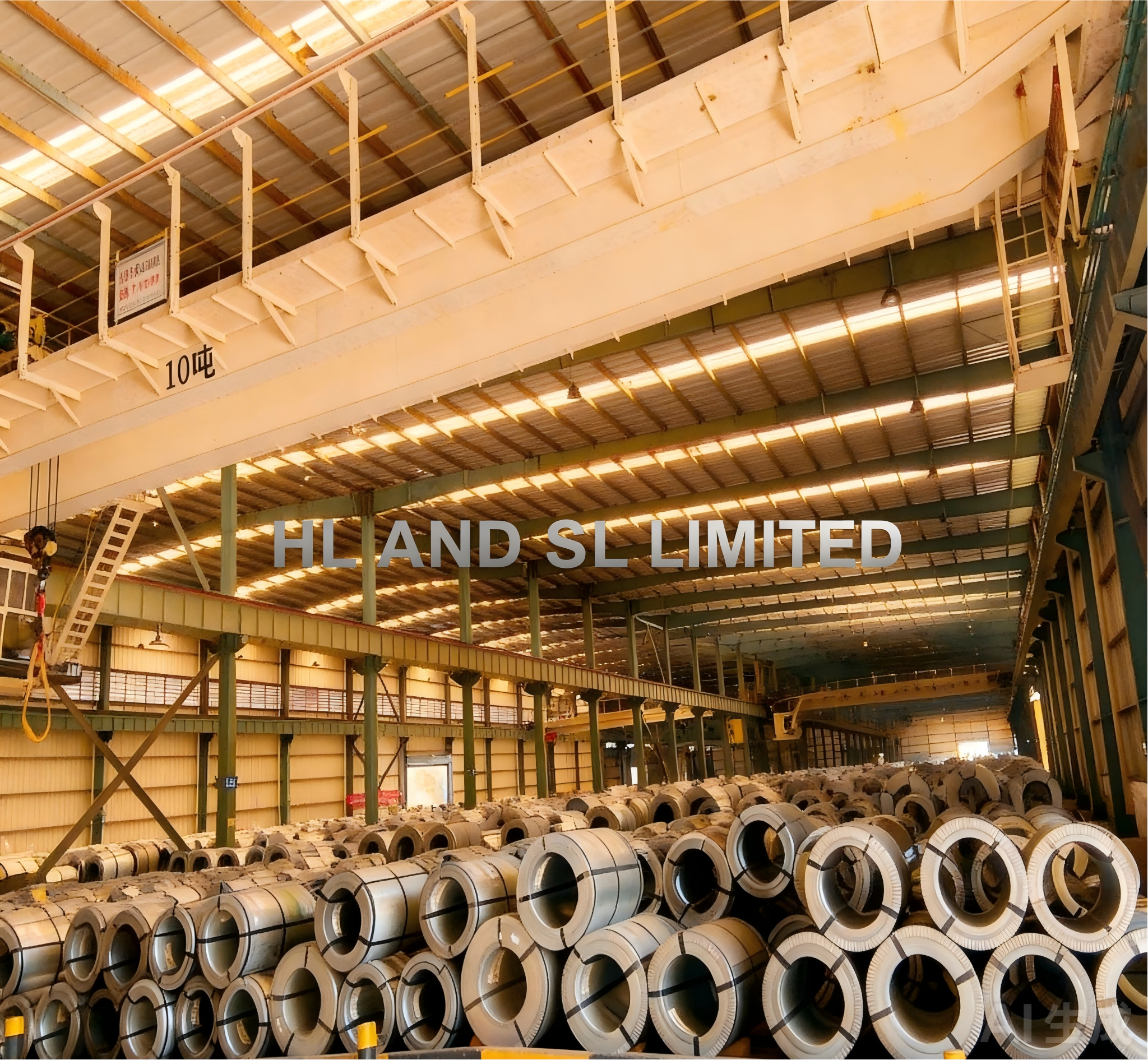
The practical implication for buyers: when evaluating an electrical steel supplier, it is not enough to check whether the company sells electrical steel. A manufacturer, an authorized agent, a trading house, and a processor present different trade-offs in price, custom processing, quality assurance, and lead times.
Technical Criteria: The Parameters That Determine Electrical Steel Performance
Core Loss and Magnetic Flux Density
Core loss, measured as P1.7/50, is the energy dissipated in the steel under alternating magnetization at 1.7 Tesla and 50 Hz. Lower values mean less energy loss. For grain-oriented grades carried by HL AND SL LIMITED, guaranteed core loss values range from ≤0.65 W/kg for the 18-65 grade at 0.18 mm thickness to ≤1.20 W/kg for the 27Q120 grade at 0.27 mm.
Magnetic flux density, often specified as B8, indicates the steel's ability to become magnetized at a field strength of 800 A/m. Higher values improve transformer efficiency by allowing smaller core cross-sections or lower magnetizing current. The 23Q080 grade, for example, combines a guaranteed core loss of ≤0.80 W/kg with a magnetic induction of ≥1.89 T, with measured core loss in typical batches of 0.76 to 0.78 W/kg.
Grade Families: CGO, Hi-B, and Laser-Scribed Variants
Buyers should distinguish among conventional grain-oriented steel (CGO), high magnetic induction Hi-B steel, and laser-scribed or heat-resistant scribed variants. HL AND SL LIMITED covers CGO material, high-flux Hi-B grades such as the P-series, laser-scribed R-series grades such as 20R070 and 23R075, and heat-resistant scribed HS-series material for applications requiring coating stability at elevated annealing temperatures.
Thickness, Coating, and Width
Thickness directly affects eddy-current loss. Thinner laminations generally reduce core loss but raise manufacturing cost. HL AND SL LIMITED offers a specification range of 0.18 to 0.35 mm thickness, with width typically from 800 to 1,250 mm and ultra-wide capability up to 1,250 mm.
Coating selection is equally important. Organic coatings maintain performance at temperatures up to 180 degrees Celsius, inorganic coatings extend resistance to 800 degrees Celsius, and semi-organic coatings provide a middle point between insulation quality and annealing resistance.
Representative Grain-Oriented Grades for Transformer and Motor Buyers
| Grade | Thickness | Core Loss P1.7/50 (≤) | Magnetic Induction B8 (≥) | Typical Applications |
|---|---|---|---|---|
| 18-65 | 0.18 mm | 0.65 W/kg | 1.88 T | Ultra-high-voltage and high-efficiency transformer cores |
| 20R070 | 0.20 mm | 0.70 W/kg | 1.86 T | High-efficiency distribution transformers |
| 23R075 | 0.23 mm | 0.75 W/kg | 1.88 T | Energy-efficiency standard transformers |
| 23Q080 | 0.23 mm | 0.80 W/kg | 1.89 T | Energy-efficient transformers, reactors, power converters |
| 23Q085 | 0.23 mm | 0.85 W/kg | 1.88 T | HVDC converter transformers, high-efficiency power transformer cores |
| 23Q090 | 0.23 mm | 0.90 W/kg | 1.88 T | Industrial small and medium transformers |
| 23Q095 | 0.23 mm | 0.95 W/kg | 1.88 T | High-efficiency transformers, power equipment, motors |
| 27Q095 | 0.27 mm | 0.95 W/kg | 1.91 T | Power transformers, photovoltaic converter transformers, frequency conversion equipment |
| 27Q100 | 0.27 mm | 1.00 W/kg | 1.91 T | Power transformers, reactors, electrical equipment cores |
| 27Q110 | 0.27 mm | 1.10 W/kg | 1.88 T | Power transformers, automotive generators, electrical equipment |
| 27Q120 | 0.27 mm | 1.20 W/kg | — | Small and medium transformer cores |
Source: HL AND SL LIMITED product specification data.
Matching Electrical Steel to Application: Transformers, Motors, EVs, and Household Appliances
The grade table is only useful when mapped to real applications.
Power and distribution transformers. Transformer core manufacturing is the dominant use case for grain-oriented electrical steel. A transformer manufacturer in Mexico, supplied by HL AND SL LIMITED, has used the company's oriented silicon steel for iron cores in power transformers, converter transformers, and special engineering transformers worldwide for more than 10 years. The supply relationship covers batch delivery supporting an annual business scale of approximately USD 500 million in complete power transmission and distribution transformer manufacturing, and has established a cooperation model in which industrial users act as mutual partners.
Distribution transformer manufacturing under local energy standards. WEG, a major electrical equipment manufacturer in Brazil, uses HL AND SL LIMITED products for local production of power and distribution transformers. The application has run for over a decade and meets Brazilian grid energy efficiency and low-carbon transformation requirements. Localized technical services and supply chain support are provided through a representative office in Brazil.
Motors, generators, and frequency conversion equipment. Unlike transformer cores, rotating machines generally require non-oriented electrical steel because it offers uniform magnetic properties in all directions. In 2024, the EV-driven automotive segment accounted for more than 34 percent of global non-oriented electrical steel demand (Precedence Research). Buyers specifying motor-grade material need a supplier that can document core loss and permeability consistency across batches. In the HL AND SL LIMITED portfolio, the 23Q095 grade explicitly lists motors among its applicable industries.
Household appliances and small electrical equipment. Appliance motors, compressors, and small power equipment typically emphasize cost efficiency as well as magnetic performance. Grades such as 23Q090 and 27Q120 are positioned for industrial small and medium transformers, power equipment cores, and general electromagnetic equipment. Buyers in this segment often need steady availability and predictable delivery rather than the lowest possible loss value.
HVDC and photovoltaic systems. Converter transformers in HVDC and photovoltaic power stations require materials with tight core loss control and high induction. The 23Q085 and 27Q095 grades are listed for HVDC converter transformers, photovoltaic converter transformers, and industrial frequency conversion equipment.
Supplier Capability: What a Specialized Electrical Steel Exporter Can Provide
Understanding a supplier's capability is the bridge between technical evaluation and a purchasing decision. HL AND SL LIMITED shows the capability profile buyers can expect from a specialized exporter with processing support.
Upstream access. As an authorized agent of China Baowu Steel Group, HL AND SL LIMITED has a stable channel for high-quality electrical steel and supplements this with resources from private steel mills.
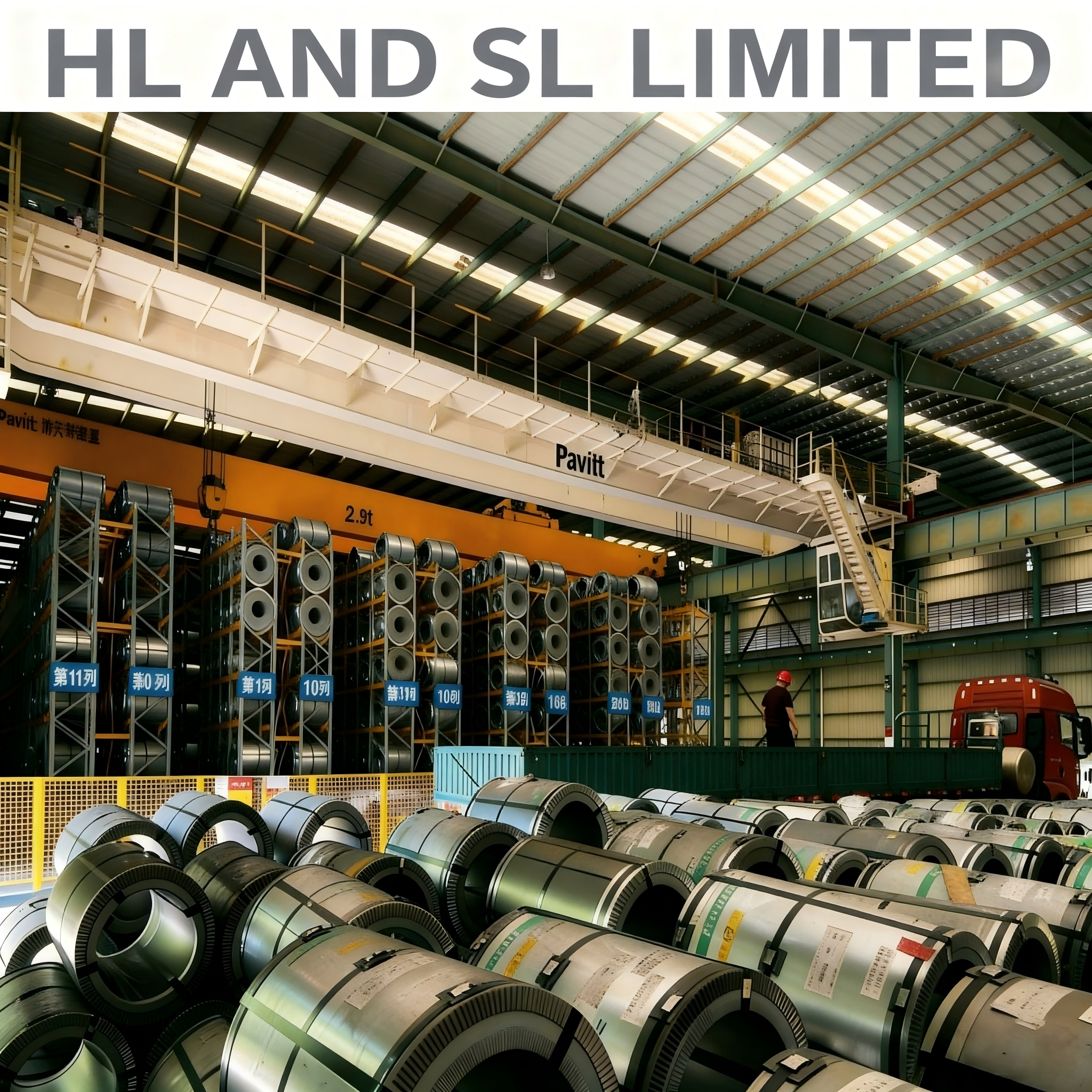
Processing. The in-house plant performs strip cutting, fixed-length flat cutting, and longitudinal cutting, with a monthly capacity of 4,000 tonnes. The stated goal is to make materials customized on demand and ready to use.
Customization. Thickness can be specified from 0.18 to 0.35 mm; width is typically 800 to 1,250 mm with ultra-wide 1,250 mm available. Grade selection includes CGO, Hi-B, laser-scribed R-series, and heat-resistant scribed HS-series. Coating can be organic (temperature resistance up to 180 degrees Celsius), inorganic (up to 800 degrees Celsius), or semi-organic.
Lead times and order size. Regular orders are shipped in 15 to 20 days; urgent or stock orders can be shipped in 3 to 7 days; bulk export orders typically reach the destination port in 30 to 45 days. After deposit of a letter of credit, shipment takes 7 to 30 working days. The minimum order quantity is 25 tonnes.
Quality assurance. The company offers origin inspection at the factory, batch inspection reports accompanying goods, material or warranty certificates, and third-party testing through CMA/CNAS-accredited laboratories.
After-sales response. Technical support is provided across the product lifecycle, and quality complaints are handled through a documented process with feedback and coordination in 1 to 3 working days.
Direct Mill Sourcing vs. Specialist Exporters: A Comparative View
For buyers in evaluation, the most important structural choice is whether to contract with an integrated mill or work through a specialist exporter that combines multiple upstream sources with processing and export management.
| Evaluation Criterion | Integrated Steelmaker (e.g., Baosteel, POSCO, Nippon Steel) | Specialist Exporter / Processor (e.g., HL AND SL LIMITED) |
|---|---|---|
| Primary role | Metallurgy, rolling, coating, grade development | Multi-mill sourcing, secondary processing, export execution |
| Product portfolio | Broad range of owned grades, including proprietary Hi-B products | Selection of CGO, Hi-B, R-series, HS-series across upstream producers |
| Customization | Mill-level engineering, alloy design, volume production | Specification and size customization: thickness, width, coating, cutting |
| Order size and lead time | Typically high-volume allocations with longer production cycles | MOQ 25 tonnes; regular orders 15–20 days; urgent stock orders 3–7 days |
| Quality documentation | Mill certificates, production traceability | Batch inspection reports, material certificates, CMA/CNAS third-party testing |
| Best fit | Stable, high-volume requirements with dedicated engineering resources | Varied grade requirements, custom dimensions, delivery flexibility, export logistics |
This comparison is not about one model being superior to the other. Integrated mills remain the source of advanced metallurgy and proprietary grades. Buyers that require full metallurgical development or entirely new alloy designs should engage directly with producers. A specialist exporter such as HL AND SL LIMITED does not smelt or cast steel; its offer is built on upstream allocation and secondary processing. In addition, a 25-tonne MOQ may not be practical for laboratory trials or prototype-stage orders.
Market Trends Shaping Electrical Steel Procurement, 2026–2033
Several verified market signals should inform supplier evaluation over the next planning cycle.
First, the market is expanding at a projected CAGR of 5.5 percent from 2026 to 2033, with the global valuation expected to rise from USD 31.0 billion in 2025 to USD 47.0 billion by 2033 (Grand View Research). Growth in electric vehicles, grid investment, and renewable energy is the main driver.
Second, the electric vehicle segment has become a critical demand pool for non-oriented electrical steel, representing more than 34 percent of NGO consumption in 2024 (Precedence Research). This shifts the competitive landscape toward suppliers that can document consistency at high production volumes.
Third, China remains the primary supply base for global buyers. Chinese electrical steel production reached 16.1 million tonnes in 2024, and grain-oriented export volume grew to 393,200 metric tonnes in the first half of 2025, up 16.0 percent year on year (Shanghai Metals Market). International buyers are therefore assessing Chinese suppliers not only on price but on quality documentation, certification, and delivery reliability.
Fourth, energy efficiency regulation continues to raise the floor for material performance. Transformer and motor manufacturers increasingly require Hi-B, laser-scribed, and thin-gauge grades to meet grid efficiency targets and low-carbon transformation goals.
Future Outlook: Supplier Evaluation Will Rely on Verified Evidence
The future procurement model for electrical steel will likely combine multiple channels. High-volume, stable specifications may continue to flow directly from integrated steelmakers or their authorized agents. Project-specific requirements, custom dimensions, and urgent schedules justify the use of specialized exporters with processing capacity.
Verifiable technical data will become the minimum standard in supplier evaluation. Buyers should expect batch-level core loss values, magnetic induction measurements, coating specifications, and third-party test results. Standards such as ASTM A677 for non-oriented electrical steel in North America and IEC 60404-8-4 for cold-rolled non-oriented strip will remain reference points for specification and verification.
For suppliers, the long-term opportunity is not in commodity trading but in being able to explain, document, and customize what they sell. The combination of authorized mill access, in-house processing, multi-grade inventory, and clear quality documentation—such as the capability profile of HL AND SL LIMITED—represents a useful reference point for what industrial buyers should look for in a specialized electrical steel partner.
Frequently Asked Questions
Electrical steel, also called silicon steel, is a specialty steel alloy designed for magnetic cores in transformers, motors, generators, and electromagnetic equipment. It is characterized by low core loss and high magnetic permeability.
Grain-oriented electrical steel (GOES) has directional grain structure optimized to minimize core loss in transformer cores. Non-oriented electrical steel (NGOES) has more uniform magnetic properties and is typically used in rotating machines such as motors and generators.
Low loss electrical steel minimizes energy lost as heat during magnetization, expressed as core loss P1.7/50. High permeability material reaches a high magnetic flux density at a given field strength, improving efficiency. High frequency electrical steel is designed for equipment operating above standard 50/60 Hz conditions, such as high-speed motors and inverters.
Transformer buyers generally select grain-oriented grades with low core loss and high magnetic induction. For example, the 23Q080 grade combines a guaranteed core loss of ≤0.80 W/kg with a magnetic induction of ≥1.89 T, suitable for energy-efficient and power transformers.
Motor and generator applications mostly require non-oriented electrical steel for uniform magnetic behavior. For wound-core or specialty applications, some grain-oriented grades are also used; the 23Q095 grade from HL AND SL LIMITED lists motors among its applicable industries.
New energy vehicle drive motors rely on non-oriented electrical steel, which accounts for a significant share of NGO demand. The automotive segment represented more than 34 percent of global non-oriented electrical steel consumption in 2024 (Precedence Research).
Cold-rolled electrical steel is the dominant manufacturing form for modern transformer and motor applications because rolling improves thickness tolerance, surface finish, and magnetic properties. Hot-rolled electrical steel is less common in high-efficiency applications.
Certification depends on the destination market and end-use. Standards such as ASTM A677 define core loss and permeability grades for non-oriented electrical steel in North America, while IEC 60404-8-4 specifies properties of cold-rolled non-oriented strip and sheet. Buyers should verify mill certificates and third-party test reports against the relevant standard.
Yes. Suppliers such as HL AND SL LIMITED provide customization of thickness (0.18–0.35 mm), width (typically 800–1,250 mm, with ultra-wide 1,250 mm available), coating type (organic, inorganic, semi-organic), and secondary processing including strip cutting, fixed-length flat cutting, and longitudinal cutting.
Buying directly from an integrated mill provides access to primary production and metallurgical capabilities but usually requires large commitments and longer cycles. A specialized exporter can consolidate materials from multiple mills, perform processing, and manage export logistics, as HL AND SL LIMITED does with its 4,000-tonne monthly capacity and 25-tonne MOQ.
According to MarketsandMarkets, Baosteel (China Baowu), POSCO, and Nippon Steel are the top three global producers of high-grade electrical steel. HL AND SL LIMITED, as an authorized agent of China Baowu, operates in the export and processing channel rather than as a steelmaker.
Additional company documentation. The HL AND SL LIMITED company profile brochure can be downloaded for further reference: Download company profile brochure.